Romans 4:1-12 – Saved by Grace Through Faith

“Abraham Journeying to the Land of Canaan” by Giovanni Benedetto Castiglione (1609-1664); The Fitzwilliam Museum; http://www.artuk.org/artworks/abraham-journeying-to-the-land-of-canaan-5550

So how do we fit what we know of Abraham, our first father in the faith, into this new way of looking at things? If Abraham, by what he did for God, got God to approve him, he could certainly have taken credit for it. But the story we’re given is a God-story, not an Abraham-story. What we read in Scripture is, “Abraham entered into what God was doing for him, and that was the turning point. He trusted God to set him right instead of trying to be right on his own.”

If you’re a hard worker and do a good job, you deserve your pay; we don’t call your wages a gift. But if you see that the job is too big for you, that it’s something only God can do, and you trust him to do it—you could never do it for yourself no matter how hard and long you worked—well, that trusting-him-to-do-it is what gets you set right with God, by God. Sheer gift.

David confirms this way of looking at it, saying that the one who trusts God to do the putting-everything-right without insisting on having a say in it is one fortunate man:

Fortunate those whose crimes are whisked away,
    whose sins are wiped clean from the slate.
Fortunate the person against
    whom the Lord does not keep score.

Do you think for a minute that this blessing is only pronounced over those of us who keep our religious ways and are circumcised? Or do you think it possible that the blessing could be given to those who never even heard of our ways, who were never brought up in the disciplines of God? We all agree, don’t we, that it was by embracing what God did for him that Abraham was declared fit before God?

Now think: Was that declaration made before or after he was marked by the covenant rite of circumcision? That’s right, before he was marked. That means that he underwent circumcision as evidence and confirmation of what God had done long before to bring him into this acceptable standing with himself, an act of God he had embraced with his whole life.

And it means further that Abraham is father of all people who embrace what God does for them while they are still on the “outs” with God, as yet unidentified as God’s, in an “uncircumcised” condition. It is precisely these people in this condition who are called “set right by God and with God”! Abraham is also, of course, father of those who have undergone the religious rite of circumcision not just because of the ritual but because they were willing to live in the risky faith-embrace of God’s action for them, the way Abraham lived long before he was marked by circumcision. (The Message)

“Abraham Journeys Forth into the Unknown” by Yoram Raanan

We all need help. Yes, we like our independence and would rather give help than receive it. Yet, there are some things which we can do nothing about without some divine intervention. This is where faith comes into the picture.

“Faith” is a big word in Holy Scripture and in the Christian life. Faith encompasses the totality of how we come to Jesus Christ, and then how we live for him. In talking about faith, it is important to distinguish between the faith which saves us from guilt, shame, sin, death, and hell, and the faith which sanctifies and makes us holy. 

“Salvation” and “sanctification” are also big words in Scripture and in life. If we are fuzzy on our understanding and application of these two spiritual realities of salvation and sanctification, we are going to end up sleepwalking through life as spiritual zombies.

Christianity’s answer to the vital help we need for deliverance is the death and resurrection of Jesus Christ. This deliverance, or salvation, only occurs by faith. A person is “saved” by knowing about Jesus and his finished work on the cross and trusting that this work has taken care of my need for salvation, once for all. 

Christ sacrificed himself for us. He took our place. The punishment that belonged to us, he bore. When we acknowledge our lost and wayward lives, and believe Jesus is the way, the truth, and the life, then we are delivered and experience salvation from the awful emptiness of life. 

A person cannot earn this deliverance; they cannot buy it or work for it. No, salvation is a gift that comes only by faith in the person and work of Jesus. That is the essence of saving faith in Christianity. It is a one-time event of trust.

“Sanctification,” on the other hand, is what begins when becoming a believer in Jesus. The word simply means “to become holy,” or, “to be set apart for God.” Sanctification is not a singular event, but a process Christians engage in for the rest of their earthly lives. 

Whereas saving faith is a gift given to us without effort, sanctification requires a great deal of effort. We work and struggle and expend lots of energy to live the Christian life. 

“Grace [God’s gift to us in granting forgiveness] is not opposed to effort, it is opposed to earning. Earning is an attitude. Effort is an action. Grace, you know, does not just have to do with forgiveness of sins alone.” 

Dallas Willard

When a student gets a college scholarship at a university, the giving of the scholarship is a one-time event. It is granted to the student. They now possesses it and are able to attend school without trying to earn the money to pay for it. 

But that scholarship has been given for a reason – so that the student can now focus entirely on their studies and/or sport. The work has just begun. More blood, sweat, and tears will take place living into that scholarship than the student could ever imagine. It won’t be easy, and it will consume the student’s waking hours for the next four years.

Our life is a matter of faith, not of sight.

2 Corinthians 5:7, GNT

The biblical character of Abraham is Exhibit A of faith. He was delivered from an empty way of life in a pagan country and given a gift of grace to move to the country God would show him. Abraham did nothing to earn this favor. Before Abraham chose God, God chose him. 

Abraham sojourned as a pilgrim throughout the land God gave him, which mirrored his spiritual sojourning and learning to be a follower of God. Abraham likely faced the greatest test of faith a person could ever experience; he was asked to sacrifice his son. He responded to God with complete obedience.

Abraham’s faith was made complete by what he did; and it occurred well before his circumcision of being physically marked as belonging to God. 

We are made right not on our own but through the sheer grace of God in Christ by faith. Then, we continue to exercise faith by living into the righteousness given to us by the mercy of God.

God’s mercy is so abundant, and his love for us is so great, that while we were spiritually dead in our disobedience he brought us to life with Christ. It is by God’s grace that you have been saved. In our union with Christ Jesus he raised us up with him to rule with him in the heavenly world. He did this to demonstrate for all time to come the extraordinary greatness of his grace in the love he showed us in Christ Jesus. For it is by God’s grace that you have been saved through faith. It is not the result of your own efforts, but God’s gift, so that no one can boast about it.

Ephesians 2:4-9, GNT

God grants his faith scholarships to whomever he wants: rich and poor, men and women, from every race, ethnicity, and background imaginable across the entire earth. 

From the standpoint of faith, Abraham did nothing to receive God’s gracious scholarship of faith. He did not work for it. It was granted to him solely because of God’s grace. Then, his faith was confirmed and proven as genuine by his life of faith and obedience.

Therefore, our own deliverance and ability to live rightly is firmly rooted in faith – and not by holding a prominent position, having a particular pedigree, or expending personal power. All of humanity needs the saving help of Jesus Christ. Salvation is in Christ alone, by grace alone, through faith alone.

Lord Jesus Christ, I am sorry for the things I have done wrong in my life. Please forgive me. I now turn from everything that I know is wrong. Thank you that you died on the cross for me, so that I could be forgiven and set free. Thank you that you offer me forgiveness and the gift of your Spirit. I receive that gift with a grateful heart. Amen.

Blessed Is He Who Comes In the Name of the Lord

Welcome, friends, on this second Sunday in Lent. During his earthly ministry, Jesus had no intention of halting his travels because of all the unrest in the world. Christ assured his listeners that the work he is doing will be done today, and the next, and the day after that—building ultimately to his greatest work of securing redemption through his crucifixion and resurrection. Click the videos below and let us say together, “Blessed is he who comes in the name of the Lord!”…

Pastor Tim Ehrhardt, Luke 13:31-35

Lord, grant us simplicity of faith
and a generosity of service
that gives without counting cost.
A life overflowing with Grace
poured out from the One
who gave everything,
that we might show
the power of love
to a broken world,
and share the truth
from a living Word.
Lord, grant us simplicity of faith,
and a yearning to share it. Amen.

Psalm 27 – Wait…

Psalm 27:4 painting by Marguerite Moreau McCarthy

The Lord is my light and my salvation;
    whom shall I fear?
The Lord is the stronghold of my life;
    of whom shall I be afraid?

When evildoers assail me
    to devour my flesh—
my adversaries and foes—
    they shall stumble and fall.

Though an army encamp against me,
    my heart shall not fear;
though war rise up against me,
    yet I will be confident.

One thing I asked of the Lord,
    that will I seek after:
to live in the house of the Lord
    all the days of my life,
to behold the beauty of the Lord,
    and to inquire in his temple.

For he will hide me in his shelter
    in the day of trouble;
he will conceal me under the cover of his tent;
    he will set me high on a rock.

Now my head is lifted up
    above my enemies all around me,
and I will offer in his tent
    sacrifices with shouts of joy;
I will sing and make melody to the Lord.

Hear, O Lord, when I cry aloud,
    be gracious to me and answer me!
“Come,” my heart says, “seek his face!”
    Your face, Lord, do I seek.
    Do not hide your face from me.

Do not turn your servant away in anger,
    you who have been my help.
Do not cast me off, do not forsake me,
    O God of my salvation!
If my father and mother forsake me,
    the Lord will take me up.

Teach me your way, O Lord,
    and lead me on a level path
    because of my enemies.
Do not give me up to the will of my adversaries,
    for false witnesses have risen against me,
    and they are breathing out violence.

I believe that I shall see the goodness of the Lord
    in the land of the living.
Wait for the Lord;
    be strong and let your heart take courage;
    wait for the Lord! (New Revised Standard Version)

“The key to everything is patience. You get the chicken by hatching the egg, not by smashing it.”

Arnold H. Glasow

The Christian season of Lent is a time of waiting…. Believers patiently wait for Easter and the resurrection of the Lord. But there must be a crucifixion before there is a resurrection. There must be suffering before there is glory. Truncating the process of spiritual development, including the hard circumstances of life, will stunt our growth.

So, we need to wait for the Lord….

But, dang it, waiting is hard! Patience is especially difficult whenever we are experiencing hardship and difficulty. We already know that praying for patience is problematic; we end up getting plenty of opportunities to exercise patience and may feel like we’re worse off than before. So, what do we do?

The way to wait patiently is through hope. And hope is a reality which needs to be continually fortified.

Whatever we long to see realized…

the return of a wayward son or daughter…

revitalization and revival within the church…

courage to face the high wall of adversity…

protection and deliverance from mean-spirited people…

an end to pandemic…

freedom from racism and injustice…

healing from chronic pain…

enough finances to make our budget budge…

whatever the situation we long for, patience is to be our breakfast every morning to help us through each day, living one day at a time, putting one foot forward.

Apart from patience, faith, and hope in God, we will lose our spiritual zeal and settle for a mediocre existence with tepid relationships and lukewarm engagement of the world. 

God desires more for us…

than simply having a marriage in which two people only exist under the same roof…

for church to be more than buildings, budgets, and butts in the pews…

for our work to be more than a necessary evil to make a living…

for our lives to be more than fear, worry, and anxiety…

for much more than broken dreams, messed up relationships, and situations gone sideways.

The confident expectation of hope neither eliminates trouble from our lives nor magically makes everything better.

Deep faith, like the psalmist expressed, does not change or alter reality – but it does change us.

The way in which we view and handle our troubles is understood differently through the filter of faith and the lens of hope.

The mammoth adversity in our lives is no longer feared because of settled trust in God; the danger which lurks about has no teeth to hold us when we are secure in the Lord.

The actions believers take toward God amidst the fallen nature of this world are to wait and hope, to be strong and take courage. It is precisely when we are totally discombobulated that faith and confident expectation kick in and take effect.

Our faith leads us to confess:

I believe the Lord is the Light which keeps me safe and illumines my path.

I believe the Lord is my Fortress, a castle to protect me.

I believe the Lord is an Army surrounding me, defending my life.

I believe the Lord is the Rock of my salvation, keeping me secure.

I believe the Lord is a Parent who holds me close and does not let go.

I believe the Lord is the right and good Judge, always extending grace and mercy to me.

I believe the Lord is Healer, oftentimes healing me from the need to be healed.

Therefore:

I have confidence and courage to engage the world, knowing God has my back.

I have confidence God will handle malevolent persons, systemic evil, and sinister forces on my behalf.

I have confidence I can approach God, since God’s character is always gracious and loving.

I have confidence to pray with authority, understanding God is the Sovereign of the universe.

I have confidence better days are ahead, that the Christ is soon coming.

I have confidence God bends to attentively listen to me praying.

I have confidence God is neither angry at me nor hidden from me.

I have confidence God shall lead me, guide me, and teach me in the way I ought to go.

I have confidence knowing that God has my best interests in mind.

Rather than losing heart, we can be strengthened with solid theology. Making daily affirmations of faith, persevering in hope, and performing small acts of love are our daily tasks while we wait and watch….

Almighty and everlasting God, the One who sees, knows, and protects, by the power of your Holy Spirit, you are refining us, purifying our discipleship, pulling us into following Jesus in this scary new world of uncertainty. Grant us mercy and grace to trust you more deeply, for the only secure place is with you, our light and our salvation, the stronghold of our life. We pray in the name of Jesus, the first-born of your new creation, and our hope, our life. Amen.

Job 1:1-22 – A Better Way Through Impossible Suffering

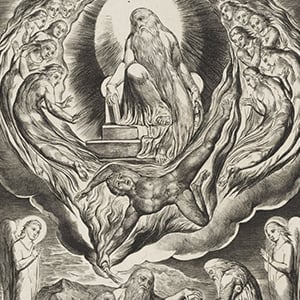
Satan Going Forth from the Presence of the Lord by William Blake, 1825

In the land of Uz there lived a man whose name was Job. This man was blameless and upright; he feared God and shunned evil. He had seven sons and three daughters, and he owned seven thousand sheep, three thousand camels, five hundred yoke of oxen and five hundred donkeys, and had a large number of servants. He was the greatest man among all the people of the East.

His sons used to hold feasts in their homes on their birthdays, and they would invite their three sisters to eat and drink with them. When a period of feasting had run its course, Job would arrange for them to be purified. Early in the morning he would sacrifice a burnt offering for each of them, thinking, “Perhaps my children have sinned and cursed God in their hearts.” This was Job’s regular custom.

One day the angels came to present themselves before the Lord, and Satan also came with them. The Lord said to Satan, “Where have you come from?”

Satan answered the Lord, “From roaming throughout the earth, going back and forth on it.”

Then the Lord said to Satan, “Have you considered my servant Job? There is no one on earth like him; he is blameless and upright, a man who fears God and shuns evil.”

“Does Job fear God for nothing?” Satan replied.“Have you not put a hedge around him and his household and everything he has? You have blessed the work of his hands, so that his flocks and herds are spread throughout the land. But now stretch out your hand and strike everything he has, and he will surely curse you to your face.”

The Lord said to Satan, “Very well, then, everything he has is in your power, but on the man himself do not lay a finger.”

Then Satan went out from the presence of the Lord.

One day when Job’s sons and daughters were feasting and drinking wine at the oldest brother’s house, a messenger came to Job and said, “The oxen were plowing and the donkeys were grazing nearby, and the Sabeans attacked and made off with them. They put the servants to the sword, and I am the only one who has escaped to tell you!”

While he was still speaking, another messenger came and said, “The fire of God fell from the heavens and burned up the sheep and the servants, and I am the only one who has escaped to tell you!”

While he was still speaking, another messenger came and said, “The Chaldeans formed three raiding parties and swept down on your camels and made off with them. They put the servants to the sword, and I am the only one who has escaped to tell you!”

While he was still speaking, yet another messenger came and said, “Your sons and daughters were feasting and drinking wine at the oldest brother’s house, when suddenly a mighty wind swept in from the desert and struck the four corners of the house. It collapsed on them, and they are dead, and I am the only one who has escaped to tell you!”

At this, Job got up and tore his robe and shaved his head. Then he fell to the ground in worship and said:

“Naked I came from my mother’s womb,
    and naked I will depart.
The Lord gave and the Lord has taken away;
    may the name of the Lord be praised.”

In all this, Job did not sin by charging God with wrongdoing. (New International Version)

Much of life is a mystery. We simply do not know why some things happen. And it’s likely we won’t have answers to many of our vexing questions, this side of heaven. From our limited human perspective, **** happens, and that’s about all we can say about it. 

There are times in Holy Scripture, however, when the veil between heaven and earth is peeled back long enough for us to catch a glimpse of mystery. Today’s Old Testament lesson is such a story. 

Job was a wealthy man and had everything this earthly life could offer. What’s more, he was a pious godly person of faith. It was commonly understood that those two things always went together. So, when we see behind the curtain and are privy to a conversation between God and Satan, the devil himself points this out – that Job only praises God because of how good he has it.  Even with this understanding of what was behind Job’s misery, we still see the mysterious God allowing Satan to operate with only God-knows reasons why.

Whenever calamity strikes, or bad news causes us to slump in our chairs, or adversity hits unexpectedly, or trouble smacks us upside our life like a sledgehammer, it’s only human to begin wondering what we did wrong or what we did to bring on such a terrible set of circumstances. 

But the truth is this: We just don’t always know. 

Yes, I fully understand that statement is hard to swallow; it even sucks. For example, no amount of understanding why my grandson has a rare form of epilepsy will make the pain go away. All my wonderings about his future isn’t going to help my daughter. It’s an impossible emotional place to be. It’s sad and it’s frustrating.

Yet, there is a better way.

Although there is so much we don’t know, we do know Job’s inconceivable response to the mystery of God. He made an incredible confession of faith, despite the most awful of circumstances. Job made the affirmation:

“When I was born into this world,
    I was naked and had nothing.
When I die and leave this world,
    I will be naked and have nothing.
The Lord gives,
    and the Lord takes away.
Praise the name of the Lord!”

Job 1:21, ERV

Rather than spending all of our emotional energy trying to figure out an answer to our “why” questions, perhaps the more sage response is to confess our faith in a radical trust of God. 

Using these actual words from Job can be a necessary start to navigating the troubled waters of evil which swirl around us, even if we have to say them over and over again to believe them.

I know I do.

Almighty God, every good thing I have in my life comes from you. It is your prerogative whether I continue to have those things, or not. Whatever happens, whether it causes heartbreak or happiness, is completely known to you. I trust that you know what you are doing, and I completely throw myself upon your mercy through Jesus Christ, my Savior. Amen.