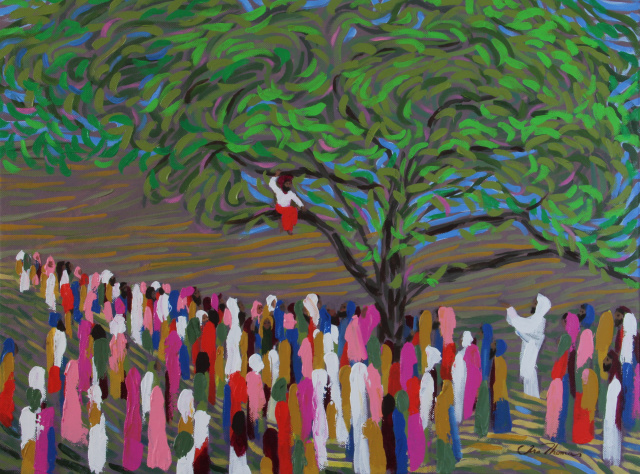
A Parable On Being Right with God (Luke 18:9-14)

The Tax Collector and the Pharisee by Peter Gallen

To some who were confident of their own righteousness and looked down on everyone else, Jesus told this parable: “Two men went up to the temple to pray, one a Pharisee and the other a tax collector. The Pharisee stood by himself and prayed: ‘God, I thank you that I am not like other people—robbers, evildoers, adulterers—or even like this tax collector. I fast twice a week and give a tenth of all I get.’

“But the tax collector stood at a distance. He would not even look up to heaven, but beat his breast and said, ‘God, have mercy on me, a sinner.’

“I tell you that this man, rather than the other, went home justified before God. For all those who exalt themselves will be humbled, and those who humble themselves will be exalted.” (New International Version)

There’s a lot to observe in Christ’s parable for today. Notice six observations of the story….

1. We Cannot Make Ourselves Right with God

I’m convinced that most Gentile Christians, standing two millennia apart from Christ’s telling of this parable, are much too hard on the Jewish Pharisees: “Well, I’m certainly glad that I am not like the Pharisee in this story!” so many tell themselves. It seems to me the Pharisees get a bad rap because of our own predilection to justify ourselves.

After all, we can only really criticize something we are already familiar with.

A temptation which every individual and community faces is the seduction toward self-justification, instead of being justified by God.

Way back in the day, when I made treadmill belts for a living, I was in charge of quality control. It was my job to make sure that the quality department provided the shipping department with a finished product, free of defects, and could stand the test of continual use. I justified the belt as being a treadmill belt of integrity; the belt did not, nor could not, justify itself, hide or fix its flaws, or make itself right.

To think that a treadmill belt could justify itself is in the same sort of crazy that believes we can make ourselves right. No, it is God alone who justifies the sinner.

The paradox of Christ’s parable is that the real sinners are those who claim to be righteous, while the truly righteous are those who recognize they cannot justify themselves and need God to make them right.

2. We Need to Be Honest about the Right Thing

In order to hear the good news about God’s ability to justify and make right, we must also hear the bad news about why we need justification to begin with. An honest look into the mirror reveals that we have been hiding behind a cosmetic façade of self-justification.

Our illusions and delusions need to be confronted and shattered. Because only then can we receive grace and realize the peace and harmony of God’s justification.

Since God justifies, I don’t have to!

I don’t need to defend myself, make myself look better than I am, nor fool myself into believing that the false façade is the true self.

The parable of Jesus is a contrast between the Pharisee who justifies himself, and the tax collector who looks to God alone for his justification.

3. The Put-Together Guy Wants to Make Himself Right

Jesus uses a Pharisee as a character in the parable because the guy represented someone who everyone else looks up to as the model of a spiritual and religious person. Christ is inviting his hearers to look beyond the façade of what we see with our physical eyes.           

We need to use our spiritual eyes to notice below the surface. Look at the attitude. The smug self-justifying disposition is flat-out sin. What’s more, self-justification is a root of all sorts of sins.

Judging ourselves to be right means that others are wrong. That attitude creates division, separates people into bad and good, fosters disharmony, and is an affront to God. 

To try and obtain what is already provided by grace is plain old-fashioned sin.

4. We’re Obsessed with the Right Lines

Adam and Eve were told by God that they could eat from any tree in the garden but were given strict instructions not to eat of the tree of the knowledge of good and evil. (Genesis 2:15-17) So, why avoid that particular tree?

Because it was a tree which spiritually and socially blinds people. Adam and Eve ate from it and their eyes were “opened” to a different reality – which was actually a “closed” view of reality that changed the way humanity deals with one another. From that point forward, people began drawing lines down the middle and placing themselves on the “good” side while vilifying those on the other side, the “bad” side.

“Apple Picking,” the fall of Adam and Eve, by Vittorio Canta

Adam and Eve immediately began justifying their actions, their attitudes, and their behavior. (Genesis 3:8-13) Adam drew a line: “That woman, Eve, gave me the fruit; she’s on the other side; it’s her fault!” Eve drew a line: “The serpent made me do it; that wasn’t really me, I’m basically good….” And ever since, the quest of making ourselves right has never stopped….

Today, we draw all sorts of lines. A popular religious line is this: “We’re good; they’re bad. Our theology is right, everybody else’s is wrong. The Bible says….” (insert a kooky interpretation of Scripture, based in self-justification and separation of people into good and bad groups)

People draw class lines, race lines, gender lines, ethnic lines, economic lines. We want clean lines, vertical lines, horizontal lines, perpendicular lines, thick lines, thin lines, any kind of line; just give me a line! Let’s go line dancing. Maybe take an airline. There are offensive lines and defensive lines. By the way, what’s the line on the Packers? We even judge the lines themselves: Long lines, short lines, front lines, back lines, and DMV lines are clearly evil, right!?

Why are we so obsessed with drawing lines? So that we can take self-justifying sides. Violence, war, and most every other sin of the world comes from the original sin project of trying to make ourselves right: “I’m okay; you’re not.”

The Pharisee (really a representative of us all) drew a very clear line between himself and the despised sinful tax collector. Notice that self-justification always compares itself with others. Those who obsessively draw lines are compulsively concerned about other people; they believe they have a right to know what’s going on with them. They remain vigilant to keep the lines drawn and distinguish themselves from those on the other side.

5. God Is On the Other Side of the Right Line

The Pharisee found that every time he drew a line, God was on the other side with the “sinners.” That makes perfect biblical sense. If God alone justifies sinners and makes them right; and if Jesus identifies with them in his life, death, and resurrection; then God is to be found on the other side of our line-drawing.  

A self-justified person sees no need for God’s justification. Therefore, God is not on their side; God is on the other side, justifying sinners by making them right.

6. The Unraveled Guy Wants To Be Made Right

“O God, Be Merciful To Me, A Sinner,” by Ronald Raab

The tax collector’s only concern was for God to show him mercy because he is a sinner. In contrast to the proud attitude of the Pharisee, the tax collector, a sinner by anyone’s definition, humbled himself and sought justification from God alone.

  • Justification by God makes us right and:
  • Lifts the curse upon humanity and reverts everything back to its original design. (Revelation 22:1-5)
  • Erases the lines. (Romans 4:7-8)
  • Restores our souls are and strengthens our faith. (Acts 16:5; Romans 4:20)
  • Enables us to rest in Christ’s finished work. (John 19:28-30)
  • Does not condemn us. (Romans 8:1-2)
  • Eliminates comparisons because Christ is sufficient for us. (Colossians 2:13-14)
  • Replaces the anxiety and fear about how we look to others with the contentment and satisfaction of God’s love in Christ. (1 John 4:16-18)

Conclusion

Self-justification separates us from people and creates distance and division. But God’s justification connects people in love and crosses the arbitrary lines created by others.

The bad news: Many religious folk, when confronted with their self-justifying attitudes, do not change. Instead, they label the person as bad and place the offending person on the other side of their line so that they can maintain their façade of righteousness.

The good news: Jesus can be found on the other side of the line because justification is a gift. Yet, until we go to him, outside our little camp, we will continue in vain to make ourselves look good and be on the right side of everything while making others look bad.

The good and the right is to humbly – and with much flavor – cry out to God for mercy because only the Lord can save us from our plight.

Lord Jesus Christ, Son of God, have mercy on me, a sinner. 

Lord Jesus Christ, Son of God, have mercy on me, a sinner. 

Lord Jesus Christ, Son of God, have mercy on me, a sinner, and grant me your peace.

Just and right God, by your mercy we were created, and by your mercy you redeemed us through your Son, the Lord Jesus. Your mercy is the light by which all people – both sinner and saint – return to you. Your divine justice and your divine mercy exist together so that you refuse to punish us as we deserve.

Lord Jesus, it was not enough for you to take on our humanity; you died for us as well. So, we humbly and gratefully receive your gracious deliverance from sin, death, and hell. Amen.

He Has Done Great Things For Me (Luke 1:46-55)

Madonna of the Magnificat by Sr. Mary Grace Thul

And Mary said,

“My soul magnifies the Lord,
    and my spirit rejoices in God my Savior,
for he has looked with favor on the lowly state of his servant.
    Surely from now on all generations will call me blessed,
for the Mighty One has done great things for me,
    and holy is his name;
indeed, his mercy is for those who fear him
    from generation to generation.
He has shown strength with his arm;
    he has scattered the proud in the imagination of their hearts.
He has brought down the powerful from their thrones
    and lifted up the lowly;
he has filled the hungry with good things
    and sent the rich away empty.
He has come to the aid of his child Israel,
    in remembrance of his mercy,
according to the promise he made to our ancestors,
    to Abraham and to his descendants forever.” (New Revised Standard Version)

Mary’s great song of praise, her “Magnificat” came from having grasped the reality of being pregnant with the Messiah. She affirmed that the all-powerful God “has done great things for me.” 

Indeed, the Lord shows mercy to everyone who worships and adores such mighty acts. It strikes me that Mary, instead of being full of worry and afraid of the future, and as an unmarried teen with child, is full of the Spirit and faith. 

Mary, the mother of Jesus, neither complained nor fretted for the nine months of her pregnancy; she praised God and had clear-headed faith about the grace shown to her. Mary’s canticle gives us insight into the mystery of the Christ’s incarnation: God chooses the weak, those of low esteem, and the powerless.

Mary was quite ordinary for her day. She had no wealth. There was nothing which caused anyone to pick her out of a crowd. Yet, she is the one chosen by God.

Her wonderful response to God’s grace demonstrated that there is so much more to any person than what we can see with our eyes and perceive through our earthly glasses of high positions and strength of personalities.

What’s more, Mary had the wisdom to discern that her situation typified the Lord’s egalitarian work of leveling the field so that all persons have what they need.

Her son, the Messiah, would carry this into his own life and ministry – declaring good news to the poor, comforting the brokenhearted, proclaiming freedom for captives, telling those who mourn that the time of the Lord’s favor has come.

Statue of Mary, Stella Maris Chapel, St. Joseph, Minnesota

God is full of grace, mercy, and strength to those who are powerless and in need of help. The Lord has our back. Perhaps if we all, both individually and corporately, continually used our words to identify and declare the great things God has done, then we would realize and have awareness of the Lord’s abiding blessing. 

One good way of gaining a greater awareness and appreciation of God’s gravity of grace is by journaling.

I encourage you to take some time today and write out some of the ways God has been good to you in the past days, weeks, or months.

Perhaps you might even craft your own song of praise, like Mary, and poetically and/or musically express your gratitude. Or maybe, instead of using words, a sketch or a painting may better communicate the great things God has done for you.

However you choose to do it, like Mary, offer praise for each act of mercy which comes to your memory. 

An outsider, looking in, might judge Mary to be helpless and weak, not the sort of a person who could carry a Messiah. Yet, we get a view from the inside, a glimpse into Mary’s heart. All along, she had her heart calibrated to detect the grace of God when it was present.

May we all follow her example of faith and confidence.

My Soul Magnifies The Lord ~ Chris Tomlin 

O Lord Jesus Christ, Son of God, Son of Humanity: Make me worthy to understand the profound mystery of your holy incarnation, which has happened for our sake and for our salvation.

Truly there is nothing so great and wonderful that you, my God, the Creator and Sustainer of all things, should become a creature, so that we might become children of God.

You have humbled yourself and made yourself small that we might be made mighty.

You have taken the form of a servant, so that you might confer upon us a royal and divine beauty.

You, who are beyond our understanding, have made yourself understandable to us in Jesus Christ.

You, who are the uncreated God, have made yourself a creature for us.

You, who are the untouchable One, have made yourself touchable to us.

You, who are Most High, make us capable of understanding your amazing love and the wonderful things you have done for us.

Make us able to understand the mystery of your incarnation, the mystery of your life, example, and doctrine, the mystery of your cross and passion, the mystery of your resurrection and ascension. Blessed are you, O Lord, for coming to earth as a man.

You have done great things for me!

Amen, and amen.

The Parable of the Persistent Widow (Luke 18:1-8)

“The Persistent Widow” by Ronnie Farmer, Jr.

Then Jesus told his disciples a parable to show them that they should always pray and not give up. He said: “In a certain town there was a judge who neither feared God nor cared what people thought. And there was a widow in that town who kept coming to him with the plea, ‘Grant me justice against my adversary.’

“For some time he refused. But finally he said to himself, ‘Even though I don’t fear God or care what people think, yet because this widow keeps bothering me, I will see that she gets justice, so that she won’t eventually come and attack me!’”

And the Lord said, “Listen to what the unjust judge says. And will not God bring about justice for his chosen ones, who cry out to him day and night? Will he keep putting them off? I tell you, he will see that they get justice, and quickly. However, when the Son of Man comes, will he find faith on the earth?” (New International Version)

“God desires of us nothing more ardently than that we ask many and great things of him, and he is displeased if we do not confidently ask and entreat.”

Martin Luther

God wants us to pray! Prayer happens from a place of faith because to pray, one must believe that God is good and answers prayer. Conversely, prayerlessness is faithlessness. A person of little faith prays only a little. A person full of faith cannot stop praying.

Today’s Gospel lesson is a parable about not losing heart, about justice, and ultimately about faith.

Be Persistent In Prayer

For the Gospel writer, Luke, the widow, along with orphans, the diseased, and the handicapped, represent those who are dependent and vulnerable. And so, Jesus took a particular interest in them. (Luke 20:47, 21:3)

Widows are also presented by Luke as prophetic, active, and faithful. The widow in Christ’s parable, much like the other widows mentioned by Luke, is persistent and persuasive enough to get the justice she demands – even from an unjust judge. Her persistent petitioning is held up as a lesson in prayer.

Don’t lose heart and give up praying when your prayers are not answered as quickly as you want. No matter the prayer, we typically hope for and even expect them to be answered quickly. And if they don’t, we may get upset or discouraged.

“We must patiently, believingly, continue in prayer until we obtain an answer… Most frequently we fail in not continuing in prayer until the blessing is obtained, and in not expecting the blessing.”

George Müller

We pray daily for a variety of situations as individuals and as a congregation. Not all those prayers get answered in the ways we expect. Many times, it can seem like nothing is changing, or things are just getting worse. It is possible for us to despair in those moments and give up.

Yet, even if we do not immediately see an answer to our prayers, we need to keep praying. Even if we are suffering and seeing darkness all around us, we should not stop crying out to the Lord. And the content of those prayers is important.

Be Persistent In Justice

The parable is like a sandwich. The two pieces of rye bread are prayer and faith, with justice being the ham and cheese between them. The meat of the parable is in the ingredients of the prayers.

The widow is the vulnerable justice-seeker, and the powerholder is the unjust judge. The powerful and just God replaces the unjust authority’s reluctance, granting justice to vulnerable people who cry out to him day and night.

We are to persistently and passionately pray as Jesus instructed us:

“Father,
hallowed be your name,
your kingdom come.
Give us each day our daily bread.
Forgive us our sins,
    for we also forgive everyone who sins against us.
And lead us not into temptation….”

“So I say to you: Ask and it will be given to you; seek and you will find; knock and the door will be opened to you. For everyone who asks receives; the one who seeks finds; and to the one who knocks, the door will be opened.” (Luke 11:2-4, 9-10, NIV)

Jesus said, “Seek his kingdom, and these things [food, clothing, basic necessities] will be given to you as well. Do not be afraid, little flock, for your Father has been pleased to give you the kingdom. Sell your possessions and give to the poor. Provide purses for yourselves that will not wear out, a treasure in heaven that will never fail, where no thief comes near, and no moth destroys. For where your treasure is, there your heart will be also.” (Luke 12:31-34, NIV)

Be Persistent In Faith

Christ’s parable ends with a question: When the Son of Man comes, will he find faith on the earth? In Luke’s Gospel, there are several folks whom Jesus commended for their faith:

  • A Roman centurion asked Jesus to heal his servant, being confident that Christ could do so without even being present to do it. Jesus commented, “I tell you, I have not found such great faith, even in Israel.” (Luke 7:1-10)
  • A “sinful” woman anointed the feet of Jesus with perfume and her tears, loving the Lord despite the judgmental people around her. Jesus said to the woman, “Your faith has saved you; go in peace.” (Luke 7:36-50)
  • Friends of a paralyzed man dug through a roof to get him access to Jesus, knowing that Christ could heal. When Jesus saw their faith, he said, “Friend, your sins are forgiven.” (Luke 5:17-26)
  • An unclean woman, because of a chronic issue of bleeding, touched the edge of Christ’s cloak, believing that even this small touch will heal her. Jesus said to her, “Daughter, your faith has healed you. Go in peace.” (Luke 8:43-48)
  • A Samaritan leper cried out for mercy, recognizing that Jesus is the Christ who could heal him; and then fell at his feet in profound gratitude. Jesus said to him, “Rise and go; your faith has made you well.” (Luke 17:11-19)
  • A blind beggar called out to Jesus, seeing with spiritual eyes who Jesus really is. Jesus said to him, “Receive your sight; your faith has healed you.” (Luke 18:35-43)

So, will Jesus find faith on the earth when he returns?  Yes, he will, but it may likely be in unexpected places — not among the religious professionals or the ones certain of their own righteousness, but among the outsiders, the unlovely, the unclean, the ones certain of their sinfulness.

Perhaps the best sign of faith is a willingness to persist in prayer, like widow who persisted against all odds in her struggle for justice with the powerful judge.

Conclusion

We must have faith in Christ, and not in faith itself.

If we are honest, every one of us who has made a difficult prayer request, mustering-up all the faith we can, and then being disappointed when it did not happen, has been hurt. The unstable person vacillates when this happens, playing the “God-loves-me, God-loves-me-not” game. The person of faith, however, believes God answers prayer, and that if it is not answered when I want, God knows what’s up and will answer it in God’s own good time and grace.

None of this is about the amount of faith. Maybe you have told yourself, or somebody else has said to you, that you don’t have enough faith, and that’s why your prayer was not answered.

“The value of persistent prayer is not that God will hear us, but that we will finally hear God.”

William McGill

Know this: positive thinking is not the same as Christian faith. Faith is neither a matter of optimism nor of sending $19.95 to some hack preacher who promises to give you the secret of answered prayer, along with a free gold cross.

Taking a lesson from Christ’s parable about the persistent widow, we can put aside tepid, milquetoast, mumbling prayers with hunched shoulders (i.e. “Well, God, if it is your will, could you help me?”) and instead, because of our union with Jesus Christ and our redemption in him, pray confidently and boldly. In Christ, we have the privilege and authority to do so.

Blessed heavenly Father, we praise you for the grace we possess through the Lord Jesus Christ. We rejoice in Christ’s teaching, the gift of faith, the privilege to approach your throne with boldness, and the victory you have provided for us through Christ’s crucifixion, resurrection, and ascension. 

We pray your mercy over our sins, the sins of other believers, and the sins of our world. We confess the sin of prayerlessness, faithlessness, apathy, complacency, and indifference to your concerns for righteousness and justice. We acknowledge the wickedness of our world through injustice, oppression, and exploitation of others.

We recognize that the kingdom of darkness has laid strategies against us, trying to keep your people from faith and prayer. So, in the name of the Lord Jesus Christ, we claim our place as children of God. We smash and pull down all the strongholds which Satan has erected against humanity – and pray that the power of Christ’s resurrection would hinder and frustrate the plans formed against us. 

We, your people, accept the role of standing in the gap for others in prayer. In Christ, we are mighty through God to the pulling down of strongholds. So, we bring all the work of the Lord Jesus Christ – his incarnation, crucifixion, resurrection, ascension, and glorification directly against all of Satan’s power in their lives.

By faith we pray for fruitful lives of spiritual abundance, social justice, and sanctified relationships in the name of Jesus Christ our Lord.  Amen.

Coming to Grips with Grinding Adversity (Psalm 137)

“By the Waters of Babylon, They Sat Down and Wept” by Kate Gardiner Hastings

Alongside Babylon’s streams,
    there we sat down,
    crying because we remembered Zion.
We hung our lyres up
    in the trees there
    because that’s where our captors asked us to sing;
    our tormentors requested songs of joy:
    “Sing us a song about Zion!” they said.
But how could we possibly sing
    the Lord’s song on foreign soil?

Jerusalem! If I forget you,
    let my strong hand wither!
Let my tongue stick to the roof of my mouth
    if I don’t remember you,
    if I don’t make Jerusalem my greatest joy.

Lord, remember what the Edomites did
        on Jerusalem’s dark day:
    “Rip it down, rip it down!
    All the way to its foundations!” they yelled.
Daughter Babylon, you destroyer,
    a blessing on the one who pays you back
    the very deed you did to us!
    A blessing on the one who seizes your children
    and smashes them against the rock! (Common English Bible)

This side of heaven is full of both love and heartbreak, celebration and lament, encouragement and insult. It is a spiritually schizophrenic existence of heaven’s kiss and hell’s bite. 

We live in a fundamentally broken world. Yet, it is a world that is presently being reclaimed by God’s kingdom. Therefore, our emotions run the gamut from joyful happiness to sheer sorrow. Either way, especially through the difficult stretches of our lives, Christians are to tether themselves to their true home of heaven.

The psalmist was speaking of Jerusalem, the city that represented the very presence of God. Yet, the Babylonians came and destroyed the temple, their homes, and carried thousands of her citizens into exile.

Although experiencing the Babylonian Exile, the people of Jerusalem were not to forget their real home. 

For the believer in Jesus, this present abode is like camping in a tent – it is a temporary home, and not our permanent residence.

It is easy to forget our true home, which is why we need the constant perspective of eternity. We ought not get too familiar with our current living conditions. 

Simple acts like looking up at the stars at night or gazing into the vast expanse of the day’s sky can be tangible reminders that we are meant for larger things, for the embrace of heaven.

None of this, however, means that we are to ignore what is happening in the here and now. Trauma is real and needs to be dealt with. Having an expansive perspective doesn’t mean we stuff the details and emotions of traumatic events.

The psalmist names the difficult experience, the agonizing emotions, and the bitter thoughts. None of it is hidden or buried under a layer of positivity.

“Lamenting Jews in Exile” by Eduard Bendemann, 1832

We need the combination of faith that my experienced is acknowledged, of hope that a better future is coming, and of love that good still presently exists in the world. Faith, hope, and love are all vital in coming to grips with terrible adversity.

Hiding large swaths of our lives and stories from others is not the path to spiritual wellness, emotional healing, and personal peace. Spiritual and emotional health comes from owning our internal struggles. The virtues of weakness, humility, vulnerability, and faith opens us to the way of grace.

We too often struggle because we don’t struggle. 

I’m the expert on stuffing feelings and turning them into thoughts. I learned it well early in my life. Yet, feelings never evaporate just because we ignore them. Just the opposite, like a forgotten half-carton of cottage cheese in the back of the fridge, our feelings only gather moldy bacteria and crust over with nastiness. 

We need to understand that feelings really do have an expiration date to them. If not openly acknowledged and dealt with, they’ll fester into bitterness. It’s much better to deal with our present struggles instead of living with the wishful thinking that they’ll just go away.

There are 52 references to “one another” in the New Testament, including: 

  • Love one another (John 13:34-35)
  • Be kind to one another (Ephesians 4:32)
  • Show hospitality to one another (1 Peter 4:9)
  • Forgive one another (Colossians 3:13)
  • Encourage one another (Hebrews 3:13)
  • Bear the burdens of one another (Galatians 6:2)
  • Spur one another on toward spiritual well-being and healthy community relationships (Hebrews 10:24)

Nowhere in Holy Scripture will you find references to hide from one another, pester one another, or put up a false front toward one another.

God desires for us to take a risk on betting the farm on Jesus. Embracing Christ involves owning our struggles, both to God and to one another. 

You may argue that it isn’t helpful to wear your feelings on your sleeve. But I’m not talking about emotional diarrhea; I’m referring to something far worse: emotional prostitution, where we sell ourselves to others in a cheap façade of who we really are and how we are really doing. 

We want to be liked, loved, and longed for. And we very much desire to avoid heartrending pain. So, many mistakenly believe that keeping up false appearances will get them what they long for.

What matters most is faith expressing itself through love (Galatians 5:6). It takes personal risk to have faith. And it takes two to have love.

Own your struggle. Face it squarely in all of its foulness, degradation, and ugliness. Face it with both God and others. 

If you’re mad as hell at God, then say it; the Lord is big enough to take it. If you need prayer or help, ask for it. Don’t just expect someone to read your mind or your emotions. If someone asks you to pray, stop what you’re doing, get on your knees with that person, and pray like there’s no tomorrow.

Life is too short to sleepwalk through it with a constellation of unacknowledged emotions. It takes no relational effort to ask a pat question like, “How are you?” It takes even less relational energy to give a pat answer such as, “Fine,” or “Busy.” Instead, let’s get down to why you feel a constant need to say how busy you are, even when you’re not really all that busy.

Holy Scripture doesn’t call us to hide, but to love one another enough to both give and receive God’s grace. 

Daily reading and praying of the psalms is a good place to begin in learning to be authentic with God and the people in our lives. It’s the only way of dealing with the overwhelming circumstances and emotions we face.

Loving God, please grant me peace of mind and calm my troubled heart. My soul is like a turbulent sea. I can’t seem to find my balance, so I stumble and worry constantly. Give me spiritual strength, mental clarity, and emotional calm to find my purpose and walk the path you’ve laid out for me. Just as the sun rises each day against the dark of night, may the light of your divine countenance shine on the shadowy places of my life, through Jesus Christ my Lord, in the illumination of the Holy Spirit. Amen.