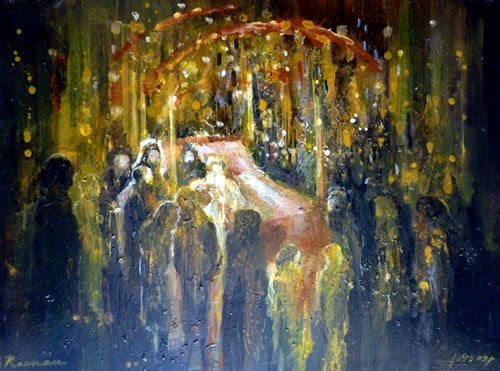
Shining the Light on Fear (Psalm 27:1-6)

The Lord is my light and my salvation.
        Should I fear anyone?
    The Lord is a fortress protecting my life.
        Should I be frightened of anything?
When evildoers come at me trying to eat me up—
    it’s they, my foes and my enemies,
    who stumble and fall!
If an army camps against me,
        my heart won’t be afraid.
    If war comes up against me,
        I will continue to trust in this:
    I have asked one thing from the Lord—
    it’s all I seek:
        to live in the Lord’s house all the days of my life,
        seeing the Lord’s beauty
        and constantly adoring his temple.
Because he will shelter me in his own dwelling
    during troubling times;
    he will hide me in a secret place in his own tent;
        he will set me up high, safe on a rock.

Now my head is higher than the enemies surrounding me,
    and I will offer sacrifices in God’s tent—
        sacrifices with shouts of joy!
    I will sing and praise the Lord. (Common English Bible)

Being afraid of the dark is a common fear. After all, whenever we cannot see anything around us, then we don’t know what’s really there – and that’s understandably frightening for most people. Typically, it’s not what we see that’s so scary; the scary stuff is what our imagination conjures up that’s out there in the dark, which we cannot see.

Kids, with their curiously active imaginations, tend to be fearful of the dark – which is why we parents, and grandparents, ensure there’s a nightlight for them so they can sleep. The light illumines their surroundings, reminding them of where they are; the light also helps them remember that we are with them.

As children of God, we need the same reminders. We must continually check-in with our internal selves, reorienting our lives around the reality that the Lord is present, that Jesus is our Immanuel, God with us.

Having the Light of the World surrounding us provides confidence that God is watching and will save us from whatever threatens our life. Indeed, being immersed in the Lord helps us snuggle down and realize our ultimate security blanket holds us tight.

Not only do we have confidence with God’s presence, but we are also fearless in the face of the most adverse and scary of circumstances. Knowing that God has our back enables us to accept, cope, and transcend overwhelming situations.

God protects because God is present.

Admittedly, we don’t have all the answers as to why the Lord sometimes seems absent in the midst of our trouble. That’s maybe because God is a Being, a Person, and not an insurance policy. Ultimately, personal presence and protection is a whole lot better than the impersonal and legal sort.

Which is why it’s important to delight in the Lord, to enjoy being in God’s house, to bask in the beauty of divine holiness, righteousness, and justice. With this as our way of life, we tend to better understand that not everything is necessarily going to go right but that the Lord is alongside us, giving strength and hope.

It’s important to note that divergent emotions can be held together. Many folks tend to believe that if there is fear within the heart, then faith, courage, and praise cannot exist. But nothing could be further from the truth.

The more likely scenario is that trying to suppress feelings of fear only results in becoming more afraid; thus, leading to forced or manufactured praise with little to no bravery behind it.

Instead, the sage thing to do is acknowledge whatever emotions bubble up for us. That is our inner spirit’s way of alerting us that we must pay attention to something. Ignoring the fear makes the monster under the bed more fearsome.

Being aware of the emotion and acknowledging it brings options and choices. Getting it out there to actually feel it means that now we can choose what we’re going to do with the emotion. Hiding the fear only gives it power; naming the fear gives us control over it.

This is one reason why I believe it is significant to read the psalms out loud; it provides more fortitude in dealing with what’s in front of us.

Holding both our fears and our faith together enables us to face our troubles with wisdom and courage. If attacked – whether it be spiritual, emotional, mental, or physical – the worst thing to do is grin and bear it or plaster a fake smile on your face.

It’s okay to be conflicted, to wonder what the heck is going on, to not know what’s up or down, to live with the seeming incongruence of emotions.

Healing comes through feeling, speaking, and acting – and not by suppressing emotions, keeping words bottled up inside, and acting as though everything is peachy keen when it isn’t. Expressing words of trust in the Lord, without having first expressed words describing our emotions, is a fool’s errand. If we trust God to answer a prayer, then we also need to trust God in hearing our real emotions.

God encourages honesty, sincerity, and feeling; the Lord disparages ingenuine offerings of praise and inauthentic gestures merely meant to fake-it-till-you-make-it. The psalmist encourages us to express all our emotions – whether “positive” or “negative” – and find the empathy, solidarity, and healing we need.

God is our light. So, let’s not keep him in the dark about our real selves.

A Changed Life (Galatians 1:11-24)

A mosaic of the Apostle Paul in St Isaac’s Cathedral, St. Petersburg, Russia

I want you to know, brothers and sisters, that the gospel I preached is not of human origin. I did not receive it from any man, nor was I taught it; rather, I received it by revelation from Jesus Christ.

For you have heard of my previous way of life in Judaism, how intensely I persecuted the church of God and tried to destroy it. I was advancing in Judaism beyond many of my own age among my people and was extremely zealous for the traditions of my fathers. But when God, who set me apart from my mother’s womb and called me by his grace, was pleased to reveal his Son in me so that I might preach him among the Gentiles, my immediate response was not to consult any human being. I did not go up to Jerusalem to see those who were apostles before I was, but I went into Arabia. Later I returned to Damascus.

Then after three years, I went up to Jerusalem to get acquainted with Cephas and stayed with him fifteen days. I saw none of the other apostles—only James, the Lord’s brother. I assure you before God that what I am writing you is no lie.

Then I went to Syria and Cilicia. I was personally unknown to the churches of Judea that are in Christ. They only heard the report: “The man who formerly persecuted us is now preaching the faith he once tried to destroy.” And they praised God because of me. (New International Version)

I didn’t ask God for this

Saul wasn’t looking to change anything – except maybe to keep those confounded Christians, the group known as “The Way,” out of his beloved religion. He didn’t wake up one morning, sit on the edge of his bed and say, “Well, now, gee-whillikers, I think I’ll become the Apostle Paul, follow Jesus, and rankle a bunch of my fellow Jews with establishing churches all over the place.”

The only well-thought out plan Saul had was to ensure that Christians stayed away by any means possible. He had quite the turn around by actually joining the Christian movement. (Acts 9:1-19)

From the very get-go of his conversion, the new Paul faced skepticism, doubts, and opposition from both church and synagogue. Christians knew how Saul breathed all kinds of threats against them; so, understandably, they were reticent to receive him, perhaps wondering if it were some sort of ruse to topple the church. If it were not for the insight and encouragement of Barnabas, Paul may not have ever entered the ranks of the church. (Acts 9:26-27)

Paul’s fellow devout Jews were so upset with him for becoming a turncoat that they sought to kill him – which became a theme of Paul’s life – getting rocks thrown at him, whipped, beaten, and left for dead more than once. (Acts 9:23-24; 2 Corinthians 11:24-29)

Although Paul never asked for a dramatic conversion to Christianity, a missionary life, and continual suffering at the hands of others, he nevertheless embraced it with all the gusto of faith God gave him.

So, the gospel that the Apostle Paul proclaimed wasn’t something he sought; it was given to him. God graciously revealed the good news to Paul. For three years, he received it. Considering Paul’s background and former life, we can see why it might not be a good idea for him to hang out in Jerusalem and learn about Jesus.

Arabia is a desert. That is precisely where Paul needed to be in his early life as a Christian. Eventually, the churches and believers came around to seeing the authenticity of Paul’s faith and embraced him as a disciple. Paul is considered an Apostle because he had direct contact with Jesus himself in the Arabian desert.

God called me through the grace of Jesus

That phrase is Paul’s spiritual autobiography in a nutshell. It represents his dramatic transformation — from persecutor to preacher — and gives evidence of the hand of God at work in his life.

The fundamental conviction of being called by God, anchors Paul’s faith story. He tells that story in order to remind the Galatian Church of their own experience of being called by God’s grace.

Paul wrote his letter to the Church to help keep them on the track of grace; they were saved by grace, so therefore, they needed to also be sanctified by grace (and not law). He feared they were being led astray by believers who twisted the gospel for their own ends in order to avoid suffering. (Galatians 6:12)

The question Paul tackled head on was: Do the Gentiles have to become Jewish in order to be Christians? “Absolutely not!” Paul insisted. Neither circumcision nor uncircumcision counts for anything; the only thing that counts is faith working through love. (Galatians 5:6)

I connected with God, and you can, too

Paul was arguably the most influential Christian who ever lived. He shared his faith story in order to encourage the Galatians to examine their own experiences for signs of God’s call.

How has God called you?

It matters little whether it’s a dramatic call, like Paul’s, or whether it seems mundane, as if you don’t remember a time that you didn’t believe. And everything in between.

The important point is that we all need moments, events, and experiences of life transformation; and God’s grace must be the defining center of our personal and collective narratives.

Grace makes all the difference and is what leads to a changed life.

Once you were separated from God. The evil things you did showed your hostile attitude. But now Christ has brought you back to God by dying in his physical body. He did this so that you could come into God’s presence without sin, fault, or blame. (Colossians 1:21-22, GW)

Almighty God, transform us – not for our benefit, but for the benefit of the world. Do your work in changing us to be the new creation you have called us to be in Jesus Christ.  

Holy Spirit of God, do your sanctifying work in the church and help us to be the Body of Christ – engaged in mission, testifying to our faith, and bearing witness to the presence of our Savior, Jesus Christ. 

Lord Jesus, enable us to surrender the church back to you. It is yours, not ours. Help us lay aside our personal agendas and preferences so we can be fully committed to your calling for us. 

Blessed Holy Trinity – Father, Son, and Spirit – the God whom we serve: Do your work in our world and give to us a vision of transformed lives, renewed neighborhoods, and restored communities – bringing blessings and redemption for the glory of God. Amen.

Out of the Slimy Pit (Psalm 40:1-11)

He Lifted Me by Nate Owens

I put all my hope in the Lord.
    He leaned down to me;
    he listened to my cry for help.
He lifted me out of the pit of death,
    out of the mud and filth,
    and set my feet on solid rock.
        He steadied my legs.
He put a new song in my mouth,
    a song of praise for our God.
Many people will learn of this and be amazed;
    they will trust the Lord.
Those who put their trust in the Lord,
    who pay no attention to the proud
    or to those who follow lies,
    are truly happy!

You, Lord my God!
    You’ve done so many things—
    your wonderful deeds and your plans for us—
        no one can compare with you!
    If I were to proclaim and talk about all of them,
        they would be too numerous to count!
You don’t relish sacrifices or offerings;
    you don’t require entirely burned offerings or compensation offerings—
    but you have given me ears!
So I said, “Here I come!
    I’m inscribed in the written scroll.
    I want to do your will, my God.
    Your Instruction is deep within me.”
I’ve told the good news of your righteousness
    in the great assembly.
    I didn’t hold anything back—
        as you well know, Lord!
I didn’t keep your righteousness only to myself.
    I declared your faithfulness and your salvation.
I didn’t hide your loyal love and trustworthiness
    from the great assembly.

So now you, Lord—
    don’t hold back any of your compassion from me.
Let your loyal love and faithfulness always protect me. (Common English Bible)

Every follower of the Lord has a powerful story of God’s grace in lifting them out of a slimy pit experience. 

We live in a profoundly broken world; and no one is exempt from its effects upon us. Whether physical problems, emotional trials, or relational hardships, there is always something going on in our lives – with the added pull toward trusting in things other than God. 

The temptation to say unjust words and do unjust actions is always over-promised and under-delivered. 

It’s easy to get sucked-in to poor decisions and be stuck in an empty hole with seemingly no way out. We often find ourselves slipping into a slimy pit because of our own bad decisions, as well as by no fault of our own. 

Living in a fallen world means that we inevitably experience troubles and hardships.

So, what do we do if we find ourselves in a slimy pit?

Look for Hope

David, the psalmist, waited patiently for the Lord. With great expectation, he fully anticipated God to act on his behalf. The sort of patience he practiced was an intense waiting – a waiting filled with longing and expectant hope, a patience that kept looking and praying and seeking.

The reason believers in Jesus keep hoping beyond hope is that we know that God is ultimately the One who delivers from the pit. 

But what if you have been looking for deliverance from the slimy pit experience and you have not seen it come to pass? 

Expectantly expect God to act. Wait patiently. Do not give up. Keep praying and watching. Like the father in the story of the prodigal son, keep looking out the window, waiting for the son to return, and picture the deliverance coming – because our waiting is not in vain.

flickr.com/photos/joshtinpowers

The psalmist, David, was eventually delivered. The Lord leaned down to him. God listened and lifted him. The Lord God set him on a firm place to stand and put a new song in his mouth. 

This was not only a personal matter for David; it was also an occasion that other people needed to know about.

Look for God

We all must finally come to the end of ourselves and look up. Whenever the deliverance doesn’t come quickly, we may look to other people or things to give us the freedom we long for. It’s easy to become impatient and begin searching for answers in everything else but God. 

Yet, if we will let patient hope have its way, we are blessed when we trust in the Lord.

In all my years of churchgoing as a kid, I had never read my Bible. But God was gracious to me. I remembered all those sermons I heard about Jesus. I gained a newfound sense of my own inner darkness, as well as the desire to read God’s Word. And God saved me. 

My circumstances did not change, but I did. My loneliness turned to joy; my aimlessness turned into purpose; and my selfishness became a deep concern for others. My heart had been black, and what God did to change it was nothing less than miraculous.

Look Within

The person who looks for hope and seeks God is also a person who looks into their own heart and there finds the attitude which God will bless. 

Blessing does not come from great sacrifice, but by syncing one’s heart with the heart of God. 

The Lord cares little about how much money or stuff you have, or how many sacrifices were made for God; that’s because God wants your heart, your mind, your will, and your emotions. In other words, God wants you! 

And God desires you because the Lord made you with a heart that beats for the same things God cares about: justice, mercy, and humility.

If you and I will but look within at the very spirit God has put within us, we shall find resources beyond what we can ask or think.

Look to Bless Others

We possess more than a personal faith which is to benefit ourselves; we also have an equal responsibility to bless the community with our experiences of what God has done in our lives. 

The telling of stories about what God has done for us is a necessary part of building up the church and helping others move forward in faith, hope, and love.

The psalmist proclaimed his testimony in the great assembly, that is, publicly. This isn’t about standing behind a microphone in front of lots of people; it’s about being so touched by God that we cannot keep our mouths shut about the Lord’s deliverance on our behalf.

So, let’s not shelve the idea of giving testimony to others as if it were only for pastors, missionaries, or other very religious people. 

When a person decides to play hockey in -20 degrees below zero weather, we might think that person is a little crazy;  but, hey, we reason, if they love hockey that much, more power to them. 

We must not think about Christianity in the same way, that if a person is passionate about Jesus and desires to tell others about what God has done for them, more power to them; just don’t expect me to go out in the cold and do that because it isn’t my thing. 

Christianity is a life, not a hobby; it’s about humble service, and not a means to look respectable; it cannot be reduced to a few practices, such as church attendance or putting money in an offering plate.

Christianity is a relationship with God through Jesus. Try looking at marriage as simply showing up for supper and paying the bills and see how far that gets you.

Look to Get Lost to Get Found

We may become obsessed with getting out of our slimy pit of illness, infirmity, pain, adversity, hardship, or discord. If that happens, we will likely lose our proper focus.

Instead, get lost in the wonder of God. The Lord does wondrous things when we are immersed in God’s wonders.

“Any of you who try to save the life you have will lose it. But you who give up your life for me will find true life.” Jesus (Matthew 16:25, ERV)

New life comes from a change of heart, not a change of circumstances. Wherever there is a firm reliance on God; a glad obedience to God; and a readiness to give testimony to God’s actions, then we are living into the spirit of today’s psalm.

Lamb of God, who takes away the sins of the world, have mercy on us.
Lamb of God, who takes away the sins of the world, grant us your peace. Amen.

Sensing the Divine (Exodus 3:1-5)

The Burning Bush by Yoram Raanan

Now Moses was tending the flock of Jethro his father-in-law, the priest of Midian, and he led the flock to the far side of the wilderness and came to Horeb, the mountain of God. There the angel of the Lord appeared to him in flames of fire from within a bush. Moses saw that though the bush was on fire it did not burn up. So Moses thought, “I will go over and see this strange sight—why the bush does not burn up.”

When the Lord saw that he had gone over to look, God called to him from within the bush, “Moses! Moses!”

And Moses said, “Here I am.”

“Do not come any closer,” God said. “Take off your sandals, for the place where you are standing is holy ground.” (New International Version)

The burning bush is one of those iconic objects and stories in Holy Scripture. Moses had an experience which changed his life, as well as the lives of all the Israelites then and now.

Having spent the first forty years of his life as a darling in the Egyptian court; and then the next forty years far from that life on the backside of the desert with a bunch of sheep; it’s an understatement to say that Moses did not expect or ever envision encountering God in a burning bush. The impossible has no possibility… Or does it?…

The experience of the burning bush fired the five senses of Moses:

  • See. There was the paradoxical sight of seeing fire in a bush that isn’t burning up.
  • Smell. All around there were the smells of sheep, the outdoors, and perhaps, even the lack of smelling burnt wood.
  • Hear. Listening to the voice and call of God from within the bush.
  • Taste. Spiritually and emotionally savoring God’s attentive justice toward the people.
  • Touch. Removing his sandals to feel the grounding of sacred space.

The story also comments on the senses of God, as well. Even though God is Spirit and is worshiped as such, God is alive with divine sensations:

  • See. Observing the approach of Moses, and the misery of the Israelites.
  • Smell. The stench of injustice wafting into God’s nostrils, bringing a strong divine reaction.
  • Hear. Listening to the cries of suffering and oppression amongst the people.
  • Taste. Anticipating the savor of showing mercy, justice, and righteousness.
  • Touch. A profound and holistic touching of Moses so that both he and the Israelites would never be the same again.

Through it all, the close identification between God and the people is expressed. The Lord feels the humiliation and pain of the Israelites – and vows to uproot them from the Egyptian factory farm of slavery and plant them firmly into rich Promised Land soil.

And what God promises to do, God has the authority and power to make good on.

Although experiencing all of this unbelievable sensory encounter, Moses knew it to be an impossible task in freeing so many Israelites from such a powerful Egyptian juggernaut.

After all, the people had their senses aflame, as well; and not in a good way:

  • See. The sight of family being worked to the bone; and cruelly treated.
  • Smell. The constant smell of bricks baking, mixed with the ever-present smell of death.
  • Hear. Listening day after day to the groans of people, just trying to survive under awful conditions.
  • Taste. Every day tasting the desert dust.
  • Touch. Overstimulated with handling tools to the point of hard callouses and dry, cracked, bloody hands.

Hundreds of years of backbreaking bondage to a national force so mighty that nothing can be done about it be broken…. Ah, but God specializes in systems of oppression and miserable people.

It is the Lord’s abilities which conquer the mightiest of foes and can extend mercy to the lowest and the least powerful. The entire Israelite situation was ripe for divine intervention and supernatural wonders to occur.

God will make a way where there seems to be no way. God works in ways which transcend our senses.

  • See. We are blind, but God gives us the gift of sight.
  • Smell. Our nostrils have become accustomed to the smell of death, but God’s aroma of life awakens us to new hope.
  • Hear. We are deaf, but God opens our ears with the sound of justice.
  • Taste. Our taste buds are shot with the gruel of poverty, but God causes our tongues to dance with the zest of mercy.
  • Touch. Our nerve endings are raw from cruel bondage, but God touches us with freedom.

You already intuitively know deep in your spirit that the impossible is possible with God. It’s never a question of God’s ability, but of God’s timing.

God is able and works the impossible in its proper time so that justice and mercy will have their full effect.

God of the impossible: I believe. Help me in my unbelief.

God of mercy: I receive. Help me in my denial.

God of justice: I accept. Help me in my rejection.

God of all time: I endure. Help me in my impatience.

God of All: I submit. Help me in my rebellion.

God of power and of might: I trust. Help me in my distrust.

God of our Lord Jesus Christ: I follow. Help me in my wandering.

God of the nations: Yes, you know that I love you. Yes, Lord, you know I love you. Lord, you know all things, and you know that I love you. So, yes, I will answer your call to go. Help me in my sending. Amen.