God Will Take Care of You (Ezekiel 34:23-31)

I will give them a king like my servant David to be their one shepherd, and he will take care of them. I, the Lord, will be their God, and a king like my servant David will be their ruler. I have spoken. I will make a covenant with them that guarantees their security. I will get rid of all the dangerous animals in the land, so that my sheep can live safely in the fields and sleep in the forests.

“I will bless them and let them live around my sacred hill. There I will bless them with showers of rain when they need it. The trees will bear fruit, the fields will produce crops, and everyone will live in safety on his own land. When I break my people’s chains and set them free from those who made them slaves, then they will know that I am the Lord. The heathen nations will not plunder them anymore, and the wild animals will not kill and eat them. They will live in safety, and no one will terrify them. I will give them fertile fields and put an end to hunger in the land. The other nations will not sneer at them anymore. Everyone will know that I protect Israel and that they are my people. I, the Sovereign Lord, have spoken.

“You, my sheep, the flock that I feed, are my people, and I am your God,” says the Sovereign Lord. (Good News Translation)

We all need a safe place to live and our needs provided. When protection from harm and provision of needs are realized, we call this “peace.”

So many people long for peace, simply because they aren’t experiencing it. They feel unsafe – either physically, mentally, emotionally, or spiritually – and are separated from the sort of resources which would give them what they need to live well.

God is the expert on security and safety, peace and protection. The Lord has provided what we need.

His divine power has given us everything we need for a godly life through our knowledge of him who called us by his own glory and goodness. Through these he has given us his very great and precious promises, so that through them you may participate in the divine nature, having escaped the corruption in the world caused by evil desires. (2 Peter 1:3-4, NIV)

The Shepherd Ruler

God made a covenant with David that was to last forever. There was the anticipation of a leader, even the Messiah, who would come from the line of King David. Such a ruler will bring unity to the people. This leader shall be a servant of the people, a shepherd, characterized by humility. And, most of all, the hoped for ruler will usher in an unprecedented time of peace.

The flock of sheep – the people – will not have a care in the world. The new divine shepherd will not live off the sheep, but will instead live for the sheep. The shepherd shall be the ultimate non-anxious presence among the sheep, assuaging their fears and keeping them well-fed.

“I am the good shepherd; I know my sheep and my sheep know me—just as the Father knows me and I know the Father—and I lay down my life for the sheep.”

Jesus (John 10:14-15, NIV)

From the standpoint of Christianity, this great restoration project of the Lord finds its fulfillment in the person and work of Jesus. We needed a faithful shepherd, a merciful ruler, and we now have one.

The Settled Rest

Wholeness, integrity, thriving, flourishing, satisfaction, contentment, and a good life are all wrapped up in the biblical concept of peace and rest. And that is what the shepherd does for the sheep.

There is no peace when shepherds view the sheep as merely animals to be fleeced and used. But with a good shepherd, predators are kept away from the flock, plenty of pasture is provided to feed upon, and other shepherds in other fields attempting to steal sheep don’t stand a chance against the Good Shepherd.

A large chunk of humanity lives in a state of fear and anxiety because of violence, lack of basic necessities, disease, or natural disaster. Life can become so overwhelming that the future seems bleak and without hope. People long for peace – personal peace, family peace, world peace. They’re tired, and just want some rest.

“Come to me, all you who are weary and burdened, and I will give you rest.”

Jesus (Matthew 11:28, NIV)

Although the list of stressors may seem endless, divine blessings shall create the conditions in which humanity can live without fear and with hope in the world. No one will make them afraid, ever again.

“Peace I leave with you; my peace I give you. I do not give to you as the world gives. Do not let your hearts be troubled and do not be afraid.” (John 14:27, NIV)

The Sure Restoration

The divine/human relationship, so marred and messed up by the presence and power of sin, will be perfectly restored. The Lord is God; and God is with us. The divine energy is no longer against us, but is for us. And if God is for us, who can be against us?

Who shall separate us from the love of Christ? Shall trouble or hardship or persecution or famine or nakedness or danger or sword? As it is written:

“For your sake we face death all day long;
    we are considered as sheep to be slaughtered.”

No, in all these things we are more than conquerors through him who loved us. For I am convinced that neither death nor life, neither angels nor demons, neither the present nor the future, nor any powers, neither height nor depth, nor anything else in all creation, will be able to separate us from the love of God that is in Christ Jesus our Lord. (Romans 8:35-39, NIV)

God will care for you. Along with you, the Lord will care for your loved ones who need a faithful leader, a place of peace and rest, and a new life.

O God, the source of all holy desires, all good counsels, and all just works: Give to your servants the peace which the world cannot give, so that our hearts may obey your commandments, and that we, being defended from the fear of our enemies, may pass our time in rest and quietness, through the merits of Jesus Christ our Savior. Amen.


I Am the Gate (John 10:1-10)

“Very truly I tell you Pharisees, anyone who does not enter the sheep pen by the gate, but climbs in by some other way, is a thief and a robber. The one who enters by the gate is the shepherd of the sheep. The gatekeeper opens the gate for him, and the sheep listen to his voice. He calls his own sheep by name and leads them out. When he has brought out all his own, he goes on ahead of them, and his sheep follow him because they know his voice. But they will never follow a stranger; in fact, they will run away from him because they do not recognize a stranger’s voice.” Jesus used this figure of speech, but the Pharisees did not understand what he was telling them.

Therefore Jesus said again, “Very truly I tell you, I am the gate for the sheep. All who have come before me are thieves and robbers, but the sheep have not listened to them.I am the gate; whoever enters through me will be saved. They will come in and go out, and find pasture. The thief comes only to steal and kill and destroy; I have come that they may have life, and have it to the full. (New International Version)

In an idyllic world, we would never have to contend with thieves and interlopers within the flock of God. But, as you well know, we live in a less than perfect world. The spiritual robber-baron is the one who poses as a religious figure, yet is really around to fleece the sheep.

Obviously, anyone who has to jump the fence, instead of entering through the gate, has something nefarious up their dastardly sleeve. In fact, these interlopers feel they have a right to get in, by any means, because of their inflated sense of self-importance.

Jesus, of course, is using metaphor and figure of speech to communicate something important: The thieves are robbing God’s honor for themselves and bringing harm to God’s people. By trying to take away the way, the truth, and the life, the religious leaders were spiritual burglars attempting to be both gate and gatekeeper.

In short, the religious leaders believed they were more important than Jesus; and they tried to keep Christ and the people from connecting with each other.

And that is the insidious form of all religious quackery – to keep people separated from what can help them the most so that the charlatan can soak up all the attention, authority, and accolades.

But a faithful and true shepherd enters through the gate with confidence and care. Such a person has no other agenda and no other concern than Jesus and what Christ has said, has done, and will do.

The pastoral ministers amongst us help lead the flock through the gate so that they might enjoy safety, security, and succulence. The shepherd calls people by name, and doesn’t generically yell at nameless folk, to bring them alongside the Good Shepherd.

Thus, we are to have a faithful concentration and commitment to Christ; a voice which is discernibly oriented toward pointing people’s attention to Christ; and a teaching and leadership which moves into the world in order to bring Christian speech and action that blesses the world.

One of the problems many persons experience is that they listen to strange voices, instead of the familiar voice of their trusted pastor and the voice of Scripture, reason, and history. They follow a pet preacher’s or person’s interpretation of everything without reservation, rather than seeking to hear the voice of God in everything which is said.

Big churches, large ministries, and eloquent people are not necessarily the vocal chords of God. We must be discerning and wise. Not everyone who says, “Lord, Lord,” will enter the kingdom of heaven. It’s only the person and the faith community which does the will of God that’s able to get in.

Wolves in sheep’s clothing exist. So, we must beware.

Idioms, figures of speech, and metaphors get lost on some folk. That’s what happened for Christ’s original hearers. A lot of head-scratching was happening because they couldn’t figure out what in the world Jesus was talking about. “They” are the people who interpret all of life through personal agendas and selfish means. Their self-absorption prevented them from seeing the person right in front of them, who he really was, and what he was actually saying to them.

I Am the Gate of the Sheepfold, by Kathrin Burleson

So, Jesus plainly told them that he himself is the gate of the sheep. “I am” the gate. Deliverance, reconciliation, freedom, and protection all come together in Christ to provide a good life, a life of abundance that is worth living. We have peace with God through the Lord Jesus.

In today’s Gospel lesson, we learn from Jesus the following:

  • The key to being a good shepherd is being faithful to Jesus Christ
  • The concerns of a good shepherd are to attract, bring in, protect, free, feed, and lead God’s people into a good life through Jesus Christ
  • The way for a good shepherd is to love the sheep, care for them, and be with them through thick and thin, as Christ does
  • The preoccupations of those who ignore entering through the gate, which is Jesus, are to gain for themselves what rightly belongs to God: glory, honor, praise, power, authority, accolades, and devotion.

Everything hinges on Jesus as the gate of life. In centering ourselves completely around Christ, and by giving up the false self of keeping up appearances to others, we find our true self, connected to God in which all our needs are fully met and satisfied.

Merciful Father, you gave your Son Jesus Christ to be the Good Shepherd. In his love for us, he laid down his life and rose again. Keep us always under his protection, and give us grace to follow in his steps, in the strength and enablement of the Holy Spirit. Amen.

Trust In God’s Timing (Exodus 2:15-25)

Moses fled from Pharaoh and went to live in Midian, where he sat down by a well. Now a priest of Midian had seven daughters, and they came to draw water and fill the troughs to water their father’s flock. Some shepherds came along and drove them away, but Moses got up and came to their rescue and watered their flock.

When the girls returned to Reuel their father, he asked them, “Why have you returned so early today?”

They answered, “An Egyptian rescued us from the shepherds. He even drew water for us and watered the flock.”

“And where is he?” Reuel asked his daughters. “Why did you leave him? Invite him to have something to eat.”

Moses agreed to stay with the man, who gave his daughter Zipporah to Moses in marriage. Zipporah gave birth to a son, and Moses named him Gershom, saying, “I have become a foreigner in a foreign land.”

During that long period, the king of Egypt died. The Israelites groaned in their slavery and cried out, and their cry for help because of their slavery went up to God. God heard their groaning and he remembered his covenant with Abraham, with Isaac and with Jacob. So God looked on the Israelites and was concerned about them. (New International Version)

Faith is active, not static; it’s a dynamic experience of growth, not a possession that sits on your desk to admire. The experience of faith is much like a muscle that needs exercise and growth in order to be strengthened. 

Moses needed to learn and grow in faith, just as much or more than the rest of us. He didn’t always get it right. Wanting to show solidarity with his own people, and to help them by doing what he could, Moses killed an Egyptian overseer who was abusing a Hebrew slave.

Even though Moses tried to hide what he did, the word got out. And having grown up in the royal court of Pharaoh, he knew it was only a matter of time before he was found out. So, he left, at forty years old, knowing nobody outside of Egypt that he might connect with.

For the next forty years, Moses was in Midian, having received the hospitality he needed to survive. He married, settled down, and lived a very different life than the one he once had in Egypt. I doubt he forgot about his people in slavery. But I am pretty sure Moses doubted himself and saw no connection between himself and being able to do anything about his people’s awful situation.

Little did he know what was coming in his future.

“God is too good to be unkind. Too wise to be mistaken; and when you cannot trace his hand you can trust his heart.”

Charles Haddon Spurgeon

The fact that Moses was eighty years old before he became the human agent of God’s deliverance, after a forty year stint in the backside of the desert as a shepherd, tells us that it took him awhile to mature. Even though Moses may have had a sense that the Israelites needed freedom from slavery, and acted on that sense by killing a ruthless Egyptian, his sense of timing was not good.

There is a time for everything, said the writer of Ecclesiastes. Wisdom, the ability to apply faith in concrete situations, is often in the timing of things. To know when to speak and when to listen, when to act and when to wait, is an important facet of faith. 

The ancient Israelites were slaves in Egypt for centuries. Moses knew they were suffering, and he acted impetuously. But it was not yet time. The groans of the people, however, did not go unnoticed. Eventually, the Jewish cry came up to God, and God heard them. The Lord remembered his covenant with them. 

But why did God not act sooner, or use Moses earlier? Why did the Hebrew people have to suffer for so long? That, my friend, is information that is only privy within the mind of God. The Lord has the big picture of what is happening in the universe; and I don’t.

The perspective of time surely looks much different when you can stand above it and see the past, present, and future all in one look.

For us, if we are to develop in faith and gain a wise sense of timing, we will need to rely on God. Trusting in ourselves, our own efforts, and our own perceived timing of how things ought to proceed will usually not end well. 

We may, much like Moses, find ourselves taking a “time out” from God in obscurity, until we learn to wait on the Lord’s deliverance.

Moving into the New Testament, in the fullness of time, Paul said to the Galatians, Jesus came, born of a woman, born under law, to redeem those under the law. (Galatians 4:4-5)

Faith is trusting in what God is doing, even though it might seem like the Lord is painfully slow in acting when circumstances are difficult. Yet, God sees; and God delivers. 

The Lord accomplishes deliverance according to divine timing – not ours. So, don’t be impetuous and cockeye about what needs to be accomplished, and when it needs to be done. Instead, do your best to keep up your spiritual growth, develop a good sense of timing, and rely upon the wisdom gained while you’re living in the backside of the desert.

Redeeming God, you control all things, including the clock. Give me wisdom so that my sense of timing might reflect your will and your way. Help me to persevere through suffering, and to trust in your goodness and grace, through Jesus Christ my Lord, in the strength of the Holy Spirit. Amen.

A Laughable Faith (Genesis 18:1-14)

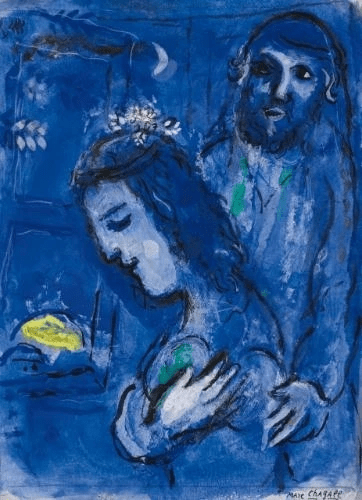
Abraham and Sarah, by Marc Chagall, 1956

One hot summer afternoon while Abraham was sitting by the entrance to his tent near the sacred trees of Mamre, the Lord appeared to him. Abraham looked up and saw three men standing nearby. He quickly ran to meet them, bowed with his face to the ground, and said, “Please come to my home where I can serve you. I’ll have some water brought, so you can wash your feet, then you can rest under a tree. Let me get you some food to give you strength before you leave. I would be honored to serve you.”

“Thank you very much,” they answered. “We accept your offer.”

Abraham went quickly to his tent and said to Sarah, “Hurry! Get a large sack of flour and make some bread.” After saying this, he rushed off to his herd of cattle and picked out one of the best calves, which his servant quickly prepared. He then served his guests some yogurt and milk together with the meat.

While they were eating, he stood near them under the tree, and they asked, “Where’s your wife Sarah?”

“She is right there in the tent,” Abraham answered.

One of the guests was the Lord, and he said, “I’ll come back about this time next year, and when I do, Sarah will already have a son.”

Sarah was behind Abraham, listening at the entrance to the tent. Abraham and Sarah were very old, and Sarah was well past the age for having children. So she laughed and said to herself, “Now that I am worn out and my husband is old, will I really know such happiness?”

The Lord asked Abraham, “Why did Sarah laugh? Does she doubt that she can have a child in her old age? I am the Lord! There is nothing too difficult for me. I’ll come back next year at the time I promised, and Sarah will already have a son.” (Contemporary English Version)

You never know what a day will bring.

Abraham and Sarah woke up one morning and went about their daily routines. But when they went to bed that night, their lives were turned upside-down. After all, God has a way of shaking up our lives, in a good way.

There’s nothing quite like an unsolicited promise. It seems the old couple, Abraham and Sarah, had come to grips with their childlessness. But the Lord was about to upset the status quo, in a good way.

“To one who has faith, no explanation is necessary. To one without faith, no explanation is possible.”

St. Thomas Aquinas

A divine promise was made. The only thing Abraham and Sarah needed to do was believe – and, well, do what a couple needs to do to conceive a child. I don’t know many couples who are sexually active at 100 years old. It certainly would take an act of faith to believe that you could become impregnated and give birth to a baby at that age.

True belief results in decisive action. Abraham and Sarah believed and God’s promise was activated in their lives, not only changing the couples’ life, but also transforming history. The experience taught them to keep their heads up and continue looking ahead for the fulfillment of all God’s good promises.

By faith Abraham obeyed when he was called to go out to a place that he was going to receive as an inheritance. He went out without knowing where he was going.

By faith he lived in the land he had been promised as a stranger. He lived in tents along with Isaac and Jacob, who were coheirs of the same promise. He was looking forward to a city that has foundations, whose architect and builder is God.

By faith even Sarah received the ability to have a child, though she herself was barren and past the age for having children, because she believed that the one who promised was faithful. So descendants were born from one man (and he was as good as dead). They were as many as the number of the stars in the sky and as countless as the grains of sand on the seashore. (Hebrews 11:8-12, CEB)

Sometimes faith seems laughable. Belief in God, or at least in God’s promise, might appear by some to be about as possible or relevant as getting a hamburger named after you at Burger King. But faith, nonetheless, is very real and very needed.

Without faith, there’s no hope, and no basis for love. Belief is the foundation from which we construct a life. Faith imagines and actualizes a new reality, even when that reality seems improbable, impossible, and far-fetched.

In the New Testament Gospels, there were people who believed Jesus could heal their paralyzed friend. They envisioned a different reality than the one their friend was experiencing.

Some people brought to him a paralyzed man on a mat. Seeing their faith, Jesus said to the paralyzed man, “Be encouraged, my child! Your sins are forgiven”…. Then Jesus turned to the paralyzed man and said, “Stand up, pick up your mat, and go home!” And the man jumped up and went home! (Matthew 9:2, 6b-7, NRSV)

The size of the faith is not the issue – it is in whom that faith is placed. The littlest of faith in Jesus can have massive results, whereas the biggest of faith in someone who cannot get you to the other side gets no results.  Small information put into action through placing complete trust in Jesus makes all the difference.

“I [Jesus] assure you that if you have faith the size of a mustard seed, you could say to this mountain, ‘Go from here to there,’ and it will go. There will be nothing that you can’t do.” (Matthew 17:20, CEV)

God is ready to open a new future to us. And, indeed, it will be a good, just, and right future beyond what we ourselves can even ask or imagine. We just need a bit of faith to see the impossible become possible.

You never know what a day will bring. Maybe today you’ll experience a faith so laughable that it will change your life forever.

O heavenly Father, in whom we live and move and have our being: We humbly pray you to guide and govern us by the Holy Spirit, so that in all the cares and occupations of our life we may not forget you, but may remember that we are ever walking in your sight, and so, trust in your grace and goodness, through Jesus Christ our Lord. Amen.