Thankful for Your Faith (1 Thessalonians 1:1-10)

Paul, Silas and Timothy,

To the church of the Thessalonians in God the Father and the Lord Jesus Christ:

Grace and peace to you.

We always thank God for all of you and continually mention you in our prayers. We remember before our God and Father your work produced by faith, your labor prompted by love, and your endurance inspired by hope in our Lord Jesus Christ.

For we know, brothers and sisters loved by God, that he has chosen you, because our gospel came to you not simply with words but also with power, with the Holy Spirit and deep conviction. You know how we lived among you for your sake. You became imitators of us and of the Lord, for you welcomed the message in the midst of severe suffering with the joy given by the Holy Spirit. And so you became a model to all the believers in Macedonia and Achaia. The Lord’s message rang out from you not only in Macedonia and Achaia—your faith in God has become known everywhere. 

Therefore we do not need to say anything about it, for they themselves report what kind of reception you gave us. They tell how you turned to God from idols to serve the living and true God, and to wait for his Son from heaven, whom he raised from the dead—Jesus, who rescues us from the coming wrath. (New International Version)

The Apostle Paul wrote to the Church in Thessalonica, essentially saying, “I really can’t say enough good about you!” I also echo the same about your faith. Paul had plenty of reasons to express thanks for them in his prayers. He was thoroughly convinced of God’s work in them, and acknowledged the good work of God in their spiritual transformation.

The background of Paul and the Thessalonians

Paul visited Thessalonica on his second missionary journey (Acts 17). Thessalonica was the capital of Macedonia, located on an inlet, and so, was a port city along an important trade route. Thessalonica was a very religious city, with a host of various deities that were worshiped. It was also a politically prominent city that prided themselves on embodying the ideals of the Roman Empire, including bravery, loyalty, piety, seriousness, respect and authority.

When the Thessalonians heard Paul’s message and accepted its call to worship the God of Israel exclusively, they faced rejection and possibly persecution from their polytheistic families and neighbors. To accept and worship Jesus took some solid faith, hope, and love, because to be a Christian was costly within the culture.

God loved and chose the Thessalonians

Paul could praise their faith because it lifted and upheld the gracious work of God on this earth. Before the Thessalonians chose God, God chose them. God didn’t have to do that. But the Lord was gracious, merciful, and kind, extending salvation and deliverance from an empty way of life to a group of people who didn’t deserve it. In fact, none of us do. God’s grace chooses to grant us faith and salvation. To be included amongst God’s people is an incredible privilege.

The good news of Jesus Christ came to the Thessalonians with power, assurance, and the Holy Spirit. They turned from their idols to God. Jesus redeemed and rescued them from darkness and judgment. The Thessalonian believers turned from their previous religious expressions in order to serve the living and true God. As a result, they began imitating Jesus and his apostles. And because of their Christian way of life, the Thessalonian Christians then became worthy of imitation themselves.

Because of God’s merciful intervention in their lives, Paul was grateful for the work of God for three specific elements and expressions about the Thessalonians’ Christian lives:

  1. Their work produced by faith
  2. Their labor prompted by love
  3. Their endurance inspired by hope

Indeed, for every Christian, the Christian life is lived with the essential tools of faith, hope, and love.

Endurance inspired by hope

It’s a standup quality to be characterized as people of hope. The Thessalonian believers were anticipating and waiting for the Lord’s return; they had no doubt Jesus will come again. The Christians just needed some reassurance about those who have already died without yet seeing Christ – which is why Paul wrote his letter to them. And the believers were good at encouraging each other with the hope of Christ’s return.

Labor prompted by love

Paul didn’t really even need to teach the Thessalonian Christians about loving each other because they were good students of God as their teacher. They had a reputation of hearing the Word of God, then doing it. Specifically, they learned to love, not only one another within their local church, but the whole of the family of God throughout Macedonia. So then, the Thessalonians excelled at expressing their faith through love. (Galatians 5:6)

Work produced by faith

The Thessalonian believers became well-versed and practiced in the Christian elements of hope and love. And their faith became known everywhere. Paul was thankful for their work produced by faith. Yet, as the rest of the letter bears out, along with the second letter to the Thessalonians, Paul will have much to say to them about the nature of faith.

Paul reminded the Christians of his example to them and the gospel which he proclaimed. Several times, Paul talked of the work he put into them on their behalf (1 Thessalonians 2:9; 3:5; 2 Thessalonians 3:8). On the topic of following godly examples, Paul also admonished them to respect those who have authority over them, who labor and work among them (1 Thessalonians 5:12-13).

The Apostle encouraged the Thessalonians to continue in their work, so that every need would be met within the church; and so that there would be a good witness to those outside the church (1 Thessalonians 4:11-12). Paul let them know that a very practical way they can express their love is by working with their hands so that none among them have any need.

Faith and work are not mutually exclusive. Even though the Thessalonian believers were transformed by their belief in Christ, they still needed to remember that they must carry on in their regular daily lives until Christ returns.

Imitating the faith and patience of solid believers

And we are all still responsible to be faithful, every day, no matter what the situation or circumstances are. We must carry on in our faith, hope, and love through obeying and living into the words and ways of Jesus. We do this through imitating the faith and patience of trusted Christians, like the Apostle Paul.

Remember your leaders, who spoke the word of God to you. Consider the outcome of their way of life and imitate their faith.

Hebrews 13:7, NIV

People can only experience the fullness of their humanity when they are in deep, trusting relationships with one another. Even more, relationships have more depth when experienced and centered in a relationship with Jesus Christ. Imitation then becomes an outgrowth of this strong relationship.

Far too often we seek excuses, or to find loopholes, in order to avoid the vulnerability that a close mentoring relationship demands. We may look for ways to justify not getting close, or simply distance ourselves from other believers.

Maybe we do not want to do the work — desiring to avoid being hurt. It could be that we are tired of doing the relational work necessary for closeness and walking with Christ and one another. Relationships get messy and they take lots of energy. But our spiritual growth is completely tied to relational growth. The Apostle Paul himself was vulnerable:  

Just as a nursing mother cares for her children, so we cared for you. Because we loved you so much, we were delighted to share with you not only the gospel of God but our lives as well. Surely you remember, brothers and sisters, our toil and hardship; we worked night and day in order not to be a burden to anyone while we preached the gospel of God to you. (1 Thessalonians 2:7-9, NIV)

This imitative relationship is important for the advancement of the gospel. The faith is passed on from generation to generation, from disciple to disciple, in one long progression stretching all the way back to Jesus and the original twelve disciples. For our own faith, hope, and love to be effective, it requires following the example of Paul, and of committed faithful believers in your own life, through close relationships with them.

God of all faith, hope, and love, we praise and give you thanks for the resurrection of your Son, Jesus Christ. We celebrate the joy of life in you, and are grateful for the privilege and opportunity to live into the reality and power of the resurrection.

Inspire us, by your grace, to live the life of intentionally following Jesus. We surrender ourselves to the life of Jesus, who called us to be faithful servants of God. We commit to living for Christ, our Savior and Lord, in whose name we are bold to pray. Amen.

God Is Good, Idols Are Bad (2 Kings 17:7-20)

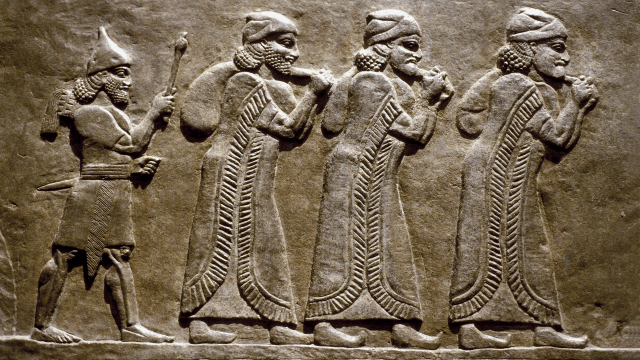
 An Assyrian solider deporting people from their land (From the Southwest Palace of Tiglath-Pileser III at Nimrud, ca. 730-727 B.C.E.; British Museum.)

The Israelites sinned against the Lord their God, who brought them out of Egypt and rescued them from the power of Pharaoh (the king of Egypt). They worshiped other gods and lived by the customs of the nations that the Lord had forced out of the Israelites’ way. They also did what their kings wanted them to do.The Israelites secretly did things against the Lord their God that weren’t right:

They built for themselves illegal places of worship in all of their cities, from the smallest watchtower to the largest fortified city.

They set up sacred stones and poles dedicated to the goddess Asherah on every high hill and under every large tree.

At all the illegal places of worship, they sacrificed in the same way as the nations that the Lord had removed from the land ahead of them.

They did evil things and made the Lord furious.

They served idols, although the Lord had said, “Never do this.”

The Lord had warned Israel and Judah through every kind of prophet and seer, “Turn from your evil ways, and obey my commands and decrees as I commanded your ancestors in all my teachings, the commands I sent to you through my servants the prophets.” But they refused to listen. They became as impossible to deal with as their ancestors who refused to trust the Lord their God. They rejected his decrees, the promise he made to their ancestors, and the warnings he had given them. They went after worthless idols and became as worthless as the idols. They behaved like the nations around them, although the Lord had commanded them not to do that. They abandoned all the commands of the Lord their God:

They made two calves out of cast metal.

They made a pole dedicated to the goddess Asherah.

They prayed to the entire army of heaven.

They worshiped Baal.

They sacrificed their sons and daughters by burning them alive.

They practiced black magic and cast evil spells.

They sold themselves by doing what the Lord considered evil, and they made him furious.

The Lord became so angry with Israel that he removed them from his sight. Only the tribe of Judah was left. Even Judah didn’t obey the commands of the Lord their God but lived according to Israel’s customs. So the Lord rejected all of Israel’s descendants, made them suffer, handed them over to those who looted their property, and finally turned away from Israel. (God’s Word Translation)

The Flight of the Prisoners, by James Tissot, 1898, depicting the Babylonian exile from Jerusalem

The prophets had warned the northern kingdom of Israel; but they did not listen, nor did they heed the prophetic utterance. Israel then stood as an example and a warning to the southern kingdom of Judah; yet they, too, refused to learn from their brother’s downfall.

And even before the kingdom was split between Israel in the north and Judah in the south, the ancient Israelites had a troubling tendency to buck the Lord’s instructions and find other more and creative ways of expressing themselves spiritually.

Every generation of people are responsible for their own spirituality and their own actions in life. We, in our contemporary time and place, need to learn the lessons of the past – for we also are not an exception in history, as if we can do whatever we want without attending to the common good of all persons and worshiping in any sort of way we want.

The trouble with the ancient worshipers of Yahweh is that they decided to pick and choose whatever commands they wanted to follow, or not. They went through continual times of idolatry and forgot about God and God’s Word to them.

To respect and revere the Lord is to obey God’s instructions. To worship Yahweh is to have an undivided allegiance to God and God’s commands. The failure to obey is really a failure of faith.

The prophets Amos, Hosea, Micah, and Isaiah specifically called out the sinful practices of the people and their negligence in upholding basic social and economic justice for everyone. They condemned violence and oppression of the poor; and expressed the divine displeasure with taking advantage of the disadvantaged.

How to treat people and live well were explicitly spelled out in the entirety of God’s Law. Yet, the leaders and the people, as a whole, decided to go another way. They kept introducing idolatrous and unhealthy forms of worship and living. And it led to their ruin.

The ancient people were continually offered grace if they would only accept it. They could return to the Lord and come back to the true worship and obedience of the God who had rescued them from trouble again and again. Turning from their unholy practices, and turning back to Yahweh, would reverse God’s impending judgment. Yet, tragically, the people did not listen.

Idolatry is a failure to trust God, and to rely instead on something else which is not able to sustain a life. Unfortunately, those who create a god according to their own liking end up becoming like the thing they worship, that is, worthless.

The tragedy of the Israelites is that they were to be God’s people, the Lord’s treasured possession, a kingdom of priests, and a holy nation which brings blessing to the earth. Instead, they traded their meaning and purpose in life to imitate everyone else around them.

Sadly, people have felt throughout history, and even we ourselves today, that there is something else, other than God, that we need in order to be happy – something more important to your heart than the Lord – whether it is human acceptance and approval, social reputation, political power and control, or financial advantage and privilege.

Idolatry creates an ignoring of the divine in our life. We might even have the chutzpah to think we can challenge God, like some small yippee pup who growls and takes on the big dog, who knows that with an effortless paw across the body, could toss the prideful pup away.

Like a mother bird who scours the land for food to sustain the babies, and brings it back to their gaping mouths, God longs to provide us with a good and beautiful life – if we will but only receive it.

Listen, my people, I’m warning you!
    If only you would listen to me, Israel.
There must be no foreign god among you.
    You must not bow down to any strange deity.
I am the Lord your God,
    who brought you up from Egypt’s land.
    Open your mouth wide—I will fill it up! (Psalm 81:8-10, CEB)

O Lord, as you gave us the greatest commandment, to love you with all our heart, soul, strength and mind, help us to love you above all else, putting you above the potential idols in our lives, including success, fame and wealth. May your benevolent kingdom come, and your moral and ethical will be done, here on this earth for this time, as it is always done in your heaven. Amen.

Use Your Freedom For Good (Exodus 33:1-6)

Then the Lord said to Moses, “You and the people you brought out of Egypt must leave this place. Go to the land I promised to Abraham, Isaac, and Jacob with an oath, saying, ‘I will give it to your descendants.’ I will send a Messenger ahead of you, and I will force out the Canaanites, Amorites, Hittites, Perizzites, Hivites, and Jebusites. Go to that land flowing with milk and honey. But I will not be with you, because you are impossible to deal with, and I would destroy you on the way.”

When the people heard this bad news, they acted as if someone had died. No one wore any jewelry. The Lord had said to Moses, “Tell the Israelites, ‘You are impossible to deal with. If I were with you, I might destroy you at any time. Now take off your jewelry, and I’ll decide what to do with you.’” After they left Mount Horeb, the Israelites no longer wore their jewelry. (God’s Word Translation)

It took little time for the covenant between God and the Israelites to be violated. The relationship between the Lord and the people was meant to be cemented through a special covenant in which Yahweh makes promises to them and gives them instructions and commandments; and the Israelites pledge their fealty and promise to obey.

But the people quickly reneged on the relationship. While Moses was up on Mount Sinai, receiving the Law from God, the Israelite grumbles and complaints came to full flower. They went their own way and made a calf idol out of gold.

So, the Lord’s judgment broke out amongst them. The Levites, to their credit, rallied around Moses and the Lord, and took out the rabble rousers in the camp. What’s more, God sent a plague that killed many.

In the aftermath of the rebellion against Moses and the Lord, God ordered the people to leave Mount Sinai – the place where everyone was to have a positive experience of Yahweh’s presence. God’s anger and wrath were so aroused that it became impossible for the divine presence to go with the people. Only Moses, as God’s emissary, would be able to guide the Israelites so that they are not completely eradicated.

Mount Sinai, by Sefira Lightstone

Yet, even after all the bad attitudes, rebellious actions, and an idolatrous spirit among the Israelites, Yahweh will still keep the divine promise to Abraham, Isaac, and Jacob to deliver them and bring them to the Promised Land.

Today’s story has the feel of a chastened child sitting in the corner, having to think about what they just did to raise the ire of the parent. The Israelites moved from Sinai in a somber mood, realizing more clearly than ever how much their lives are tied and linked to God’s divine presence.

At God’s command, the people removed their jewelry and took off their party clothes from the celebration that got them into so much trouble. It began to sink in, that the Lord departed from them because of their great sin. They started to realize, albeit too late, that they really screwed up their relationship with God.

The Israelites didn’t know how good they had it with the divine pillar of cloud by day and fire by night to lead them – and how much they actually depended on the God-given manna for their sustenance and existence.

It’s all too typical for us humans that we fail to realize what we have, until it’s gone. The ancient Israelites were freed from a cruel slavery in Egypt. They clearly did not handle their freedom well, at all. Perhaps the people were so used to being in bondage that, when they go their freedom, they just adopted a different sort of slavery – to their sinful passions.

Let’s handle our freedom with some responsibility and accountability, so that we do not go down the same rebellious path as the ancient people of God. You and I are free to choose what we do, what we think, and how we spend our time. It’s easy to blame outside forces when circumstances are hard; and to grumble whenever we don’t like something.

Freedom is a spiritual discipline; we must learn how to intentionally practice it and use it for good. The following are four areas to purposefully work on with our freedom by making good choices:

Choose your words carefully. What comes out of your own mouth is up to you. Let those words reflect who you truly are; and let your speech impact others around you for good, and not evil.

Choose your attitude with some self-awareness. With awareness comes choices. For example, if we are not aware of our own anger, it will eventually come out sideways on another person. Our sullen attitude and jaded perspective will color our relational interactions. But if we are aware of our emotions, we can choose to effectively work through them, and then decide what sort of attitude we’re going to have.

Choose your actions before you do them. Seemingly insignificant choices turn into small actions. The small actions become habits. And habits shape character and create a life. We make choices every day about what we’ll do and not do. In every sort of situation we have choices to act, such as: Will I let go, or will I try and control others? Will I walk, or drive? Will I spend, or save? Shall I prepare, or procrastinate? Be fit, or be fat? Talk or listen?… and a thousand other choices of action.

Choose your beliefs with care. Our beliefs and our faith determines how we act and behave. If we believe in a good God who has our best interests at heart, we will freely trust such a God. But if we believe God to be a capricious Being who is aloof from my concerns, then we will make choices to watch out for number one and view others with suspect.

If you are behaving in ways that aren’t working for you, examine what belief is causing that behavior. Then decide whether that’s a belief you really need to have, or not, then change it, if necessary.

Every choice we make, contributes to the person we want to become, and sets us on the path to where we want to be in life. Maybe if the ancient Israelites had more awareness of this, they might have chosen very differently.

Gracious God, grant me clarity and awareness to make wise decisions. Enlighten my heart and mind, as I seek to follow your divine guidance. In the face of uncertainty, give me the courage to trust your promises. Help me embrace the path set before me, with a spirit of love and grace. Amen.

The Golden Calf (Exodus 32:1-14)

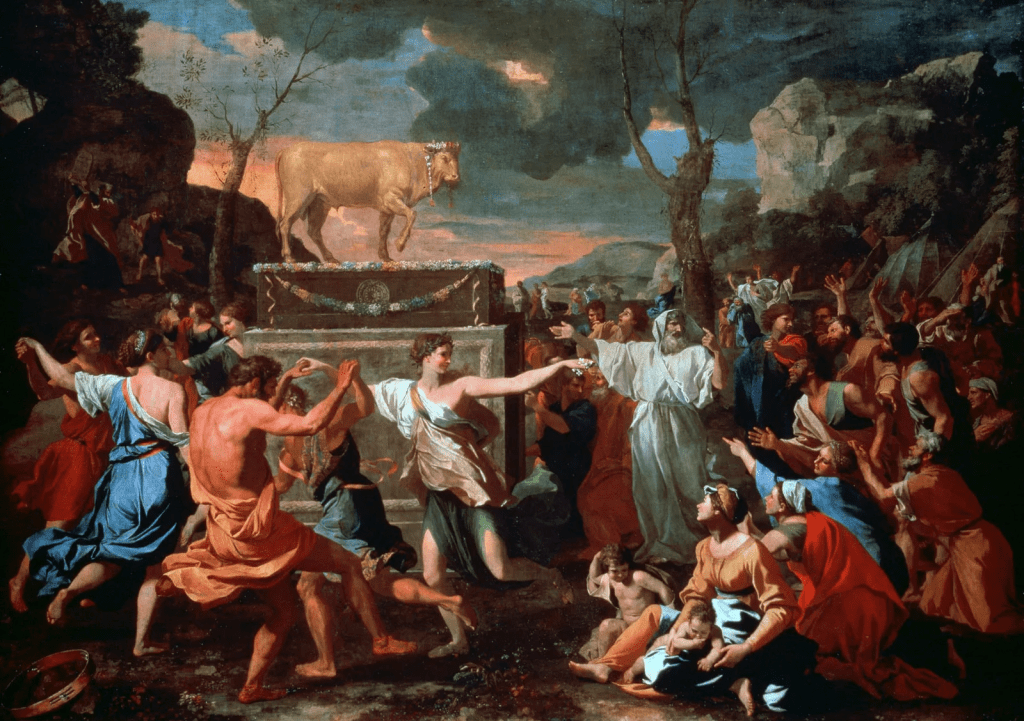
Adoration of the Golden Calf, by Nicolas Poussin (1594-1665)

When the people saw that Moses was so long in coming down from the mountain, they gathered around Aaron and said, “Come, make us gods who will go before us. As for this fellow Moses who brought us up out of Egypt, we don’t know what has happened to him.”

Aaron answered them, “Take off the gold earrings that your wives, your sons and your daughters are wearing, and bring them to me.” So all the people took off their earrings and brought them to Aaron. He took what they handed him and made it into an idol cast in the shape of a calf, fashioning it with a tool. Then they said, “These are your gods, Israel, who brought you up out of Egypt.”

When Aaron saw this, he built an altar in front of the calf and announced, “Tomorrow there will be a festival to the Lord.” So the next day the people rose early and sacrificed burnt offerings and presented fellowship offerings. Afterward they sat down to eat and drink and got up to indulge in revelry.

Then the Lord said to Moses, “Go down, because your people, whom you brought up out of Egypt, have become corrupt. They have been quick to turn away from what I commanded them and have made themselves an idol cast in the shape of a calf. They have bowed down to it and sacrificed to it and have said, ‘These are your gods, Israel, who brought you up out of Egypt.’

“I have seen these people,” the Lord said to Moses, “and they are a stiff-necked people. Now leave me alone so that my anger may burn against them and that I may destroy them. Then I will make you into a great nation.”

But Moses sought the favor of the Lord his God. “Lord,” he said, “why should your anger burn against your people, whom you brought out of Egypt with great power and a mighty hand? Why should the Egyptians say, ‘It was with evil intent that he brought them out, to kill them in the mountains and to wipe them off the face of the earth’? Turn from your fierce anger; relent and do not bring disaster on your people. Remember your servants Abraham, Isaac and Israel, to whom you swore by your own self: ‘I will make your descendants as numerous as the stars in the sky and I will give your descendants all this land I promised them, and it will be their inheritance forever.’” Then the Lord relented and did not bring on his people the disaster he had threatened. (New International Version)

The Golden Calf, by Sefira Lightstone

The ancient Israelites were dramatically delivered from slavery through a series of plagues on Egypt. Then, their lives were saved when God parted the Red Sea and the people fled from the advancing Egyptian army; collapsing the water on the soldiers when they tried to pursue the people.

The Israelites were led to Mount Sinai where God graciously entered into covenant with them; and gave them the law and the commandments. Yet, between receiving the covenant, and waiting for Moses to return from the mountain, the Israelites fell into chaos and a failure of faith. So, how did the relationship between God and Israel go so awfully sideways?

Moses spent a great amount of time with God on Mount Sinai. Apparently, the people believed that the forty days and forty nights on the mountain was too long and assumed that Moses would not return. So, what followed was idolatry, near annihilation, and intercession.

A failure of leadership

Aaron was left to lead the people during Moses’ absence. It didn’t take long for the people to get unruly and start working on Aaron. They asked him to make gods who will go before them, just as Yahweh and Moses had done in the pillar of cloud by day and fire by night.

For whatever reason, Aaron complied with their request. Maybe the people pestered him to death with constant bickering and asking, and he eventually gave-in to their coercion. Perhaps Aaron thought they had a point, and went with it as a willing participant. We aren’t told why. We are told that Aaron ordered the people to remove all the gold earrings they were wearing and bring them to him.

Aaron took all the gold he received and fashioned it into the form of a calf. Again, we aren’t told why Aaron chose to make a golden calf, in particular. Maybe he was forging a false god altogether in the shape of one of the Egyptian gods. After all, there had been a significant “back to Egypt” movement earlier, when circumstances got tough without food or water in the desert. Or perhaps Aaron was making a false image of the one true God. Either way you look at it, it’s not good.

The golden calf was handed to the people and proclaimed as the gods who brought them out of Egypt. If that weren’t bad enough, Aaron made the situation even worse by building an altar for the calf and declaring a feast for the next day. So, it’s no surprise to us as readers when we see poor leadership decision-making that leads to the people getting way out-of-hand in their festivities through drunkenness and sexual immorality.

The consequences of poor leadership

All of the revelry got God’s attention. The Lord saw the people’s depravity and commanded Moses to get back down the mountain, at once. God’s tone of voice and choice of pronouns took a turn. The Lord said to Moses, “Your people have acted perversely,” effectively distancing the divine from the mass of humanity at the foot of the mountain.

God was so upset that he started planning to destroy the whole lot of them and completely start over through the descendants of Moses. Yet, even though the Lord was very angry, and rightly so, Moses stepped in and interceded on the people’s behalf. Moses appealed to God’s reputation rather than God’s compassion. In an interesting twist, Moses turned the responsibility for the Israelites back onto God by saying they are your people, the ones whom you brought out of the land of Egypt.

What’s more, Moses pointed out to God that the Egyptians would question God’s motives for bringing the Israelites into the desert. And then Moses appealed to God’s covenant with Abraham, Isaac, and Jacob (Israel) to make a great nation of their descendants to dwell forever in the land God promised them. Moses actually persuaded the God of the universe to set aside divine anger and let the people live.

The people forgot who rescued them from slavery in Egypt. Regardless whether or not they had good intentions, the people failed in keeping their covenant obligations to God and sought to substitute God’s physical absence with a false image of God.

The implications of leadership for us

Today’s Old Testament story raises many questions for us. Here are just a few to ponder:

  • Which golden calves in our culture today draw our loyalty and love away from God when we get impatient with waiting for God’s timetable? Maybe our grumbling and complaining is a telltale sign that we are not content with God and what God is doing among us – and that we are fashioning (or have already fashioned) a god of our own making in the form of financial budgets, church buildings, or dogmatic theologies.
  • How have we made the God whom we worship into an idol that we try to control and manipulate for our own purposes? Perhaps we have substituted the one true God who is free, untamed, mysterious, and surprising, for a puny humanly constructed image, ideology, institution, or idol.
  • How do we maintain the balance between divine judgment with its consequences for disobedience, alongside God’s mercy, forgiveness, and faithfulness to the people? It could be, we are being led to grace, no matter how we go about answering the question.

Faithful God, you preside over an unfaithful people. Just as the people of Israel doubted your power and turned to other gods to fulfill their needs, we too, turn to other gods, seeking acceptance, power, and independence. Show us how to live humbly and walk in your ways, through the One who offered true power to all humanity, Jesus Christ our Savior and Lord. Amen.