Wisdom for Life (Proverbs 11:1-31)

The Lord detests dishonest scales,
    but delights in an accurate weight.
When pride comes, so does shame,
    but wisdom brings humility.
Integrity guides the virtuous,
    but dishonesty ruins the treacherous.
Riches don’t help in the day of wrath,
    but righteousness rescues from death.
The righteousness of the innocent makes their path straight,
    but the wicked fall in their wickedness.
Those who do right are saved by their righteousness,
    but the untrustworthy are caught by their own desires.
When the wicked die, their hope perishes.
    Yes, any hope based on money perishes.
The righteous are saved from distress,
    and the wicked take their place.
The godless destroy their neighbors by their words,
    but the righteous are saved by their knowledge.
When the righteous succeed, a city rejoices;
    when the wicked perish, there are shouts of joy.
A city is honored by the blessing of the virtuous;
    it is destroyed by the words of the wicked.
Whoever despises their neighbor lacks sense;
    a sensible person keeps quiet.
A slanderer walks around revealing secrets,
    but a trustworthy person keeps a confidence.
Without guidance, a people will fall,
    but there is victory with many counselors.
Guaranteeing the debt of a stranger brings big trouble,
    but the one who refuses to shake hands will be secure.
A gracious woman gains honor;
    violent men gain only wealth.
Kind persons benefit themselves,
    but cruel people harm themselves.
The wicked earn false wages,
    but those who sow righteousness receive a true reward.
The righteous are headed toward life,
    but those who pursue evil, toward death.
The Lord detests a crooked heart,
    but he favors those whose path is innocent.
The evil person will surely not go unpunished,
    but the children of the righteous will escape.
Like a gold ring in a pig’s nose
    is a beautiful woman who lacks discretion.
The desires of the righteous end up well,
    but the expectations of the wicked bring wrath.
Those who give generously receive more,
    but those who are stingy with what is appropriate will grow needy.
Generous persons will prosper;
    those who refresh others will themselves be refreshed.
People curse those who hoard grain,
    but they bless those who sell it.
Those who look for good find favor,
    but those who seek evil—it will come to them.
Those who trust in their wealth will wither,
    but the righteous will thrive like leafy trees.
Those who trouble their family will inherit the wind.
    The fool will be servant to the wise.
The fruit of the righteous is a tree of life,
    and the wise gather lives.
If the righteous receive their due on earth,
    how much more the wicked and sinners? (Common English Bible)

The good and the bad, the wise and the foolish, the righteous and the wicked. When it comes to proverbial wisdom, there are two kinds of people: Those who take a right, just, and good path of life; and those who take the wrong exit, practice injustice, and embrace being bad.

We are all, of course, a strange amalgam of sinner and saint. Everyone has some altruism, along with a devious bent. So, life really comes down to our choices. Will our decision-making be wise, or foolish?

This is where the Book of Proverbs helps us. It lays out a prudent course of action for us, so that we can gain a perspective on the consequences of those actions, whether good or bad.

We have to carefully weigh our decisions and consider the likely outcomes of the choices we make.

As we decide, keep in mind that honesty is the best policy (11:1-4); choices have consequences (11:5-6); certain choices lead to rewards (11:7-10); good brings good, and bad brings bad (11:11-31).

Honesty Is the Best Policy

Making the decision to be honest in all things is what builds our capacity to resist evil. Poor choices often come from simply giving in, because we don’t have our resistance to saying “no” built up yet.

Humility enables us to keep our minds on the task at hand, rather than compromise on our integrity in order to achieve something we believe we need or want. The humble person understands that all things are a gift from God – and that the Lord can give, and the Lord can take away. Humility teaches us to say, “Blessed be the name of the Lord.”

When we are emptied of self-promotion, and filled with honest humility, righteousness results. And the righteous person automatically and reflexively denies all evil and wickedness.

Choices Have Consequences

Just because no one sees it, doesn’t mean there won’t be consequences. And just because there was no lightning strike from God immediately after a transgression, doesn’t mean that God’s judgment isn’t coming later.

I talk to far too many people, in my line of work as a hospital chaplain, who are filled with regret about some decision they made earlier in their life. Because now they are experiencing the physical consequences of that choice (and the emotional and relational consequences, as well).

A set of choices made earlier in life not only have real consequences later that one can see and feel; those decisions also erode the ability to make sound decisions in the present. It is a tough uphill struggle to gain some spiritual and emotional health, whenever any reserve of righteousness was not properly developed and maintained.

Certain Choices Lead to Rewards

Conversely, however, consistently good decisions, made over a stretch of time, provide solid spiritual and emotional dividends from which we can draw from in difficult times.

The chief reward for the righteous is that they have a robust life of faith and goodness because of their relationship to the Lord and a good supportive community of persons.

Foolish living leads to punishment; wise living leads to reward. A good life is really a reward itself. That’s because we are meant to live this way, to be merciful and just in all we do, walking humbly with our God. (Micah 6:8)

When the wicked die, that’s it. But when the righteous die, they leave a profound legacy in the form of others who have been encouraged, helped, and loved by their righteousness. They carry on the legacy of good. It makes a big difference.

I cannot imagine any greater reward than to know that I have been faithful to my God, and good to my fellow humanity. Such persons become like a great cloud of witnesses, testifying to the worth of investing in wisdom and humility.

Good Brings Good, Bad Brings Bad

A just and good life inspires others, invigorates groups of people, and leads to holistic health of individuals. Purity of heart is beneficial to the individual, and is contagious to the community.

A foolish life trusts in their own bad attitudes and personal opinions – and then they will wonder why they don’t get anywhere in life, and nobody wants to be around them.

King Solomon himself, gatherer of the biblical proverbs, knew all too well about both the good and the bad, and their eventual outcomes.

Solomon was quite humble and wise at the beginning of his reign. He did everything his father David asked of him, and more. But his wild success as king gradually brought him to acquire more stuff, more wives, and to fudge on the responsibilities and requirements of being king.

If a guy like King Solomon, who was the wisest person who ever lived, can ignore his own nation’s God and Holy Scripture to get whatever he wanted, then how much more do we, who have less wisdom, need the grace of loving people speaking truth to our hearts?

The people we surround ourselves with, no matter who we are, is vitally important. Everyone needs loving persons around them who will tell them what they need to hear in a spirit of love and grace. 

None of us do well with success unless we have humble and wise persons close to us who have the gumption and the grace to speak into our lives to help us, not hurt us. When we don’t have that, things go sideways.

I encourage you to go back and read Proverbs chapter 11 again, slowly, letting its wisdom seep into you. Also, a good practice is to read a chapter of Proverbs each day for the next month; and to occasionally, in the future, come back to this practice.

May the proverbial biblical wisdom fill your heart and your mind, so that you are able to make sage decisions in all of the various circumstances you encounter in this life. Amen.

There Is a Larger Perspective (Psalm 73:1-20)

Psalm 73, by Keli Hogsett. The artist states, “This piece is made entirely of wood ‘ends.’ The wood colored ends represent nearness to God, where the darker pieces represent the opposite. The darker ends can attract and manipulate the wooden ends, but the darker they get, they turn downward and are swallowed by the wooden ends.

God is indeed good to Israel,
    to those who have pure hearts.
But I had nearly lost confidence;
    my faith was almost gone
because I was jealous of the proud
    when I saw that things go well for the wicked.

They do not suffer pain;
    they are strong and healthy.
They do not suffer as other people do;
    they do not have the troubles that others have.
And so they wear pride like a necklace
    and violence like a robe;
their hearts pour out evil,
    and their minds are busy with wicked schemes.
They laugh at other people and speak of evil things;
    they are proud and make plans to oppress others.
They speak evil of God in heaven
    and give arrogant orders to everyone on earth,
so that even God’s people turn to them
    and eagerly believe whatever they say.
They say, “God will not know;
    the Most High will not find out.”
That is what the wicked are like.
    They have plenty and are always getting more.

Is it for nothing, then, that I have kept myself pure
    and have not committed sin?
O God, you have made me suffer all day long;
    every morning you have punished me.

If I had said such things,
    I would not be acting as one of your people.
I tried to think this problem through,
    but it was too difficult for me
    until I went into your Temple.
Then I understood what will happen to the wicked.

You will put them in slippery places
    and make them fall to destruction!
They are instantly destroyed;
    they go down to a horrible end.
They are like a dream that goes away in the morning;
    when you rouse yourself, O Lord, they disappear. (Good News Translation)

The psalmist Asaph communicated his own experience, which is really the experience of all Israel, and of all who genuinely seek to follow God.

Everyone who is truly pure in heart will struggle, at times, to make sense of all the impurity and injustice in the world. Even a cursory observation of this old world clearly sees that it is a broken messed up place.

Those observations challenge the faithful with questions such as, “Is God really good?” and “Is maintaining my purity and faithfulness worth it?”

Most often, the response to those questions is “Yes, but…”

Arrogant people prosper. They get away with being jerks. And it isn’t fair. Good people continually face adversity and hardship. Nothing comes easy. And it doesn’t make sense.

Contemplating this reality for too long can lead to a spiritual crisis of faith. It can produce doubt. It is likely to either morph into anger and bitterness, or a passive “meh” to most things in life.

However, observational appearances can be deceiving. There is much more to seeing than with our two physical eyes. There is the kind of sight which God has:

“I do not judge as people judge. They look at the outward appearance, but I look at the heart.”

1 Samuel 16:7

In truth, the real and actual power of arrogantly wicked people is their ability to create envy and jealousy in the righteous persons.

We need a different way of seeing, a reorientation of our limited understanding of life. Look at the world, containing both the wicked and the righteous, from an angle you haven’t seen before.

For Asaph, this breakthrough perspective happened in the sanctuary of his God. The psalmist began to see that the seeming wealth, health, and invincibility of the arrogant is merely a façade. Their true future is anything but prosperous.

Asaph also had a reorientation of himself. He began to understand and accept that his own heart had the shadows of bitterness and ignorance. He himself had too much vice hiding in his heart.

With the spiritual eyes of the heart, we can focus in on the presence of God. The Lord’s guidance is constant, even when it doesn’t seem like it. God’s handle on the future is secure.

The arrogant and the wicked will not last. There is a day coming when they will not rule over anything. Their end is a sure thing.

The wise heart discerns that not everything I see today will be the same tomorrow. Therefore, I can plan wisely for the future, and be patient that the goodness of God will ultimately prevail over it all. This orientation to life brings confidence and hope.

Wisdom also directs us to discern that our hope and confidence can wax and wane. Just because we may be full of faith, hope, and love today, does not mean that from here-on-out we will never have to struggle with these feelings of jealousy, envy, disappointment, and anger.

Far too often we think emotions can be easily replaced, the negative ones for the positive, envy for happiness, or jealousy for satisfaction.

However, we are more complex creatures than that, having the capacity to hold multiple emotions at the same time. Sometimes, the best thing is to recognize that I can be happy, even though I am sad, without ignoring or stuffing the sadness.

Consider this: At the same time, all the time, God is both terribly sad, as well as quite exuberant. The Lord both grieves and celebrates continually. That’s because God sees it all.

And if I were to see the entire scope of your life, I am sure there are aspects of that life which are joyous, and elements which are despondent, with great longing for change.

Asaph got a much fuller picture of how things actually are in this world. And with that more expansive perspective he discovered a sense of settled hope, despite the fact that nothing in his world had changed at all.

Indeed, I myself am to be the change that I long for in this world. And it starts with gaining a perspective of wisdom, and seeing the angle of immateriality.

Arrogant pride, hoarding of wealth, and injustice will not last forever. They are temporary. But there are permanent things in this universe, and none of them have to do with money or stuff.

When all is said and done, Love survives and thrives. God hasn’t gone anywhere. Jesus Christ is the same yesterday, today, and forever. The Spirit is still alongside us.

And the wicked are no more.

So, may righteousness, justice, and peace surround you today and everyday like a warm security blanket of hope. And may you know that you are seen and loved by a God who cares. Amen.

The Power of Emptiness (Mark 7:24-37)

From there Jesus set out and went away to the region of Tyre. He entered a house and did not want anyone to know he was there. Yet he could not escape notice, but a woman whose little daughter had an unclean spirit immediately heard about him, and she came and bowed down at his feet. Now the woman was a Gentile, of Syrophoenician origin. She begged him to cast the demon out of her daughter. 

Jesus said to her, “Let the children be fed first, for it is not fair to take the children’s food and throw it to the dogs.” But she answered him, “Sir, even the dogs under the table eat the children’s crumbs.” Then he said to her, “For saying that, you may go—the demon has left your daughter.” And when she went home, she found the child lying on the bed and the demon gone.

Then Jesus returned from the region of Tyre and went by way of Sidon toward the Sea of Galilee, in the region of the Decapolis. They brought to him a deaf man who had an impediment in his speech, and they begged him to lay his hand on him. 

Jesus took him aside in private, away from the crowd, and put his fingers into his ears, and he spat and touched his tongue. Then looking up to heaven, he sighed and said to him, “Ephphatha,” that is, “Be opened.” And his ears were opened, his tongue was released, and he spoke plainly. 

Then Jesus ordered them to tell no one, but the more he ordered them, the more zealously they proclaimed it. They were astounded beyond measure, saying, “He has done everything well; he even makes the deaf to hear and the mute to speak.” (New Revised Standard Version)

Two stories. Two suffering people, because of their infirmities. A mother and a community suffering along with them, not knowing how to help them.

Lo and behold, Jesus, of all people, was the last person they expected to hear was in the area. He a Jew. They Gentiles. Yet, what if….

Maybe there is a ray of hope. After all, where there is emptiness, there is potential. And Jesus is the expert on that!

Christ had the rare ability to give the necessary gift of envisioning potential in another’s life, of seeing how the empty space could be filled with life and joy. Indeed, with Jesus there is possibility.

It is important to not only look at what is there, but also on what is not there. Because that’s where we find the quality, opportunity, and potential in another, and in ourselves.

The daughter in the narrative was vexed and incapacitated by an unclean spirit, a demon. The man in the story was deaf and mute, unable to hear and speak, lacking capacity for effective interaction in a society which relied so heavily on the ears and the mouth.

We may imagine their emptiness, feeling bereft of ever experiencing abundant life in their respective circumstances. However, they had those around them who cared, and interceded on their behalf.

Just realizing that Jesus was amongst them seemed to inspire a spark of possibility. Their thinking began to move in a slightly different direction with Christ in the neighborhood.

500 years before Christ’s encounters with these folks, the Chinese philosopher Lao Tzu crafted this poem:

A wheel may have thirty spokes,

but its usefulness lies in the empty hub.

A jar is formed from clay,

but its usefulness lies in the empty center.

A room is made from four walls,

but its usefulness lies in the space between.

Matter is necessary to give form,

but the value of reality lies in its immateriality.

Everything that lives has a physical body,

but the value of a life is measured by the soul.

The immaterial is the real substance. The material is only the form we see around it. It isn’t the material which effects the immaterial; it is the immaterial which has the power to transform the material.

Yet, change is never easy, even the necessary changes we long to see realized. It was not easy for any Gentile living in a Jewish world, and vice versa. Both Jews and Gentiles find out how hard things really can be.

Exorcising the Canaanite Woman’s Daughter, by Peter Gorban, 1990

The word got around that Jesus was in town. Nobody knew where he was. But desperate people discover ways to find the people they believe can help. The mother of the daughter with an unclean spirit found where Jesus was staying.

Furthermore, desperate persons are resilient; they rarely give up. The woman was used to tension in the room. She was unfazed by the Jew and Gentile disparity. I happen to think that the response of Jesus was probably expected by the woman. It certainly didn’t discourage her.

The woman asked for help. Jesus rebuffed her. Perhaps this seems incongruent with your understanding of Christ. It may even shock you. It was anything but Midwest nice.

One of the realities, it seems to me, that we need to understand and grapple with, is that Jesus was a real bona fide human being. He was born, grew up, had to learn things and become mature, in every sense of the word.

Christ also needed to develop and live into his own ministry. He had to learn how to establish personal boundaries, apply wisdom to particular situations, and deal with being hungry and tired with a world of human need around him.

I believe that is what we see in this interaction with the woman. And it in no way diminishes Christ’s divinity. We need to be able to hold all of Jesus – both his divinity and his humanity – at the same time, all the time.

Undeterred, the woman bent the words of Jesus to her advantage. That’s what desperate people do. So, Christ, recognizing true desperation and the faith behind her persistence, then immediately exercised his divinity by expelling the unclean spirit from the daughter and bringing her to full capacity.

I’m glad the Gospel writer Mark recorded the narrative as he did. I see a Messiah who deeply desires to do his Father’s will, and has to struggle with how to accomplish it.

I see Jesus in the story as actively growing in his understanding and ability, learning to break into the world with grace and truth; yet at the same time, not conforming to the world’s status quo.

Methinks that not much of this had anything to do with Christ’s sense of ethnicity and gender, but with everyone else’s understanding of the terms. Jesus, along with all of us who desire to follow the ways of God, must struggle with how to bring God’s kingdom values to people.

Jesus, to his credit, is a quick study. Being oriented to love, mercy, and obedience will do that for you. The woman was an outside voice. Christ was willing to listen and banter with her. He was not threatened when she spoke her truth to his power.

I will suggest to you that perhaps the reason for Christ’s willingness and ability to have effective ministry with the woman and her daughter (as well as everyone else) is that he had his own sacred emptiness.

Whenever we are full of ourselves, full of all our thoughts of how things ought to go, and full of all our settled beliefs, then there is no room to see and listen to another person.

Jesus was empty so that the woman could add to him with her own story and struggle. And when that happened, a miracle occurred.

The same sort of sacred emptiness happened with the deaf and mute man who was healed of his infirmity. Jesus was able to receive and be filled with the people who brought the man to him.

They begged Christ to help the man. Jesus saw them and heard them, because he was not so full of himself. And if anyone ever had a right to be full and tell others what to do, it is Jesus.

But he didn’t. In his empty humility, he had room for others. Since Christ emptied himself, he could empty others of all the stuff that gets in the way of living a peaceful life. (Philippians 2:5-8)

That is precisely why I am here. Because Jesus had room for me. Christ has a very large inner space, big enough to accommodate an untold amount of people. He has room for you, too. He sees you, and is able to listen to you.

So, go ahead; speak your own truth to Christ’s power.

How To Live When Things Are Bad (Isaiah 33:10-16)

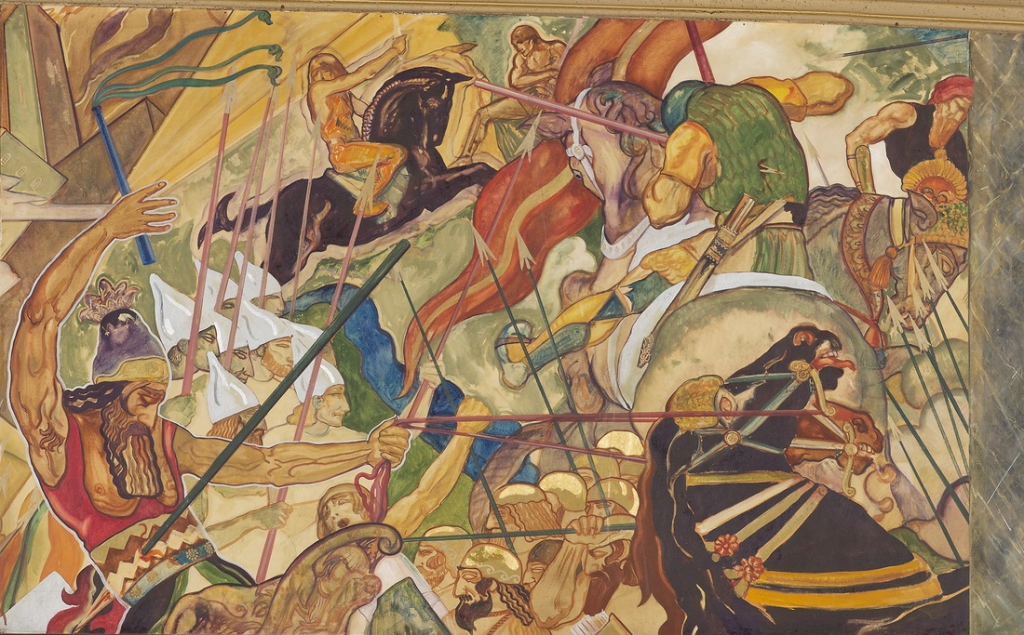
Mural depicting the wars of Israel and Judah with the surrounding nations, Wilshire Boulevard Temple, Los Angles

But the Lord says: “Now I will stand up.
    Now I will show my power and might.
You Assyrians produce nothing but dry grass and stubble.
    Your own breath will turn to fire and consume you.
Your people will be burned up completely,
    like thornbushes cut down and tossed in a fire.
Listen to what I have done, you nations far away!
    And you that are near, acknowledge my might!”

The sinners in Jerusalem shake with fear.
    Terror seizes the godless.
“Who can live with this devouring fire?” they cry.
    “Who can survive this all-consuming fire?”
Those who are honest and fair,
    who refuse to profit by fraud,
    who stay far away from bribes,
who refuse to listen to those who plot murder,
    who shut their eyes to all enticement to do wrong—
these are the ones who will dwell on high.
    The rocks of the mountains will be their fortress.
Food will be supplied to them,
    and they will have water in abundance. (New Living Translation)

The Assyrians were a nasty bunch. So were the people of Jerusalem, at the time of Isaiah’s prophecy. Maybe the folks in Judah played the comparison game and thought they were better than their foe. After all, the Assyrians were experts in war and torture.

Jerusalem was understandably terrified of the Assyrian army. And they trusted God, that is, to a degree. There’s a difference between looking to the Lord because you’re between a rock and a hard place, and placing faith in God because that is the default response of your life.

Easy for me to say. I’ve never stood on a city wall watching a powerful army surrounding me like a bunch of bullies on the playground.

Jerusalem was intimidated to the point of letting the Assyrian ruffians take their gold and silver. Well, actually, it wasn’t their gold; it was God’s. And when the army left, the city was still intact. But for how long?

It was humiliating. Being the victim of a bully always is. And because they’re bullies, it’s never enough. Like feeding the neighbor’s cat, the Assyrians end up going nowhere. They want more. In fact, they never really intended on leaving anyway. It was all a double-cross.

Judah, out of their fear and anxiety, made a bargain with the devil. A bully is a bully because they can be. Give in to them, and it only enables them to keep bullying. The Assyrians were ready for battle. It’s what they always did: fight and conquer.

It was at this point that Jerusalem finally got the clue that they’d been living with God in the background, not the foreground. They did their own thing, much like the hated and dreaded Assyrians.

So, the only recourse the people of Judah had was the mercy of their God. Yet, even though they ought to have petitioned the Lord from the get-go, at least they noticed the Lord is still there.

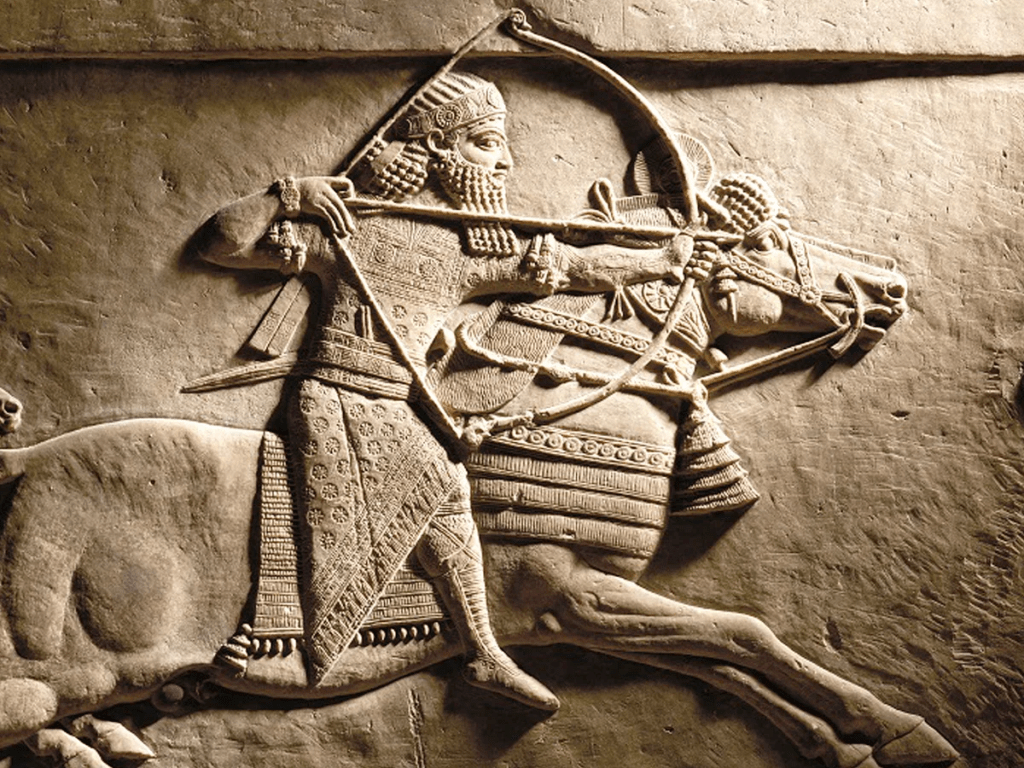
Assyrian king, British Museum

Unfortunately, most of our repentant overtures are way overdue. And yet, because of divine grace, the crazy mess we make of our lives is the very same place where a merciful God meets us.

Any sort of help is surely undeserved. It always is. The Lord, however, avoids making us grovel in our own vomit. God accepts us where we are, and not where we ought to be.

In truth, we all need to make a change, and not just the bullies. The sheer reality of God demands that we pay attention to what is right, just, and good. And the prophet Isaiah informed the people exactly how we must live in a world full of bullies and busted dreams.

We are to have an awareness of ethics and morality, a concern for humanity, and an orientation to help everyone thrive and flourish in this life.

The answer to life’s question of how to exist in this world and do more than just survive comes down to human morality:

  • Live right
  • Speak the truth
  • Despise exploitation
  • Refuse bribes
  • Reject violence
  • Avoid evil pleasures

The safe and stable way to live is to participate in the rhythms of mercy and justice that are woven into the fabric of the universe. The path to a contented and satisfying life is through goodness, not hatred.

Security and satisfaction don’t come through control of all circumstances; it comes by discerning that God has ultimate control, and that this God is good, not evil; just, not unjust; and righteous, not capricious.

According to the prophet, God will determine when the suitable time for assistance will come for us. And the Lord will deal with the ungodly according to the divine timetable, and not when we believe judgments should be rendered.

None of this is in our purview. Sometimes, talking about this sort of theology is a way of taking the focus off of our own need for an ethical and moral life. Sometimes, it is a helpful way of coming to grips with what is happening. Discernment is needed with oneself in these matters.

Trusting God means to exercise patience and perseverance, to focus on faith, to discipline ourselves in prayer, and to express confidence in hope.

We are not necessarily ruined whenever our circumstances are dire. The worse things become, the greater the display of divine power that can come.

By orienting ourselves around God and God’s strength and will, we grow in courage and develop in faith. We learn to trust in the worst of situations. We discover that the Lord knows the score of things, that God understands what’s going on.

And God laughs at the ungodly who believe they can bully the godly around. The most brilliant of military commanders is like a little toddler before the sovereign Lord of the universe. The fiery words they blow will blow back on them and consume their arrogance.

So, let us not harden our own hearts, but exercise a change of heart to let God be God, and to want for nothing but the courts of the Lord.

Let us not be like the bullies of Assyria who lived without a thought to the divine reality in front of them. Let us not become tormented, as if a fire were devouring us with inward anguish of soul, but instead:

  • Walk in right relations with others and with the Lord
  • Maintain truth and integrity in everything
  • Be free from corruption and offending others and God
  • Act with love toward your neighbor and your God
  • Refuse to accept a bribe
  • Restrain evil impulses
  • Open wide the spigot of goodness and justice

God is our refuge and strength, an ever-present help in trouble. Safety and abundance of good things is provided by the Lord. God protects. And God supplies. Rely upon God’s promises, and not the empty bellowing of others.

Be safe. Be strong. Be spiritual. We are all in this life together.

O God, my refuge and strength: In this place of unrelenting light and noise, enfold me in your holy darkness and silence, so that I may rest secure under the shadow of your wings. Amen.