The Parable of the Sower

The Sower by Van Gogh 1881
“The Sower” by Vincent Van Gogh, 1881

“A farmer went out to sow his seed. As he was scattering the seed, some fell along the path, and the birds came and ate it up. Some fell on rocky places, where it did not have much soil. It sprang up quickly because the soil was shallow. But when the sun came up, the plants were scorched, and they withered because they had no root. Other seed fell among thorns, which grew up and choked the plants. Still other seed fell on good soil, where it produced a crop—a hundred, sixty or thirty times what was sown. Whoever has ears, let them hear.” (Matthew 13:3-9, NIV)

Introducing the Parable

I have been preaching sermons for over thirty-five years, so I have seen my share of people falling asleep in church.  The most common ways of drifting off during a sermon are, what I call, the “Snapback” in which the head dramatically snaps back from its gradual descent backward; the “Pious Nod” where it might appear the person is praying until the head either hits the pew in front of it or snaps up, as in the snapback; and, the “Cozy-Sweet” where the head goes to the side and eventually lands on its neighbor’s shoulder for a bit of a nap.

I tend to believe if you need to sleep, you need to sleep – and I find the nodding-off antics of parishioners as bringing some light-hearted levity to my life. That said, for the Christian, it is important to listen to the Word of God.  We need, first and foremost, to take a posture of listening, really hearing what Jesus has to say so that we can do the will of God.

The Parable

“Whoever has ears, let them hear,” said Jesus.  Truly hearing Jesus’ words and listening with focused attention is the key to life.  Our ears are the soil of our lives.  Ears that are attentive and devoted to listening to Jesus are good soil; ears that are distracted and inattentive and stopped up with ear wax are the bad soil.  Receptive listening to the Word of God brings a fruitful harvest of righteousness, peace, and joy in the Holy Spirit.  The Parable of the Sower (or Soils) lets us know that sowing (planting) the Word is important.   It is sown on four different soils….

  1. The seed on the path. A path is for walking, which is why the seed never takes root.  Here there is no listening. When we act without listening, our actions will be misguided.
  2. The seed on rocky soil. Here there is no deep listening.  A lack of attentive hearing results in a shallow person who perhaps relies more on Christian clichés or on his/her personality or abilities instead of the sown Word.
  3. The seed on the thorny soil. Here there is significant listening. However, there is too much listening to a cacophony of voices and not enough singular listening to the sown Word.  Listening to the wrong voices will cause an unfruitful life, so we must be careful to the kind of preaching and type of preachers we hear!
  4. The seed on good soil. A devoted listening to the Word without distraction leads to a productive, fruitful believer.

The Nature of Parables

A parable is a genre of biblical literature.  Parables are as much about concealing truth as they are conveying truth.  A person needs to give focused attention to the story to learn from it, much like a good novel conveys truth about the human condition without being preachy or outright saying the truth; or, much like a good movie that relies on character development and the power of story for its message instead of being a straightforward documentary.

Jesus neither strong-arms people into the kingdom nor puts a person in a full nelson to force them to do God’s will.  We will miss the kingdom if we are looking for a big dramatic hoo-ha of an event, because it comes as an awareness within people and works its way out. For the person who has no intention of changing, they will find Christ’s words confusing.  They might “hear” Jesus yet fail to really listen since they have their own ideas about how the kingdom ought to operate.

Yet, grace is present.  The very fact that Jesus addressed the crowd of people demonstrates he cared enough to communicate.  He could have said, “Hey, you guys, get lost, I’m just going to interact with people who really listen to me.”  Jesus, however, is full of mercy.  Instead of coming at the crowd and bursting through the front door, he came at them through the side door so that they would be able to receive the message well.

When I was a young Christian, I had a habit of puking the good news of Jesus all over people without really listening to them.  Being blunt without being attentive is not the best approach; neither is being worried about saying something offensive, so nothing is said at all.  Others cannot listen if we are either obnoxious or silent. A better approach is to ask permission to tell your story of what Jesus means to you, or what you have learned from God’s Word.
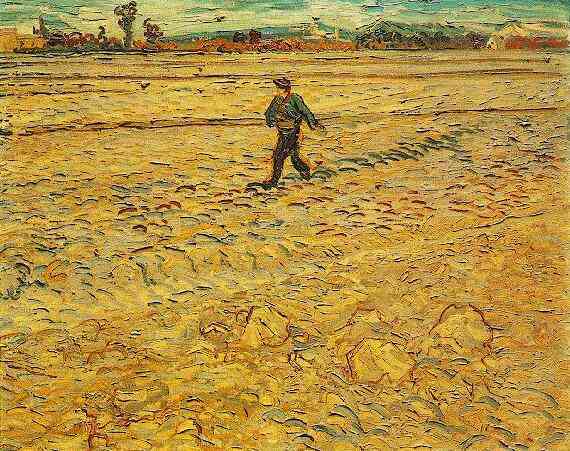
The Sower by Van Gogh 1888
“The Sower” by Vincent Van Gogh, 1888

The Parable Interpreted

“Listen then to what the parable of the sower means: When anyone hears the message about the kingdom and does not understand it, the evil one comes and snatches away what was sown in their heart. This is the seed sown along the path. The seed falling on rocky ground refers to someone who hears the word and at once receives it with joy. But since they have no root, they last only a short time. When trouble or persecution comes because of the word, they quickly fall away. The seed falling among the thorns refers to someone who hears the word, but the worries of this life and the deceitfulness of wealth choke the word, making it unfruitful. But the seed falling on good soil refers to someone who hears the word and understands it. This is the one who produces a crop, yielding a hundred, sixty or thirty times what was sown.” (Matthew 13:18-23, NIV)

The focus of the interpretation Jesus gave is the experience of the seed in a variety of soils.  The outside powers that act on the Word – devouring birds, rocks, the burning sun, choking thorn-bushes – demonstrate that the Word is central and needs to be received well:

  1. The soil on the path is the person who hears the message yet is unable to hear God’s Word because their heart is hard. The devil snatches it before any real understanding can take place.  We see that the devil is real and has ability to influence people who have listening issues.
  2. The rocky soil is the person who hears just enough to respond with joy but drops out when hard circumstances come around. “I didn’t sign up for this!” is their cry.  They needed to count the cost of discipleship before responding to the message.  This is merely a professing Christian, nothing more.  Rather than listening and internalizing the Word, there is only positive affirmation without any action or practice. So, tomorrow the message is gone and forgotten.  When difficulty comes, there are no supporting words to draw from, so the person fades away, unable to navigate life successfully.
  3. The thorny soil also hears and responds to the message. This person is also a professing Christian, nothing more.  The issue with such a person is that he/she also listens to the voices of worry and wealth.  Like some sort of spiritual attention-deficit-disorder, there is no ability to filter all the voices calling out, and so there is no growth.  The Word of God must reign supreme; there cannot be two thrones of Wealth and Word and two Masters of God and Money.
  4. The good soil is listening with the intention of understanding and putting into practice the message heard is what brings about fruit. Receiving the Word through careful listening brings about spiritual growth.  God brings the growth when we focus on the Word.  So, priority must be to listening well to the Word of God.  When a whole group does this, then it creates a greenhouse effect in which people cannot help but grow in the Lord!

Conclusion on the Parable

The simple reception of God’s Word makes a person fruitful.  The first soil did not receive the Word at all, though it listened to it; the second received it with joy but under pressure let it go; the third received it with only one hand because the other hand was busy; only the fourth soil received the seed of the Word with both hands.

Blessed is the one who does not walk in step with the wicked or stand in the way that sinners take or sit in the company of mockers, but whose delight is in the law of the Lord, and who meditates on his law day and night. That person is like a tree planted by streams of water, which yields its fruit in season and whose leaf does not wither—whatever they do prospers. (Psalm 1:1-3, NIV)

George-Whitefield
George Whitefield (1714-1770) preaching outdoors by English artist John Collet (c.1720-1780)

George Whitefield, arguably the greatest of all revivalists, addressed the topic of listening in a mid-eighteenth- century sermon based on the words of Jesus in Luke 8:18, “Take care how you hear:”

  1. Come to church out of a sincere desire to know what God has to say to you. Sermons are not for entertainment. They are to reform our hearts and teach us our duty towards God and men.
  2. Give focused attention to the things that are spoken. Listen as you would to the voice of someone you respect; the King of Kings demands even more respect! The stuff of sermons concerns eternal matters and not just the things of this world.
  3. Guard you heart against prejudice to the minister. Even when ministers urge us in the ways they themselves have trouble with, don’t refuse the urging on that account. If what they urge is biblical, receive as though Jesus were the one who spoke.
  4. Guard your heart at thinking more highly of a minister than you ought.It was the Corinthian evil that they began to prefer one preacher to another openly with terrible consequences for the body of Christ. Though one may minister to you more than another, respect both for what God does through them to the body of Christ and remember they are people just like you.
  5. Make application to your own heart of everything that is said.  Beware of that roving eye that says in a sermon, “That was meant for him” or “I sure hope she heard that!”
  6. Pray to the Lord, before, during, and after the sermon. Pray that the minister might be endued with power and boldness to declare the whole counsel of God and not be intimidated by anyone. Pray that God would apply the words to your own heart.

Whitefield concludes: “If only all who hear me this day would seriously apply their hearts to practice what has now been told them! How ministers would see Satan, like lightning, fall from heaven, and people find the Word preached sharper than a two-edged sword and mighty, through God, to the pulling down of the devil’s strongholds!”

May it be so, to the glory of God.

John 12:44-50 – Christ’s Philosophy of Ministry

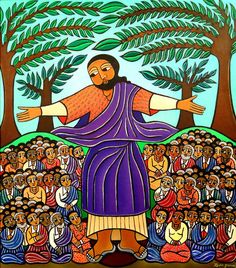
Jesus teaching
“Sermon on the Mount” by Laura James

In a loud voice Jesus said:

Everyone who has faith in me also has faith in the one who sent me. And everyone who has seen me has seen the one who sent me. I am the light that has come into the world. No one who has faith in me will stay in the dark.

I am not the one who will judge those who refuse to obey my teachings. I came to save the people of this world, not to be their judge. But everyone who rejects me, and my teachings will be judged on the last day by what I have said. I do not speak on my own. I say only what the Father who sent me has told me to say. I know that his commands will bring eternal life. That is why I tell you exactly what the Father has told me. (CEV)

Everybody has a philosophy of ministry of how to proceed with the actual doing of Christian works and service to others. We might think of philosophy as a theory about how to gain knowledge and what we are supposed to do with the knowledge we possess. We all have philosophies, even if they are not written down for others to see.

Ponder the thought that Jesus had a philosophy of ministry… which he did.  If Christ’s words carry a lot of weight for us, then perhaps he articulated what he believes about the nature of knowledge; what to do with that knowledge; and, how to handle humanity. Contained within today’s Gospel lesson is the heart of Christ’s philosophical (and thus practical) approach.

Here are several observations about Christ’s philosophy of ministry:

  1. True faith is Trinitarian faith.
  2. Jesus came to dispel darkness by deposing its ruler.
  3. Jesus did not come to nit-pick, harangue, or reject people.
  4. Jesus came to save the world.
  5. Jesus has the authority to save the world.
  6. Belief in Jesus brings deliverance from sin, death, and hell.

Yes, there is a Day of Judgment coming – but that day is not today. Today is the day of salvation, of availing oneself of the opportunity to discover the life, teaching, claims, death, resurrection, and ascension of Christ. Jesus has declared (in a loud voice so we can hear him) that he is the light of the world, the path to God, the Savior of humanity. Those are some very audacious assertions! So, before tomorrow comes, we need to consider the claims of Christ today.

Those whose philosophies include generous portions of people-pleasing and posturing for people-praise will not be judged or rejected by Jesus today (and, so, ought not to be rejected by us, as well!) but will be judged by the words and message of Jesus on the Last Day. According to this philosophy of ministry, there is neither a precedent nor a need to step in and (attempt) to do the Spirit’s work. Rather, we place our faith in Jesus and allow that belief to shape our conversations and interactions with others.  A Christian philosophy of ministry does not need to be complex; it just needs to be Christ-centered.

Great God of deliverance, thank you that you sent your Son, Jesus, to save people from their sins.  I believe in you and what you did and what you stand for.  Each time I open my mouth, may you form my words so that they are not judgmental, but helpful in bringing others to realize life-giving faith through the power of your Holy Spirit.  Amen.

Genesis 22:15-18 – Faith, Obedience, and Blessing

Blessing to Abraham

The angel of the Lord called to Abraham from heaven a second time and said, “I swear by myself, declares the Lord, that because you have done this and have not withheld your son, your only son, I will surely bless you and make your descendants as numerous as the stars in the sky and as the sand on the seashore. Your descendants will take possession of the cities of their enemies, and through your offspring all nations on earth will be blessed, because you have obeyed me.” (NIV)

The biblical character of Abraham is synonymous with faith. And for good reason. God had told Abraham that he would have a son with his wife Sarah. This was especially unusual because the couple were well advanced in age, and Sarah was incapable of having children. Infertility is not just a modern problem; it has always existed.  Yet, despite all the contrary evidence of age and ability, Abraham believed God. Years later and with a mix of patience and impatience from the would-be parents, the promise from God was realized.  Abraham and Sarah had a son, Isaac.

“The child of the promise.” This was Isaac’s moniker – which made the command from God so perplexing: “Take your son, your only son, whom you love—Isaac—and go to the region of Moriah. Sacrifice him there as a burnt offering on a mountain I will show you.” (Genesis 22:2). Huh? I can easily imagine Abraham saying to himself, perhaps not out loud, “What the [insert favorite expletive]!”  But it only seems strange and super-weird to us. We get no reaction from Abraham, no questioning, no talk back.  He just goes about the business of saddling up the donkey, chopping some wood for the sacrifice, and takes his only son with him on the journey to the mountain.

While you and I might try and figure out if we really heard God or not, Abraham had a history of talking with God. He knew God’s voice as well as he knew his own. Abraham was well down the road of relationship with the God he served. We get an insight from the author of Hebrews into Abraham’s thought process, a line of thinking that is consistent with a person who has a regular habit of talking with God:

“Abraham had been promised that Isaac, his only son, would continue his family. But when Abraham was tested, he had faith and was willing to sacrifice Isaac, because he was sure that God could raise people to life. This was just like getting Isaac back from death.” (Hebrews 11:17-18, CEV)

Abraham did not try and figure out God’s mind. He picked no fights and chose not to debate with God about the contradiction of ethics he was being asked to do.

Abraham simply obeyed.

He reasoned that it did not matter if Isaac were killed because God could raise him from death. This, of course, is not what happened. It was all a test of faith. Abraham knew beyond a shadow of a doubt that God is the Lord who provides. After God stepped in and provided a ram for the sacrifice instead of Isaac, Abraham named that place “The Lord Will Provide.” (Genesis 22:14)

You and I most certainly do not always know why we are facing the circumstances we must endure. We very much are rarely privy to know what in the world God is thinking. Yet, like Abraham, if we have a spiritual history of walking with God and hearing his voice, there is no hesitation to respond with obedience. We are convinced that God will provide. Obedience for the follower of Christ is not a burden; it is a privilege, even when we are being tested beyond our seeming emotional ability to do it.

Blessings come through obedience. They are not willy-nilly thrown into a crowd like some cheap stadium trinket between innings of a baseball game. When the Israelites were about to enter the Promised Land, this very connection between obedience and blessing was re-emphasized:

If you fully obey the Lord your God and carefully follow all his commands I give you today, the Lord your God will set you high above all the nations on earth. All these blessings will come on you and accompany you if you obey the Lord your God…. The Lord will establish you as his holy people, as he promised you on oath, if you keep the commands of the Lord your God and walk in obedience to him. (Deuteronomy 28:1-2, 9, NIV)

A simple observation about the blessing of Abraham: It took nearly five-hundred years before that blessing was realized. Furthermore, in the Christian tradition, it then took another fifteen-hundred years before the blessing was fulfilled in the person of Jesus. And, I might add, all the promises of God to his people will be fully consummated at the end of the age when Christ returns. For a contemporary society which prides itself on timeliness and efficiency, taking the much broader scope of all history might seem unacceptable.

So, we come back around again to trust. Just as Abraham trusted God, even when it seemed like nonsense fraught with major moral implications, so we are to exhibit patient and persevering faith. Although the scope of history is massively large, the only moment we have is the now. It is now, today, in which we put one foot in front of the other and toddle forward into the next moment – by faith.

We simply obey.

Then, we obey again… and, again. It is in such continual small steps of faith and obedience that we will discover the blessings of God in the middle of our path.

Sovereign Lord, your ways are sometimes strange.  Yet, I know that everything you do is always right, just, and good.  It is to your gracious and merciful character that I know you will guide and provide. My allegiance is to you as I anticipate your divine blessings in my life through the Name of Jesus Christ, in the power of the Holy Spirit. Amen.

Psalm 13 – How Long, O Lord?

The Scream by Edvard Munch
“The Scream” by Edvard Munch, 1893.

How long, O Lord? Will you forget me forever?
How long will you hide your face from me?
How long must I make decisions alone
with sorrow in my heart day after day?
How long will my enemy triumph over me?

Look at me! Answer me, O Lord my God!
Light up my eyes,
or else I will die
and my enemy will say, “I have overpowered him.”
My opponents will rejoice because I have been shaken.

But I trust your mercy.
My heart finds joy in your salvation.
I will sing to the Lord because he has been good to me. (GW)

Faith is more than the mind’s affirmation of theological beliefs. Faith is also visceral, an expression from deep in the gut about what is going on around us. For faith to be truly faith it needs to hold the whole person, not merely the brain.

Today’s psalm is the reaction of a person of faith to God when the world as they knew it was crumbling and broken. This is a psalm of lament which moves and deepens the faith of the worshiper.

When the world around us changes and all seems horribly awry, we understandably become disoriented – we lose our normal bearings and feel confused and lost.

One of the simplest observations we can make about this psalm, along with all psalms of lament, is that, whether the content is ethically pure or not, the words of the psalmist directed toward God reflect the pain and agony of  people in the middle of world-shattering circumstances. In such dire situations, there are no simplistic answers or easy diagnoses of problems. Complicated layers of grief exist, and mere cerebral responses will always fall short of adequately being in the present moment, sitting with emotions, and getting in touch with the gut.

I am leery of folks who quickly affirm trust in God when a terrible event has just occurred. Bypassing the gut and the heart cannot bring a whole person response to that event and will inevitably result in a cheap faith which cannot support the immensity of the situation. Even worse, it leads to a bootstrap theology where people are expected to pull themselves up in a free-willpower way that is impossible to even do. Sometimes failure of faith comes not because of a person’s weakness but because the faith being espoused is not faith, at all.

Biblical faith expresses weakness, need, help, curiosity, and doubt with a healthy dose of emotional flavor and visceral reaction.

If we had just one psalm of lament as an example, that would be enough. In fact, we have dozens of them, with more sprinkled throughout Holy Scripture. We even have an entire book of the Bible, Lamentations, a deep reflection of the prophet Jeremiah’s grief.

So, let us now be honest with ourselves and each other. All of us, at one time or another, have given a cry of “How long, O Lord!” There are times when our prayers seem unheard and unnoticed, as if they only bounce off the ceiling and fall flat. There are hard circumstances which continue to move along unabated with evil seeming to mock us. We long for divine intervention, we long for deliverance, we long for healing – and when it does not come our disappointment and frustration boils over into an unmitigated cry of wondering where God is in all the damned thick crud.

When a person and/or a group of people are traumatized not once but over-and-over again, how can we not cry aloud, “How long, O Lord!?” When despair settles in the spirit, disappointment seeps in the soul, and depression becomes our daily bread, how can we not muster up the voice that yells, “How long, O Lord!?” When powerful people cause the lives of others to be downtrodden and despised, how can we not scream, “How long, O Lord!?” When the covert actions of others demean and denigrate, leaving us with private pain which no one sees, how can we not bring forth the words, “How long, O Lord!?” If you have never uttered this kind of wondering about God, then perhaps a profound disconnect with your own spirit exists.

A full orb faith names the awful events and sits with the feelings surrounding those events with God.

Psalm 13 is important because it gives us words when the bottom falls out of our lives and everything is upside-down. This psalm helps us admit that life is not as well-ordered as a simple Sunday School faith may pretend. The psalm acknowledges that life is terribly messy, and the psalmist protests to heaven that this quagmire of injustice is plain unfair. What is more, this psalm helps move the sufferer to a new place.

God is big enough to handle everything we throw at him — our pain, our anger, our questions, our doubts. Genuine biblical faith is comfortable challenging God. And God is there, listening, even if we cannot perceive it. Just because we might need to endure adversity does not mean there is something wrong with us, or God.

We likely will not get an answer to our “how long?” We will get something else: mercy. Mercy is compassion shown to another when it is within one’s power to punish. If we widen our horizon a bit, we will observe a God who cares:

“The Lord isn’t slow to keep his promise, as some think of slowness, but he is patient toward you, not wanting anyone to perish but all to change their hearts and lives.” (2 Peter 3:9, CEB)

The only thing better than the joy of personal salvation is the joy of many people’s deliverance and collective emancipation. Patience, perseverance, and endurance through hardship will require expressions of faith with words of affirmation, along with words of agony. The psalms help us with both.

Lord God Almighty, I pray for the forgotten and the unseen – the stranger, the outcast, the poor and homeless – may they be remembered and seen by you.

Merciful God, I pray for those who struggle with mental illness, anxiety, depression, and suicidal ideation – may there be resources to help, enough staff employed, and finances given, toward mental health services. May there be basic human kindness available for the hurting.

Compassionate God, I pray for those who wrestle with sorrow – may they know your comfort within the dark thoughts which currently seem to triumph.

Attentive Lord, I pray for the crestfallen and the ones considered fallen by those around them – may they receive your restoration and reconciling grace. Protect them from judgment and shield them with your mercy.

Lord of all creation, I trust in your steadfast love and rely upon your infinite grace. May our tears turn to songs of joy, to the glory of Jesus Christ. Amen.