Guilt, Grace, and Debt-Collecting: The Parable of the Unmerciful Servant

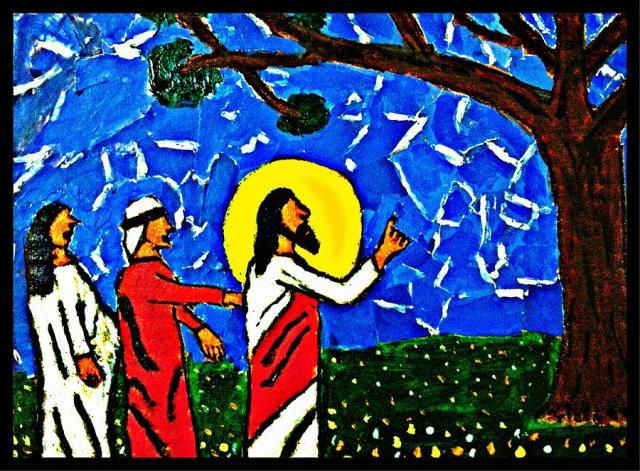
Parable of the Unforgiving Servant by Nikola Saric
Parable of the Unforgiving Servant by Serbian German painter Nikola Saric

Then Peter came to Jesus and asked, “Lord, how many times shall I forgive my brother or sister who sins against me? Up to seven times?”

Jesus answered, “I tell you, not seven times, but seventy-seven times.

“Therefore, the kingdom of heaven is like a king who wanted to settle accounts with his servants. As he began the settlement, a man who owed him ten thousand bags of gold was brought to him. Since he was not able to pay, the master ordered that he and his wife and his children and all that he had be sold to repay the debt.

“At this the servant fell on his knees before him. ‘Be patient with me,’ he begged, ‘and I will pay back everything.’ The servant’s master took pity on him, canceled the debt, and let him go.

“But when that servant went out, he found one of his fellow servants who owed him a hundred silver coins. He grabbed him and began to choke him. ‘Pay back what you owe me!’ he demanded.

“His fellow servant fell to his knees and begged him, ‘Be patient with me, and I will pay it back.’

“But he refused. Instead, he went off and had the man thrown into prison until he could pay the debt. When the other servants saw what had happened, they were outraged and went and told their master everything that had happened.

“Then the master called the servant in. ‘You wicked servant,’ he said, ‘I canceled all that debt of yours because you begged me to. Shouldn’t you have had mercy on your fellow servant just as I had on you?’ In anger his master handed him over to the jailers to be tortured, until he should pay back all he owed.

“This is how my heavenly Father will treat each of you unless you forgive your brother or sister from your heart.” (Matthew 18:21-35, NIV)

It is unfortunate that one of the few guarantees in life is that someone will hurt you, and that hurt will tear a hole in your heart and last a long time.

When the hurt comes, we all must decide how to handle the issue of forgiveness. Oh, it’s easy to talk about forgiveness when you are doing fine – its another thing when you are hurt. One man, during a conversation with his Pastor, had this story:

“Nineteen years ago, this guy stole my wife away from me. They got married and moved to Florida while my life unraveled.  After I was arrested for assaulting a police officer, this guy smirked through the entire hearing.  When I was convicted, he flipped me the finger. I’ve hated him for nineteen years. He’s coming up here next week. I have a thirty-two-caliber pistol strapped around my ankle, and when I see him, I will kill him. I’ve thought about it. I’m sixty-three years old. I’ll get a life sentence, but I’ll also get free medical, a warm bed, and three meals a day.  I’m ready to end my life this way.”

We may wonder: “Why even bother to forgive?  Why even care about that person?” Emotional pain and angry hurt can be so deep that we see no need for forgiveness. “After all,” we might reason, “look at what that person has done to me!”

Jesus does not want bitterness to be the last word; he wants it to be forgiveness. The parable of the unmerciful servant is a piece of Christ’s teaching concerning “little people,” that is, people who are, by status, lowly and unimportant to others. The heavenly Father’s heart is one that cares deeply for them. They are lost, lonely, and languishing in pain. They need help. Jesus clearly explained what to do, giving a three-step process to privately go to others who have hurt us and win them back through reconciliation (Matthew 18:15).

The disciple Peter, ever the wondering, if not wandering disciple knows that if a person hurts someone, they might do it again. So, if a lost sheep is brought back to the fold, and then is offensive again-and-again, at what point do we say enough-is-enough and stop forgiving?

We as people can often feel a keen sense of “ought to.” We feel we ought to pay the debt we owe to others, and that others must pay us the debt they owe. This works on the emotional level just as much or more than any other arena of life. If we offend someone and they become angry, we believe we ought to make them feel better.  If someone angers us, we expect them to make it right and make us feel better.

The late Methodist scholar and author, Dr. David Seamands, said the two major causes of most emotional problems among Christians are: 1) The failure to understand, receive, and live out God’s unconditional grace and forgiveness; and, 2) The failure to give that grace and forgiveness to other people. I wholeheartedly agree with Dr. Seamands.

We have grace available to us in Jesus Christ through his death and resurrection. We cannot earn forgiveness.  Grace is free.  Equally true is the fact that no one owes us anything.  Grace is free for others, as well.

The Failure to Receive Forgiveness

In the end, was the unmerciful man in Christ’s parable forgiven?… No…. Why not?… Because he failed to understand forgiveness and receive it.  It was not the master’s fault; it was the man’s own fault. So, why did he react so mercilessly to a fellow person in debt? (The man’s debt was in the billions and could not be paid off, but the other man’s debt was just a few dollars). The unmerciful guy failed to grasp the master’s grace; he didn’t get it.  He thought he could work it off, and when the debt was canceled, he could not wrap his heart around such mercy. None of us can repay grace – it is free.

The inability to know and receive grace drives many Christians to the tragic treadmill of constant striving for perfection, achievement, and recognition from others. Many people refuse grace and instead try to get rid of their guilt through endless work – fueling the workaholic, motivating the addict, and animating much of the service done in the church and the world. The problem is not a lack of understanding sin or acknowledging personal sinful actions among Christians; the problem is what to do about it. Too many believers are trying to work-off their debt.

The Unforgiving Servant by American artist James B. Jangknegt

Here is a little test: Why do you do what you do? Why do you do good and right things?  Be honest.  Is it to truly worship and celebrate the Lord who has erased such a great debt of sin in our lives? Or, are we working to pay off a debt to God?  Am I striving to assuage my guilt? Are we searching to feel better through our service to others?

We can be so accustomed to operating according to guilt instead of grace that we don’t know what to with the absence of guilt – so we just go back to guilt as our default setting, like a dog returning to its vomit. Furthermore, the tragedy is compounded by insisting that others operate out of guilt, too.

Another little test: Are we content to simply ask people to help or to serve, or do we believe that there must be arm-twisting with some guilt to motivate them? Guilt and arm-twisting are inconsistent with the gospel of grace.  If we believe we must guilt our kids, family, co-workers, neighbors, or anyone else before they will do anything, then it is us who have a spiritual problem.

Ideally, we live and work out of a sense of gratitude toward God and not by guilt. Yet, there are always folks who continue to work out their unhappiness on other people by insisting they get on the guilt train along with them. We are unable to forgive ourselves, so we live with the guilt and try to pay off our debt, making ourselves and everyone else miserable in the process.

The Failure to Give Forgiveness

The unforgiven are the unforgiving. The reason the guy in the story responded so violently to a person who only owes him a few bucks is because he never really believed he was forgiven by the master in the first place. He could not envision a world in which his debt was paid. The unmerciful man was still operating as though life were a matter of collecting debts.

At the heart of many broken relationships and emotional conflicts is an insistence on debt-collecting. We want from others something they cannot give us. God in Christ erases the great debt we have, not some other person.  Yet, we go out and seek from others what only God provides. People are good at being people – but they make lousy gods. It is God who meets the deepest needs of our hearts – your spouse, children, friends, church, and community cannot do it. That is a job for Jesus. The watershed issue is grace – whether we can receive it, or not.  We cannot give something we have not first received.

It would be weird if a marriage vow went something like this: “I have a lot of terrific inner needs and inner emptiness and debts to pay, and I’m going to give you a marvelous opportunity to fill my Grand Canyon of insecurity and take care of me!”

Sometimes people have a nasty tendency to make idols of other people and look at them as though they owe us a debt of happiness, joy, and peace. For example, the weird marriage vow, if followed through with, inevitably will result in debt-collecting. A few years down the road the spouse says, “This is not what you were like when I married you… You owe me!” Our insecurity comes from the inability to receive grace. It is all about grace. Everything is about grace, not guilt and not debt-collecting because the debt has already been paid and the guilt has been erased.

Let us draw near to God with a sincere heart in full assurance of faith, having our hearts sprinkled (with the blood of Christ) to cleanse us from a guilty conscience. (Hebrews 10:22)

Conclusion

You and I are forgiven. There is no need to collect a debt which is already paid. The cross of Jesus Christ has taken care of the sin issue once for all, and not one person reading this is an exception to grace. Here is a final exam, to determine if there is someone we need to forgive:

  1. The Resentment Test: Is there someone you resent? Is there someone who has wronged you?  When you see them or think about them, do you have resentment in your heart?
  2. The Responsibility Test: You say to yourself, “I wouldn’t have this problem if it wasn’t for ________.”  This is passing the buck and believing that my happiness is dependent on another person. The truth is that no one is responsible for your emotional well-being and happiness except you.
  3. The Reminder and Reaction Test: Is there someone who “presses your buttons?” This is when we see or talk to a person who reminds us of someone else who hurt us, and we react to that person by transferring our anger and/or pain onto them.

The Pastor responded to the man mentioned earlier who had lost his wife to another man by saying, “Well, I guess it doesn’t matter if you go to jail because you’re already in jail.  The guy who stole your wife and smirked at your hearing isn’t in jail. You are. You are a prisoner of your own hate, and you are slowly killing yourself.”  A week after that conversation the man called the Pastor and said, “You know, I get your point.  I put the gun away.  I don’t want to spend the rest of my life in jail – and I want to get rid of this bitterness.”

The way to do deal with bitterness is through forgiveness. To forgive involves a long journey, just like every other aspect of following Jesus. Hopefully, by retelling the gospel of grace to one another week after week our hearts will be soft.  We will want to begin the journey to forgive others, stumbling forward with hearts torn by hurts, yet set free by grace.

May it be so to the glory of God.

Psalm 114 – A Mighty God

Mono Crater by Chiura Obata
Painting by American artist Chiura Obata (1885-1975)

God brought his people
out of Egypt,
that land
with a strange language.

When the sea looked at God,
it ran away,
and the Jordan River
flowed upstream.
The mountains and the hills
skipped around like goats.

Ask the sea why it ran away
or ask the Jordan
why it flowed upstream.
Ask the mountains and the hills
why they skipped like goats!

Earth, you will tremble,
when the Lord God of Jacob
comes near,
because he turns solid rock
into flowing streams
and pools of water. (CEV)

I’m a metaphor guy. I like word pictures, analogies, and illustrations. Maybe that’s one reason I resonate with the Old Testament. The Hebrew mind revels in story, symbol, similitude, and even the occasional sarcasm. The turn-of-phrase is something which connects well with me – which is why I like today’s psalm. The language is freighted with metonymy and personification.

This psalm is a poetic response to the Jewish Passover and exodus out of slavery to freedom. It is a brief song of thanksgiving which nicely recounts the Israelite experience from Egypt to the Promised Land. At the behest of a mighty God, the Red Sea parted when the people left Egypt, and the Jordan River stopped its flowing when the people entered the Promised Land.

It’s a whole lot more powerful to say, “When the sea looked at God, it ran away,” than it is to say, “The Red Sea parted.” God is so mighty, so powerful, so large and sovereign that we must use the full extent of language to even begin to describe his wonderful works. A big God with awesome capability needs some wordsmithing worthy of his greatness.

Not only does the sea flee from its place, the river turns back, the mountains and hills shake and skip. To try and somehow capture the immensity of God, the psalmist used language which communicates that even inanimate objects come alive and fulfill his divine bidding.

It is one thing to make a flat statement such as, “Put your trust in God,” and it is quite another matter to open up the tool of language and allow it to picture a divine Being so amazing that nothing nor anyone can possibly stand in his way. And this very same God works for us, not against us.

The Lord God almighty, Creator of heaven and earth, has taken his formidable power and granted us a pinch of it – because that’s all we really need. Jesus, intimately familiar with his mighty heavenly Father, commented:

If your faith is as big as a mustard seed, you can say to this mulberry tree, “Dig yourself up and plant yourself in the ocean!” And the tree will obey you. (Luke 17:6, ERV)

For assuredly, I say to you, whoever says to this mountain, “Be removed and be cast into the sea,” and does not doubt in his heart, but believes that those things he says will be done, he will have whatever he says. (Mark 11:23, NKJV)

All of creation conspires together to participate in the great liberating and saving acts of God for his people. And if that wasn’t enough, we have been given his Holy Spirit to be with us forever – uprooting trees and moving mountains to accomplish the good and loving plan of God here on earth as it is always done in heaven.

Mighty God you invite us to be with you, to have a place near you. Your presence is joy, light, and comfort. Your nearness is holy, awesome, and wonderful. In the play of sunlight through rainbows, in the sounds of music and laughter, in the beauty of creation and the taste of bread and wine, your presence is known. Your saving presence surrounds us, whether we are fearful or joyful, laughing or crying. You invite us, welcome us, forgive us and renew us with fresh hope and new life. You love us into your presence. We bless and thank you. We praise and adore you. We enjoy being with you, in the name, the spirit and the presence of Jesus. Amen

Matthew 21:18-22 – Faith and Prayer

Jesus Cursing the Fig Tree
Jesus Cursing the Fig Tree by Ganosh Kelagina Beedu Shenay, 2016

Early in the morning, as Jesus was on his way back to the city, he was hungry. Seeing a fig tree by the road, he went up to it but found nothing on it except leaves. Then he said to it, “May you never bear fruit again!” Immediately the tree withered.

When the disciples saw this, they were amazed. “How did the fig tree wither so quickly?” they asked.

Jesus replied, “Truly I tell you, if you have faith and do not doubt, not only can you do what was done to the fig tree, but also you can say to this mountain, ‘Go, throw yourself into the sea,’ and it will be done. If you believe, you will receive whatever you ask for in prayer.” (NIV)

God wants us to pray! Prayer happens from a place of faith because to pray, one must believe that God is good and answers prayer. Conversely, prayerlessness is faithlessness.  A person of little faith prays only a little. A person full of faith cannot stop praying.

God’s world revolves more around promise than command – which means that Jesus merely exhorting the disciples to pray would fall flat; they needed a deep change of heart. God calls us all to transformation. Lasting change takes place at the roots of our lives. When there is a drought, pouring lots of water on our backyard trees at the first sign of withering leaves is too late. The tree may look fine on the outside, but on the inside, it is dying from lack of water. Real change comes from the inside-out.  It is the root of a person’s life, below the surface where others do not see, that needs change, and not merely the outward behavior.  Prayer must be directed to the root, to the heart of the issue.

In today’s Gospel story, Jesus was up early and going to Jerusalem. He was hungry and wanted some breakfast, so he approached a fig tree. Figs were known back in Christ’s day as the poor man’s food. Fig trees were everywhere. Approaching a certain fig tree, Jesus found one that looked fine, but no figs. He chose to use the tree as a teachable moment for his disciples. Christ cursed the tree and immediately the entire tree withered.  So, why did Jesus curse the tree?

Jesus cursed the fig tree because it looked good on the outside, but it was already dead on the inside. The tree had everything a tree needed: branches, leaves, and a trunk – except fruit.  The tree served as an illustration for the disciples of believing prayer. The tree looked fine, and had the promise of fruit, yet, none was found.  The point of the tree illustration is this: Jesus is looking for faith in his followers.

In the prophet Jeremiah’s day, the nation of Judah had enjoyed a long stretch of prosperity and good circumstances. By all outward appearances they were doing fine. Temple attendance was at its peak and everyone was offering their sacrifices. But something was wrong….

I will put an end to them,
declares the Lord;
there are no grapes on the vine,
no figs on the tree,
only withered leaves.
They have squandered what I have given them!
(Jeremiah 8:13, CEB)

Although fine on the outside, the people of Judah trusted in themselves, their ability to produce a harvest, and their outward show of how many cattle and sheep they brought to the temple. But what God was looking for was fruit, not nice leaves. He was watching for offerings of believing prayer, born of a faith that is confident in the goodness of God. And the Lord is still looking for people’s faith in God alone – rather than in religiously outward forms of success.

Jesus wants his followers to understand and believe that our words and prayers can have the immediate effect of changing the world.  We can even speak to a mountain and it will have to move if we tell it to. We probably do not go around talking to mountains, but all of us go around talking to ourselves about mountain-like problems. The power that levels mountains is prayer that speaks confidence and boldness.  If you believe, you will receive whatever you ask for in prayer.

Doubt sometimes stands in the way of prayer – not doubt in ourselves because we do not answer our own prayers. The Apostle James said:

“If any of you needs wisdom, you should ask God for it. He is generous to everyone and will give you wisdom without criticizing you. But when you ask God, you must believe and not doubt. Anyone who doubts is like a wave in the sea, blown up and down by the wind. Such doubters are thinking two different things at the same time, and they cannot decide about anything they do. They should not think they will receive anything from the Lord.” (James 1:5-8, NCV)

Both James and his brother Jesus refer to an unshakable faith in the goodness of God. This is faith in the person of God, and not faith in faith itself. If we are honest, every one of us who has made a difficult prayer request, mustering-up all the faith we can, and then being disappointed when it did not happen, has been hurt. The unstable person vacillates when this happens, doubting whether God is good (playing the he-loves-me, he-loves-me-not game). The person of faith believes God answers prayers according to his will, and that if the prayer is not answered, God knows what he is doing and will answer it in his own good timing and purposes.

Maybe you have even indulged your inner-critic, a Job-like friend, telling you that you have a failure of faith, or not enough faith, and that is why your prayer was not answered. Yet, positive thinking is not the same as Christian faith.  It is neither a matter of being optimistic, nor of sending $19.95 to some hack preacher who promises to give you the secret of answered prayer, along with a free gold cross.

God’s will for our lives is sometimes, maybe even oftentimes, a mystery. However, we do know what God’s will is for a lot of things. For example, God is not willing that any should perish but all be brought to eternal life.  So, we can pray with confidence for a person’s deliverance from sin.  We can be bold about trusting in God’s promises – he will do what he says he will do.  Boldness is only as good as the truth it is based upon.

Imposing Mountain View and Lake Glacier National Park
Imposing Mountain View and Lake Glacier National Park. Many Glacier Area. Swiftcurrent Lake.

We have every right, based in our union with Jesus Christ and our redemption in him, to ask God confidently and boldly for the removal of mountains.  We have the authority in Christ to do so.  Therefore, we do not need to offer tepid, milquetoast, mumbling prayers with sighs and hunched shoulders (i.e. “Well, God, if it is your will, could you help me?”).

It is time for men to step out and give God some healthy hairy-chested prayers.  And, this is not the time for women to be worried about what the men do, or not do. Everyone is to be bold in prayer.

“God desires of us nothing more ardently than that we ask many and great things of him, and he is displeased if we do not confidently ask and entreat.” –Martin Luther

Jesus wants faithful and fruitful prayer. He still scans the horizon of our spiritual lives looking for believing prayer. Christ desires from those who follow him bold prayers which curse and wither fruitless and feckless places. When my children were small there was an adult store in our neighborhood. It disturbed my spirit. Each time I passed it I confidently prayed that the pornography and exploitation of women would dry up and cease in Jesus’ name, and that those who worked in that establishment would find more gainful and ethical employment. And that is exactly what happened.

Aggressive prayer against the enemy of our souls is needed, prayer that claims the authority which has been given us in Christ, prayer that is based in solid biblical truth and robust theology. So, let us pray in faith and confidence….

Heavenly Father, we praise you for the grace we possess through the Lord Jesus Christ.  We rejoice in Christ’s teaching and the victory you have provided for us to live above sin and failure.  We come before you in confession and to plead your mercy over our sins, the sins of other believers, and the sins of our world.  We confess the sin of prayerlessness, faithlessness, apathy, complacency, and indifference to those who are lost.  We also acknowledge before you the wickedness of our world through the evil machinations of injustice, oppression, and exploitation of others.

We praise your holy name, O God, that there is plenty of grace through the person and work of the Lord Jesus.  We plead the blood of the cross and the power of the resurrection against the sins and rebellion of people against you.  We pray and wait for you, Holy Spirit, to bring us all to new life in Jesus Christ. 

We recognize that Satan and the kingdom of darkness have plotted and laid strategies against new spiritual life, keeping your people from believing prayer.  So, in the name of the Lord Jesus Christ, we claim our place as children of God. We smash and pull down all the strongholds which Satan has erected against humanity – and pray that the power of Christ’s resurrection would hinder and frustrate the plans formed against us. 

We pull down demonic strongholds of prayerlessness and carelessness with the Word of God. We claim back for the Lord Jesus Christ the ground Satan is claiming as a means of hindering faith, hope, and love; and, we affirm that Satan’s plans were fully defeated through the cross and resurrection of Jesus. We pull down all of Satan’s plans to divert fresh faith when it comes. Blessed Holy Spirit, may you send a renewal to the hearts and souls of all people. May it bring a wondrous season of peace and joy.

We, your people, accept the role of standing in the gap for others in prayer.  You yourself, God, said that we, in Christ, are mighty through God to the pulling down of strongholds.  So, we bring all the work of the Lord Jesus Christ to focus directly against the powers of darkness that blind people and keep them in bondage.  We pray the victory of Christ’s incarnation, crucifixion, resurrection, ascension, and glorification directly against all of Satan’s power in their lives.  We now bind all powers of darkness set to destroying them, and we unbind those demonic bonds and blinders from them in the mighty name of Jesus. 

By faith we claim humanity for fruitful lives of spiritual abundance, social justice, and sanctified relationships in the name of Jesus Christ our Lord, who defeated all powers and principalities of this world.  Amen.


Matthew 26:6-13 – More Than Meets the Eye

Quincy
Jack Klugman as “Quincy, M.E.” (1976-1983)

While Jesus was in Bethany in the home of Simon the Leper, a woman came to him with an alabaster jar of very expensive perfume, which she poured on his head as he was reclining at the table.

When the disciples saw this, they were indignant. “Why this waste?” they asked. “This perfume could have been sold at a high price and the money given to the poor.”

Aware of this, Jesus said to them, “Why are you bothering this woman? She has done a beautiful thing to me. The poor you will always have with you, but you will not always have me. When she poured this perfume on my body, she did it to prepare me for burial. Truly I tell you, wherever this gospel is preached throughout the world, what she has done will also be told, in memory of her.” (NIV)

When I was a teenager there was a show on TV called “Quincy.”  Quincy was a coroner.  Every episode was him performing an autopsy on someone who appeared to have a rather normal death.  But Quincy always found something suspicious and spent his time prying into people’s lives to confirm his investigation.  His boss and the police chief would chide and warn him saying, “Leave it alone, Quincy.”  Quincy’s typical response was: “But I can’t leave it alone.  There’s more here than what meets the eye!”

Indeed, there is more going on in today’s Gospel lesson than what meets the eye. The Apostle John identifies the woman as Mary (John 12:1-11), a woman with a sordid background who had her life transformed through meeting Jesus.  Now, near the end of Christ’s life as he was about to enter Jerusalem and be arrested, tried, tortured, and killed, this woman, Mary, is aware of what is happening when others are not.  Her own brokenness cracked open to her the true reality of life.

The surface event itself is a touching and tender moment in history.  This woman, whom everyone knew was a damaged person, took a high-end perfume and broke the entire thing open. She then proceeded to anoint Christ’s feet with it.  You can imagine the aroma which filled the entire house with expensive perfume for all to smell.  Giving what she had to Jesus, Mary demonstrated the path of true discipleship.

Yet, that is not all, because there is more here than what meets the eye:

  • The broken jar of perfume shows us the brokenness of the woman and our need to be broken (Matthew 5:3-4).
  • The woman used an extraordinary and extravagant amount of perfume, picturing her overflowing love for Jesus (John 20:1-18).
  • The woman poured the perfume on the head of Jesus, and she herself used her hair as the application (according to John); hair is a rich cultural symbol for submission and respect (1 Corinthians 11:14).
  • The perfume directs us to the death of Jesus (John 19:38-42).
  • The perfume highlights for us the aroma of Christ to the world (2 Corinthians 2:15-17).
  • There is more to the disciples’ response than mere words about perfume; the Apostle John specifically names Judas as questioning this action – the one who is not actually concerned for the poor (Matthew 26:15).
  • The woman and the disciples, or Judas and Mary, serve as spiritual contrasts: Mary opens herself to the sweet aroma of Christ; Judas plain stinks.
  • The perfume presents a powerful picture of the upcoming death of Christ, for those with eyes to see; he was broken and poured out for our salvation (Luke 23:26-27:12).

Christianity was never meant to be a surface religion which only runs skin deep.  The follower of Christ is meant to be profoundly transformed, inside and out, so that there is genuine healing, spiritual health, and authentic concern for the poor and needy.  Keeping up appearances is what the Judas’s of this world do.  But the Mary’s among us dramatically point us to Jesus with their tears, their humility, their openness, and their love.

In this contemporary environment of fragmented human ecology, our first step toward wholeness and integrity begins with a posture of giving everything we have – body, soul, and spirit – to the Lord Jesus.  Methinks Quincy was on to something.

Loving Lord Jesus, my Savior, and my friend, you have gone before us and pioneered deliverance from an empty way of life and into a life of grace and gratitude.  May I and all your followers, emulate the path of the woman Mary and realize the true freedom which comes from emptying oneself out for you.  Amen.