Blessings or Woes?

The Sermon on the Mount, by Miki de Goodaboom

There are many persons who currently feel angry and powerless in the face of recent and contemporary political events. All of this has large implications, especially for workers.

I admit to being one who is frustrated and saddened by the U.S. government’s unwillingness and inability to simply care about all of its citizens (as well as the citizens of the world). Along with their spirit of the age, they are failing to ensure the common good of everyone.

What’s more, there are large swaths of American Christianity who are either complicit or actively involved in establishing and perpetuating a system of governance which is fundamentally out of sync with biblical norms.

The Church and the Christian have a responsibility and a call, based in the words and ways of Jesus, of whom we purport to follow. In some of the first words uttered to his disciples, establishing what is of upmost importance for us to know, Jesus said:

“Blessed are you who are poor,
    for yours is the kingdom of God.
“Blessed are you who are hungry now,
    for you will be filled.
“Blessed are you who weep now,
    for you will laugh…

“But woe to you who are rich,
    for you have received your consolation.
“Woe to you who are full now,
    for you will be hungry.
“Woe to you who are laughing now,
    for you will mourn and weep.” (Luke 6:20-21, 24-25, NRSV)

Jesus was building and upholding an alternative kingdom to the political systems of the time. Christ came to this earth to set things right amidst a corrupt world whose authority was held in the hands of evil.

But change would not come through the typical means of worldly power such as coups, revolutions, or economic exploitation of some persons over others.

For those who feel helpless and without power, Christ brings a liberation which transcends all other powers and authorities. He brings blessing.

What this means for those who are enamored with worldly aspects of power (money, wealth, resources, political authority, etc.) the words and actions of Jesus brings woe.

An evil grip of the world cannot be loosened with practices and responses of hate, class warfare, verbal and physical violence, and economic takeovers. For those with spiritual eyes to see, and ears to hear, the sandy and shifting foundations of this present government administration are being, and will be, washed away. (Luke 6:49)

It’s important that people of faith participate with what is good, right, and just – that they are concerned with the public good of everyone; and are attuned to a social and economic vision for humanity that is concerned for all citizens, and not just some or a few of them.

For the past few hundred years, much of the church has made spiritual deliverance and socio-economic freedom a matter of only the individual. As long as one embraces a personal salvation in Christ, well then, all is well, right!?

Wrong. Holy Scripture is filled with concerns for the whole of humanity because of the exploitive powers of this world. We have stories in the Bible replete with such powers as the Pharaoh who enslaved and exploited workers for his and Egypt’s own wealth, power, and benefit.

Jesus came not to the religious leaders and the kings of the earth, but instead made it his purpose to spend time amongst the least in society, those for whom the rich and powerful had no inclination to pay attention to and help.

“We have for much too long settled for a gospel of private other-worldly possibility.”

Walter Brueggemann

Even amongst God’s own ancient people, King Solomon built an empire on the driving force of both slavery and cheap labor, exploiting a large class of persons in order to feed the behemoth of structural wealth.

Economic systems which exploit workers do it so that they can maintain cheap labor. They seek to keep those persons invisible and outside of any safety net of security which might cost the system money.

Unfortunately, there are extremely rich persons who rely upon workers remaining on the underbelly of their companies and of society. Embracing unrestrained individualism and unbridled capitalistic practices make for a permanent class of exploited workers who remain poor on purpose by those wishing them to remain there.

Such extremely rich individuals become political players only because of their wealth. They know little about statecraft and how a politics concerned for the common good really works. And, frankly, they don’t seem to care.

I bring up these things because many Christians have been complicit in the injustice and exploitation; and because many churches and church leaders try to operate like the super-rich, instead of trying to follow the words and ways of the Lord Jesus, whom they purport to follow.

The Apostle James minced no words in addressing the rich within the church:

Come now, you rich people, weep and wail for the miseries that are coming to you. Your riches have rotted, and your clothes are moth-eaten. Your gold and silver have rusted, and their rust will be evidence against you, and it will eat your flesh like fire. You have laid up treasure during the last days. Listen! The wages of the laborers who mowed your fields, which you kept back by fraud, cry out, and the cries of the harvesters have reached the ears of the Lord of hosts. You have lived on the earth in luxury and in pleasure; you have nourished your hearts in a day of slaughter. You have condemned and murdered the righteous one, who does not resist you. (James 5:1-6, NRSV)

Meanwhile, the poor and exploited are suffering. Christians are not to kiss-up to those in power, nor try to be like them. And, for God’s sake, we are never to get into the game of systemic evil, like those who mistreat us.

Instead, we learn to practice patience and endurance in the face of suffering, while we work toward a better society. We strengthen one another’s hearts through faith. We do not grumble and turn against each other, like a pack of wild dogs, but pray continually and practice forgiveness, so that we can be compassionate and merciful.

Since we are all connected on this planet, any time an individual shows unmitigated kindness toward another, chooses to love the enemy, expresses gratitude, or offers sincere forgiveness to someone who doesn’t deserve it, we shift the balance of the world back toward the axis of grace.

Unless we all work together to embrace our collective poverty of spirit and acknowledge our grinding emotions (and sit with them), we will eventually go the way of the already condemned who spend, eat, and laugh with sinister abandon.

Life is not a 100 meter sprint; life is a marathon. We are in the long haul of life, and do not live for the pleasures of the moment. So then, let us live up to who we are in Christ, created in the image and likeness of God, and possessing divine light and living water which will nourish us through our time of need.

For humanity does not live on bread alone, but by every word that comes from the mouth of God. I, for one, want to be blessed by Jesus, and not experience a woe from him. That means paying attention to the people and the matters of importance to Christ.

How Much Is Too Much? (1 Kings 4:20-28)

King Solomon’s court, by Claude Vignon (1593-1670)

The people of Judah and Israel were as numerous as the sand on the seashore; they ate, they drank and they were happy. And Solomon ruled over all the kingdoms from the Euphrates River to the land of the Philistines, as far as the border of Egypt. These countries brought tribute and were Solomon’s subjects all his life.

Solomon’s daily provisions were thirty cors of the finest flour and sixty cors of meal, ten head of stall-fed cattle, twenty of pasture-fed cattle and a hundred sheep and goats, as well as deer, gazelles, roebucks and choice fowl. For he ruled over all the kingdoms west of the Euphrates River, from Tiphsah to Gaza, and had peace on all sides. During Solomon’s lifetime Judah and Israel, from Dan to Beersheba, lived in safety, everyone under their own vine and under their own fig tree.

Solomon had four thousand stalls for chariot horses, and twelve thousand horses.

The district governors, each in his month, supplied provisions for King Solomon and all who came to the king’s table. They saw to it that nothing was lacking. They also brought to the proper place their quotas of barley and straw for the chariot horses and the other horses. (New International Version)

Wealth, in and of itself, is neither good nor bad – it just is. The real issue is why any particular person wants to be wealthy, how we view wealth, and what we do with it when we have it.

In ancient Israel, under King Solomon, the Israelites enjoyed a time of prosperity, safety, and abundance. To flourish and thrive in life is good. The ability to meet basic needs, and to enjoy life is good.

King Solomon on his throne, by Frans Francken the Younger (1581-1642)

But what about beyond that? Is there such a thing as too much? And what about others who may not be able to make ends meet?

Solomon certainly had a lot. Yet, we do have warnings in Holy Scripture about exorbitant wealth. Here is what the Deuteronomic law says concerning any future king:

The king, moreover, must not acquire great numbers of horses for himself or make the people return to Egypt to get more of them, for the Lord has told you, “You are not to go back that way again.” He must not take many wives, or his heart will be led astray. He must not accumulate large amounts of silver and gold. (Deuteronomy 17:16-17, NIV)

Whatever standard one may use, I would say 12,000 horses falls into the great-numbers-of-horses category. And likewise, having 1,000 wives is most likely 999 too many for just about every man on the planet.

Indeed, Solomon’s heart was eventually led astray. It’s quite sad. Even the wisest and wealthiest person who ever lived was not able to sustain complete faithfulness to God. The remainder of Deuteronomy’s instruction about a future king is this:

When he takes the throne of his kingdom, he is to write for himself on a scroll a copy of this law, taken from that of the Levitical priests. It is to be with him, and he is to read it all the days of his life so that he may learn to revere the Lord his God and follow carefully all the words of this law and these decrees and not consider himself better than his fellow Israelites and turn from the law to the right or to the left. Then he and his descendants will reign a long time over his kingdom in Israel. (Deuteronomy 17:18-20, NIV)

In all fairness, King Solomon started out paying attention to God’s law. In his wisdom, he sought to learn and obey – but it ended up being only a partial obedience.

A dimension of any rule or government is to realize that – with any sort of success, security, and wealth – there is always a dark underbelly to it. That is, there are people within that government who are not enjoying its largess and wealth.

Under the new expanded governmental system, Solomon had his kingdom, and its subject peoples, divided into districts in order to give provisions, as well as laborers for his ambitious building projects. Not everyone was enjoying leisure time under a fig tree.

King Solomon set up an economic system that transferred wealth from nations subservient to Israel, and from subsistence farmers within Israel, to support the massive needs of Jerusalem.

The city, under Solomon, was living off the surplus grain to feed all of the horses, as well as the tribute exacted from surrounding nations. In other words, the wealth was being centralized by Solomon for his many projects and interests.

All of the opulence was meant to impress people with wealth, exhibiting Israel’s and Solomon’s great power and wisdom. Yet, if we are to follow the old adage, “follow the money,” we would discover a governmental system that extracted money from others; and produces a lot of oppression, grievances, and exploitation – hence, the dark underbelly of it all.

This sort of situation is precisely why we have prophetic literature in the Old Testament. The prophets are especially attuned to the cries of injustice amongst the people. Every society needs such persons who are within the system, yet are able to be a voice for those who are voiceless.

Had King Solomon moved beyond his partial obedience to complete and total obedience, I surmise that he likely would have considered the needs of everyone within his empire, before establishing a system of government that depended upon economic exploitation.

Specifically, perhaps Solomon ought to have engaged more vigorously and robustly with the covenant code between God and Israel that he was supposed to know so well.

And perhaps, Christianity and the Church have been too lax on the subject of handling Holy Scripture. Because, for all of our talk of being faithful to scripture, that talk has not translated into a solid social and economic understanding of human need and justice.

It simply will not do to label anything we don’t like as communist or socialist. And it will not do to say King Solomon was wealthy and successful, as if that, in and of itself, is the evidence of God’s favor. In reality, it means little, apart from a complete fidelity to God’s law.

In my judgment, Jesus did better than all of this. He pointed us to an alternative system which considers the common good of all persons, and not just some people. The ethics and morality of his Sermon on the Mount lays out the foundational means upon which any sort of governmental system ought to build upon. (Matthew 5-7)

But seek first his kingdom and his righteousness, and all these things will be given to you as well.

Jesus (Matthew 6:33, NIV)

If we are looking for the same sort of wealth and success as Solomon, that means we’ll need to ignore Jesus. Yet, if faithfulness, obedience, humility, righteousness, mercy, purity, and peacemaking matter more than our economic bottom line, then I believe we will discover that the pursuit of these virtues leads to having all of our needs met, as well.

Lord of our lives, teach us how to use our money and our possessions. Deliver us from stinginess and wasteful extravagance; inspire our giving with the spirit of true generosity. Help us always to remember your generous love for us, that we may be wise and faithful stewards of the good gifts you have given us. Amen.

Psalm 82 – Help Others, Without Prejudice

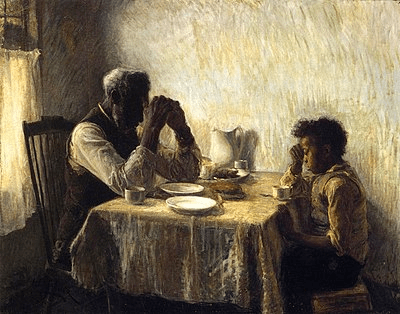
“The Thankful Poor” by Henry Ossawa Tanner, 1894

God takes his place in his own assembly.
He pronounces judgment among the gods:
“How long are you going to judge unfairly?
How long are you going to side with wicked people?”

Defend weak people and orphans.
Protect the rights of the oppressed and the poor.
Rescue weak and needy people.
Help them escape the power of wicked people.

Wicked people do not know or understand anything.
As they walk around in the dark,
all the foundations of the earth shake.
I said, “You are gods.
You are all sons of the Most High.
You will certainly die like humans
and fall like any prince.”

Arise, O God!
Judge the earth, because all the nations belong to you. (God’s Word Translation)

“My dear friends, pay attention. God has given a lot of faith to the poor people in this world. He has also promised them a share in his kingdom that he will give to everyone who loves him.”

James 2:5, CEV

God’s mercy and grace is what makes the world go round. God’s attention to people who possess little to nothing is what upholds the earth from being consumed with judgment.

An absence of grace in people is offensive to God. An uncharitable spirit, indifferent to those in need, will eventually face the crushing weight of God’s glory upon them.

The psalmist is uncompromisingly clear on divine imperatives for humanity: defend the weak; protect the rights of the poor; rescue the needy; and deliver them from unjust power. That’s what God does. And that is what we are to do, without prejudice.

When I was growing up, our family dog was named “Sam.” Sam loved being on the farm. One time he tussled with a skunk. I could barely get close enough to clean him up because he stunk so badly. 

Favoritism toward those with means over those who don’t, stinks, and God has a hard time getting close to us when we show partiality to others. And the Lord is going to clean us up when he smells the stench of discrimination on us. 

Showing favoritism to some over others is evidence that the dog is running away from the bath of grace. In order to develop relationships and interact with people the way God wants us to, we must be free from prejudice.

No matter how you slice the Bible, God cares about persons trapped in poverty. The poor are important to the Lord. 

When Jesus began his earthly ministry, he pointed people to the words of the prophet Isaiah.

“The Spirit of the Lord is upon me, because he has chosen me to bring good news to the poor.” (Isaiah 61:1; Luke 4:18) 

In the Old Testament, there are seven different words for the “poor” because poverty was such a pervasive reality (and still is across the world!). The range of meanings includes those who are poor because of laziness; those born into poverty; being poor because of inhuman oppression or slavery; simple beggars; and the pious humble poor. 

These spiritual poor persons are the Hebrew “anawim.” (pronounced “on-a-wheem”) The anawim are humble persons caught in grinding poverty, having no choice but to put their trust in God.

God has a lot to say about such persons because they are near and dear to the divine heart. Old Testament law was quite clear about how to treat the poor. 

Poor persons will never disappear from the earth. That’s why I’m giving you this command: you must open your hand generously to your fellow Israelites, to the needy among you, and to the poor who live with you in your land. (Deuteronomy 15:11, CEB)

Do not cheat poor and needy hired servants, whether they are Israelites or foreigners living in one of your towns. Each day before sunset pay them for that day’s work; they need the money and have counted on getting it. If you do not pay them, they will cry out against you to the Lord, and you will be guilty of sin. (Deuteronomy 24:14-15, GNT) 

The mistreatment, exploitation, and inattention to the poor, the anawim, was the chief reason God sent prophets to Israel. 

Listen to this, you who rob the poor
    and trample down the needy!
You can’t wait for the Sabbath day to be over
    and the religious festivals to end
    so you can get back to cheating the helpless.
You measure out grain with dishonest measures
    and cheat the buyer with dishonest scales.
And you mix the grain you sell
    with chaff swept from the floor.
Then you enslave poor people
    for one piece of silver or a pair of sandals.

Now the Lord has sworn this oath
    by his own name, the Pride of Israel:
“I will never forget
    the wicked things you have done! (Amos 8:4-7, NLT)

Instead of being generous to the poor and allowing them to forage for grain at harvest behind the harvesters, they kept “those people” away from the fields so that they could turn a profit at every little bit they could. And God thought it all stunk to high heaven.

Bear in mind, only the poor in spirit will enter the kingdom of heaven. The real issue is humility that demonstrates grace to people who cannot offer you something in return. 

It’s easy to be merciful to people who will turn around later and scratch your back. It’s altogether a different thing to be humble, gracious, and generous to those you know cannot give anything back to you.

God cares about the condition of our souls and not the balance of our bank accounts. 

Inattention to the needy only betrays a heart far from the Lord. God does not judge people on face value and the state of their finances, and neither should we.

The only way to rid ourselves of the stench of showing favoritism is to receive the cleansing bath of God’s mercy in Jesus Christ. The shampoo of grace is available, that is, if we will let God apply it. God is the expert in:

  • Turning people from only associating with those they are comfortable with, to lovingly reaching out to people very different from themselves
  • Changing people from the stinking thinking about what they can continually obtain and consume, to people who are loving and generous with their words and their physical resources
  • Putting to death a proud spirit that looks to get ahead and accomplish an agenda by any means possible, to giving new life through humble repentance.

Ministry to the poor is a non-negotiable for the Christian and Christ’s Church. 

Beyond mere dispensing of benevolent funds, the poor also need relationships, connections, resources, and a chance to give back in ways they can contribute. That’s just part of being attentive to them and extending basic human respect and dignity. 

How do you or your church show their concern for the poor in your city and/or region?

Almighty and most merciful God, we remember before you all the poor and neglected persons whom it would be easy for us to forget: the homeless and the destitute, the old and the sick, and all who have none to care for them. Help us to heal those who are broken in body or spirit, and to turn their sorrow into joy. Grant this, gracious Father, for the love of your Son, who for our sake became poor, Jesus Christ our Lord. Amen.

Leviticus 19:9-18 – Be a Good Neighbor

When you reap the harvest of your land, do not reap to the very edges of your field or gather the gleanings of your harvest. Do not go over your vineyard a second time or pick up the grapes that have fallen. Leave them for the poor and the foreigner. I am the Lord your God.

Do not steal.

Do not lie.

Do not deceive one another.

Do not swear falsely by my name and so profane the name of your God. I am the Lord.

Do not defraud or rob your neighbor.

Do not hold back the wages of a hired worker overnight.

Do not curse the deaf or put a stumbling block in front of the blind but fear your God. I am the Lord.

Do not pervert justice; do not show partiality to the poor or favoritism to the great but judge your neighbor fairly.

Do not go about spreading slander among your people.

Do not do anything that endangers your neighbor’s life. I am the Lord.

Do not hate a fellow Israelite in your heart. Rebuke your neighbor frankly so you will not share in their guilt.

Do not seek revenge or bear a grudge against anyone among your people but love your neighbor as yourself. I am the Lord. (New International Version)

All of these Old Testaments commands to the ancient Israelites are a development and expansion upon the basic core Ten Commands or Words given by God to Moses.

Those core commands are based in the character of God. That same character is to be the normal daily lived experience of God’s people.

The Levitical instructions are a fleshing-out of God’s basic commands for a specific people in their particular social, economic, and historical situation.

Although we need not, as modern folk, strictly observe the commands, as they are culturally constructed, we very much need to fulfill the ethics and morality which are behind the specific instructions.

Today’s Old Testament lesson has to do with being a good neighbor – a person who conscientiously lives in community with others and pays attention to the collective needs and wants of everyone. It is to live into God’s overarching ethic for the common good of all persons.

A commitment to community life needs good neighbors. They are characterized by the following virtues:

Sacrifice

Israel was chiefly an agrarian society. So, when the season of harvest came, the workers gleaning the fields were to only go over it once. That way, the poor and less fortunate could come behind and pick up what the workers missed or dropped.

Any landowner who instructed the workers to keep working until they got every scrap of grain or fruit was being cruel to the poor. Merciful and generous owners would, conversely, instruct the workers to leave a bit behind and not get everything.

Since God sacrifices on behalf of humanity, so we, too, are to make sacrifices which benefit the common good of all persons in the community.

Live a life filled with love, following the example of Christ. He loved us and offered himself as a sacrifice for us, a pleasing aroma to God. (Ephesians 5:2, NLT)

A sacrificial spirit, not a self-indulgent one, is what God is looking for in a good neighbor.

Honesty

Cheating, lying, stealing, and deceit have absolutely no place in the kingdom of God. Instead, honest dealings with others, always being above board in all matters, is of upmost importance to God.

Witnesses in court are expected to speak the truth without falsehood. Business dealings are to have accurate weights and measures. Integrity and trustworthiness are the building blocks of any good society.

Since God is truth, so we, too, are to live into truth through being honest in all we say and do.

Have nothing to do with a false charge and do not put an innocent or honest person to death, for I will not acquit the guilty. Do not accept a bribe, for a bribe blinds those who see and twists the words of the innocent. (Exodus 23:7-8, NIV)

An honest spirit, not a thieving one, is what God is looking for in a good neighbor.

Fairness

In the ancient world, and still in many parts of the world today, workers were paid at the end of the day for their day’s work. Bosses who withheld expected wages till the next day were quite literally depriving a family of their supper.

For those who are not able to do a solid day’s work, such as the blind and the handicapped, it’s bad enough to simply ignore them, because God is attentive to their plight. That situation is exacerbated exponentially, whenever someone or a group of people, decide to make such persons’ lives even harder than they already are.

Since God is fair in all dealings, so we, too, are to extend fairness to all without any prejudice or favoritism.

The Lord watches to see if we are fair or if we cheat others. (Proverbs 16:11, CEV)

A fair spirit, not an exploitive one, is what God is looking for in a good neighbor.

Justice

Unequal treatment is about as far from God as one can get. Being concerned only about those with similar political views, economic interests, or spiritual inclinations is a gross practice of injustice. It denies the ethic of the common good of all in favor of the common good of some.

Since God is just in all things, so we, too, are to uphold biblical justice for our fellow humanity, no matter who they are or where they come from.

Never deprive foreigners and orphans of justice. And never take widows’ clothes to guarantee a loan. (Deuteronomy 24:17, GW)

A spirit of justice, not injustice, is what God is looking for in a good neighbor.

Love

Hate is the inevitable result of holding onto anger through nursing a grudge and holding onto bitterness. It fails to speak up and speak out.

Love, however, assertively addresses anger and seeks to make things right in a calm and concerned way. Love attacks problems, not people.

Since God is love, so we, too are to love one another.

Dear friends, let us love one another, for love comes from God. (1 John 4:7, NIV)

Don’t let evil get the best of you; get the best of evil by doing good. (Romans 12:21, MSG)

A spirit of love, not a hateful vengeful one, is what God is looking for in a good neighbor.

A good neighbor is one who seeks the common good of all persons because God is good, all the time, and always does what is right, just, and fair.

Gracious God and Father, in a world of fear and suspicion, teach us that love is the only means to conquer fear.

Loving Lord Jesus, Son of God, in a world full of anger and frustration, teach to overturn the tables and tear down the fences which turn away the hungry and homeless; and to practice hospitality without prejudice.

Blessed Holy Spirit of God, in a world of indifference and ignorance, teach us wisdom, to be caring of one another, and to protect one another.

Blessed Holy Trinity, the God whom we serve, help us to know the peace that steals gently in through quiet acts of kindness, just as peace is always within you as one God, now and forever. Amen.