Make Room for Jesus (John 8:39-47)

Christ and Pharisee, by Russian painter Ivan Filichev, 1993

“Abraham is our father,” they [the religious leaders] answered.

“If you were Abraham’s children,” said Jesus, “then you would do what Abraham did. As it is, you are looking for a way to kill me, a man who has told you the truth that I heard from God. Abraham did not do such things. You are doing the works of your own father.”

“We are not illegitimate children,” they protested. “The only Father we have is God himself.”

Jesus said to them, “If God were your Father, you would love me, for I have come here from God. I have not come on my own; God sent me. Why is my language not clear to you? Because you are unable to hear what I say. You belong to your father, the devil, and you want to carry out your father’s desires. He was a murderer from the beginning, not holding to the truth, for there is no truth in him. When he lies, he speaks his native language, for he is a liar and the father of lies. 

Yet because I tell the truth, you do not believe me! Can any of you prove me guilty of sin? If I am telling the truth, why don’t you believe me? Whoever belongs to God hears what God says. The reason you do not hear is that you do not belong to God.” (New International Version)

Glass-half-full or glass-half-empty? I confess I really don’t like those binary categories for people. That’s because I believe it misses a very important aspect of being a human. What’s most necessary is to have glass-fully-empty people.

While the religious leaders of Christ’ day were debating the subject of whether Jesus is of God, or not, they failed to notice something significant about themselves:

Their glasses were so full that they had no room for Messiah, even when he was standing right in front of their faces.

You cannot be full of God and full of yourself at the same time.

Only an empty vessel can be filled. Half-full or half-empty people only end up being in conflict with each other. They cannot find any room for Jesus in their lives.

Jesus had been dealing with these sort of shenanigans even before he was born. His poor parents had a dickens of a time finding a place for him to be born. There was no room in the inn. All the places were full. God was about to break into the world, and everyone was scuttling about as glass-half-full and glass-half-empty people.

In his earthly ministry, the religious leaders viewed Jesus as a competitor, not a compatriot – pitting themselves in conflict with him, even to the extreme.

“You are looking for a way to kill me, because you have no room for my word.” (John 8:37, NIV)

Conflict is inevitable. Put a bunch of sinners together in one place, add a few grumpy curmudgeons, some know-it-alls, then fireworks happens. I’ve always thought that every human institution is about one or two knock-down drag-out fights away from being non-existent.

At the heart of all the conflict is either an inability or an unwillingness to make room for another’s point of view. Where there is no room for mystery, there’s no room for Jesus.

How many settled beliefs and behaviors do you have? So many that your head and hands have no room for Jesus to do the unexpected?

Are you full of thoughts, opinions, and convictions? So much so that your interpretation of everything leaves no room for the contrary, even if it comes from Jesus?

Here’s how we get full of ourselves:

  1. Desire arises within. Options are considered in meeting the want or need.
  2. Conflict enters because there are others with competing desires.
  3. Expectations are formed when the desire is unmet. 
  4. Demands are made because of missed expectations.
  5. Judgment is meted-out to those not complying to the demands.
  6. Separation occurs with the intent of hurting another through a withdrawal of relationship.

You end up not making room for the other in your heart and life. You don’t make room because you’re already full of yourself and don’t want to change.

We, however, are to make room for Jesus and others because Jesus made room for us and expects us to do so for others.

My Father’s house has room to spare. (John 14:2, CEB)

Make room in your hearts for us. (2 Corinthians 7:2, NRSV)

Let the Word of Christ—the Message—have the run of the house. Give it plenty of room in your lives. (Colossians 3:16, MSG)

Finding true and lasting satisfaction in Jesus as the Way is how to realize forgiveness, peace, and reconciliation. There is room at the foot of Christ’s cross for both me and you.

There’s Room at the Cross for You, by Billy Gaines

The cross upon which Jesus died
Is a shelter in which we can hide
And its grace so free is sufficient for me
And deep is its fountain as wide as the sea.

There’s room at the cross for you
Though millions have come, there’s still room for one
Yes there’s room at the cross for you.

Though millions have found him a friend
And have turned from the sins they have sinned
The Savior still waits to open the gates
And welcome a sinner before it’s too late.

The hand of my Savior is strong
And the love of my Savior is long
Through sunshine or rain, through loss or in gain,
The blood flows from Calvary to cleanse every stain.

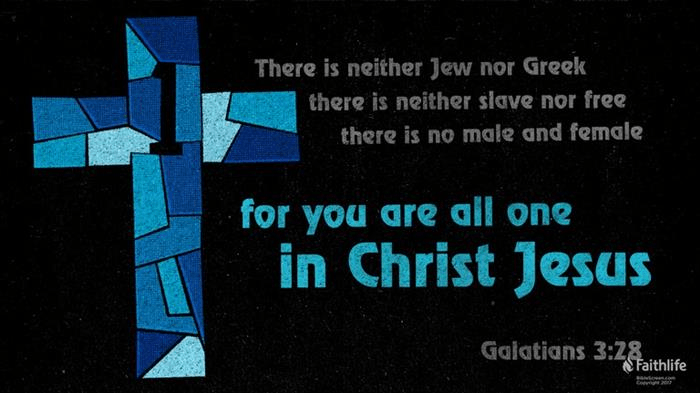
Get Along with Each Other (Romans 3:1-8)

So, what difference does it make who’s a Jew and who isn’t, who has been trained in God’s ways and who hasn’t? As it turns out, it makes a lot of difference—but not the difference so many have assumed.

First, there’s the matter of being put in charge of writing down and caring for God’s revelation, these Holy Scriptures. So, what if, in the course of doing that, some of those Jews abandoned their post? God didn’t abandon them. Do you think their faithlessness cancels out his faithfulness? Not on your life! Depend on it: God keeps his word even when the whole world is lying through its teeth. Scripture says the same:

Your words stand fast and true;
Rejection doesn’t faze you.

But if our wrongdoing only underlines and confirms God’s right-doing, shouldn’t we be commended for helping out? Since our lies don’t even make a dent in his truth, isn’t it wrong of God to back us to the wall and hold us to our word? These questions come up. The answer to such questions is no, a most emphatic No! How else would things ever get straightened out if God didn’t do the straightening?

It’s simply perverse to say, “If my lies serve to show off God’s truth all the more gloriously, why blame me? I’m doing God a favor.” Some people are actually trying to put such words in our mouths, claiming that we go around saying, “The more evil we do, the more good God does, so let’s just do it!” That’s pure slander, as I’m sure you’ll agree. (The Message)

The Apostle Paul’s letter to the Roman Church is a hefty sixteen chapters of dense material and extended arguments of intense reasoning. Likely,

Likely, Paul felt compelled to be so verbose because of the church’s situation.

The Roman Church, at the time of Paul’s writing, was made up of both Jewish and Gentile believers in Jesus. Jews and Gentiles have a complicated history together, to say the least.

The Roman Empire was firmly in control of Palestine and did not always treat the Jewish people well. In addition, the religious backgrounds of Jew and Gentile were as different as you can get.

Whereas the Jewish Christians had a long and rich history with God and the Old Testament, the Gentile Christians were green believers, fresh from centuries of paganism and esoteric rituals. Now, the two of them were together in one place, worshiping Jesus together.

Jews and Gentiles together made for a potentially combustible situation.

Throughout the letter to the Romans, Paul goes back and forth addressing the two groups of Jews and Gentiles. The overarching problem was this:

  • The Jewish believers tended to look down on the Gentile Christians and thought they needed to become Jewish to really be the kind of Christians God was looking for.
  • The Gentile believers tended to dismiss their Jewish brothers and sisters as backward and stuck in tradition.

Each group thought the other must become like them. So, Paul, bless his apostolic heart, had a hot mess in the making with these believers.

In our New Testament lesson for today, Paul is directing his comments toward the Gentile Christians. He wanted them to gain some appreciation for the Jewish people. After all, they were chosen by God to become a nation of priests and prophets for the world. Discounting that history would be to neglect and even invalidate their shared salvation.

For Paul, to have two churches, one Jew and the other Gentile, would be a complete travesty of Christ’s redemption for humanity.

Jesus sought to bring disparate peoples together and not keep them divided. The cross freed us by eliminating the barriers which separate us. The Roman Church needed to work together at being one people under the lordship of Christ.

There was to be no ethnic, religious, or political one-upmanship on Paul’s watch.

Truth be told, both Jew and Gentile did not always do so well with their respective histories. So, there is no ground for boasting or trying to argue for their own way. In fact, the unfaithfulness of people simply shows the incredible faithfulness of God in greater relief. 

If there were no sin, grace would not be needed; no cross would have existed. Just because the foulness and degradation of sin brings out the gracious, faithful, and forgiving character of God in Christ, does not mean that sin is okay or that we can flippantly wave it off with uttering some mumbo-jumbo cheap grace which devalues the majesty of God.

For example, when antebellum southern slaveholders in nineteenth-century America argued for their peculiar institution by saying that snatching black Africans from their homes was a good thing so that they could get out of their religious animistic worldview and be exposed to Christianity, I am positively sure that the Apostle Paul rolled over in his grave and begged Jesus to resurrect him early and send him to tackle such an affront to the cross of Christ!

Sin is never to be excused through twisted human mental gymnastics.

Paul worked laboriously to unite the churches he established and bring differing people groups together under Christ.

  • This does not mean is that all cultural and personal distinctions are ignored or erased.
  • This does mean that we value one another’s differences and gather around the shared value of knowing Jesus Christ.

The Church was neither going to become Jewish nor Gentile but something altogether new – one new people out of the two. Paul framed the matter this way to the Ephesian Church:

Therefore, remember that formerly you who are Gentiles by birth and called “uncircumcised” by those who call themselves “the circumcision” (which is done in the body by human hands)— remember that at that time you were separate from Christ, excluded from citizenship in Israel and foreigners to the covenants of the promise, without hope and without God in the world. But now in Christ Jesus you who once were far away have been brought near by the blood of Christ.

For he himself is our peace, who has made the two groups one and has destroyed the barrier, the dividing wall of hostility, by setting aside in his flesh the law with its commands and regulations. His purpose was to create in himself one new humanity out of the two, thus making peace, 16 and in one body to reconcile both of them to God through the cross, by which he put to death their hostility. He came and preached peace to you who were far away and peace to those who were near. For through him we both have access to the Father by one Spirit. (Ephesians 2:11-18, NIV)

Solitary righteousness is an oxymoron. Righteousness can only be truly lived and expressed with other people.

Yes, there is freedom in Christ. Yet, that freedom must be continually applied through making every effort to keep the unity of the Spirit through the bond of peace.

So, get along with one another.

O God, the Father of our Lord Jesus Christ, our only Savior, the Prince of Peace: Give us grace to seriously lay aside all unhappy divisions. Take away all hatred and prejudice, and whatsoever else may hinder us from godly union and harmony: that, as there is but one Body, and one Spirit, and one hope of our calling, one Lord, one faith, one baptism, one God and Father of us all; so, may we be forever all of one heart, and of one soul, united in one holy bond of truth and peace, faith and love, with one mind and one mouth, glorify Jesus Christ our Lord. Amen.

Luke 8:22-25 – Where Is Your Faith?

One day Jesus said to his disciples, “Let us go over to the other side of the lake.” So, they got into a boat and set out. As they sailed, he fell asleep. A squall came down on the lake, so that the boat was being swamped, and they were in great danger.

The disciples went and woke him, saying, “Master, Master, we’re going to drown!”

He got up and rebuked the wind and the raging waters; the storm subsided, and all was calm. “Where is your faith?” he asked his disciples.

In fear and amazement, they asked one another, “Who is this? He commands even the winds and the water, and they obey him.” (New International Version)

“I’m not afraid of storms, for I’m learning how to sail my ship.”

Louisa May Alcott

The opposite of faith isn’t little to no faith – it’s fear.

Fear, at its core, is being afraid of getting hurt. Fear is an emotion which alerts us to some danger that may break my heart or my body.

Being afraid, in and of itself, is neither good nor bad. It’s more about why fear bubbles up for us.

So, what makes you afraid? Why? How does fear influence your life?

Fear is often at the root of unhealthy behaviors such as:

  • Vilifying another, afraid that others I don’t know or who are different from me might harm me, my family, or my community.
  • Hiding my emotions, afraid my weaknesses or failures will be exposed or exploited.
  • Serving others, afraid that I won’t have worth, meaning, or purpose without helping.
  • Achieving or winning, afraid that I will be irrelevant or unwanted.
  • Smiling and being upbeat, afraid of facing and feeling the deep sadness within me.
  • Procrastinating projects, tasks, or conversations, afraid of being disliked or rejected.

Today’s Gospel story has Jesus at the center of the storm. The wind and the waves, the storm, is not the central element of the story. Jesus is. And that’s an important distinction, because whenever we put outside circumstances as the central elements of our own stories, anxious fear is the inevitable result.

“Fear keeps us focused on the past or worried about the future. If we can acknowledge our fear, we can realize that right now we are okay.”

Thich Nhat Hanh

The disciples were surprised that even the wind and the waves obey him! They were afraid because of the furious storm. Yet, Jesus was sleeping, not the least bit fearful. The disciples woke him, and in shallow breathed words of anxiety stated they all were going to drown because of the extreme conditions.

In my mind’s eye, I imagine Jesus slowly awaking and lazily rising from his slumber, simply rebuking the wind and waves, with neither any anxiety nor any hurry, and then chiding the disciples for their inability to place their faith in him.

Jesus Calms the Storm by the Benedictine Sisters of Turvey Abbey

The disciples’ expectations of and faith in Jesus were way too low! That’s what fear does. It diminishes faith. Like Chicken Little, who thought the sky was falling and all was ruined, we become chickens of little faith.

Many people believe God hears and answers prayer. Yet sometimes, our faith can be so small that, when God answers those prayers in ways far superior to our expectations, we are slack-jawed and astonished by it. Luke’s Gospel records several instances of people being surprised by Jesus: 

Everyone who heard him was amazed at his understanding and his answers. (Luke 2:47, NIV)

They were astounded at his teaching because he spoke with authority. In the synagogue there was a man who had the spirit of an unclean demon, and he cried out with a loud voice, “Leave us alone! What have you to do with us, Jesus of Nazareth? Have you come to destroy us? I know who you are, the Holy One of God.” But Jesus rebuked him, saying, “Be quiet and come out of him!”

Then the demon, throwing the man down before them, came out of him without doing him any harm. They were all astounded and kept saying to one another, “What kind of word is this, that with authority and power he commands the unclean spirits and they come out?” (Luke 4:32-36, NRSV)

I want you to know that the Son of Man has authority on earth to forgive sins.” Then he said to the paralyzed man, “Get up, pick up your stretcher, and go home.”

The man immediately stood up in front of them and picked up the stretcher he had been lying on. Praising God, he went home.

Everyone was amazed and praised God. They were filled with awe and said, “We’ve seen things today we can hardly believe!” (Luke 5:24-26, GW)

Jesus was driving out a demon that could not talk; and when the demon went out, the man began to talk. The crowds were amazed. (Luke 11:14, GNT)

Jesus is more marvelous, wonderful, powerful, and awesome than we know. Jesus will take care of us; he will not let his people be destroyed. And, what’s more, he has the power and authority to heal us.

Whenever we truly grasp who Jesus is, and how much he loves us, there is no room for fear, only faith. 

Even though the disciples’ faith was small, Jesus still responded to it with grace because even small faith is faith. Grace is undeserved help. Our Lord helps anyone who approaches him, whether with little faith or big. Our small faith is no obstacle for Jesus in delivering us from the storms of life.

You might be presently experiencing a violent storm in your life. Please know that Jesus can bring peace.

Perhaps you have a besetting sin that dogs you every day. Jesus can deliver you.

It could be that depression follows you like a lost kitten wherever you go. Jesus can bring new life and fresh joy to your life.

Maybe there is an estranged relationship you have lost hope over. Jesus can restore it.

Perchance you think your neighbor, co-worker, or family member is too far from God to ever know Jesus. By now you know the response….

Ethiopian Orthodox Church depiction of Jesus calming the storm

Our expectations of Jesus are much too small! We can pray big prayers because we serve a big and powerful God who has the authority to command even the wind and the waves!

The Gospel of Mark portrays Jesus as the ultimate authority over everything, including powerful storms. Christ uses that authority to bestow grace, even in the face of the smallest of faith in his followers. Jesus cares about people and seeks to deliver them from the dominion of darkness.  

So, may we participate with Jesus in his agenda for this world.

May we submit to his rule and authority.

May we exhibit the same care, compassion, and concern for people as Jesus does.

May we find our faith, especially amidst the worst of situations.

Lord Jesus, Son of God, I believe all things are possible through you; help my unbelief! Take my small and seemingly insignificant faith and use it to calm the storms in my life and demonstrate your authority even over the wind and the waves. Amen.

Luke 7:18-30 – Use the Right Color

John’s disciples told him about all these things. Calling two of them, he sent them to the Lord to ask, “Are you the one who is to come, or should we expect someone else?”

When the men came to Jesus, they said, “John the Baptist sent us to you to ask, ‘Are you the one who is to come, or should we expect someone else?’”

At that very time Jesus cured many who had diseases, sicknesses and evil spirits, and gave sight to many who were blind. So, he replied to the messengers, “Go back and report to John what you have seen and heard: The blind receive sight, the lame walk, those who have leprosy are cleansed, the deaf hear, the dead are raised, and the good news is proclaimed to the poor. Blessed is anyone who does not stumble on account of me.”

After John’s messengers left, Jesus began to speak to the crowd about John: “What did you go out into the wilderness to see? A reed swayed by the wind? If not, what did you go out to see? A man dressed in fine clothes? No, those who wear expensive clothes and indulge in luxury are in palaces. But what did you go out to see? A prophet? Yes, I tell you, and more than a prophet. This is the one about whom it is written:

“‘I will send my messenger ahead of you,
    who will prepare your way before you.’

I tell you, among those born of women there is no one greater than John; yet the one who is least in the kingdom of God is greater than he.”

(All the people, even the tax collectors, when they heard Jesus’ words, acknowledged that God’s way was right, because they had been baptized by John. But the Pharisees and the experts in the law rejected God’s purpose for themselves, because they had not been baptized by John.) (New International Version)

For a short time in my life, I had a side business doing some painting. I once painted an interior apartment in a large beautiful Victorian house. When I was done, it looked great. However, there was a bit of a problem. The owner came to check on my progress only to find that I had painted with the wrong color! I was certain I had it right, but, alas, the job ended up taking twice as long as anticipated.

Sometimes, we can be so sure about our plans, only to discover our expectations were off. John the Baptist was sitting in jail, not for any crime other than offending the king. As he sat there, John began to doubt. He started wondering about Jesus. Maybe he had been wrong about him. Perhaps he was not the Messiah, after all. 

John had been doing ministry with the expectation that Jesus would beat up the Romans, usher in a renewed political Israel, and put down all threats to his Lordship. But that was not happening. John was now uncertain. So, he sent some of his disciples to Jesus to ask, “Are you the one who is to come, or shall we look for another?”

John reasoned that if Jesus were really a sovereign king, he would not be languishing in a prison and facing imminent death. Jesus responded to John’s uncertainty by quoting the prophet Isaiah and letting him know that the kingdom takeover was going exactly as planned. 

“Huh!?” John must have wondered. Maybe something was lost in translation. But no. The problem was that John had been using the wrong paint. John’s plans and expectations did not fully sync with Jesus.

It’s easy to doubt when unexpected and unwanted adversity strikes. When things don’t go according to our expected plans, then what? 

This is why it is so vitally important to continually seek the Scriptures and seek the Lord Jesus so that we might not only paint the right building but also use the paint Jesus expects us to use. 

The thing John got right was pursuing Jesus. When in doubt, he sought the Lord – and that is something we all can emulate.

As we paint the portrait of our lives, let’s be sure to use the colors Jesus gives us.

Lord Christ, you came into the world as one of us, and suffered as we do. As I go through the trials of life, help me to realize that you are with me at all times and in all things; that I have no secrets from you; and that your loving grace enfolds me for eternity. In the security of your embrace, I pray. Amen.