On a Time Out (Exodus 2:11-15)

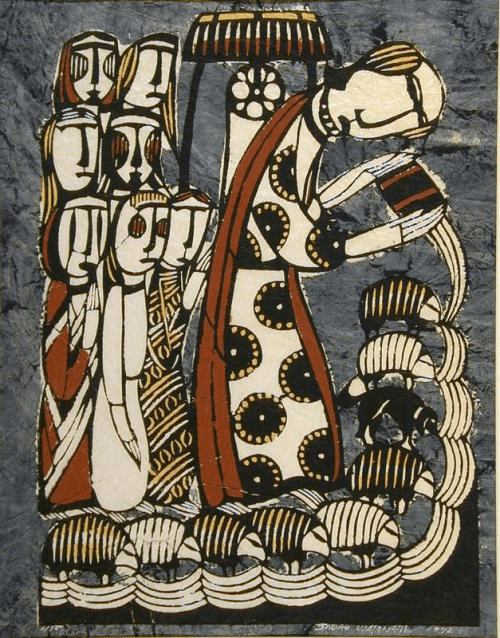
Moses in Midian, by Japanese artist Sadao Watanabe, 1972

One day, after Moses had grown up, he went out to where his own people were and watched them at their hard labor. He saw an Egyptian beating a Hebrew, one of his own people. Looking this way and that and seeing no one, he killed the Egyptian and hid him in the sand. The next day he went out and saw two Hebrews fighting. He asked the one in the wrong, “Why are you hitting your fellow Hebrew?”

The man said, “Who made you ruler and judge over us? Are you thinking of killing me as you killed the Egyptian?” Then Moses was afraid and thought, “What I did must have become known.”

When Pharaoh heard of this, he tried to kill Moses, but Moses fled from Pharaoh and went to live in Midian, where he sat down by a well. (New International Version)

Faith is dynamic, not static. It flows and moves, waxes and wanes, strengthens and weakens. Faith isn’t like a kitschy trinket you buy in a quaint downtown shop, and then place it as a nice object in a prominent place of your house or office. Rather, faith is much more subjective, like taking an adventure down some whitewater rapids, not quite knowing what’s going to happen.

Moses needed to learn how to make healthy decisions of faith, just like the rest of us. Just because we stand at this point in history and can look back at what a religious titan he was, doesn’t mean that Moses was always a paragon of faith and patience. In fact, quite the opposite.

An eighty year old Moses became the human agent of God’s deliverance of the Israelites from the Egyptians, after a forty year stint in the backside of the desert. This tells us that it took him awhile to mature into being the sort of leader God wanted to bring God’s people out of slavery. 

Even though the forty year old Moses may have had a sense that the Israelites needed freedom from slavery and acted on that sense by killing a ruthless Egyptian, his method, maturity, and misplaced timing were off.

There is a time for everything, said the Teacher of wisdom (Ecclesiastes 3:1). Wisdom – the ability to apply faith to concrete situations with appropriate forms – is often in the timing of things. To know when to speak and when to listen, when to act and when to wait, is an important facet of faith. 

The ancient Israelites were slaves in Egypt for a long time, 400 years. Moses knew they were suffering, and he acted in “good faith.” Yet, it was not yet time, and it was a rash action, in killing the Egyptian. Eventually, the Jewish cry of suffering arose to God, and God heard them, remembering the divine covenant. 

Questions of why God did not act sooner, or use Moses earlier, is information that is only privy within God, and likely will not be answered satisfactorily for us, this side of heaven.

In order to develop a strong and wise faith – with an opportune sense of timing – we need to rely on God. Trusting in ourselves, our own efforts, and our own gauge of how things ought to proceed, will usually not end well. We may, like Moses, find ourselves taking a “time out” from God in obscurity until we learn to wait on him.

Some might think of a “time out” as being negative, even punitive, such as giving a time out to a toddler because of naughtiness, or calling a time out in sports because the team is playing poorly. However, a time out can also be a positive experience. The following are some advantages of the “time out:”

Reflect

Little did Moses know at the time, but he would have the next 40 years to reflect on his life and actions in Egypt. Reflection is important. It gives us a chance to step back, learn from what happened, and adjust for the next time we experience a similar situation. Taking this time acts like a mirror, enabling us to gain some clarity on what we’ve said and done.

So I reflected on all this and concluded that the righteous and the wise and what they do are in God’s hands, but no one knows whether love or hate awaits them. All share a common destiny—the righteous and the wicked, the good and the bad, the clean and the unclean, those who offer sacrifices and those who do not. (Ecclesiastes 9:1-2, NIV)

Refocus

Upon taking the time to reflect, it then provides us with the opportunity to refocus our efforts with wisdom. To refocus means to come back around in giving close attention and concentration on what’s most important to us. The desire of Moses was admirable in being concerned about his fellow Israelites. He just went too far and needed to fix his eyes on the Lord and how to best go about freeing them.

We must focus on Jesus, the source and goal of our faith. He saw the joy ahead of him, so he endured death on the cross and ignored the disgrace it brought him. (Hebrews 12:2, GW)

Renew

Reflecting on the past and refocusing in the present are not quite enough to get us back in the game of life. We also need renewal. To be renewed involves fresh commitment to the things we have learned. I believe it’s best to renew our commitments with some sort of ritual, because rituals help us psychologically and spiritually to launch into the focused endeavors ahead of us. That’s why athletes always have a short ritual of breaking their huddle before returning to the contest.

Don’t be conformed to this world, but be transformed by the renewing of your mind, so that you may prove what is the good, well-pleasing, and perfect will of God. (Romans 12:2, WEB)

Return

A “time out” is designed to be temporary. Eventually, a “time in” happens. We get back in the game. We return to what we were doing, hopefully with a better understanding and grasp of what needs to happen and how to go about it.

In the fullness of time, the Apostle Paul said to the Galatians, Jesus came, born of a woman, born under law, to redeem those under the law (Galatians 4:4-5). God knows what he’s doing, even though it might seem like the Lord is sometimes slow to act. Yet, God sees, and God delivers – and does it according to divine timing.

If we live, we live for the Lord; and if we die, we die for the Lord. So, whether we live or die, we belong to the Lord. For this very reason, Christ died and returned to life so that he might be the Lord of both the dead and the living. (Romans 14:8-9, NIV)

Redeeming God, you control all things, including the clock. Give me wisdom so that my sense of timing might reflect your will and your way, through Jesus Christ, your Son, who with you and the Holy Spirit reign supremely as one God, now and forever. Amen.

Hold It Loosely (Exodus 1:1-7)

When Jacob went to Egypt, his son Joseph was already there. So Jacob took his eleven other sons and their families. They were: Reuben, Simeon, Levi, Judah, Issachar, Zebulun, Benjamin, Dan, Naphtali, Gad, and Asher. Altogether, Jacob had 70 children, grandchildren, and great-grandchildren who went with him.

After Joseph, his brothers, and everyone else in that generation had died, the people of Israel became so numerous that the whole region of Goshen was full of them. (Contemporary English Version)

Exodus is the second book of the Bible, and the second of five books known as the “Pentateuch” by Christians, and the “Torah” by Jews. The first book, Genesis, ended with the story of Joseph – who was one of the 12 patriarchs. God established a covenant with Abraham, the father of Judaism, and promised him land and descendants – even though he did not have a son. God miraculously gave Abraham and Sarah a biological son, Isaac, who grew up to be the father of Jacob, or Israel, Joseph’s father.

The stories in Genesis surrounding Abraham, Isaac, Jacob, and Joseph were filled with wonderings of whether God’s promise would ever survive, or not. Yet, it did. Joseph, in the ultimate reversal of fortunes, went from the lowest person in Egypt to it’s highest official. Through Joseph, the brothers and their families ended up relocating to Egypt because of a severe famine.

Present-day land of Goshen, Egypt

As time moved on, Joseph, his brothers, and all that generation died. In contrast to the extended family of Jacob, 70 of them, who initially went to Egypt, the opening of of Exodus relays an exponential growth in numbers of Israelites.

God was faithfully and tirelessly preserving the covenant and the promise for Israel. When the people went to Egypt, God assured them they need not be afraid. The Lord will make them a great nation, will be with them, and shall lead them back out again. (Genesis 46:1-4)

The opening of Exodus not only connects us with events in the latter part of Genesis, but also hearkens back to it’s very beginning, when God spoke to the first human couple. The Lord gave them a five-fold blessing, consisting of commands to 1) be fruitful 2) multiply 3) fill the earth 4) subdue it, and 5) have dominion over it. (Genesis 1:28)

Following the Flood, God blessed Noah, repeating the commands to be fruitful, multiply, and fill the earth (Genesis 9:1). Later, God spoke to Abraham, promisingto make him fruitful (Genesis 17:5-9). Moving into Exodus, we see a fulfillment of the commands and the promise taking shape, stating that the descendants of Israel were fruitful and multiplying, so that the land was filled with them.

It was this very blessing of progeny, and the fertile increase of descendants, which sets up the entire book of Exodus. The great and growing numbers of Israelites became a source of concern and fear amongst the Egyptians. It wasn’t long before the Jews were seen as another source of slave labor.

Sometimes, we must bear in mind and remember that great blessing also has an underbelly of great blight. Only God and relationships last forever; everything else is temporary, including our earthly blessings.

Therefore, it is wise to hold all things loosely, with open hands, and not with clenched fists that believes possessing things in this moment will be permanent. The following are some things to remember:

Remember who is in control

When things are going well, it may create the illusion that I am in charge of the blessing. But, in reality, it was given to you, and it can be taken away, as well.

The only thing you can control are your thoughts, feelings, emotions, choices, actions and the story you are telling yourself about what happened in the past, is happening now, and will happen tomorrow.

We all have our personal invisible backpacks to carry. That backpack is ours, and nobody else’s. Others have their own burdens to carry, which are individual to them. They aren’t yours to carry. Their stories aren’t yours to tell.

God is the Sovereign of the universe, and controls all things. That is God’s burden to carry. Not yours. Carrying the world on your shoulders isn’t your job. So, hold loosely whatever happens on this earth, whether for good or ill. 

Remember that life is both planning and improvisation

We have an agenda, make our plans, and put things in place. Yet, in the execution of doing it, we have to move with whatever circumstances and conditions arise – with whatever life throws our way – and then adjust our expectations.

Remember it’s both in planning and in improvising. The Israelites laid plans to go to Egypt, went there, and then had to deal with changing conditions once they were there. All planning and no improvising is unrealistic; and all improvisation with no plan is flying by the seat of your pants and living in a dream world which doesn’t exist.

What’s more, it might be your plan, or your group’s plan, but it’s not everybody’s plan. They have the freedom to say, “No thank you.” So, be careful to not marry yourself to a particular outcome. Release the urge to cling or obsess about certain expectations. Hold your plans loosely, and plan to improvise.

Remember to cooperate with God

In reality, there is a divine/human cooperative which exists on the earth. Ideally, we are to work together, me doing my part, and God handling the rest. And the both of us constantly must be in dialogue with each other.

When we align with this truth, and participate with God and integrate this cooperative into daily life, then we begin to relax, breathe, move with confidence, and speak with purpose. Head, heart, and gut are no longer disparate parts within me, but work together in a harmonious sync with the Lord.

If this is a challenge for you, set aside some time and be in nature. Look around you and observe all the life thriving right in front of you. Connecting with what is alive connects us to the universal Love which exists everywhere. And that Love can help us and heal us – if we will but let it.

I can hold things loosely because I know the internal pressure of “getting it right” isn’t mine to carry. I can cooperate with God, relax, do my best, and trust.

Blessings are wonderful and abound everywhere. Yet, adversity, acrimony, and even abuse still lurk about in this old fallen world. So, may you learn to hold all things loosely, and live as you know you can, and ought. Amen.

Some Needed Encouragement (Revelation 15:1-4)

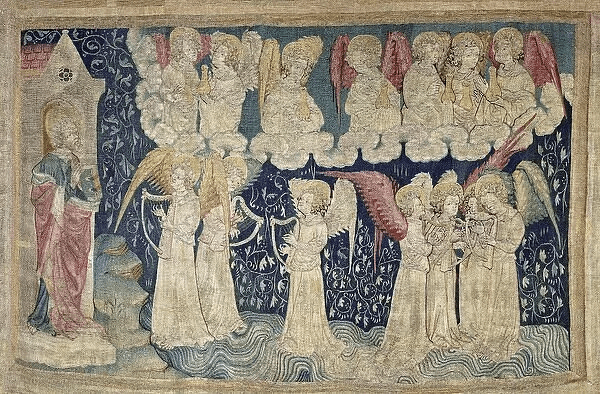
The Seven Last Plagues and the Harps of God, by Nicolas Bataille, c.1380 C.E.

I saw in heaven another great and marvelous sign: seven angels with the seven last plagues—last, because with them God’s wrath is completed. And I saw what looked like a sea of glass glowing with fire and, standing beside the sea, those who had been victorious over the beast and its image and over the number of its name. They held harps given them by God and sang the song of God’s servant Moses and of the Lamb:

“Great and marvelous are your deeds,
    Lord God Almighty.
Just and true are your ways,
    King of the nations.
Who will not fear you, Lord,
    and bring glory to your name?
For you alone are holy.
All nations will come
    and worship before you,
for your righteous acts have been revealed.” (New International Version)

Let’s keep in mind that the book of Revelation (also known as The Apocalypse of John) is a vision of the Apostle John about how things shake out in the end. The purpose of the vision is not for us to get lost in esoteric speculations about the future and try to figure out specific dates and times of God’s judgment.

Rather, John’s Revelation was primarily meant to give believers a future hope that their hardships and suffering will not last forever; there is a time coming, soon, when Judge Jesus will make all things right and all things new. In other words, the vision of John was designed to provide needed encouragement to followers of Jesus.

The believers needed a connection to their spiritual heritage – a way to see that they weren’t an isolated faith island in the middle of the world’s crud. The heavenly beings were singing a song of Moses and of the Lamb (Jesus). The two are connected, thus bringing together the saints of ages past with the struggling Christians of the present.

The song of Moses is a song of triumph, sung after the Israelites passed through the Red Sea unharmed and the Egyptian army was eradicated:

“I will sing to the Lord,
    for he is highly exalted.
Both horse and driver
    he has hurled into the sea.

“The Lord is my strength and my defense;
    he has become my salvation.
He is my God, and I will praise him,
    my father’s God, and I will exalt him.
The Lord is a warrior;
    the Lord is his name.
Pharaoh’s chariots and his army
    he has hurled into the sea.
The best of Pharaoh’s officers
    are drowned in the Red Sea.
The deep waters have covered them;
    they sank to the depths like a stone.
Your right hand, Lord,
    was majestic in power.
Your right hand, Lord,
    shattered the enemy.

Flee From Egypt, by Rev. Albert Lee Wagner, 1975

“In the greatness of your majesty
    you threw down those who opposed you.
You unleashed your burning anger;
    it consumed them like stubble.
By the blast of your nostrils
    the waters piled up.
The surging waters stood up like a wall;
    the deep waters congealed in the heart of the sea.
The enemy boasted,
    ‘I will pursue, I will overtake them.
I will divide the spoils;
    I will gorge myself on them.
I will draw my sword
    and my hand will destroy them.’
But you blew with your breath,
    and the sea covered them.
They sank like lead
    in the mighty waters.
Who among the gods
    is like you, Lord?
Who is like you—
    majestic in holiness,
awesome in glory,
    working wonders?

“You stretch out your right hand,
    and the earth swallows your enemies.
In your unfailing love you will lead
    the people you have redeemed.
In your strength you will guide them
    to your holy dwelling.
The nations will hear and tremble;
    anguish will grip the people of Philistia.
The chiefs of Edom will be terrified,
    the leaders of Moab will be seized with trembling,
the people of Canaan will melt away;
    terror and dread will fall on them.
By the power of your arm
    they will be as still as a stone—
until your people pass by, Lord,
    until the people you bought pass by.
You will bring them in and plant them
    on the mountain of your inheritance—
the place, Lord, you made for your dwelling,
    the sanctuary, Lord, your hands established.

“The Lord reigns
    for ever and ever.” (Exodus 15:1-18, NIV)

Throughout the millennia, this deliverance from harsh slavery to freedom is annually recalled and remembered in the Passover. The original Passover in Egypt involved a lamb being slain and it’s blood applied to the doorposts of each Jewish home. The avenging angel “passed over” those homes and instead dealt with the Egyptian houses which had no lamb’s blood over the door.

The song of Moses and the song of the Lamb (Jesus) are really the same song. Both the deliverance out of Egypt and through the Red Sea, as well as the deliverance from guilt and shame through the cross and resurrection, was real salvation from all that oppressed and hindered the people from living into their true selves.

This connection to salvation history was a great boon to the early believers undergoing their own brand of injustice, oppression, and persecution – just for being followers of Jesus.

So, we all need to apply the death of the Lamb to our present situations, so that we can endure through hardship and not give up and experience a failure of faith. We continually need a strengthening of faith, to recall and remember who we are and to whom we belong, so that we will sing our own song of hope and deliverance.

“Awake and Sing the Song,” by English hymnist William Hammond (1719-1783)

Awake, and sing the song
Of Moses and the Lamb;
Tune every heart and every tongue
To praise the Savior’s name.

Sing of His dying love;
Sing of His rising power;
Sing how He intercedes above
For those whose sins He bore.

Tell, in seraphic strains,
What He has done for you;
How He has taken off your chains
And formed your hearts anew.

His faithfulness proclaim
While life to you is given:
Join hands and hearts to praise His name
Till we all meet in heaven.

Amen.

Living with Purpose (Exodus 19:1-9a)

Moses, by Marc Chagall, 1956

On the first day of the third month after the Israelites left Egypt—on that very day—they came to the Desert of Sinai. After they set out from Rephidim, they entered the Desert of Sinai, and Israel camped there in the desert in front of the mountain.

Then Moses went up to God, and the Lord called to him from the mountain and said, “This is what you are to say to the descendants of Jacob and what you are to tell the people of Israel: ‘You yourselves have seen what I did to Egypt, and how I carried you on eagles’ wings and brought you to myself. Now if you obey me fully and keep my covenant, then out of all nations you will be my treasured possession. Although the whole earth is mine, you will be for me a kingdom of priests and a holy nation.’ These are the words you are to speak to the Israelites.”

So Moses went back and summoned the elders of the people and set before them all the words the Lord had commanded him to speak. The people all responded together, “We will do everything the Lord has said.” So Moses brought their answer back to the Lord.

The Lord said to Moses, “I am going to come to you in a dense cloud, so that the people will hear me speaking with you and will always put their trust in you.” (New International Version)

If I were to list every job I’ve ever had in my life, it would be a long list. I’m sure, at this point in my life, that I wouldn’t immediately recall some of them. Some workplaces were run well. Others, especially in the factories I worked, were characterized by inattention to working conditions and expected employees to be more like extensions of their machines than like people. And I typically never knew why we were doing what we were doing.

I’ve also been in many churches and pastored a wide array of congregations. Some of the churches were run well and were attentive to their mission and service to the world. Others left a lot to be desired. Without trying to be simplistic, today’s Old Testament lesson gives the clue to what makes the difference: a clear sense of purpose. 

God made it clear that Israel was given the mandate “to be a kingdom of priests and a holy nation.”

Although there was always a remnant of Israelites who held to this original purpose, we know the end of the story. Israel largely failed to fulfill their God-given reason for existence and did not follow through with their missionary goal. They ended up in exile, mostly because of straying from their intended purpose, which then also led to a lack of holiness.

When Christians, Churches, and faith communities of all kinds lose sight of why they exist, they degenerate into a bunch of finicky cats who want ever richer food and a lusher bed to sleep on. 

So, let’s be clear about the reason for our existence as an institutional Body of believers: We exist not to be catered to, but to be people who do the priestly work of interceding for others so that the nations might come to know the God of all the earth. 

“Intercessory prayer might be defined as loving our neighbor on our knees.”

Charles Bent

We exist for holiness, set apart to be the conduit between heaven and earth so that others might come to embrace the life that is truly life. 

Christianity recognizes that it was Christ who fulfilled the great promises of God as the ultimate Prophet, Priest, and King. Through his holy life, Christ became the priest who made the once for all sacrifice to end all sacrifices. He reigns over a moral kingdom which is a light to the nations. And the Church, as Christ’s Body, is to continue this purpose of kingdom ethics by letting the light of Jesus shine into the shadowy dark places of this world.

Wherever you find complaining, backbiting, gossip, and slander, there you will find a profound lack of purpose. Because without a “why,” people fill the vacuum with endless squabbling about petty affairs which amount to nothing, in the scope of eternity.

And wherever there is only talk of how others can meet personal needs and satisfy pet desires, in that place there is a lost mandate to be a priest bringing others to God. 

The gracious and priestly work of intercession is the purpose many are lacking. Believers everywhere must return to this holy and sacred vocation.

Jesus modeled for us the work of intercession when he prayed:

“Father, I want those you have given me to be with me where I am, and to see my glory, the glory you have given me because you loved me before the creation of the world. Righteous Father, though the world does not know you, I know you, and they know that you have sent me. I have made you known to them, and will continue to make you known in order that the love you have for me may be in them and that I myself may be in them.” (John 17:24-26, NIV)

The Lord has said what the divine purpose is. It is our task, therefore, to do everything God has spoken.

O sovereign and majestic God, you are holy. So, I choose to be holy in all I do. I intercede for those around me who either cannot or will not come to you on their own. Draw them to yourself so that they might experience the grace and mercy of Jesus Christ, through the power of the Holy Spirit. Amen.