
God Will Make a Way (Exodus 2:1-10)

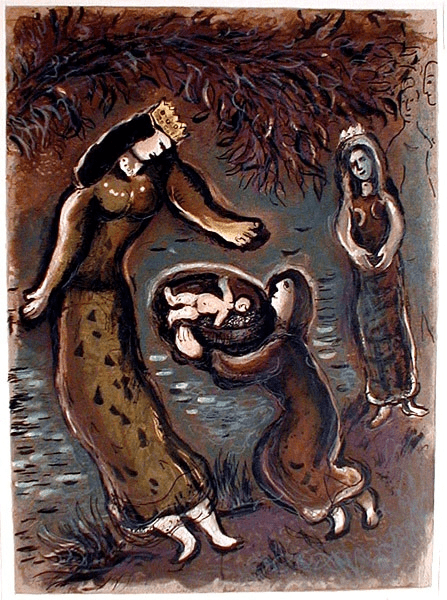
Moses is saved from the water by Pharaoh’s daughter, by Marc Chagall, 1966

Now a man from Levi’s household married a Levite woman. The woman became pregnant and gave birth to a son. She saw that the baby was healthy and beautiful, so she hid him for three months. When she couldn’t hide him any longer, she took a reed basket and sealed it up with black tar. She put the child in the basket and set the basket among the reeds at the riverbank. The baby’s older sister stood watch nearby to see what would happen to him.

Pharaoh’s daughter came down to bathe in the river, while her women servants walked along beside the river. She saw the basket among the reeds, and she sent one of her servants to bring it to her. When she opened it, she saw the child. The boy was crying, and she felt sorry for him. She said, “This must be one of the Hebrews’ children.”

Then the baby’s sister said to Pharaoh’s daughter, “Would you like me to go and find one of the Hebrew women to nurse the child for you?”

Pharaoh’s daughter agreed, “Yes, do that.” So the girl went and called the child’s mother. Pharaoh’s daughter said to her, “Take this child and nurse it for me, and I’ll pay you for your work.” So the woman took the child and nursed it. After the child had grown up, she brought him back to Pharaoh’s daughter, who adopted him as her son. She named him Moses, “because,” she said, “I pulled him out of the water.” (Common English Bible)

A new Pharaoh was enthroned in Egypt. Enough time had gone by that the legacy of Joseph as the administrator in saving many Egyptian people was lost. So, because the Israelites had grown to such large numbers, Pharaoh was afraid.

The politics of fear typically results in somebody getting oppressed. Indeed, fear became the driving force to a series of escalating oppressive policies initiated by Pharaoh, even to the point of planned infanticide. The Jewish midwives were instructed toward this end.

But the midwives did not fear the Egyptian Pharaoh. Instead they had a healthy fear of God (Exodus 1:17, 21). With such rightly ordered fear, the Jewish midwives defied the order of Pharaoh and openly disobeyed the royal command to murder Hebrew boys.

Here then, we have the setting for a special Hebrew baby to be born named Moses. He is the healthy child of two devout Levites. And although God’s name is not referenced in the verses for today, we can nonetheless see the providence and protection of the Lord within the narrative.

Through a complex chain of events, both the birth mother and the royal daughter care for this baby, protecting his life, with a divine provision for the needs of the infant Moses. Most stories in the Old Testament have contrasting characters within them, and today’s is no exception.

Pharaoh was the ruler over all of Egypt, and yet, he feared a loss of power and the status quo because of the Israelites – even though he reigned during a time of political peace, with hegemony reaching into the Middle East. As Pharaoh’s paranoid fear rose, so did God’s response of divine sovereignty over him, by providing protection against his diabolical intentions.

In contrast to Pharaoh, a powerless and non-descript Hebrew couple were married, conceived and bore a family of a daughter and two sons – Moses being the youngest. They had nothing, yet everything; whereas Pharaoh had everything, yet nothing. Thriving and flourishing has to do with a lot more than wealth and material resources.

Maternal care is powerful. And it finds a way to win the day and not only save a baby, but also to ensure that the baby grows, lives, and thrives. No royal edict can defeat the resilient strength of maternal compassion.

Despite Pharaoh’s increasing oppression, the compassion of several women ends up raising the very one who will lead the Israelites into liberation from this oppression.

With the Lord, a way will be found where there is no way. God + nothing = everything.

For us today, there is often a tendency to look back on the good old days when God did great things, and to look ahead when the Lord will return and make all things new and right. Yet we too often neglect to be mindful and live in the present moment, and know the God who is present with us right now.

We may remember the awesome deeds that God once did; and rejoice in biblical stories which demonstrate the Lord’s power, provision, and protection. We may look forward to the fulfillment of God’s promises in the person of Jesus when he returns, and gain hope from that.

Now, in this present evil age, and in this messed up world, we also have the God of the present tense. God will make a way, in this present time, where there seems to be no way. God is doing something new and amazing for us today.

And that way will be clear enough for us to know – and incredible enough for us to not predict or imagine. For God’s watch-care and deliverance can (and does) take many forms. When the Lord fulfills divine plans, it sometimes comes in the most creative and incredible way possible, so that we will have no doubt where it came from.

“God Will Make a Way” by Don Moen

God will make a way, Where there seems to be no way
He works in ways we cannot see, He will make a way for me
He will be my guide, Hold me closely to His side
With love and strength, For each new day
He will make a way He will make a way

By a roadway in the wilderness, He’ll lead me
And rivers in the desert will I see
Heaven and earth will fade
But His Word will still remain
He will do something new today

On a Time Out (Exodus 2:11-15)

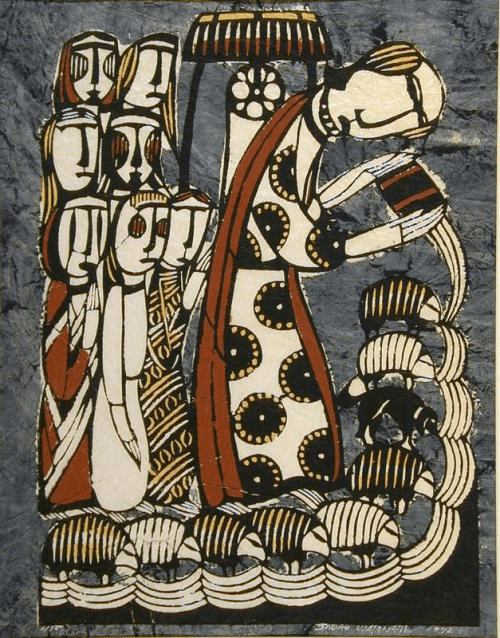
Moses in Midian, by Japanese artist Sadao Watanabe, 1972

One day, after Moses had grown up, he went out to where his own people were and watched them at their hard labor. He saw an Egyptian beating a Hebrew, one of his own people. Looking this way and that and seeing no one, he killed the Egyptian and hid him in the sand. The next day he went out and saw two Hebrews fighting. He asked the one in the wrong, “Why are you hitting your fellow Hebrew?”

The man said, “Who made you ruler and judge over us? Are you thinking of killing me as you killed the Egyptian?” Then Moses was afraid and thought, “What I did must have become known.”

When Pharaoh heard of this, he tried to kill Moses, but Moses fled from Pharaoh and went to live in Midian, where he sat down by a well. (New International Version)

Faith is dynamic, not static. It flows and moves, waxes and wanes, strengthens and weakens. Faith isn’t like a kitschy trinket you buy in a quaint downtown shop, and then place it as a nice object in a prominent place of your house or office. Rather, faith is much more subjective, like taking an adventure down some whitewater rapids, not quite knowing what’s going to happen.

Moses needed to learn how to make healthy decisions of faith, just like the rest of us. Just because we stand at this point in history and can look back at what a religious titan he was, doesn’t mean that Moses was always a paragon of faith and patience. In fact, quite the opposite.

An eighty year old Moses became the human agent of God’s deliverance of the Israelites from the Egyptians, after a forty year stint in the backside of the desert. This tells us that it took him awhile to mature into being the sort of leader God wanted to bring God’s people out of slavery. 

Even though the forty year old Moses may have had a sense that the Israelites needed freedom from slavery and acted on that sense by killing a ruthless Egyptian, his method, maturity, and misplaced timing were off.

There is a time for everything, said the Teacher of wisdom (Ecclesiastes 3:1). Wisdom – the ability to apply faith to concrete situations with appropriate forms – is often in the timing of things. To know when to speak and when to listen, when to act and when to wait, is an important facet of faith. 

The ancient Israelites were slaves in Egypt for a long time, 400 years. Moses knew they were suffering, and he acted in “good faith.” Yet, it was not yet time, and it was a rash action, in killing the Egyptian. Eventually, the Jewish cry of suffering arose to God, and God heard them, remembering the divine covenant. 

Questions of why God did not act sooner, or use Moses earlier, is information that is only privy within God, and likely will not be answered satisfactorily for us, this side of heaven.

In order to develop a strong and wise faith – with an opportune sense of timing – we need to rely on God. Trusting in ourselves, our own efforts, and our own gauge of how things ought to proceed, will usually not end well. We may, like Moses, find ourselves taking a “time out” from God in obscurity until we learn to wait on him.

Some might think of a “time out” as being negative, even punitive, such as giving a time out to a toddler because of naughtiness, or calling a time out in sports because the team is playing poorly. However, a time out can also be a positive experience. The following are some advantages of the “time out:”

Reflect

Little did Moses know at the time, but he would have the next 40 years to reflect on his life and actions in Egypt. Reflection is important. It gives us a chance to step back, learn from what happened, and adjust for the next time we experience a similar situation. Taking this time acts like a mirror, enabling us to gain some clarity on what we’ve said and done.

So I reflected on all this and concluded that the righteous and the wise and what they do are in God’s hands, but no one knows whether love or hate awaits them. All share a common destiny—the righteous and the wicked, the good and the bad, the clean and the unclean, those who offer sacrifices and those who do not. (Ecclesiastes 9:1-2, NIV)

Refocus

Upon taking the time to reflect, it then provides us with the opportunity to refocus our efforts with wisdom. To refocus means to come back around in giving close attention and concentration on what’s most important to us. The desire of Moses was admirable in being concerned about his fellow Israelites. He just went too far and needed to fix his eyes on the Lord and how to best go about freeing them.

We must focus on Jesus, the source and goal of our faith. He saw the joy ahead of him, so he endured death on the cross and ignored the disgrace it brought him. (Hebrews 12:2, GW)

Renew

Reflecting on the past and refocusing in the present are not quite enough to get us back in the game of life. We also need renewal. To be renewed involves fresh commitment to the things we have learned. I believe it’s best to renew our commitments with some sort of ritual, because rituals help us psychologically and spiritually to launch into the focused endeavors ahead of us. That’s why athletes always have a short ritual of breaking their huddle before returning to the contest.

Don’t be conformed to this world, but be transformed by the renewing of your mind, so that you may prove what is the good, well-pleasing, and perfect will of God. (Romans 12:2, WEB)

Return

A “time out” is designed to be temporary. Eventually, a “time in” happens. We get back in the game. We return to what we were doing, hopefully with a better understanding and grasp of what needs to happen and how to go about it.

In the fullness of time, the Apostle Paul said to the Galatians, Jesus came, born of a woman, born under law, to redeem those under the law (Galatians 4:4-5). God knows what he’s doing, even though it might seem like the Lord is sometimes slow to act. Yet, God sees, and God delivers – and does it according to divine timing.

If we live, we live for the Lord; and if we die, we die for the Lord. So, whether we live or die, we belong to the Lord. For this very reason, Christ died and returned to life so that he might be the Lord of both the dead and the living. (Romans 14:8-9, NIV)

Redeeming God, you control all things, including the clock. Give me wisdom so that my sense of timing might reflect your will and your way, through Jesus Christ, your Son, who with you and the Holy Spirit reign supremely as one God, now and forever. Amen.

Trust In God’s Timing (Exodus 2:15-25)

Moses fled from Pharaoh and went to live in Midian, where he sat down by a well. Now a priest of Midian had seven daughters, and they came to draw water and fill the troughs to water their father’s flock. Some shepherds came along and drove them away, but Moses got up and came to their rescue and watered their flock.

When the girls returned to Reuel their father, he asked them, “Why have you returned so early today?”

They answered, “An Egyptian rescued us from the shepherds. He even drew water for us and watered the flock.”

“And where is he?” Reuel asked his daughters. “Why did you leave him? Invite him to have something to eat.”

Moses agreed to stay with the man, who gave his daughter Zipporah to Moses in marriage. Zipporah gave birth to a son, and Moses named him Gershom, saying, “I have become a foreigner in a foreign land.”

During that long period, the king of Egypt died. The Israelites groaned in their slavery and cried out, and their cry for help because of their slavery went up to God. God heard their groaning and he remembered his covenant with Abraham, with Isaac and with Jacob. So God looked on the Israelites and was concerned about them. (New International Version)

Faith is active, not static; it’s a dynamic experience of growth, not a possession that sits on your desk to admire. The experience of faith is much like a muscle that needs exercise and growth in order to be strengthened. 

Moses needed to learn and grow in faith, just as much or more than the rest of us. He didn’t always get it right. Wanting to show solidarity with his own people, and to help them by doing what he could, Moses killed an Egyptian overseer who was abusing a Hebrew slave.

Even though Moses tried to hide what he did, the word got out. And having grown up in the royal court of Pharaoh, he knew it was only a matter of time before he was found out. So, he left, at forty years old, knowing nobody outside of Egypt that he might connect with.

For the next forty years, Moses was in Midian, having received the hospitality he needed to survive. He married, settled down, and lived a very different life than the one he once had in Egypt. I doubt he forgot about his people in slavery. But I am pretty sure Moses doubted himself and saw no connection between himself and being able to do anything about his people’s awful situation.

Little did he know what was coming in his future.

“God is too good to be unkind. Too wise to be mistaken; and when you cannot trace his hand you can trust his heart.”

Charles Haddon Spurgeon

The fact that Moses was eighty years old before he became the human agent of God’s deliverance, after a forty year stint in the backside of the desert as a shepherd, tells us that it took him awhile to mature. Even though Moses may have had a sense that the Israelites needed freedom from slavery, and acted on that sense by killing a ruthless Egyptian, his sense of timing was not good.

There is a time for everything, said the writer of Ecclesiastes. Wisdom, the ability to apply faith in concrete situations, is often in the timing of things. To know when to speak and when to listen, when to act and when to wait, is an important facet of faith. 

The ancient Israelites were slaves in Egypt for centuries. Moses knew they were suffering, and he acted impetuously. But it was not yet time. The groans of the people, however, did not go unnoticed. Eventually, the Jewish cry came up to God, and God heard them. The Lord remembered his covenant with them. 

But why did God not act sooner, or use Moses earlier? Why did the Hebrew people have to suffer for so long? That, my friend, is information that is only privy within the mind of God. The Lord has the big picture of what is happening in the universe; and I don’t.

The perspective of time surely looks much different when you can stand above it and see the past, present, and future all in one look.

For us, if we are to develop in faith and gain a wise sense of timing, we will need to rely on God. Trusting in ourselves, our own efforts, and our own perceived timing of how things ought to proceed will usually not end well. 

We may, much like Moses, find ourselves taking a “time out” from God in obscurity, until we learn to wait on the Lord’s deliverance.

Moving into the New Testament, in the fullness of time, Paul said to the Galatians, Jesus came, born of a woman, born under law, to redeem those under the law. (Galatians 4:4-5)

Faith is trusting in what God is doing, even though it might seem like the Lord is painfully slow in acting when circumstances are difficult. Yet, God sees; and God delivers. 

The Lord accomplishes deliverance according to divine timing – not ours. So, don’t be impetuous and cockeye about what needs to be accomplished, and when it needs to be done. Instead, do your best to keep up your spiritual growth, develop a good sense of timing, and rely upon the wisdom gained while you’re living in the backside of the desert.

Redeeming God, you control all things, including the clock. Give me wisdom so that my sense of timing might reflect your will and your way. Help me to persevere through suffering, and to trust in your goodness and grace, through Jesus Christ my Lord, in the strength of the Holy Spirit. Amen.