The Coming Divine Judgment (Revelation 20:7-15)

Lake of Fire, by David Howard Hitchcock, 1888

When the thousand years are over, Satan will be released from his prison and will go out to deceive the nations in the four corners of the earth—Gog and Magog—and to gather them for battle. In number they are like the sand on the seashore. They marched across the breadth of the earth and surrounded the camp of God’s people, the city he loves. But fire came down from heaven and devoured them. And the devil, who deceived them, was thrown into the lake of burning sulfur, where the beast and the false prophet had been thrown. They will be tormented day and night for ever and ever.

Then I saw a great white throne, and he who was seated on it. The earth and the heavens fled from his presence, and there was no place for them. And I saw the dead, great and small, standing before the throne, and books were opened. Another book was opened, which is the book of life. The dead were judged according to what they had done as recorded in the books. The sea gave up the dead that were in it, and death and Hades gave up the dead that were in them, and each person was judged according to what they had done. Then death and Hades were thrown into the lake of fire. The lake of fire is the second death. Anyone whose name was not found written in the book of life was thrown into the lake of fire. (New International Version)

Almost everything is temporary. All things temporal must come to an end. Therefore, it is foolish to live as if everything we have will last forever.

Conversely, there are a few things which are permanent, namely, God and relationships. So, it only makes sense that we exist for values that will last, while holding very loosely the temporal things. Jesus put the matter like this:

“Do not store up for yourselves treasures on earth, where moths and vermin destroy, and where thieves break in and steal. But store up for yourselves treasures in heaven, where moths and vermin do not destroy, and where thieves do not break in and steal. For where your treasure is, there your heart will be also. (Matthew 6:19-21, NIV)

Yet, despite knowing this, people struggle with their espoused values. Many times, we succumb to the temporal as if it were permanent; and with permanence the things which are temporary. This situation speaks to the power of evil; and evil is not something to trifle with.

Just when we might evil is contained, it isn’t. In today’s lesson, Satan is loosed from his imprisonment, still a threat. That is the nature of evil amongst us; it has the sinister capacity to rebound and wreak havoc in people’s lives.

In the Apostle John’s apocalyptic vision, Satan is joined by Gog and Magog, who represent the nations of the earth. This hearkens back to the prophecy of Ezekiel in the Old Testament (Ezekiel 38-39) in which Gog – the leader of the land of Magog – leads an attack on Jerusalem. In other words, evil comes together and focuses its energies on the people of God in order to destroy them.

However, God intervenes; the destruction the nations intended on God’s people comes upon them. Evil is finally done for, once and for all; it is thoroughly purged from the presence of the righteous.

With evil put in its place, there is nowhere for the old rebellious systems and order of things to exist anymore. A new heaven and a new earth is needed – not just a reconstituted heaven and earth – because that’s how nasty evil really is, that it must be completely purged. New systems are put in place which can accommodate righteousness. Jesus predicted this new reality:

And no one pours new wine into old wineskins. Otherwise, the new wine will burst the skins; the wine will run out and the wineskins will be ruined. No, new wine must be poured into new wineskins.  (Luke 5:37-38, NIV)

When the time comes, all persons will stand as they truly are before the Lord. There can be no making oneself look better than they are, or presenting a particular optic that spins a good look in order to impress. All the actions and deeds of people are laid bare.

God’s grace, along with and human actions, are held together in tension. God grants salvation; and what we humans do with that gift matters a great deal.

Humanity’s works in this life demonstrate what sort of person they actually are. So, if those works are inconsistent and incongruent with how one’s life has been lived, it demonstrates where their hearts truly are; and where their final destination will be.

There is a coming judgment in which death and hell are done away with forever. Anyone whose name is not found in the Book of Life goes the way of death and hell, because when they had the chance to use their temporal life to give permanent life for others, they did not.

The point is not to try and determine who Gog and Magog are; or when in the future this all will happen. The sage person remains far away from such useless folly.

The aim of the Apostle John, for which we must pay attention, is twofold: encourage the faithful; and warn the unfaithful.

The Book of Revelation was given to believers in Jesus, to help them see that suffering, persecution, and hardship is temporary; remain faithful, persevere in faith, and you will see your name written in the Book of Life.

Revelation was also given as great warning sign to those who have put so much stock into power politics, jostling for authority, and oppressing others to get what they want. The positions they hold now are temporary. The oppression they give in this life will be what they receive in the next.

In the end, all things shall be judged rightly. In this, I take great comfort and hope.

Lord Jesus Christ, by your patience in suffering you hallowed earthly pain and gave us the example of obedience to your Father’s will: Be near me in my time of weakness and pain; sustain me by your grace, that my strength and courage may not fail; heal me according to you will; and help me always to believe that what happens to me here is of little account if you hold me in eternal life, my Lord and my God. Amen.

Don’t Get Too Comfortable (Amos 9:7-15)

“Are not you Israelites
    the same to me as the Cushites?”
declares the Lord.
“Did I not bring Israel up from Egypt,
    the Philistines from Caphtor
    and the Arameans from Kir?

“Surely the eyes of the Sovereign Lord
    are on the sinful kingdom.
I will destroy it
    from the face of the earth.
Yet I will not totally destroy
    the descendants of Jacob,”
declares the Lord.
“For I will give the command,
    and I will shake the people of Israel
    among all the nations
as grain is shaken in a sieve,
    and not a pebble will reach the ground.
All the sinners among my people
    will die by the sword,
all those who say,
    ‘Disaster will not overtake or meet us.’

“In that day

“I will restore David’s fallen shelter—
    I will repair its broken walls
    and restore its ruins—
    and will rebuild it as it used to be,
so that they may possess the remnant of Edom
    and all the nations that bear my name,”
declares the Lord, who will do these things.

“The days are coming,” declares the Lord,

“when the reaper will be overtaken by the plowman
    and the planter by the one treading grapes.
New wine will drip from the mountains
    and flow from all the hills,
    and I will bring my people Israel back from exile.

“They will rebuild the ruined cities and live in them.
    They will plant vineyards and drink their wine;
    they will make gardens and eat their fruit.
I will plant Israel in their own land,
    never again to be uprooted
    from the land I have given them,”

says the Lord your God. (New International Version)

No one is immune from judgment, nor from the watchful eye of the God who knows both the actions of humanity and what is truly within their hearts.

Every one of us has the capacity and the potential for evil – even, and perhaps especially, those who claim to believe and follow God. To be arrogant and cocky is to set up oneself for a fall. To think that you could never fall or do evil is to operate in the realm of pride and hubris – which are the very traits of the Evil One.

Don’t get too comfortable with your life. Don’t simply believe you’re okay and anyone who disagrees with you is not okay.

Evil is not always (and usually isn’t) an in-your-face sort of thing. The sinister and unjust amongst us is much more like someone putting the text of the United States Constitution, the Bill of Rights, the Declaration of Independence, and the Pledge of Allegiance inside of a Bible, making it a convenient collection for those who are tired of having to separate their church from their state.

The Lord, however, will do some separating – the wheat from the chaff, and the sheep from the goats. (Matthew 3:12; 25:31-33)

God does not punish simply for the sake of punishment; rather, judgment is a means to restore and renew. Curses will give way to blessings. What has been lost shall be found.

“They will rebuild the ruined cities and live in them...”

Doom and hope, judgment and grace, suffering and glory. These are the movements and rhythms of the Old Testament prophets. The great sin of Israel which warranted divine wrath was not only that they trampled on the poor and needy. On top of it all, they saw nothing wrong with their way of life. 

This profound lack of awareness, rooted in the spiritual blindness of greed, is what led to judgment. It would take the form of having the Assyrian Empire come, seize the land, and take the people away to a place where they would have no chance to oppress others. Sadly, death would come to many.

The sin of oppressing others and believing there’s nothing wrong with it comes with severe consequences. The people relied too much on their ethnicity and spiritual pedigree. The ancient Israelites wrongly assumed that because they were the people of the covenant, this somehow inoculated them from disaster. Their belief in Jewish exceptionalism was their downfall.

Yet, all would not be endless gloom. The Lord will not destroy completely. God’s anger lasts for a moment. However, God’s grace lasts forever. Restoration, renewal, and fruitful times will come because of God’s mercy. 

Yes, God pronounces judgment when it is warranted. But God also makes and keeps promises to people. In our lesson for today, the Lord promises to restore the fortunes of the people through rebuilding ruined cities and letting them inhabit them once again.

God steps in and graciously acts on behalf of all people because that is what God does. We might get the notion in our heads that God executes judgment to teach people a lesson or to make a point. In my line of work, it is common to hear people express the idea they are under divine punishment because of personal illness or hard circumstances. 

God, however, acts independently out of a vast storehouse of righteousness and mercy. The Lord maintains holy decrees while showing grace to the undeserving. The nation of Israel, in the days of the prophet Amos, deserved only judgment, not grace. 

It seems to me God would have been completely justified to never restore or renew a recalcitrant people. Yet, God’s grace overwhelms and swallows human sin. Try as you might to understand grace, you will end up befuddled. That’s because grace is wildly illogical, nonsensical, and unconditionally free. Grace shows radical acceptance where there ought to be only the punishing fire of hell.

The height of grace and the pinnacle of restoring the fortunes of Israel (from a Christian perspective) came through a baby and a humble birth in the small village of Bethlehem. Jesus came to save the people from their sins. God acted by entering humanity with divine love so that there could be new life and fresh hope. 

So, let grace wash you clean. Allow mercy to renew your life. Receive the gift of gracious forgiveness, merciful love, and divine peace. Look ahead and see there is hope on the horizon.

For the afflicted, there is comfort. But for the comfortable, affliction is coming.

Merciful God, although you are careful to uphold your great holiness, your mercy extends from everlasting to everlasting. May the gospel of grace form all my words and actions so that true righteousness reigns in my life through Jesus, my Lord, in the power of the Holy Spirit. Amen.

Spiritual Strength (Daniel 10:2-19)

At that time I, Daniel, mourned for three weeks. I ate no choice food; no meat or wine touched my lips; and I used no lotions at all until the three weeks were over.

On the twenty-fourth day of the first month, as I was standing on the bank of the great river, the Tigris, I looked up and there before me was a man dressed in linen, with a belt of fine gold from Uphaz around his waist. His body was like topaz, his face like lightning, his eyes like flaming torches, his arms and legs like the gleam of burnished bronze, and his voice like the sound of a multitude.

I, Daniel, was the only one who saw the vision; those who were with me did not see it, but such terror overwhelmed them that they fled and hid themselves. So I was left alone, gazing at this great vision; I had no strength left, my face turned deathly pale and I was helpless. Then I heard him speaking, and as I listened to him, I fell into a deep sleep, my face to the ground.

A hand touched me and set me trembling on my hands and knees. He said, “Daniel, you who are highly esteemed, consider carefully the words I am about to speak to you, and stand up, for I have now been sent to you.” And when he said this to me, I stood up trembling.

Then he continued, “Do not be afraid, Daniel. Since the first day that you set your mind to gain understanding and to humble yourself before your God, your words were heard, and I have come in response to them. But the prince of the Persian kingdom resisted me twenty-one days. Then Michael, one of the chief princes, came to help me, because I was detained there with the king of Persia. Now I have come to explain to you what will happen to your people in the future, for the vision concerns a time yet to come.”

While he was saying this to me, I bowed with my face toward the ground and was speechless. Then one who looked like a man touched my lips, and I opened my mouth and began to speak. I said to the one standing before me, “I am overcome with anguish because of the vision, my lord, and I feel very weak. How can I, your servant, talk with you, my lord? My strength is gone and I can hardly breathe.”

Again the one who looked like a man touched me and gave me strength. “Do not be afraid, you who are highly esteemed,” he said. “Peace! Be strong now; be strong.”

When he spoke to me, I was strengthened and said, “Speak, my lord, since you have given me strength.” (New International Version)

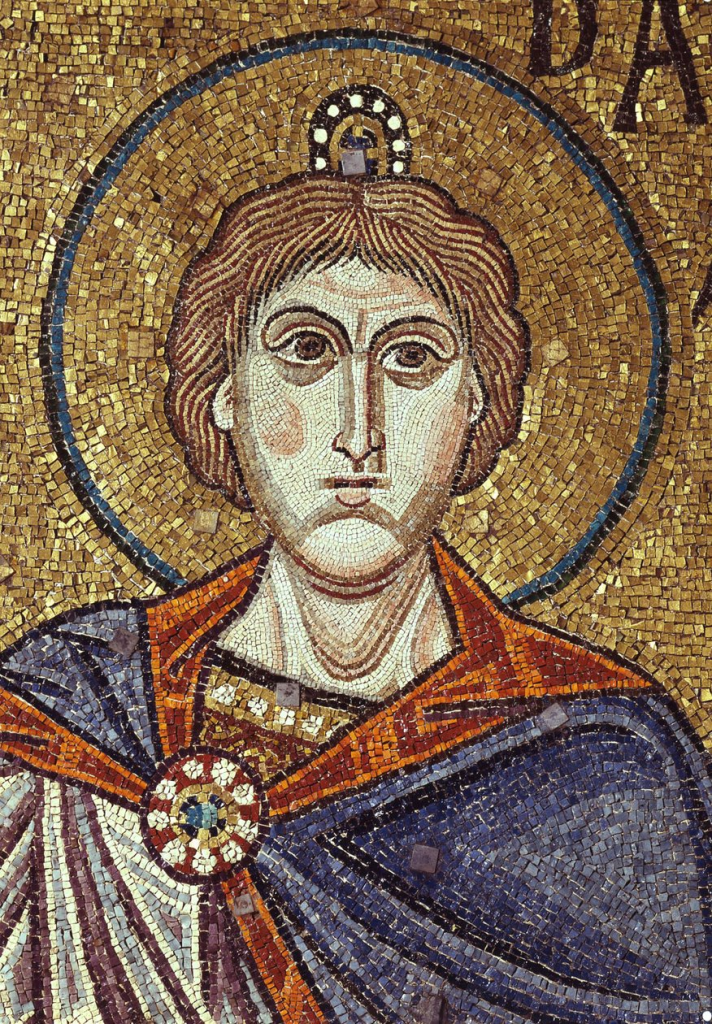
Byzantine mosaic of the prophet Daniel, 12th century, in St. Mark’s Basilica, Venice, Italy

Perhaps you, like me, have had the experience of praying, and feeling as if those prayers were only bouncing off the ceiling and never heard by God. But the Lord has been watching and listening all along. Although we may not get an immediate response, we will most certainly receive an answer to our prayers.

I am encouraged that God listened and was attentive to Daniel. The prophet had put himself in a position to hear God, so that when the Lord responded, Daniel was able to receive what was given to him.

The spiritual disciplines which Daniel was practicing almost seems like the guy was observing Lent. For three weeks, he gave up certain foods, did not eat meat, drank no wine; and he didn’t take a bath. He did all of this because he was troubled in spirit.

Daniel’s outward practices were congruent with his inward disposition. This is a far cry from our modern predilection for keeping up appearances, even though we are dying inside. But Daniel was not like us. He stopped his normal routines in order to give himself to prayer and a partial fast.

The Jews had been in exile for 70 years, and there was no sign of them going back to Jerusalem. And that troubled Daniel to no end – because the prophet Jeremiah had said the people would be in captivity for that long (Jeremiah 29:10). Daniel knew that fulfillment of the Lord’s promises would come by living in Palestine, and not by being exiled in Babylon.

While Daniel and his friends were together in a prayer meeting, Daniel experienced a vision; it was as if the veil separating this three-dimensional space from the spiritual dimension was lifted, and Daniel could see what was happening in the invisible realm.

Daniel’s prayers were being heard; they were not bouncing off the ceiling. And they were heard, I believe, because Daniel prayed according to his understanding of what God wants. He desired to participate in what God wanted, and not what he himself necessarily wanted.

And that is essentially what the Lord Jesus taught his followers in how to pray. We need not try and persuade God, as if we must be spiritual lawyers advocating for what we want. The Lord does not operate by twisting arms or harassing people; and neither ought we to try and treat God that way.

Prayer puts us in sync with what God wants. And as we desire to do God’s will, our prayers will reflect that desire. We only then need to ask. (Matthew 6:5-15; James 4:1-3)

Although God answers prayer, those responses are not always immediately put into effect. Daniel’s vision allowed him to see that there are other forces at work – dark forces – that oppose what God is doing. Sinister monkey wrenches are thrown into good plans and responses for people.

Behind the scenes of our lives, there are invisible powers which are influencing people. This is why our ultimate struggle is not on this visible realm; it is, instead, against the invisible demonic spirits of this present evil age.

Daniel saw and heard that behind the affairs of this world is a hierarchy of evil which seeks to control us for purposes contrary to God’s justice, peace, and goodness. Yet there is also an angelic host who are involved in ensuring that the Lord’s will is accomplished on this earth as it is always done in heaven.

Therefore, sometimes our delays in answered prayer have nothing to do with us; it may be because there is a great conflict happening in a dimension that you and I don’t see. In fact, if we do not have immediate answers to prayer, this is precisely the best time to persevere in prayer and not give up.

Through our perseverance in prayer, like Daniel, we are strengthened in faith. Our connection with God brings us peace and courage, emboldening us for continued wrestling in prayer and dealing with the structural and systemic evil that exists everywhere.

Faith is a belief in things we cannot see. Hope is the confidence of things which can happen. Love is a culmination of faith and hope coming together in order to make a difference in this fallen world. The Lord provides all the strength we need for the struggle. And there is perhaps no better model of how to deal with things and gain spiritual power than the prophet Daniel.

Strengthen us, O Lord, by your grace, so that we may overcome all spiritual enemies; and with pure hearts serve you; through Jesus Christ our Lord, who lives and reigns with you and the Holy Spirit, one God, for ever and ever. Amen.

The Seven Deadly Sins (Proverbs 12:10-21)

A 14th century personification of the Seven Deadly Sins, by Unknown artist

The righteous care for the needs of their animals,
    but the kindest acts of the wicked are cruel.

Those who work their land will have abundant food,
    but those who chase fantasies have no sense.

The wicked desire the stronghold of evildoers,
    but the root of the righteous endures.

Evildoers are trapped by their sinful talk,
    and so the innocent escape trouble.

From the fruit of their lips people are filled with good things,
    and the work of their hands brings them reward.

The way of fools seems right to them,
    but the wise listen to advice.

Fools show their annoyance at once,
    but the prudent overlook an insult.

An honest witness tells the truth,
    but a false witness tells lies.

The words of the reckless pierce like swords,
    but the tongue of the wise brings healing.

Truthful lips endure forever,
    but a lying tongue lasts only a moment.

Deceit is in the hearts of those who plot evil,
    but those who promote peace have joy.

No harm overtakes the righteous,
    but the wicked have their fill of trouble. (New International Version)

Many of the biblical proverbs are set as contrasts between the way of righteousness and the way of wickedness.

Being aware of both vice and virtue in our personal lives, the workplace, neighborhood, family, and faith communities can create an environment of trust, love, fellowship, and enjoyment. Intentionally pursuing the good, while identifying and forsaking the bad, contributes to a thriving community who intentionally cultivates righteousness.

It’s likely that you have heard of “the seven deadly sins.” In medieval Christianity, these were vices to avoid at all costs, because they eroded personal integrity and poisoned the social community. A “vice” is a bad habit which corrupts character and debases society.

The early church eventually formed a short list of the most corrosive vices, the seven deadly sins, which were considered the most heinous desires/actions of all. We find them in our proverbs for today.

The wicked covet the proceeds of wickedness. Desiring evil is a trap for them. They chase after sinister fantasies.

Lust is an intense desire, coupled with a lack of mental self-control, which is manifested in pursuing that desire in the heart. It is to have a passion for someone (or something) that is neither yours, nor meant for you. Lust leers at and indulges in selfish daydreams, without any concern for another person.

Do not desire to possess anything that belongs to another person—not a house, a wife, a husband, a slave, an ox, a donkey, or anything else. (Exodus 20:17, CEV)

The wicked have their fill of trouble. They’ve gobbled up evil as if dining at an all-you-can-eat buffet.

Whereas lust and covetousness is mostly a lack of mental self-control, gluttony is the lack of bodily self-control.

So, whether you eat or drink or whatever you do, you should do it all for God’s glory. (1 Corinthians 10:31, CEB)

Gluttony doesn’t stop eating, buying, talking, drinking, or binging. It only excessively indulges to the point of physical and/or relational sickness. Addictions and workaholism are some modern-day forms of gluttony – it consumes to the point where it cannot control the consumption any more. The thing desired and indulged becomes the master.

Observe the Sabbath and keep it holy. You have six days in which to do your work, but the seventh day is a day of rest dedicated to me. On that day no one is to work—neither you, your children, your slaves, your animals, nor the foreigners who live in your country. (Exodus 20:8-10, GNT)

The tools of greed are deceit and lies; the greedy person goes to just about any lengths to obtain more wealth. They will misrepresent another and spread gossip and slander to get what they want.

Do not tell lies about others.

The Ninth Commandment (Exodus 20:16, CEV)

Money. More money – is the mantra of the greedy person. It is to have an inordinate desire and pursuit of wealth. Just as sex and food are good, but have their proper boundaries, so money is both good and necessary. 

But money is powerful in more ways than one. It can take over a person’s life in such a way that charging exorbitant interest, rent, or price gouging is justified by satisfying the greed. The greedy person lives every waking moment for leveraging wealth to get more wealth.

People who want to be rich fall into all sorts of temptations and traps. They are caught by foolish and harmful desires that drag them down and destroy them. The love of money causes all kinds of trouble. Some people want money so much that they have given up their faith and caused themselves a lot of pain. (1 Timothy 6:9-10, CEV)

The sloth much prefers get-rich-quick schemes to actual hard work. They spend their time in worthless projects, and are easily annoyed at others.

Sloth is more than laziness. It is also failing to do good when it is in your power and ability to do so. To be slothful is to be indifferent to the great need of the world. 

Whereas the previous sins have a more active pursuit of some desire, the sloth is passive, not wanting to get involved in making a difference. The slothful person always has an excuse why they can’t participate; they expect everyone else to do the work. 

Do your work willingly, as though you were serving the Lord himself, and not just your earthly master.

Colossians 3:23, CEV

The irony is that for all of Ebenezer Scrooge’s hard work and thrift, he was really a sloth who had no intention of improving the condition of humanity; he depended on poor houses and work farms to do all the work. It took supernatural means to get him to think differently. It typically takes a lot for the sloth to go out of their way to honor, respect, and bless another.

You must honor and respect your father and your mother. Do this so that you will have a full life in the land that the Lord your God gives you. (Exodus 20:12, ERV)

A wicked person is often an angry person – so full of anger that they abuse their pets and animals who have done nothing against them. And they let their tongues wag and fly off the handle anytime they are perturbed.

Stop being angry!  Turn from your rage!  Do not lose your temper— it only leads to harm. (Psalm 37:8, NLT)

That doesn’t mean that anger itself is a bad thing. As with most things in life, anger has its proper place. For example, we ought to be angry in the face of evil perpetrators. Anger motivates us to not be slothful, but helpful. 

But excessive selfish anger is a vice. Whereas righteous anger seeks to help a victimized person or group, sinful anger is fueled by hatred. Whether it’s a violent verbal decapitation of another, or a deep seated bitterness, such anger destroys relationships – and even life itself.

No murder.

The Sixth Commandment (Exodus 20:13, MSG)

Envy and lust are kissing cousins. They both traffic in excessive desire for what they don’t possess. 

Envy rots the bones.

Proverbs 14:30, NIV

The subtle difference has more to do with the object of the affection. Lust leers at, longs for, a person who belongs to someone else. Envy fixes its gaze on a material possession or a respected position which someone else has. It is to have a passionate pursuit of taking over someone else’s job or keeping up with Jones’s.

For where there is envy and selfish ambition, there will also be disorder and wickedness of every kind. (James 3:16, NRSV)

The wicked and the proud share a table together for lunch every day. They don’t listen to anybody else, because they believe they already have the answers and know what is best.

Pride is an over-inflated view of one’s opinions, thoughts, and self. Proud persons have an overestimation of themselves. They seem to actually believe that if only others followed their thinking and advice, the world would be a better place.  

Every antagonist in the movies, comics, and classic literature are full of themselves. They justify stepping on others to achieve what they think is the greater good of imposing their agenda in the situation. It’s no wonder that in the Bible, Satan is the ultimate antagonist.

The proud must eventually contend with God. And the Lord has no allowance for the foolishness and idolatry of any human believing they know better.

“No other gods, only me.”

First Commandment (Exodus 20:3, MSG)

Consider the following questions:

How will you respond to the seven deadly sins?

In what ways and/or behaviors do you see these vices being manifested in both the church and the world?

What can the book of Proverbs bring to such a discussion?