Matthew 6:7-15 – The Lord’s Prayer

The Lord's Prayer

And when you pray, do not keep on babbling like pagans, for they think they will be heard because of their many words. Do not be like them, for your Father knows what you need before you ask him.

This, then, is how you should pray:

“Our Father in heaven,
hallowed be your name,
your kingdom come,
your will be done,
    on earth as it is in heaven.
Give us today our daily bread.
And forgive us our debts,
    as we also have forgiven our debtors.
And lead us not into temptation, but deliver us from the evil one.”

For if you forgive other people when they sin against you, your heavenly Father will also forgive you. But if you do not forgive others their sins, your Father will not forgive your sins. (NIV)

God knows what we need before we even ask him, which means that the Creator of the universe has his ear inclined to listen to us. The Lord desires, even longs for us to pray to him. Since this is God’s disposition every day, Jesus communicated to us a model way of prayer. This prayer exemplifies the values of Christ’s Beatitudes and reflects the priorities of God’s kingdom. The Lord’s Prayer is meant to be prayed often, mindfully, and with flavor.

Jesus gave us six petitions to guide us in our prayers: The first three petitions are priorities of God that set the tone for the next three petitions, which are centered in our problems of living in this fallen world.

Addressing God

Jesus gave us instruction of how to address God: “Our Father in heaven.” All the pronouns in the Lord’s Prayer are plural, not singular. We are to be concerned for both our own individual issues, and for the needs of the community, of the problems and situations of the world.

“Father” is an endearing and relational word. “In heaven” balances the closeness and nearness of our heavenly Father with his sovereign and transcendent nature. Our God is both near and far – a close friend as well as a holy king.  So, we address him with a proper understanding of who he is.

Three Priorities

  1. First Petition: “Hallowed be your name.”

“Hallow” comes from the root word for holiness; it is to sanctify, to set apart. God is concerned that his creatures revere him and treat him as the Holy One.

Notice the use of the verb: not hallowed “is” your name, but hallowed, or holy “be” your name. That is, Jesus guides us to pray that God’s name would be shown as holy through us by the way we live. The world sees a holy God when his people walk in holiness, reflecting his benevolent nature.

After Christ’s resurrection and ascension, the Apostle Peter encouraged a struggling band of young Christians:

So, you must live as God’s obedient children. Don’t slip back into your old ways of living to satisfy your own desires. You didn’t know any better back then. But now you must be holy in everything you do, just as God who chose you is holy. For the Scriptures say, “You must be holy because I am holy.” And remember that the heavenly Father to whom you pray has no favorites. He will judge or reward you according to what you do. So, you must live in reverence of him during your time here as “temporary residents.” (1 Peter 1:14-17, NLT)

  1. Second Petition: “Your kingdom come.”

We live in a fallen world that has come under the domain of dark forces. The unfolding drama of Holy Scripture is that God himself is on a mission to restore his creation to a benevolent rule and gracious reign. Jesus is the King, we are the subjects, and God’s realm exists wherever his subjects go.  And where his subjects go, they are to pierce the darkness by embodying the good news that King Jesus has overcome the demonic realm and brought us into God’s kingdom. The prayer and proclamation of this good news is of utmost priority to God.

  1. Third Petition: “Your will be done on earth as it is in heaven.”

God’s ethical will has been revealed to us by Jesus in the Sermon on the Mount with the Beatitudes as the cornerstone of his teaching (Matthew 5-7). God’s will is that Christ’s followers be humble; grieve over personal and communal sin in the world; act with gentleness instead of prideful condescension toward others; hunger after true righteousness instead of legalistic self-righteousness; show mercy; be pure in heart; pursue peace; and, rejoice when persecuted. All of this results in being salt and light in this dark world.

Furthermore, we are to reconcile with others instead of hold grudges; deal with our lust through accountability instead of making excuses for our mental adultery; cherish our spouse instead of taking the easy way out when problems arise in marriage; tell the truth at all times instead of shading it; and, love, not retaliate when personally hurt or insulted. This is God’s will, and if it seems an impossible task, that is because we need divine resources to live our Christian ethic. In other words, we need to pray!

These three petitions are priorities for God. They are three ways of essentially asking the same thing – that the full manifestation of God’s reign on earth be realized.  Thus, our prayers are not primarily to receive goods and services from God, but for us to render service to God. The priority of prayer given by Jesus centers in the advancement of God’s merciful rule, and the doing of God’s will.  These prioritized prayers are a burning desire to see God honored on earth as he is already honored in heaven.

The Lord's Prayer 2

Three Problems

  1. Fourth Petition: “Give us today our daily bread.”

It is our bodies that enable us to do God’s will, and so we must be concerned for them. We must have the necessities of life and daily sustenance to carry out God’s priorities for the church and the world. This is not a prayer for long-term luxuries, but daily needs.

In the ancient world, people were paid at the end of each day. Folks also shopped every day at the marketplace for their food (no fridge!). When there was a flood or a drought, it did not just mean high grocery prices; people faced starvation and death. They needed to trust God for today, and not worry about tomorrow.  Even though we do not always readily perceive our great dependence on God, we still are in divine hands and need faith.

  1. Fifth Petition: “Forgive our debts, as we also have forgiven our debtors.”

Sin is pictured as a debt. If someone has sinned (trespassed) against us, we must forgive them, thus releasing them from their debt.  To forgive does not mean to forget. Rather, we are not to hold the debt or the sin over someone’s head for the rest of their life.

The simple truth is that the person who is forgiven by God is a forgiving person. Our own forgiveness implies that we have done the hard work of repentance through identifying our sin and renouncing it. So, if we fail to forgive, it demonstrates a lack of change on our part. We cannot, then, be forgiven if we are avail ourselves of the grace which is freely offered.

The practice of forgiveness is of utmost importance to Jesus. Living the Beatitudes of Jesus and being a peacemaker means we are to squarely face our bitterness. Simply sweeping our hurt under the rug and not extending forgiveness only gives the demonic realm a foothold into our lives – which is why we are to pray the final petition….

  1. Sixth Petition: “And lead us not into temptation but deliver us from the evil one.”

Just as we have real physical necessities we must trust God for, we also have genuine spiritual needs which hinge on the issue of forgiveness – our forgiveness from God through Christ, and the forgiveness we extend to others who have hurt or offended us.

An unforgiving heart is the primary reason for the temptation to hate, seek revenge, and retaliate. If we have spent days, weeks, months, years, or even decades harboring an unforgiving spirit through anger, bitterness, and avoidance of facing our past trauma, we have embraced the dark side and need deliverance from evil.

The path to deliverance is through acknowledging the offense, receiving grace and forgiveness from God, and passing that same forgiveness and grace to those who hurt us. This is not about whether they deserve it or not; it is a matter of what I need to do.

Conclusion

A desire to see God’s agenda accomplished through the first three petitions leads us to seek grace and forgiveness, not giving ground to the devil. The truth sets us free; telling our secrets brings freedom. Apart from naming our shame, we will remain bound and in need of liberation. Tell your secrets to God in the prayer closet, and then tell them to a trusted friend(s). We pray, and we act on what God tells us in prayer.

The Lord’s Prayer is a model prayer. That means we use the six petitions of Jesus to frame our prayers in our own words, as well as say the words in our favorite translation of the Bible.

We are to pray this prayer continually, for in doing so it will shape our everyday lives, serve as a guide for how to live, and provide discernment in making life’s many decisions.  To be the church is to pray. To be a Christian is to pray. So, let us daily and in every way make use of our Lord’s Prayer.

Our Father in heaven,

            The One who is both near and far,

May your Name be shown as holy,

            through us, your people.

May others submit to your lordship,

            and become holy, too.

Help us to know your will,

            and to do it.

We need you God,

           so, provide our necessities for today.

Forgive us of our great and many sins,

            just as we forgive those

            who have sinned egregiously against us.

Lead us in paths of righteousness,

            which will shoo the devil away.

For you are the Ruler,

the Mighty One,

full of glory and grace.

Amen!

Psalm 83:1-4, 13-18 – Against Evil

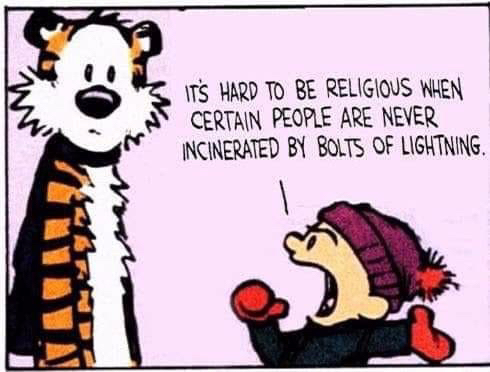
Calvin and Hobbes - imprecation

O God, do not be silent!
Do not be deaf.
Do not be quiet, O God.
Don’t you hear the uproar of your enemies?
Don’t you see that your arrogant enemies are rising up?
They devise crafty schemes against your people;
they conspire against your precious ones.
“Come,” they say, “let us wipe out Israel as a nation.
We will destroy the very memory of its existence….”

O my God, scatter them like tumbleweed,
like chaff before the wind!
As a fire burns a forest
and as a flame sets mountains ablaze,
chase them with your fierce storm;
terrify them with your tempest.
Utterly disgrace them
until they submit to your name, O Lord.
Let them be ashamed and terrified forever.
Let them die in disgrace.
Then they will learn that you alone are called the Lord,
that you alone are the Most High,
supreme over all the earth. (NLT)

The psalms are the church’s prayer book.  Many of the psalms are laments and many of them are worshipful songs of praise. Then there are the “imprecatory” (pronounced im-PRECK-a-tory) psalms.  To “imprecate” means to invoke evil upon someone; it is to pronounce a curse.  The reason for the imprecatory psalm is that it is not any person’s place to engage in revenge or retaliation.  Instead, for people who are genuinely caught in the cross-hairs of evil and have sinful persons dogging them, prayer is their most effective recourse.

Sometimes you must tell it like it is.  There is a time to do your best in putting up a good face and dealing with people who do not ever stop gossiping, slandering, and trying to get their way.

There is also a time to call such behavior “evil” and cry out to God for help.

There are many folks who consider imprecatory psalms a problem because of their detailed expressions of imprecation. Yet, such psalms refuse to put a positive spin on malevolent motives, wicked words, and destructive actions. Desperate people utter desperate prayers. Their unflinching sense of injustice will not allow them to sugarcoat the villainous plans of corrupt people. Evil is never toppled with tepid prayers from wimpy worshipers. Rather, nefarious agendas are thwarted in the teeth of specific, focused, and intense prayers directed with spiritual precision to the very core of diabolical forces.

We need not be shy about being real with God, even with praying imprecatory prayers.  There really are people in this world, maybe even in your own life, that have malicious intent against you or others.  Our job is not personal revenge, but to entrust ourselves to the God who fights for the poor, the oppressed, and the needy against the arrogant and the powerful.

Let your prayers reflect your life.

Along with psalms of praise lifted during times of celebration, so imprecatory psalms are not to be ignored but need to be uttered equally loud as prayers to almighty God in seasons of desperate evil. If you have a gut feeling deep down that wicked people are running amok, then use this psalm as a prayer against the darkness which seeks to envelop the earth.

Jesus Christ will build his church and the gates of hell shall not overcome it (Matthew 16:18). The picture Jesus portrayed is one of faithful believers equipped with righteousness and justice storming the gates of hell, not shying away from it. Baked within the Lord’s words were the promise that evil atrocities will not have the day – that God’s people will not be destroyed or overwhelmed because of demonic and satanic power.

There is a time to flee and then there is a time to engage. I am suggesting that the chief way of mitigating evil is to punch it in the mouth with imprecatory psalms prayed with righteous flavor and focused directly against the powers of this present darkness. Why prayer of all things in dealing with evil?…

For we do not wrestle against flesh and blood, but against principalities, against powers, against the rulers of the darkness of this age, against spiritual hosts of wickedness in the heavenly places. (Ephesians 6:12, NKJV)

Spiritual problems require spiritual implements to solve. And the tool of imprecatory psalms is a major way of not only pushing back the dark forces of this world but is the means of spiritual assertiveness against all forms of heinous acts and acerbic words from depraved people and evil systems.

God’s wrath is an expression of God’s love.

God is not okay with evil taking root in the lives and institutions of humanity. Prayer is our privilege of coming to the God who upholds justice and righteousness. For if God is for us, who can be against us?

God Almighty, may you hear me in the day of my trouble and send help from your holy sanctuary and strengthen my faith. Breathe your Holy Spirit into me and inspire me with a passion for goodness and truth, justice, and righteousness. Lord Jesus be present with me in your risen power and protect me from harm and from all that would hinder your healing presence in this world. You overcame the forces of Satan, redeemed the world, then ascended to the Father. May you be with me and within me; before me and behind me; on my right and on my left; above me and beneath me; and around me always. Amen.

Matthew 13:24-30, 36-43 – The Parable of the Weeds

Welcome friends! Click the video below and let us gather together around the teaching of Jesus:

You may also view this video at TimEhrhardtYouTube

Click Be Thou My Vision sung by Nathan Pacheco as we seek to grow in the soil of God’s grace through Jesus Christ our Lord in the power of the Holy Spirit.

Soli Deo Gloria.

The Parable of the Weeds

Van Gogh Wheat Field
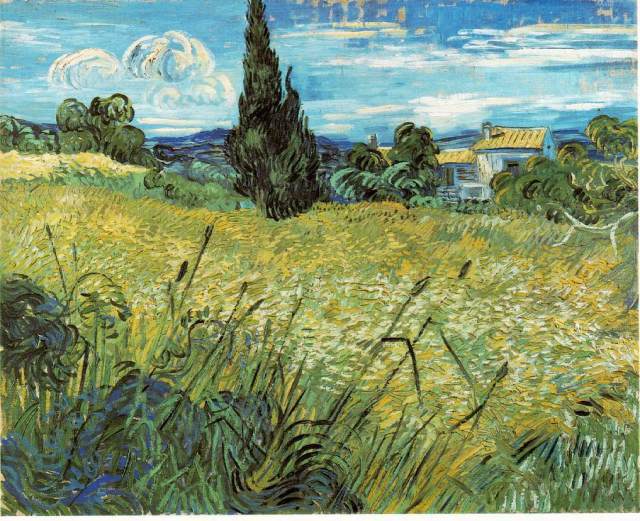
Wheat Field and Cypress by Vincent Van Gogh, 1890

Jesus told them another parable: “The kingdom of heaven is like a man who sowed good seed in his field. But while everyone was sleeping, his enemy came and sowed weeds among the wheat, and went away. When the wheat sprouted and formed heads, then the weeds also appeared.

“The owner’s servants came to him and said, ‘Sir, didn’t you sow good seed in your field? Where then did the weeds come from?’

“‘An enemy did this,’ he replied.

“The servants asked him, ‘Do you want us to go and pull them up?’

“‘No,’ he answered, ‘because while you are pulling the weeds, you may uproot the wheat with them. Let both grow together until the harvest. At that time, I will tell the harvesters: First collect the weeds and tie them in bundles to be burned; then gather the wheat and bring it into my barn.’”

Then he left the crowd and went into the house. His disciples came to him and said, “Explain to us the parable of the weeds in the field.”

He answered, “The one who sowed the good seed is the Son of Man. The field is the world, and the good seed stands for the people of the kingdom. The weeds are the people of the evil one, and the enemy who sows them is the devil. The harvest is the end of the age, and the harvesters are angels.

“As the weeds are pulled up and burned in the fire, so it will be at the end of the age. The Son of Man will send out his angels, and they will weed out of his kingdom everything that causes sin and all who do evil. They will throw them into the blazing furnace, where there will be weeping and gnashing of teeth. Then the righteous will shine like the sun in the kingdom of their Father. Whoever has ears, let them hear. (Matthew 13:24-30, 36-43, NIV)

We live in an increasingly polarized world. We see it, feel it, and experience it daily in our politics and economy, and even in our families, churches, and faith communities. How are we going to deal with our differences? What kind of path might we chart forward? Where might we turn for help?

Let us acknowledge from the outset that within our world there are vast differences in religion and belief structures, as well as deep differences on issues surrounding human sexuality, immigration, race, and COVID-19, just to name a few. And let us also acknowledge that when we read Christ’s parable of the weeds (or the parable of the wheat and the tares) there is strong tendency to view ourselves and our beliefs as the good seed, which leaves anyone who does not agree with us as the weeds.

It is fruitless for us to debate who is the genuine crop and who is the weeds. We will likely just go around and around with airing our own opinions as gospel truth and expecting others to simply accept our arguments. That approach is neither wise nor even possible. I highly suspect that Christ’s disciples had such a mindset. I see them as the servants who eagerly ask the owner, “Do you want us to pull up the weeds?” In other words, whenever we see weedy people, we want to yank them out and get them out of our lives.

Oh, wouldn’t it be nice if it were that easy? If we could only purge all those problem people with their goofy thinking and crazy politics from among us, then all would be okay. Right? Wrong. It would not be okay. For those who are followers of Jesus, we take our cues from him. So, what Jesus says takes precedence over our personal approaches of how to handle those who express evil.

And what Jesus gave was a clear and unequivocal answer to the issue of weeds: “No, do not pull them up!” I can imagine the disciples (and us for that matter) retorting with: “Well, for heaven’s sake, why not, Jesus? Don’t you see what is happening to our world? Are you going to let this evil keep happening? I thought you cared about us!”

“I’ll tell you, why not,” said our Lord, “Because doing violence to the weeds will end up doing violence to the crop as well.” Christ’s response to our questions about the problem of evil in the world is to let God take care of it. That means, in the meantime, we are supposed to co-exist with each other. Yes, you heard that right. No holy crusades to stamp out problem people. No inquisitions or purges or forced takeovers to uproot whom we consider to be wicked people.

There has always been a temptation for people throughout history to exterminate evil people and force others into right doctrine and theology. That, however, is not our mandate as Christians. God, the owner of the world’s field, will send his own harvesting angels to do the work. They will separate the crop from the weeds. That is not our job.

So, what are we supposed to do with evil – just let it go?  Am I to let that evil person just be evil?  Shouldn’t I give them what they deserve?  Shouldn’t I at least tell them that they are no good rotten sinners and that they are going to hell because they are wicked?

Earlier in the Gospel of Matthew, Jesus had already dealt with how to handle so-called problem people saying,

Love your enemies and pray for those who persecute you,” (Matthew 5:44). 

Jesus will decisively solve the problem of evil, and not us!  It is not our place, and if we make it our place, we will end up hurting and destroying our fellow brothers and sisters in the church and the world.  We are to love and pray people into God’s benevolent rule and reign of the earth, not give them the message that they must either turn or burn.

The sobering reality taught by Jesus in this parable is that it is not a simple matter that we, the crop, are here; and they, the weeds, are over there.  It is more sinister than that: The enemy is within, not out there.  We have no further to look than in our own hearts, which is why we desperately need the lordship of Christ to completely overtake us.

Evil is present alongside the good.  Evil exists in the here and now where there is a desire to trip others up, to discourage people in their respective faith commitments, to offend and hurt others who believe differently, to overlook the weak, and to speak ill of others.  Evil is in our backyards where there is an impatient eagerness to step on others to get our way.  Evil is at its height where there is ignorance of Christ’s teaching, for no one can truly follow Jesus if they do not know what that way is. “We have met the enemy, and he is us,” said Walt Kelly in his mid-twentieth century newspaper comic strip, Pogo.

Walt Kelly - Pogo 

The eventual end of evil, when Christ returns, is that wickedness will be handled once and for all. There will be no more tormenting of others; no more oppression; no more inattention to those who are in need; no more disparaging of the weak; no more misguided or petty wars waged on the innocent; no more injustice; no more pain; no more bondage to sin. The tormentors, apart from repentance, will become the tormented. As they have gone about their lives in anger fomenting division and destruction in this life, so the tables will turn in the next life. Therefore, the Holy Scripture is adamant that Today is the day of repentance and salvation because tomorrow is judgment day. As the writer of Hebrews said:

Today, if you hear his voice, do not harden your hearts… See to it, brothers, and sisters, that none of you has a sinful, unbelieving heart that turns away from the living God. But encourage one another daily, as long as it is called “Today,” so that none of you may be hardened by sin’s deceitfulness. We have come to share in Christ, if indeed we hold our original conviction firmly to the very end. As has just been said:

“Today, if you hear his voice,
    do not harden your hearts
    as you did in the rebellion.”

Who were they who heard and rebelled? Were they not all those Moses led out of Egypt? And with whom was he angry for forty years? Was it not with those who sinned, whose bodies perished in the wilderness? And to whom did God swear that they would never enter his rest if not to those who disobeyed? (Hebrews 3:7, 12-18, NIV)

Grace awaits us, my friends, ever-present and poised to wash over us with baptismal power and spiritual rest. We may expect God to do things in a hurry.  However, the kingdom of God does not work that way.  The kingdom of God comes gently, like a seed planted in the ground; and, it takes time for it to grow.  Meanwhile, evil exists, and we think it ought to be sucked-up in God’s divine vacuum cleaner like clods of dog and cat hair.  We expect not to be left waiting, and for God to act drastically when we are wronged or are uncomfortable in any way.  We might confuse God’s slowness as being uncaring, when it really means that God is patient, and desires people to come to repentance.  God awaits us, always ready to hear the prayer of the penitent person.

O Lord God Almighty, Creator of heaven and earth, we are complacent people.  While you desire us to be a beacon of light to a world in need, we have become preoccupied with all the weeds in the field.  We are sorry for the madness unleashed through our own sinful desires.  We invite you now to plant a seed of love in our hearts for all people, not just our friends.  We commit ourselves to watering that seed and nurturing it with your Word.  We choose to trust you and live by your words, Lord Jesus.  Amen.