Jeremiah 26:1-9, 12-15 – How to Use Our Voice

The Prophet Jeremiah by Marc Chagall (1887-1985)

Early in the reign of Jehoiakim son of Josiah king of Judah, this word came from the Lord: “This is what the Lord says: Stand in the courtyard of the Lord’s house and speak to all the people of the towns of Judah who come to worship in the house of the Lord. Tell them everything I command you; do not omit a word. Perhaps they will listen, and each will turn from their evil ways. Then I will relent and not inflict on them the disaster I was planning because of the evil they have done. Say to them, ‘This is what the Lord says: If you do not listen to me and follow my law, which I have set before you, and if you do not listen to the words of my servants the prophets, whom I have sent to you again and again (though you have not listened), then I will make this house like Shiloh and this city a curse among all the nations of the earth.’”

The priests, the prophets and all the people heard Jeremiah speak these words in the house of the Lord. But as soon as Jeremiah finished telling all the people everything the Lord had commanded him to say, the priests, the prophets and all the people seized him and said, “You must die! Why do you prophesy in the Lord’s name that this house will be like Shiloh and this city will be desolate and deserted?” And all the people crowded around Jeremiah in the house of the Lord….

Then Jeremiah said to all the officials and all the people: “The Lord sent me to prophesy against this house and this city all the things you have heard. Now reform your ways and your actions and obey the Lord your God. Then the Lord will relent and not bring the disaster he has pronounced against you. As for me, I am in your hands; do with me whatever you think is good and right. Be assured, however, that if you put me to death, you will bring the guilt of innocent blood on yourselves and on this city and on those who live in it, for in truth the Lord has sent me to you to speak all these words in your hearing.” (NIV)

Although much attention is given to Christmas Day, the Christian season of Christmas spans twelve days from December 25 through January 5. Celebrating Christmas as a season helps us immerse ourselves in Christ’s incarnation more fully than merely celebrating for one day.

Perhaps today’s Old Testament lesson is a curious choice for a Christmas season Scripture text. Yet, although we hold in one hand the joy and celebration of Christ’s birth, in the other hand we hold the deep sadness of recognizing that not everyone was or is excited about Jesus. For Christ is both the cornerstone of faith and the stone which causes people to stumble and fall. (1 Peter 2:8)

The fact of the matter is that God is not okay with cruel injustice, hollow worship, and an inattention to both the divine and human. Jesus came to make things right. But not everyone wants that. Systemic evil persists because there are always people who benefit from how power and resources are structured – and they care little about how it impacts those on the underbelly of their control.

Therefore, just as important it is to recognize the inbreaking of God into this world and celebrate the incarnation of Christ, it is equally necessary to acknowledge that the world is broken and that we must speak truth to power. This is no easy task because rarely are things simply black and white, all good or all bad.

Jeremiah by Marc Chagall, 1956

In Jeremiah’s day, it was not that his opponents were pure evil with no acknowledgment of God. Rather, the problem was that the power brokers in Judah tried to keep a strict separation of religion from everything else. In other words, they were perfectly fine with God, that is, if the Lord would stay in the temple where he belonged. But Jeremiah would have none of it. Keeping Yahweh out of matters of social justice, geopolitics, and institutional governance led to great humanitarian problems. Jeremiah became God’s voice to a generation of people who ignored the divine in everything but religious ritual.

Bifurcating worship and work disconnect daily life from divine resources. Without God infused in all of life, a lack of grace fills the empty places. What is more, the sovereign Lord of all can neither be silenced nor dismissed; God will find a way to accomplish peace and justice for the common good of everyone, and not just the few.

The heart of Jeremiah’s message was for king and people to be obedient in all of life, to recenter themselves around God’s law – not just the religious bits but the social ones, as well. Jeremiah did not proclaim something new. He was just calling the powers that be to Torah observance.

The true needs and interests of our communities can never be addressed and lifted-up in the narrow self-serving interests of persons in power who turn a blind eye to anyone unlike them. The needs and interests of our world lie in becoming who we were designed from the beginning to be: A people belonging to God, tapping into the deep reservoir of spirituality inside us.

For the Christian, we are to acknowledge the baby born as a king and follow in the way of grace and truth. There is to be no division between sacred and secular because Jesus is Lord of all. We are to continually use our voice for both praise and prophecy, for shouting celebration to God and speaking truth to power.

Holy God, Sovereign of all, we give you praise for sending your Son, our Savior, Jesus as a baby, a human just like us. Keep us grounded in humility, sensitive to sin, attentive to that which is just and right, merciful in all things, pure in worship, and peace-loving through Christ our Lord in the strength of your Spirit. Amen.

Psalm 79 – Unbearable Pain

The nations have come into your inheritance, God!
    They’ve defiled your holy temple.
    They’ve made Jerusalem a bunch of ruins.
They’ve left your servants’ bodies
    as food for the birds;
    they’ve left the flesh of your faithful
    to the wild animals of the earth.
They’ve poured out the blood of the faithful
    like water all around Jerusalem,
    and there’s no one left to bury them.
We’ve become a joke to our neighbors,
    nothing but objects of ridicule
    and disapproval to those around us.

How long will you rage, Lord? Forever?
    How long will your anger burn like fire?
Pour out your wrath on the nations
        who don’t know you,
    on the kingdoms
        that haven’t called on your name.
They’ve devoured Jacob
    and demolished his pasture.
Don’t remember the iniquities of past generations;
    let your compassion hurry to meet us
    because we’ve been brought so low.
God of our salvation, help us
    for the glory of your name!
Deliver us and cover our sins
    for the sake of your name!
Why should the nations say,
    “Where’s their God now?”
Let vengeance for the spilled blood of your servants
    be known among the nations before our very eyes!
    Let the prisoners’ groaning reach you.
With your powerful arm
    spare those who are destined to die.
Pay back our neighbors seven times over,
    right where it hurts,
    for the insults they used on you, Lord.
We are, after all, your people
    and the sheep of your very own pasture.
We will give you thanks forever;
    we will proclaim your praises
    from one generation to the next. (CEB)

The setting behind today’s Psalm is the destruction of the temple and a conquering army who proudly gloats over their victory. This is a prayer, an angry cry for God to step in and act on behalf of the humiliated people. The psalm is more than a simple plea for help; it is a deeply passionate appeal. As a child of the 1960’s, my phrase for the psalmist’s entreaty is, “God, stick it to the man!”

There is no polite knock at the side door of God’s house in the face of such evil. This is a pounding on the front door with the demand for God to do something about this terrible trouble. For the psalmist, the incongruence between who God is and what has happened to God’s people is inconceivable and unacceptable. To profane God’s temple is to profane God; and to kill and maim God’s people is to flip the middle finger at God. The psalmist is beside himself and overwhelmed with emotion.

There is something very instructive here that we ought not miss. When we have been brutalized, victimized, and/or demoralized, we just want someone, especially the Lord we serve, to take notice and feel what we are feeling. Never underestimate the power of empathy and solidarity. To feel alone and bereft of help is an awful feeling.

Perhaps the psalmist’s prayer offends some sensibilities. I wonder, for those who find the language difficult, have ever had a daughter raped or a house destroyed by fire or seen a person killed without mercy in front of their own eyes. Methinks they have not. The feelings of helpless despair and sheer anger defy human words. These are not casual affronts but malicious destructions of property and people.

We need someone to affirm the raw ruthlessness of it all, to have some understanding of the impossible place we are in with such wanton cruelty. When our very support is ripped from our lives, the madness within is too much to bear. Who will rescue us from this body of death?

God is big enough to handle our rage and our hurt. The Lord is available and hears our desperate voice of prayer. Yet, God is not always going to directly and immediately answer on the terms we stipulate. God acts out of God’s own providence and justice, and not from our expectations. And that is a good thing, not a bad thing.

God sees, knows, and feels with us. The realization of this enables us to recenter and reorient ourselves around faith, hope, and love. New life is never a gift in a vacuum; it comes out of agonizing struggle in reckoning with the existing evil.

So, when someone goes through a hellish experience, we are to exercise our capacity to listen and witness the horrible spiritual pain of the person. Healing hurts: it is not a pleasant affair. We are to hang in there and walk alongside another in their hour of need, even when their vitriol seems over the top to us. For only in telling our story to another will any of us find relief and renewed hope.

The psalms permit us to use language appropriate to what has happened to us. They also allow us to move beyond the venom to the God who restores broken lives.

Lord Jesus Christ, by your patience in suffering you hallowed earthly pain and gave us the example of obedience to your Father’ will: Be near me in my time of weakness and pain; sustain me by your grace, that my strength and courage may not fail; heal me according to you will; and help me always to believe that what happens to me here is of little account if you hold me in eternal life, my Lord and my God. As the Lord Jesus cried out on the cross, I cry out to you in pain, O God my Creator. Do not forsake me. Grant me relief from this suffering and preserve me in peace, through Jesus Christ my Savior, in the power of the Holy Spirit. Amen.

Matthew 12:43-45 – True Repentance

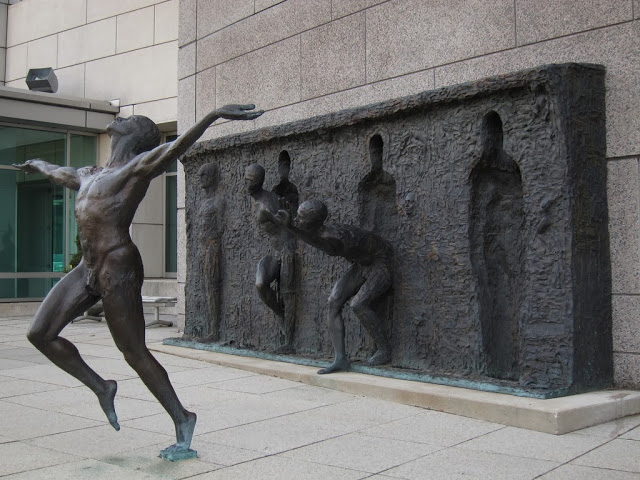
Freedom by Zenos Frudakis in Philiadelphia, Pennsylvania

Jesus said, “When an evil spirit comes out of a person, it travels through dry places looking for a place to rest, but it finds none. So, it says, ‘I will go back to the home I left.’ When it comes back, it finds that home still empty. It is all neat and clean. Then the evil spirit goes out and brings seven other spirits more evil than itself. They all go and live there, and that person has even more trouble than before. It is the same way with the evil people who live today.” (ERV) 

Nature abhors a vacuum. A tilled plot of soil will be overtaken with weeds if nothing is planted and nurtured in the turned-over dirt. The pecking order of a brood of chickens cannot handle the death of the top hen without filling the position almost immediately. And, in the spiritual realm, the exorcising of a demon will not simply leave a person empty of evil – his/her life will be filled with something in its place. 

Today’s Gospel story, told by Jesus, about the man who is delivered from an unclean spirit, is a powerful and simple narrative on the necessity of true repentance. Genuine freedom is more than getting rid of something bad and destructive; the evil must be replaced with something good and useful. That is, biblical repentance is both a turning away from ungodliness and an embrace of righteousness.

We are delivered from evil so that we can start living into the righteousness and peace intended for us. 

For example, the Apostle Paul exhorted the Ephesian believers to not only stop stealing but also to get a job and start sharing with others. They were not only to stop lying and using their tongues for gossip and slander and start using their words to speak truth that builds up others. (Ephesians 4:25-32) 

The spiritual principle is the same as the nature principle: A empty vacuum will always be filled. The man who did not fill his life with God ended up having a problem with evil seven times greater than when he started. 

If anything, or anyone, is emptied of its unhealthy elements and practices, it is imperative that the hole be immediately filled with healthy disciplines for life. 

Whether dealing with addictions, bad habits, or any kind of evil influence, a two-pronged approach is needed for its eradication. We expel the evil by replacing it with godliness. The man struggling with pornography or adultery must not only stop the behavior but take up the mantle of being a champion for women’s issues. The woman who has no healthy boundaries and allows herself to be used and abused must not only separate from the problem or person but adopt her identity in Christ as a precious child of God and enforce righteous limitations.   

None of these examples are meant to be simplistic answers to complex situations. Rather, they illustrate why so many people do not experience freedom and continue to have even greater enslavement to their passions and sufferings. 

Freedom is realized through replacing old practices with new disciplines that directly attack the old. 

We all have needs. How we get those needs met is often a mixed bag of both legitimate and illegitimate ways. In a perfect world, everyone would be aware of their needs and be able to express them to one another without shame, anxiety, or anger. Since we live on a blemished fallen planet, we end up trying to meet our needs indirectly through hustling for love, hoarding resources, and controlling others – all harmful ways which destroys souls and relationships. 

So, unless we focus on positively meeting our needs, we must go a step beyond dropping a toxic relationship, cutting up a credit card, or saying “no” to another responsibility. We often get into our mess to begin with because we are out of touch with ourselves and our needs. We need affection and encouragement, and there is no shame in needing this. We need security and safety, and there is no problem in acquiring this. There are some things we need to control, and that is okay. 

If we fail to address our needs, we might do the necessary work of deliverance, then turn right around and become worse off than before by filling the empty place of our lives with:  

  • Being all things to all people, as if we were the Messiah.  
  • Being successful so that we stay ahead of being needy.  
  • Pulling inside ourselves and trusting nobody.  
  • Distancing from our needs and pretending they are not there.  
  • Being continually vigilant so that we are never hurt that way again.  
  • Keeping a positive spin on everything, as if there is no negative stuff in the world.  
  • Challenging other’s opinions and behaviors to keep the focus off our needs.  
  • Becoming a wallflower so that we can never be the brunt of someone else’s vitriol or evil. 

Instead, we can let Jesus fill the emptiness with love, purpose, peace, joy, attention, and grace. Christ is the Savior who delivers us from evil, and the Holy Spirit is the Sanctifier who carefully applies the work of salvation to our lives.

When our hearts and minds are full of God, there is no place for the demons to get in. 

True repentance equally forsakes evil and embraces righteousness; replaces the unhealthy with the healthy; jettisons the illegitimate and seeks the legitimate; and puts away unnecessary suffering and pursues peace and joy in the Spirit.  

O God, I no longer want to live with saying I’m sorry and going right back to the old pig slop of sin. I cannot change on my own.  I need Jesus to both take away the sin and give me a new life of living for him.  Lead me not into temptation but deliver me from evil Help me to make choices that put to death the old way of life, and the courage to live into my forgiveness in the power of the Holy Spirit. Amen. 

Matthew 6:7-15 – The Lord’s Prayer

The Lord's Prayer

And when you pray, do not keep on babbling like pagans, for they think they will be heard because of their many words. Do not be like them, for your Father knows what you need before you ask him.

This, then, is how you should pray:

“Our Father in heaven,
hallowed be your name,
your kingdom come,
your will be done,
    on earth as it is in heaven.
Give us today our daily bread.
And forgive us our debts,
    as we also have forgiven our debtors.
And lead us not into temptation, but deliver us from the evil one.”

For if you forgive other people when they sin against you, your heavenly Father will also forgive you. But if you do not forgive others their sins, your Father will not forgive your sins. (NIV)

God knows what we need before we even ask him, which means that the Creator of the universe has his ear inclined to listen to us. The Lord desires, even longs for us to pray to him. Since this is God’s disposition every day, Jesus communicated to us a model way of prayer. This prayer exemplifies the values of Christ’s Beatitudes and reflects the priorities of God’s kingdom. The Lord’s Prayer is meant to be prayed often, mindfully, and with flavor.

Jesus gave us six petitions to guide us in our prayers: The first three petitions are priorities of God that set the tone for the next three petitions, which are centered in our problems of living in this fallen world.

Addressing God

Jesus gave us instruction of how to address God: “Our Father in heaven.” All the pronouns in the Lord’s Prayer are plural, not singular. We are to be concerned for both our own individual issues, and for the needs of the community, of the problems and situations of the world.

“Father” is an endearing and relational word. “In heaven” balances the closeness and nearness of our heavenly Father with his sovereign and transcendent nature. Our God is both near and far – a close friend as well as a holy king.  So, we address him with a proper understanding of who he is.

Three Priorities

  1. First Petition: “Hallowed be your name.”

“Hallow” comes from the root word for holiness; it is to sanctify, to set apart. God is concerned that his creatures revere him and treat him as the Holy One.

Notice the use of the verb: not hallowed “is” your name, but hallowed, or holy “be” your name. That is, Jesus guides us to pray that God’s name would be shown as holy through us by the way we live. The world sees a holy God when his people walk in holiness, reflecting his benevolent nature.

After Christ’s resurrection and ascension, the Apostle Peter encouraged a struggling band of young Christians:

So, you must live as God’s obedient children. Don’t slip back into your old ways of living to satisfy your own desires. You didn’t know any better back then. But now you must be holy in everything you do, just as God who chose you is holy. For the Scriptures say, “You must be holy because I am holy.” And remember that the heavenly Father to whom you pray has no favorites. He will judge or reward you according to what you do. So, you must live in reverence of him during your time here as “temporary residents.” (1 Peter 1:14-17, NLT)

  1. Second Petition: “Your kingdom come.”

We live in a fallen world that has come under the domain of dark forces. The unfolding drama of Holy Scripture is that God himself is on a mission to restore his creation to a benevolent rule and gracious reign. Jesus is the King, we are the subjects, and God’s realm exists wherever his subjects go.  And where his subjects go, they are to pierce the darkness by embodying the good news that King Jesus has overcome the demonic realm and brought us into God’s kingdom. The prayer and proclamation of this good news is of utmost priority to God.

  1. Third Petition: “Your will be done on earth as it is in heaven.”

God’s ethical will has been revealed to us by Jesus in the Sermon on the Mount with the Beatitudes as the cornerstone of his teaching (Matthew 5-7). God’s will is that Christ’s followers be humble; grieve over personal and communal sin in the world; act with gentleness instead of prideful condescension toward others; hunger after true righteousness instead of legalistic self-righteousness; show mercy; be pure in heart; pursue peace; and, rejoice when persecuted. All of this results in being salt and light in this dark world.

Furthermore, we are to reconcile with others instead of hold grudges; deal with our lust through accountability instead of making excuses for our mental adultery; cherish our spouse instead of taking the easy way out when problems arise in marriage; tell the truth at all times instead of shading it; and, love, not retaliate when personally hurt or insulted. This is God’s will, and if it seems an impossible task, that is because we need divine resources to live our Christian ethic. In other words, we need to pray!

These three petitions are priorities for God. They are three ways of essentially asking the same thing – that the full manifestation of God’s reign on earth be realized.  Thus, our prayers are not primarily to receive goods and services from God, but for us to render service to God. The priority of prayer given by Jesus centers in the advancement of God’s merciful rule, and the doing of God’s will.  These prioritized prayers are a burning desire to see God honored on earth as he is already honored in heaven.

The Lord's Prayer 2

Three Problems

  1. Fourth Petition: “Give us today our daily bread.”

It is our bodies that enable us to do God’s will, and so we must be concerned for them. We must have the necessities of life and daily sustenance to carry out God’s priorities for the church and the world. This is not a prayer for long-term luxuries, but daily needs.

In the ancient world, people were paid at the end of each day. Folks also shopped every day at the marketplace for their food (no fridge!). When there was a flood or a drought, it did not just mean high grocery prices; people faced starvation and death. They needed to trust God for today, and not worry about tomorrow.  Even though we do not always readily perceive our great dependence on God, we still are in divine hands and need faith.

  1. Fifth Petition: “Forgive our debts, as we also have forgiven our debtors.”

Sin is pictured as a debt. If someone has sinned (trespassed) against us, we must forgive them, thus releasing them from their debt.  To forgive does not mean to forget. Rather, we are not to hold the debt or the sin over someone’s head for the rest of their life.

The simple truth is that the person who is forgiven by God is a forgiving person. Our own forgiveness implies that we have done the hard work of repentance through identifying our sin and renouncing it. So, if we fail to forgive, it demonstrates a lack of change on our part. We cannot, then, be forgiven if we are avail ourselves of the grace which is freely offered.

The practice of forgiveness is of utmost importance to Jesus. Living the Beatitudes of Jesus and being a peacemaker means we are to squarely face our bitterness. Simply sweeping our hurt under the rug and not extending forgiveness only gives the demonic realm a foothold into our lives – which is why we are to pray the final petition….

  1. Sixth Petition: “And lead us not into temptation but deliver us from the evil one.”

Just as we have real physical necessities we must trust God for, we also have genuine spiritual needs which hinge on the issue of forgiveness – our forgiveness from God through Christ, and the forgiveness we extend to others who have hurt or offended us.

An unforgiving heart is the primary reason for the temptation to hate, seek revenge, and retaliate. If we have spent days, weeks, months, years, or even decades harboring an unforgiving spirit through anger, bitterness, and avoidance of facing our past trauma, we have embraced the dark side and need deliverance from evil.

The path to deliverance is through acknowledging the offense, receiving grace and forgiveness from God, and passing that same forgiveness and grace to those who hurt us. This is not about whether they deserve it or not; it is a matter of what I need to do.

Conclusion

A desire to see God’s agenda accomplished through the first three petitions leads us to seek grace and forgiveness, not giving ground to the devil. The truth sets us free; telling our secrets brings freedom. Apart from naming our shame, we will remain bound and in need of liberation. Tell your secrets to God in the prayer closet, and then tell them to a trusted friend(s). We pray, and we act on what God tells us in prayer.

The Lord’s Prayer is a model prayer. That means we use the six petitions of Jesus to frame our prayers in our own words, as well as say the words in our favorite translation of the Bible.

We are to pray this prayer continually, for in doing so it will shape our everyday lives, serve as a guide for how to live, and provide discernment in making life’s many decisions.  To be the church is to pray. To be a Christian is to pray. So, let us daily and in every way make use of our Lord’s Prayer.

Our Father in heaven,

            The One who is both near and far,

May your Name be shown as holy,

            through us, your people.

May others submit to your lordship,

            and become holy, too.

Help us to know your will,

            and to do it.

We need you God,

           so, provide our necessities for today.

Forgive us of our great and many sins,

            just as we forgive those

            who have sinned egregiously against us.

Lead us in paths of righteousness,

            which will shoo the devil away.

For you are the Ruler,

the Mighty One,

full of glory and grace.

Amen!