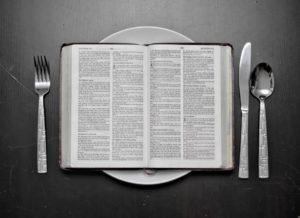
Matthew 16:5-12 – Beware of Bad Teaching

Later, after they crossed to the other side of the lake, the disciples discovered they had forgotten to bring any bread. “Watch out!” Jesus warned them. “Beware of the yeast of the Pharisees and Sadducees.”

At this they began to argue with each other because they hadn’t brought any bread. Jesus knew what they were saying, so he said, “You have so little faith! Why are you arguing with each other about having no bread? Don’t you understand even yet? Don’t you remember the 5,000 I fed with five loaves, and the baskets of leftovers you picked up? Or the 4,000 I fed with seven loaves, and the large baskets of leftovers you picked up? Why can’t you understand that I’m not talking about bread? So again, I say, ‘Beware of the yeast of the Pharisees and Sadducees.’”

Then at last they understood that he wasn’t speaking about the yeast in bread, but about the deceptive teaching of the Pharisees and Sadducees. (New Living Translation)

I tend to think in metaphors, which is probably one reason I like the teaching of Jesus so much. While on this earth, he used a range of metaphors from common everyday life to communicate his point. Seems as though the disciples were more concrete thinkers.

Yeast was a common symbol for evil, which is why the Jews ate unleavened bread. Jesus was trying to get the point across to his disciples that, like yeast, even just a little bit of unhealthy teaching can have far-reaching effects. Partaking of bad teaching works through the whole batch of dough and ruins the spiritual life.

We might think that after seeing Jesus heal the sick, raise a paralyzed man, cure the blind, restore the demon-possessed, walk on water, and feed the masses with only a few loaves of bread that his disciples would be clamoring with praise and responding with a big “Wow! Look at what Jesus did!  Tell us what to do next!”  Instead, they stood around mumbling about how to interpret the great feeding of the four thousand.

The math lesson Jesus explained to the disciples about the basketfuls of food that they had gathered was that the less the disciples had and the bigger their problem, the more Jesus did. 

Jesus Math adds up to grace.  And grace means that who we are, or are not, and what we have, or do not have, is immaterial; what matters is that we have Jesus. We give him what little we have, along with ourselves, and let him do the work.

We must avoid the trap and the temptation of thinking, “If only I had ___; If only I were ___.”  This is unsound doctrine because it denigrates the image of God within us and the good gifts God has already given to us, as if we ourselves are not enough. Yet, even if we have next to nothing, with few abilities, when offering it to Jesus, he turns it into a miraculous bounty of blessing for the world.

Seeing ourselves, our relationships, our stuff, and our world through the person and work of Jesus Christ is our task.  It does not take great powers of interpretation to see that the times are evil and bad information gets disseminated and spread.  What is more difficult for us is discerning that there is a great opportunity for mission and service amid this decaying world. 

We will miss that wonderful opportunity if we partake of bad teaching.

It is imperative that we feed upon sound teaching and be very discerning about who we listen to and what they are really saying to us. Words which are heavy with judgment and light on grace are to be suspect because such teaching is antithetical to the gospel.

Instruction which sets apart and demonizes groups of people or characterizes certain individuals as monstrous or animalistic is completely out of step with the way of Jesus Christ.

We are to be on our guard against any teaching which places an unrealistic and dispassionate heavy load of guilt and shame upon people. We must be vigilant to not accept teaching that plays upon people’s fear and twists reality, making groundless and unsubstantiated claims without evidence. In short, the Holy Scriptures are not to be used as a club to beat people into submission toward our way of thinking and acting.

The spiritual abuse and objectification of others by using the Bible is a terrible condition which unfortunately exists in today’s world. The sad reality is that there are people who engage in harassing others by using God’s Holy Word.

People have been created in the image and likeness of God, and therefore deserve to be treated with respect and civility, regardless of their creed, color, or condition.

So, let me be clear and deliberate about the use and abuse of God’s revelation to us:

I do not condone any use of the Bible which seeks to intimidate, bully, impede, or affect any person’s ability: to work effectively at their jobs, to worship joyfully at their church, or to live without fear of being blacklisted or redlined to the periphery of society.

I do not condone any use of the Bible which intends to control either by threat or by use of physical force any person, their family, and/or their property through inducing fear.

I do not condone any use of the Bible which justifies touching any person without their consent, or coerces, or physically forces another person to engage in a sexual act against their will.

I reject any use of the Bible which encourages any sort of hate crime, act of violence, or hate speech against any person regardless of their gender, sexual orientation, race, ethnicity, class, or religion.

I reject any use of the Bible by any clergy and/or church leadership which demeans and marginalizes women in their basic humanity, role, function, or leadership.

I reject any use of the Bible by any church member and/or attender which demeans and discounts the worldwide Christian community.

I uphold any use of the Bible which seeks to communicate its theology and message gently, carefully, graciously, and lovingly for the spiritual edification and healing of all people.

I uphold any use of the Bible which intends to cultivate one’s own soul and develop a teachable spirit.

I uphold any use of the Bible which looks for truth, wisdom, beauty, and humility.

I champion use of the Bible for both personal and corporate encouragement.

I champion use of the Bible for critical inquiry, scrutiny, and learning.

I champion use of the Bible for all people, regardless of age, including genuine seekers and spiritual misfits, as well as the hurt, abused, lonely, lost, confused, and concerned.

Psalm 119:113-128 – How to Change Our Spiritual Taste Buds

I hate anyone
whose loyalty is divided,
    but I love your Law.
You are my place of safety
and my shield.
    Your word is my only hope.

All of you worthless people,
    get away from me!
    I am determined to obey
    the commands of my God.

Be true to your word, Lord.
    Keep me alive and strong;
    don’t let me be ashamed
    because of my hope.
Keep me safe and secure,
    so that I will always
    respect your laws.
You reject all deceitful liars
    because they refuse
    your teachings.
As far as you are concerned,
all evil people are garbage,
    and so I follow your rules.
I tremble all over
when I think of you

    and the way you judge.

I did what was fair and right!
    Don’t hand me over to those
    who want to mistreat me.
Take good care of me,
    your servant,
    and don’t let me be harmed
    by those conceited people.
My eyes are weary from waiting
    to see you keep your promise
    to come and save me.
Show your love for me,
your servant,
    and teach me your laws.
I serve you,
so let me understand
    your teachings.
    Do something, Lord!
    They have broken your Law.
Your laws mean more to me
    than the finest gold.
I follow all of your commands,
    but I hate anyone
    who leads me astray.
(Contemporary English Version)

Some people try to avoid doing wrong and always try to do right. Others either bulldoze or sleepwalk through life, doing what they will, with impunity. Yet others try to steer clear of egregious sin, while indulging in so-called minor sins. 

Sin is messy business. No matter the form or the attempt at dealing with or without sin, the bottom line is that we all sin because we like it. We might not like the consequences of sin, but it tastes good while doing it.

That’s why we need a complete re-orienting of our hearts to hate every way contrary to God’s good commands. The psalmist proclaims and affirms that all God’s precepts are right, hating every false path which deviates from the true and good. 

If we sin because we like it, the way to avoid sin is learning to hate it – to loathe it so badly that it’s like a nasty stench in our nostrils. Hating sin comes from the acquired taste of loving God’s commandments. When we come around to cherish and desire God’s Word, then sin gradually becomes so odious that we want nothing to do with it.

The reason the psalmist could proclaim such an extended love song to the commands of God, is that he tasted how good they were. And it caused him to forsake every dubious way to human enjoyment. 

The reason I constantly encourage myself and others to read Scripture every single day, with a solid plan of spiritual rhythms, is that it really does have the power to change our taste buds. Sustained, consistent, daily eating of the psalms will teach us to want God and God’s ways – while forsaking the dark path of insolence and oppression.

The psalmist committed himself to avoiding worthless situations, as well as steering clear of harmful people with the propensity to doing wrong. These are fickle, double-minded people, divided in their loyalties. On one side of their mouth, they talk a good line about faith; and then talk out the other side of their mouth, spewing a bunch of worthless gobbledygook which, at the least, adds no value to anything, and, at worst, wrecks good plans and harms others.

If there are people in authority over us who don’t give a wit about our most cherished values, we will likely find ourselves tasked with doing things which rub against our understanding of God’s Word. In this state of moral distress, we are pushed, pulled, and tested in our single-minded devotion by the double-minded person to do what we are uncomfortable with.

In the stress and crucible of trouble, we need the courage to speak up, despite the fear of repercussions. And that strength will only be possible if we have a resilient spirit with the capacity to sustain our personal integrity in the face of our distress. That is, we need God and God’s Holy Word.

Scripture and fellow believers provide support because we need to care for one another as a community of redeemed persons who seek to live into the words of ways of almighty God.

It can be tricky business, wisely trying to discern between what we must accept and what we need to pushback against. Yet, with God, God’s Word, and God’s people, we possess all the resources required in living the spiritual life and navigating the sinful world we inhabit.

God Almighty, I pray that you will deal with me according to your steadfast love and teach me your statutes.  I am your servant; give me understanding so that I might know and live by your commands and forsake the evil of the world, through Jesus Christ my Lord, in the power of your Holy Spirit. Amen.

Luke 11:14-28 – Replace the Bad with the Good

Jesus was driving out a demon that was mute. When the demon left, the man who had been mute spoke, and the crowd was amazed. But some of them said, “By Beelzebub, the prince of demons, he is driving out demons.” Others tested him by asking for a sign from heaven.

Jesus knew their thoughts and said to them: “Any kingdom divided against itself will be ruined, and a house divided against itself will fall. If Satan is divided against himself, how can his kingdom stand? I say this because you claim that I drive out demons by Beelzebub. Now if I drive out demons by Beelzebub, by whom do your followers drive them out? So then, they will be your judges. But if I drive out demons by the finger of God, then the kingdom of God has come upon you.

“When a strong man, fully armed, guards his own house, his possessions are safe. But when someone stronger attacks and overpowers him, he takes away the armor in which the man trusted and divides up his plunder.

“Whoever is not with me is against me, and whoever does not gather with me scatters.

“When an impure spirit comes out of a person, it goes through arid places seeking rest and does not find it. Then it says, ‘I will return to the house I left.’ When it arrives, it finds the house swept clean and put in order. Then it goes and takes seven other spirits more wicked than itself, and they go in and live there. And the final condition of that person is worse than the first.”

As Jesus was saying these things, a woman in the crowd called out, “Blessed is the mother who gave you birth and nursed you.”

He replied, “Blessed rather are those who hear the word of God and obey it.” (New International Version)

You have likely heard the old adage that nature abhors a vacuum. That is, when a loss or change leaves a hole in something, that hole will quickly get filled with something else.

To stop doing one thing is only half of a necessary process. To start doing another thing is crucial.

In our Gospel lesson for today, Jesus tells a story about a demon-possessed man. He was delivered of his oppression. However, a problem arose because the man had no replacement for the demon. He simply did nothing after the demonic expulsion.

It didn’t take long for a group of demons, seemingly seeking such a situation as this man, and took full advantage of his vulnerability. In the end, the man was worse off than before – all because of the vacuum created without the hole being filled.

We are meant to hear God’s Word and obey. Both are necessary to the process of deliverance, growth, and spiritual development.

Whenever the process is only half-baked, we have double-minded people, divided in their loyalties between God and money/power or something else.

Getting rid of judgmental spirits is important but it’s only half the process. The other half is to intentionally make space for genuine inquiry, listening, and dialogue. Without the focus on helping one another through mutual discussion, a group of folks will inevitably degenerate into discouragement, even despair, as the demons of judgmentalism come back in full force.

Kicking hate to the curb only truly works if it is replaced with a spirit of love, concern, and compassion for one’s fellow human. An environment in which people feel free to share of themselves and their feelings is the result of deliberately seeking to do so. Simply policing hate in others eventually causes the demons of hate to establish themselves even deeper than before.

Attempting to eliminate a culture of secrecy and shame can only really come through courageous acts and words of creating a climate of openness which carefully and compassionately enables individuals to boldly name their shame and destroy the blood-sucking vampire feeding on them in the demonic shadows of night once-and-for-all.

A zombie apocalypse won’t happen, that is, unless the only thing we’re concerned about is getting rid of zombies. If our end game isn’t the thriving and flourishing of real live people, our planet will be overtaken with the living dead.

“We look forward to the time when the Power of Love will replace the Love of Power. Then will our world know the blessings of peace.”

William Gladstone

We live in a divided world, polarized chiefly around things we are against, rather than crafting a vision together of what we are for. It does little good to kick people out of power either through force or elections, only to have no collective and compelling cause to rally around and place our efforts.

I’m all in for the cause of living Christ’s Great Commission through making disciples, embodying the Great Commandment of loving God and neighbor, and taking up the Great Challenge to act justly, love mercy, and walk humbly. It is these activities which motivate me to put away hate, hubris, and half-baked ideas so that a healthy process of spiritual formation can happen.

If our lives are already filled with a good spirit, there will be no room for any bad spirit to enter. And if we’ve picked up one, let’s make sure to not only expel it but occupy the space with the grace and goodness which comes from knowing a good and gracious God.

Be intentional about replacing the bad with the good. If a hole is created, fill it with mercy.

O God, the source of all health: Fill my heart with faith in your love, that with calm expectancy I may make room for your power to possess me, and gracefully accept your healing; through Jesus Christ our Lord. Amen.

**Above engraving of Jesus healing a demon possessed man, by an Italian artist, 1591.

Psalm 115 – The Living God Is Both Far and Near

Not to us, O Lord, not to us, but to your name give glory,
    for the sake of your steadfast love and your faithfulness.
Why should the nations say,
    “Where is their God?”

Our God is in the heavens;
    he does whatever he pleases.
Their idols are silver and gold,
    the work of human hands.
They have mouths, but do not speak;
    eyes, but do not see.
They have ears, but do not hear;
    noses, but do not smell.
They have hands, but do not feel;
    feet, but do not walk;
    they make no sound in their throats.
Those who make them are like them;
    so are all who trust in them.

O Israel, trust in the Lord!
    He is their help and their shield.
O house of Aaron, trust in the Lord!
    He is their help and their shield.
You who fear the Lord, trust in the Lord!
    He is their help and their shield.

The Lord has been mindful of us; he will bless us;
    he will bless the house of Israel;
    he will bless the house of Aaron;
he will bless those who fear the Lord,
    both small and great.

May the Lord give you increase,
    both you and your children.
May you be blessed by the Lord,
    who made heaven and earth.

The heavens are the Lord’s heavens,
    but the earth he has given to human beings.
The dead do not praise the Lord,
    nor do any that go down into silence.
But we will bless the Lord
    from this time on and forevermore.
Praise the Lord!
(New Revised Standard Version)

Theology 101 Syllabus:

  • The earth belongs to God, not us.
  • Humanity stewards the earth, not depletes it.
  • Glory belongs to God, not us.
  • Humanity gives glory, not seeks glory.
  • God is mindful of us with blessing, not cursing.
  • Humanity is mindful of God with praise, not idolatry.
  • God is eternal, not finite, alive, and not dead.
  • Humanity is finite, not infinite. Dead people don’t steward the earth and give glory and praise to God. Mortal humans have a privilege and responsibility on this earth while they are still alive.

Any questions?

When it comes to knowing God, we learn as much or more about Divine attributes and actions in the psalms as anywhere else in Holy Scripture. This is one reason why the Lectionary has a psalm for every day – and why the same psalm is repeated three days in a row. It is the consistent, repeated, and continual reading and recitation of the psalms which provides us with the robust theology we need for practical daily living.

God speaks. Idols do not. We have the privilege of God’s Word. There are no words from idols. People become like the objects of their worship. Worshiping a mute inanimate object leads to being silent on the great problems and issues of our day. Idol worship has nothing substantive to offer. It’s worthless.

Conversely, the worship of God (a deity who has words for the immense needs of the world) brings a sense and application of humility, justice, and mercy to the very real and present situations surrounding us.

“The believer trusts in the name of the Lord to show steadfast love – to put love where love is not.”

Mit Tdrahrhe

Evil will not be perpetrated with impunity. That is, the person of violent speech and/or actions will not be able to victimize continually and without consequence. Their wicked words and deeds are held accountable by a God who cares about such things. An idol is unable to hear the cries of victims. And an idol is neither able to proclaim justice nor words of assurance. Idolatry has no ability to stop the ravaging of the earth and its people.

The Lord is both far and near – far enough and high enough to see the big picture and act accordingly – yet near enough to bring true comfort and solace. I was once speaking with a friend about this, discussing the simultaneous transcendence and immanence of God. He listened and then said, “So, it sounds like God is a loving hard-ass!” Well, yes. Not quite the way I would frame it, but he certainly picked up on the spirit of what I was saying.

It is important to hold together and maintain both God’s intimacy and distance. Because they each work together to provide the worshiper with what is needed. The Lord both infinitely observes from afar as well as gets his hands dirty working on behalf of finite humanity. This is the view of God the psalms give us. A God who cares in the total sense of the word – caring with comforting words and confident action.

A vision of God in the psalms inevitably leads to prayer, trust, praise, and worship. The Lord might be invisible, yet the evidence of this immense deity is everywhere in the blessings we have, both big and small. Deep within our personhood is firm epistemic proof that we belong to God.

May the Lord who created heaven and earth give you divine blessing.

May all people everywhere praise the Lord now and forevermore! Amen.