Psalm 1 – Choose Real Happiness

The truly happy person
    doesn’t follow wicked advice,
    doesn’t stand on the road of sinners,
    and doesn’t sit with the disrespectful.
Instead of doing those things,
    these persons love the Lord’s Instruction,
    and they recite God’s Instruction day and night!
They are like a tree replanted by streams of water,
    which bears fruit at just the right time
    and whose leaves don’t fade.
        Whatever they do succeeds
.

That’s not true for the wicked!
    They are like dust that the wind blows away.
And that’s why the wicked will have no standing in the court of justice—
    neither will sinners
    in the assembly of the righteous.
The Lord is intimately acquainted
    with the way of the righteous,
    but the way of the wicked is destroyed. (Common English Bible)

True happiness happens when we conform to disciplines of a good life and eschew practices that go against the grain of goodness. That statement might be a bit difficult to accept. Frankly, it is for me, and I wrote it.

You see, I’m not much of a conformity sort of guy. I like creatively doing my own thing, man. Bucking the system and questioning the rules is just something I do. Conformity tends to have a negative connotation with me – like a group of unthinking lemmings running off a cliff to their death.

Yet, the truth is that, although there is a wide range of creative choices we have for most everything, we as humans best function and discover happiness when we are in sync with our Creator. So, we can choose to ignore our foundational human hard-wiring, or we can live into it as the unique individuals we are.

Those two ways of shaping our lives are the path of the righteous and the path of the wicked. The way of the righteous leads to human flourishing, relational connection, and a vast spiritual life. Alternatively, the way of the wicked leads to human degeneration, disconnection from others, and spiritual death. It is to be out of sync with who we are as people.

Distinguishing between the righteous and the wicked is not always as easy as it looks. Only at the end of the age, when the Day of Judgment comes, will we know for certain the righteous and the wicked.

The magisterial Reformer of the sixteenth-century, Martin Luther, framed the two opposing ways as the theology of the cross and the theology of glory. The cross of Christ is G-d’s attack on human sin. Through being crucified with Christ, we find the way to human flourishing and life. It is the narrow road of grace.

A theology of glory is seeking to be radically independent – to rely primarily, perhaps even exclusively, on our own laurels and personal way of doing things. Although these might appear to be outwardly fine, they feed and water themselves from a wicked stream, devoid of grace.

Whenever we place our complete trust in self and forsake faith in something or someone outside of ourselves, it is a highway to the grave.

It is far too easy to place faith in our good works and to do good so that others will observe our goodness, rather than doing them out of the good soil of being planted in ancient and wise instruction.

Embracing tried and true practices of righteousness; delighting in G-d’s law; meditating on sound instruction; privately pouring over the large body of wisdom we have available to us; and diligently seeking to put it all into action is the way of good people who shall surely realize human happiness. They will yield gracious fruit. They will know blessing.

Joyful are people of integrity,
    who follow the instructions of the Lord.
Joyful are those who obey his laws
    and search for him with all their hearts.

Psalm 119:1-2, NLT

Serving only to be seen; seeking public accolades and personal recognition as a sole motivator; and disrespecting others to prop up individual respect is the way of the wicked. They don’t bother to consult the ancient ways of happiness. Instead, they pridefully believe they know what is best.

“You’re like manicured grave plots, grass clipped and the flowers bright, but six feet down it’s all rotting bones and worm-eaten flesh. People look at you and think you’re saints, but beneath the skin you’re total frauds.” (Matthew 23:27-28, MSG)

Abundance, generosity, gentleness, and grace marks the righteous because G-d is abundantly gracious and generous. Jesus is the gentle shepherd who mercifully and lovingly leads anxious sheep to the quiet pastures of settled happiness. Indeed, the Lord watches over the way of the righteous.

Only looking out for number one, stinginess, withholding good, hoarding, and angry criticism identifies the wicked. They have judgment in their future because they add no value to the great needs of humanity. Unhappiness is their lot.

We have choices. We can choose conformity to established patterns of godly instruction and happiness – or we can choose to rely solely on our own ingenuity and/or brawn to eke out a morsel of satisfaction.

Choose wisely, my friends.

O Holy Wisdom, direct us on your path. Make us worthy of your teachings and open our hearts to accept your embrace, that we may serve you in peace and grace. Amen.

James 3:1-12 – Taming the Tongue

Not many of you should become teachers, my fellow believers, because you know that we who teach will be judged more strictly. We all stumble in many ways. Anyone who is never at fault in what they say is perfect, able to keep their whole body in check.

When we put bits into the mouths of horses to make them obey us, we can turn the whole animal. Or take ships as an example. Although they are so large and are driven by strong winds, they are steered by a very small rudder wherever the pilot wants to go. Likewise, the tongue is a small part of the body, but it makes great boasts. Consider what a great forest is set on fire by a small spark. The tongue also is a fire, a world of evil among the parts of the body. It corrupts the whole body, sets the whole course of one’s life on fire, and is itself set on fire by hell.

All kinds of animals, birds, reptiles and sea creatures are being tamed and have been tamed by mankind, but no human being can tame the tongue. It is a restless evil, full of deadly poison.

With the tongue we praise our Lord and Father, and with it we curse human beings, who have been made in God’s likeness. Out of the same mouth come praise and cursing. My brothers and sisters, this should not be. Can both fresh water and saltwater flow from the same spring? My brothers and sisters, can a fig tree bear olives, or a grapevine bear figs? Neither can a salt spring produce fresh water. (New International Version)

Words and speech are the most powerful tools we have in the Christian life. And the tongue is the means of forming the words and using the speech God gives us.

The problem is, we may too often underestimate the importance and the great power of the tongue to effect both good and evil. We might not believe that our particular words carry much weight.

Yet, in reality, our words are very powerful.  In fact, what we say with our tongues is either the vehicle of praise to God, or the ruin of another person. We must measure our words because the tongue is a beast to control and tame. 

The tongue is so powerful that it determines the direction of a person’s life.

The horse is a strong animal, and the strength of a horse must be respected at all times. Yet, a small woman, even a young girl who knows what she is doing with a bridle and a bit, can make a horse do whatever she wants. Ships can be massive and carry thousands of people and huge amounts of cargo. Yet, it is controlled and directed by the rudder – a very small piece of the ship.  In our own day, we know the devastating power of a very small handgun trigger which can literally snuff out a life in an instant.

Likewise, the tongue is quite small among the parts of the body. Yet, it sets the course of a person’s life and has the power to determine its destiny.  A rider who does not know how to handle a horse is in trouble.  An undisciplined pilot of a ship is in danger of shipwreck.  A gun owner loose with gun safety is a danger to others. And the loose, unbridled, untrained and undisciplined tongue is on a one way course to destruction.

The tongue is so powerful that it can destroy another person.

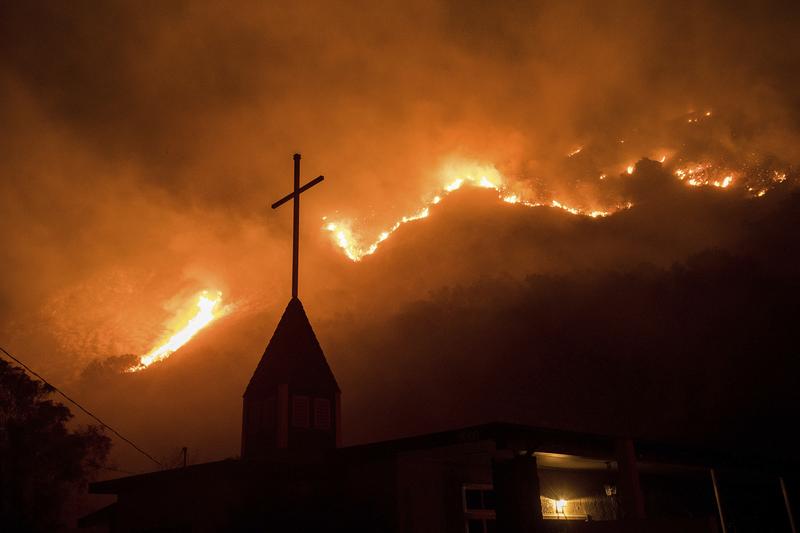
Like fire, the tongue has an awesome potential for harm. The great Chicago fire of 1871, one of the costliest disasters of the nineteenth-century, killed three hundred people and destroyed seventeen-thousand buildings.  All the destruction was started by Mrs. O’Leary’s cow kicking over a lantern in a barn. 

The Yellowstone National Park fire of 1988 burned for several months and completely destroyed nearly 800,000 acres of the park.  At the peak of the fire there were 9,000 firefighters battling the blaze. All the devastation was caused by one quick flash of lightning.

The largest fire in American history occurred in 1871 and began in northern Wisconsin. The fire created its own wind system and turned into a tornado, moving into the Upper Peninsula of Michigan. By the time it was over, 3.7 million acres were scorched with 2,500 people left dead. All the destruction was likely caused by a small meteorite.

Whenever we underestimate the power of our speech and allow a stray word to fly off the tongue, the spark has the potential to start a huge conflagration of evil. A firestorm of destruction can be set off with just a few uncontrolled words. 

Through gossip (saying something behind somebody’s back that you would not say to their face), flattery (saying something to someone’s face that you would not say behind their back), negative criticism, sarcastic humor, boasting, and a host of evil words, the tongue has the immense power to destroy life.  It is speech fueled and spread by Hell itself.

The tongue is so powerful that it cannot be tamed.

Animals can be tamed, even crocodiles.  I once took my oldest daughter to the circus, when she was a small girl, and watched as a guy had a trained crocodile open its mouth and stuck his head inside the crazy reptile! 

Yet, no one can tame the tongue. It is like a tarantula, biting its victim with paralyzing venom so that the arachnid can eat its prey alive. The untamed and uncontrolled tongue is like a poisonous spider which spreads its verbal venom, paralyzing other people and sucking the life out of them.

The Apostle James paints a hopeless picture because he wants to drive us to the grace of God for help. We cannot tame the tongue – but God can. When we begin to see the true nature of our speech, it reveals something of ourselves.

The tongue is so powerful that it exposes the duplicity of the heart.

Whatever comes out of our mouths reveals what is on the inside of our lives. If we can grasp the truth of this, I believe it could transform the way people talk to one another. Even more metaphors to communicate the point….

Salt water and fresh water cannot both come from the same spring. A fig tree cannot bear olives, and a grapevine is not going to produce figs. And whatever comes out of the mouth reveals the source. Evil words come from an evil source; good words come from a good source. 

A pattern of negative condescending speech is drawing from a well, pumping up words from the depths of Hell. Conversely, a continuous stream of helpful words that encourage and build up others, draws its nourishment from God’s Word.

Conclusion

The following are four ways to help bring the tongue under control:

  • Train your tongue for good. Speech is a skill to be developed. When starting an exercise regimen, we are deliberately training our bodies for health. When dieting, we are saying “yes” to certain foods, and “no” to others. The tongue needs to be trained to express gratitude, good news, and grace. And one of the best ways to do it is through speaking Scripture out loud in a daily regular regimen. Consider going on a fast from talking and seek only to be silent and listen for a specified amount of time.

Do not waste time arguing over godless ideas and old wives’ tales. Instead, train yourself to be godly. “Physical training is good, but training for godliness is much better, promising benefits in this life and in the life to come.” (1 Timothy 4:7-8, NLT)

Solid food is for the mature, for those whose faculties have been trained by practice to distinguish good from evil. (Hebrews 5:14, NRSV)

  • Read a chapter of Proverbs each day for a month. There are thirty one chapters in Proverbs, one for each day of the month. Pay attention to the power of words. Notice the difference between the speech of a wise person and the words of a fool – and take to heart the consequences of both approaches. 

You will say the wrong thing
    if you talk too much—
    so be sensible and watch
    what you say. (Proverbs 10:19, CEV)

Careless words stab like a sword,
    but wise words bring healing. (Proverbs 12:18, NCV)

  • Build friendships with people who are positive and encouraging. If a negative person keeps being negative, even after you have warned them more than once about it, you likely need a new relationship. 

Warn a quarrelsome person once or twice, but then be done with him. It’s obvious that such a person is out of line, rebellious against God. By persisting in divisiveness, he cuts himself off.  (Titus 3:10-11, MSG)

  • Listen and learn before speaking. A judgmental spirit often comes from misinterpreting another person’s words and/or actions. We can too often jump to conclusions about something or someone with only partial information and without the whole story.

Love never gives up.
Love cares more for others than for self.
Love doesn’t want what it doesn’t have.
Love doesn’t strut,
Doesn’t have a swelled head,
Doesn’t force itself on others,
Isn’t always “me first,”
Doesn’t fly off the handle,
Doesn’t keep score of the sins of others,
Doesn’t revel when others grovel,
Takes pleasure in the flowering of truth,
Puts up with anything,
Trusts God always,
Always looks for the best,
Never looks back,
But keeps going to the end. (1 Corinthians 13:4-7, MSG)

Right and Just God, teach us to speak wisely. Let us avoid useless thoughts and useless conversations. Help us to speak often of you. Grant that our words may never hurt others but always bring comfort to those in sorrow, and guidance to those in need. Take our tongues and make them yours. Take our minds and make them instruments of your goodness and a channel of truth. May you help us to use both words and silence in redemptive ways, through Jesus Christ our Redeemer. Amen.

Psalm 144:9-15 – Rescued from Evil

Rescued by Rodney J. Parrott

O God, let me sing a new song to you,
    let me play it on a twelve-string guitar—
A song to the God who saved the king,
    the God who rescued David, his servant.

Rescue me from the enemy sword,
    release me from the grip of those barbarians
Who lie through their teeth,
    who shake your hand
    then knife you in the back.

Make our sons in their prime
    like sturdy oak trees,
Our daughters as shapely and bright
    as fields of wildflowers.
Fill our barns with great harvest,
    fill our fields with huge flocks;
Protect us from invasion and exile—
    eliminate the crime in our streets.

How blessed the people who have all this!
How blessed the people who have God for God! (The Message)

Evil lurks everywhere. It resides in the human heart, hidden in the dark shadows, coming out sideways through shameful lies and guilty actions. Evil is also found throughout the world in every institution, organization, and group, ensconced as systemic injustice – hoarding resources for the powerful at the expense of the powerless.

Since there is wickedness found in all places and with all people, evil needs to be dealt with and expunged from both heinous hearts as well as the hoarding habitations of injustice. Part of the solution is to do away with all obstacles which stand in the way of human flourishing.

To be sure, the heart of humanity must be dealt with and be the focus of change. Yet, if we only focus one-dimensionally on evil, it will persist, and even grow into monstrous proportions, unless we equally direct our right and just efforts on institutional and systemic evil.

People and their institutions need deliverance from the power of evil in the world. And for that to happen, the hindrances and handicaps to human thriving must be eliminated.

Our entire concept of salvation needs a fuller scope. Not only do individuals need personal deliverance from sin, death, and hell, so do entire societies. Complete systemic rescue from oppressive obstacles is a must. Far too many people in this fallen world are weighed down from institutional sin.

Christ obeyed God our Father and gave himself as a sacrifice for our sins to rescue us from this evil world.

Galatians 1:4, CEV

To place this in a different context, the genius of the American experiment was that the founding fathers (and mothers!) of the United States created a political and societal system which sought to eliminate class distinctions and allowed people of lower means to achieve land ownership and business acumen simply through hard work and thrift.

Unfortunately, the experiment only extended largely to white men. Native American and African American people still had huge systemic obstacles to overcome. And the new republic had different expectations for it’s women. It took a Civil War and decades of grueling work to address political and social change (not to mention religious). We are still laboring to truly give liberty and justice to all and achieve the ideal of an egalitarian nation.

We, as both individuals and citizens, need divine intervention through deliverance. Like Gilligan and the crew of the Minnow stranded on a deserted island, we seek to be rescued – knowing we need help beyond ourselves for salvation.

Rescue us from the evil one.

Matthew 6:13, NRSV

The psalmist looked ahead in hope, convinced that a good God will deliver and provide good people with everything they need to thrive and flourish in this life, and in the life to come.

If God doesn’t fight our overwhelming battles for us, we are lost. This present darkness, this ancient and contemporary evil, is an extremely powerful foe. However, the Lord is greater and will have the last word.

Christianity asserts that Jesus is the pioneer of our salvation and the once for all answer to the problem of evil for both the world and the human heart. Christ, in other words, is the fulfillment of the psalmist’s prayers for deliverance, health, and hope.

In his earthly ministry, Jesus did not give explanations for our pain and sorrow. Instead, Jesus comes where our pain is most acute and takes it upon himself – bringing healing and hope. The Lord tackles evil, not by having a Zoom conference on the subject of wickedness, but by allowing evil to do its worst to him. Christ exhausts evil by draining it of its power, emerging resurrected with new life for all.

The good news is this: Jesus is Lord and has defeated the powers of evil. Now, reform can occur. Hearts can change. Systems can be revamped. God’s new world has begun.

God rescued us from the control of darkness and transferred us into the kingdom of the Son he loves. He set us free through the Son and forgave our sins.

Colossians 1:13-14, CEB

I, personally, am a Christian because I believe God is the one who satisfies the passion for justice, the longing for spirituality, the hunger for relationship, and the yearning for beauty. I see God in Jesus of Nazareth, the world’s true Lord.

Hope, like the psalmist expressed, is what you get when you realize a different worldview is possible. Hope springs to life when those experiencing and feeling the brunt of evil in the world become acutely aware that the rich, the powerful, and the unscrupulous are not the ones really in charge.

“Our task as image-bearing, God-loving, Christ-shaped, Spirit-filled Christians, following Christ and shaping our world, is to announce redemption to a world that has discovered its fallenness, to announce healing to a world that has discovered its brokenness, to proclaim love and trust to a world that knows only exploitation, fear and suspicion…”

N. T. Wright

May you know the place and the person of rescue from evil. And may you be buoyant in faith, confident in hope, and overflowing with love.

James 1:17-27 – Be Good because God Is Good

Every good and perfect gift is from above, coming down from the Father of the heavenly lights, who does not change like shifting shadows. He chose to give us birth through the word of truth, that we might be a kind of first-fruits of all he created.

My dear brothers and sisters, take note of this: Everyone should be quick to listen, slow to speak and slow to become angry, because human anger does not produce the righteousness that God desires. Therefore, get rid of all moral filth and the evil that is so prevalent and humbly accept the word planted in you, which can save you.

Do not merely listen to the word, and so deceive yourselves. Do what it says. Anyone who listens to the word but does not do what it says is like someone who looks at his face in a mirror and, after looking at himself, goes away and immediately forgets what he looks like. But whoever looks intently into the perfect law that gives freedom and continues in it—not forgetting what they have heard but doing it—they will be blessed in what they do.

Those who consider themselves religious and yet do not keep a tight rein on their tongues deceive themselves, and their religion is worthless. Religion that God our Father accepts as pure and faultless is this: to look after orphans and widows in their distress and to keep oneself from being polluted by the world. (New International Version)

God is Good – All the Time

And all the time – God is good. That statement is a bedrock foundation for Christian faith. Without a basic affirmation and belief of God’s goodness, our faith will experience cracks and not stand the test of hardship and difficulty in life. Without the steadfast conviction that God is good, the alternative is that God is somehow fickle or even mean – that God does not care about my problems.

The trials and tribulations of life are intended by God to be watershed experiences that prove the genuineness, or lack thereof, of our faith. When life is good, it is easy to say God is good. However, when it isn’t, we may slide into a belief system that thinks God is the source of our trouble. And if we have not been working on a relationship with God, we will have scant resources to draw from to help us.

God is good, and not mean. Every single good gift there is in this world comes from God. Nothing evil comes from God. God’s grace is constantly around us. If his grace were not here, it would be like living inside a dystopian novel, or a zombie apocalypse, where everyone is constantly looking over their shoulders for the next evil thing to happen. Although evil exists, it could be a whole lot worse if it were not for divine grace and goodness.

“This is true faith, a living confidence in the goodness of God.”

Martin Luther

God is immutable, that is, God’s goodness is ever-present. On this earth we are constantly subjected to changing light as the sun rises and sets, and as the clouds come and go. Yet, God does not change like shifting shadows. God is not fickle or capricious. God’s goodness is always at high noon, standing like an eternal sun in a bright blue sky radiating unbroken grace to us.

God’s goodness has delivered people from sin, death, and hell. God’s grace has given us new life. God created the world and pronounced it “good.” God formed you and called you “good.” And God has forgiven you, in Christ, and says it is “good.”

God gave us a good word for us to accept and live by.

Hurry Up and Listen

There is a great need for listeners today. Precious little productive communication takes place because there are so many people in a hyper-vigilant state airing their opinions. They talk over and on top of each other because they’ve already made-up their minds about how things really are and what should be done. Nobody is listening.

Bible reading is a primary source for listening to God. Yet, although many people own multiple Bibles, and Scripture is freely available through digital sources, far too many persons simply don’t read and listen to it.

Slow Down and Speak

God has given us two ears and one mouth so that we will listen twice as much as we talk.   

Too much talk leads to sin. Be sensible and keep your mouth shut. (Proverbs 10:19, NLT)

A loose tongue and constant opining happens because of faulty listening.  An inability to listen leads to a lack of understanding because we do not take the time to get the whole story. It’s easy to pronounce verdicts with little information, and offer bad advice, when there is little listening.

Have a Long Fuse

Be slow to anger. A fool speaks without thinking, which stirs up strife. Slow to listen and quick to speak leads to anger flares. An angry spirit is an unteachable spirit, unwilling to listen to both God and others. 

Rash words said in anger produce an ugly unrighteous life. Selfish opinionated anger produces harsh bitter words and kills God’s plan for a good life.

We are to accept the Word of God. Throwing labels at people only de-humanizes them. They become objects of anger and scorn, and not people made in God’s image. Nothing good comes from ignoring God’s Word and giving-in to bitterness. It destroys good people.

Get Rid of Evil

Get rid of all moral filth, and the evil that is so prevalent. The unwillingness to listen, a loose tongue, and unrighteous anger are moral evils. Evil is not only perpetuated by serial killers, terrorists, and other people different from us. In fact, the face of evil rarely comes to us in the form of red horns and a pitchfork.

Evil also resides as soft-core wickedness – common ordinary evil. The demonic can work in an almost ho-hum manner, subtly questioning whether anyone can really live up to the precepts of God’s Word, and generally undermining all that takes place to the glory of God.

The face of evil is neither hot nor cold, but “meh.” It is the bitter slow-cooked seething anger bubbling just underneath the surface which comes out in a plastic smile while offering up a morsel of slander based on a lack of listening well. It comes out in fake gestures of niceness while being quick to make judgments with little to no information.

Put away the “meh.” Receive God’s Word. Take a teachable posture. Stop and listen to what God’s Word has to say.

Be a Doer of God’s Word, Not Just a Hearer

The Word of God is not truly received until it is put into practice. 

It is not the hearers of the law who are righteous in God’s sight, but the doers of the law who will be justified. (Romans 2:13, NRSV) 

Blessed are those who hear the word of God and obey it (Luke 11:28, NIV). 

The person who only hears is like a Mr. Potato Head that is only ears. He cannot stand because he has no feet.  He cannot do anything because he has no hands. Mr. Potato Head needs some feet so that he can follow Jesus wherever he goes. And he needs hands so he can do God’s will.

Listening to the Word without obedience is just that – it is mere hearing.  Profession of faith means nothing without a practice of that faith; learning the Bible is useless without living it; and acceptance of the Word is nothing more than a mental exercise without action to back it up.  Profession, knowledge, and acceptance alone does not satisfy God’s plan for our lives. 

Pay Attention to the Person in the Mirror

A person looks at himself in the mirror. He clearly sees all his flaws. Yet he does not respond, likely because he doesn’t like what he sees. It’s silly to look into a mirror, see a major bedhead, and just do nothing about it and go to work as if everything were fine. We look. We examine. We hear. We see exactly who we are. And we can’t even identify ourselves in a police lineup.

The person forgets what he looks like because he does not really want to face himself. This isn’t a clueless guy. It is one who sees himself as he really is and chooses not to do anything about it.

Forgetfulness happens because of inaction. Remembrance, communion, and hope all occur through active participation. God blesses the one who looks hard into the mirror of God’s Word, then intentionally makes changes based on what he finds.

Obedience to God’s Word brings freedom, not bondage. Listening, seeing, adjusting, and changing is a freeing activity. That’s because it’s how we are designed to live.

Holy and good God, give me grace to see you, others, and myself clearly so that I will be conformed to the image of Jesus Christ. Amen.