Psalm 120 – Gaslighting Trouble

Ingrid Bergman and Charles Boyer in the 1944 film, “Gaslight”

I’m in trouble. I cry to God,
    desperate for an answer:
“Deliver me from the liars, God!
    They smile so sweetly but lie through their teeth.”

Do you know what’s next, can you see what’s coming,
    all you bold-faced liars?
Pointed arrows and burning coals
    will be your reward.

I’m doomed to live in Meshech,
    cursed with a home in Kedar,
My whole life lived camping
    among quarreling neighbors.
I’m all for peace, but the minute
    I tell them so, they go to war! (The Message)

I wish we lived in a world where people always speak and live the truth in love, without lying, pretense, or posturing. But we don’t. Not everyone embraces a life of encouraging others through truthful affirmation and selfless acts of service.

In reading today’s psalm, I immediately think of all the patients I’ve seen as a chaplain on my behavioral health unit who have been gaslighted.

“Gaslighting” is a recent term, yet the concept is as old as Satan’s interaction with Adam and Eve in the Garden. The word comes from the 1944 movie, “Gaslight,” starring Charles Boyer and Ingrid Bergman. In the attempt to drive his wife insane, the husband rigs the gaslights of the house so they will flicker at night. Whenever his wife comments on it, her husband flat-out lies and says the lights are not flickering at all. I’ll let you watch the film yourself to see what happens.

A person who “gaslights” uses psychological manipulation to gain and assert control over someone or some group. Gaslighters actively undermine others, using their words against them, plotting nefarious plans for them behind their backs, lying without so much of a blink of an eye, and turning family or friends against someone – all with the insidious agenda of increasing their power over that person and solidifying their dependence from the victim.

All of this gaslighting behavior is done with a smile, said with syrupy words to hook you, rather than help you. That, of course, makes it hard to spot – which is why it is so devilish. If the gaslighter can get you to doubt yourself, your abilities, or your perception of reality, then they can worm themselves into your life and plant their thoughts inside you.

Gaslighters don’t want peace. They want conflict. People at war give them an opportunity to gain more influence and power. Plus, they just plain like to watch others fight amongst themselves. It gives them a sense of control.

Today’s psalm is part of the psalms of ascent – songs used by the community as they walk their pilgrimage to Jerusalem and up the temple mount. The people collectively lament the gaslighting activity of those who oppose and hate them. And they turn to God, who abhors gaslighters, seeking solace and safety from their evil ways.

The gaslighter’s end is certain. They will have to contend with the God who will not be manipulated by anyone. Although it is not our job to punish sinners, it very much is our responsibility to see and avoid gaslighting as much as possible, as well as, God forbid, becoming a gaslighter ourselves. To that end, take note of some of the manipulative marks of gaslighters and patterns of gaslighting:

  • Pitting people against one another. This is done a variety of ways through gossip masked as trying to help, subtle slander, and carefully placed lies.
  • Avoiding responsibility. The gaslighter never owns their words and actions but are experts at blaming others for whatever goes awry.
  • Creating fights and conflicts. Gaslighters chronically avoid the dirty work. They get others riled-up at each other, then sit back and look for an opportunity to seize control over the warring parties.
  • Sucking-up to others. Flattery is a well-worn tool of gaslighters. They are masters at buttering-up people to get what they want.
  • Comparing people. This is just another way of driving a wedge between people. “Why can’t you be like ___?”
  • Mistreating the weak and powerless. The weak have no value for the gaslighter because the powerless have nothing to offer them. So, oppression becomes a means of getting the weak out of the way, like they’re some pesky insect to get rid of.
  • Bragging about accomplishments and stealing other’s. Gaslighters will always take the credit for an accomplishment and then boast about it, all the while badgering the victim.
  • Not keeping promises. Usually there’s a bait and switch where the gaslighter will promise something, then switch the rules or tell a bold-faced lie that they never promised that.

There is much more gaslighting behavior, but you get the drift. The best way to deal with a gaslighter? Get as far away from them as you can, find genuine supportive relationships, and leave them to God.

Today’s psalm can be your prayer to the Lord, offering a heartfelt plea to the Divine Being who does the opposite of gaslighting: strengthening you, giving you power, listening to your voice, and loving you with complete altruistic motives.

Eternal Father, you created us in your own image and likeness, but sin has warped the minds of humanity so that there is much injustice and much carelessness of the rights of other people in this fallen world. I pray you will right every wrong and vindicate those being treated unjustly. Keep us, your people, from trying to take matters into our own hands for vengeance. Give justice and peace to all those who have been cruelly and unfairly treated. May the injustice they have endured be the means to draw them into the saving arms of your grace, through Jesus Christ our Lord. Amen.

Romans 12:17-21, 13:8-10 – Let Love Be Your Only Debt

Don’t mistreat someone who has mistreated you. But try to earn the respect of others and do your best to live at peace with everyone.

Dear friends, don’t try to get even. Let God take revenge. In the Scriptures the Lord says,

“I am the one to take revenge
    and pay them back.”

The Scriptures also say,

“If your enemies are hungry,
    give them something to eat.
And if they are thirsty,
give them something
    to drink.
This will be the same
as piling burning coals
    on their heads.”

Don’t let evil defeat you but defeat evil with good….

Let love be your only debt! If you love others, you have done all that the Law demands. In the Law there are many commands, such as, “Be faithful in marriage. Do not murder. Do not steal. Do not want what belongs to others.” But all of these are summed up in the command that says, “Love others as much as you love yourself.” No one who loves others will harm them. So, love is all that the Law demands. (Contemporary English Version)

Not everybody is likable. We all have others that drive us crazy on the inside with their annoying habits or ungodly ways of life. 

Sometimes we might experience much more than being irritated. Raging vitriol that results in verbal persecution; becoming the targets of evil intent; and, in some cases, finding ourselves victims of violence done to us or a loved one can stretch our Christian sensibilities to their maximum. It is understandable that in such cases we would be upset, angry, in grief, and desire justice.

As we reflect back on Reformation Day and the great truth that we are justified apart from any work of our own but by grace alone through faith, this helps to give understanding as to why we do not take vengeance into our own hands. 

We are clearly exhorted in today’s New Testament lesson to repay no one evil for evil because vengeance belongs to God alone, not us. 

If justification is a work of God to rescue and redeem sinners from their plight, then wrath is also a work of God. Just as justification is initiated and made possible through Christ by faith, so vengeance belongs to God, as well. Our part in the whole affair is to trust God to take care of judging the world. Judgment is way above our pay grade.

Our responsibility is showing love, even to those whom we consider enemies. If we are to love our neighbors as ourselves, then we will leave plenty of room for God to do what God does best: either show mercy to sinners or execute judgment upon them. It’s all God’s business what happens with humanity. Our business is coming under the lordship of Christ and allowing God’s new creation to work itself out through us. 

We are to work for the kind of justice that provides others with what they need, not what they deserve. The world cannot become a better place if we keep insisting on playing judge, jury, and executioner. Sometimes the best way to show love is to sincerely pray for the person for whom we have such difficulty loving. 

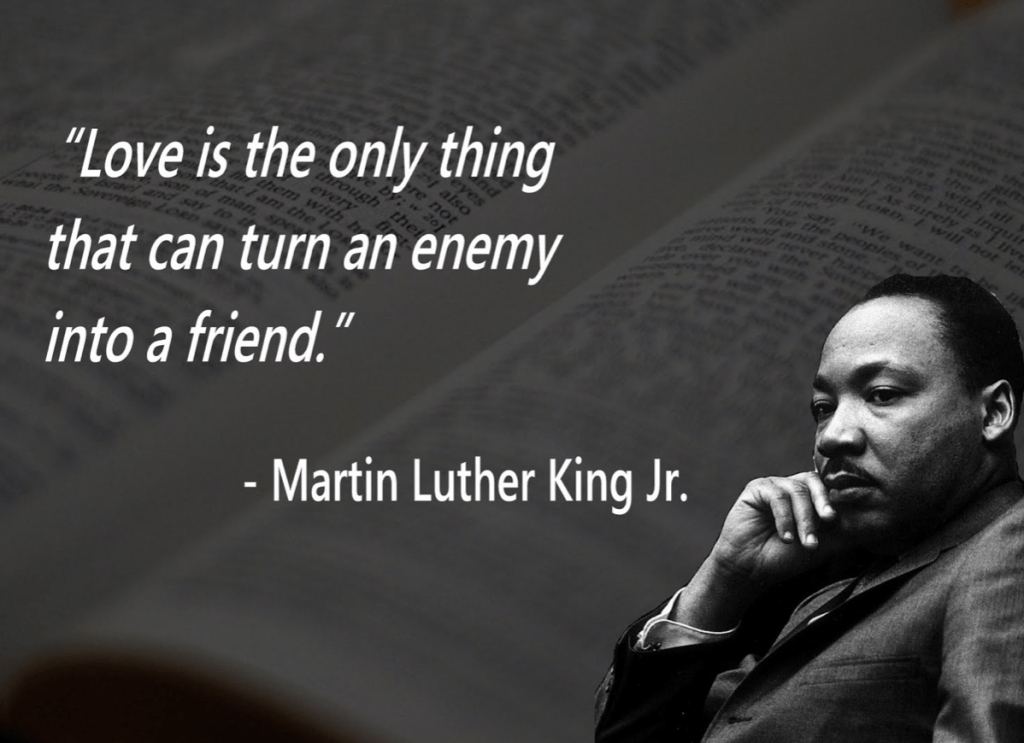
Who do you need to love today? Here is an excerpt from a sermon by Dr. Martin Luther King Jr., delivered at the Dexter Avenue Baptist Church, Montgomery, Alabama, on November 17, 1957:

“Love has within it a redemptive power. And there is a power there that eventually transforms individuals. That’s why Jesus says, ‘Love your enemies.’ Because if you hate your enemies, you have no way to redeem and to transform your enemies. But if you love your enemies, you will discover that at the very root of love is the power of redemption. You just keep loving people and keep loving them, even though they’re mistreating you.

Here’s the person who is a neighbor, and this person is doing something wrong to you and all of that. Just keep being friendly to that person. Keep loving them. Don’t do anything to embarrass them. Just keep loving them, and they can’t stand it too long. Oh, they react in many ways in the beginning. They react with bitterness because they’re mad because you love them like that. They react with guilt feelings, and sometimes they’ll hate you a little more at that transition period, but just keep loving them.

And by the power of your love, they will break down under the load. That’s love, you see. It is redemptive, and this is why Jesus says love. There’s something about love that builds up and is creative. There is something about hate that tears down and is destructive. So, love your enemies.”

Just and merciful God, you are the rightful Judge of all the earth. Help me to trust in you so that I can give room for you to do whatever you want to do in others’ lives. I pray you will grace many people with the repentance that leads to new life in Jesus. Amen.

Revelation 17:1-18 – A Vision of the End

“The Whore of Babylon” by Hans Burgkmair, 1523

One of the seven angels who had the seven bowls came and said to me, “Come, I will show you the punishment of the great prostitute, who sits by many waters.With her the kings of the earth committed adultery, and the inhabitants of the earth were intoxicated with the wine of her adulteries.”

Then the angel carried me away in the Spirit into a wilderness. There I saw a woman sitting on a scarlet beast that was covered with blasphemous names and had seven heads and ten horns. The woman was dressed in purple and scarlet, and was glittering with gold, precious stones and pearls. She held a golden cup in her hand, filled with abominable things and the filth of her adulteries. The name written on her forehead was a mystery:

BABYLON THE GREAT

THE MOTHER OF PROSTITUTES

AND OF THE ABOMINATIONS OF THE EARTH

I saw that the woman was drunk with the blood of God’s holy people, the blood of those who bore testimony to Jesus.

When I saw her, I was greatly astonished. Then the angel said to me: “Why are you astonished? I will explain to you the mystery of the woman and of the beast she rides, which has the seven heads and ten horns. The beast, which you saw, once was, now is not, and yet will come up out of the Abyss and go to its destruction. The inhabitants of the earth whose names have not been written in the book of life from the creation of the world will be astonished when they see the beast, because it once was, now is not, and yet will come.

“This calls for a mind with wisdom. The seven heads are seven hills on which the woman sits. They are also seven kings. Five have fallen, one is, the other has not yet come; but when he does come, he must remain for only a little while. The beast who once was, and now is not, is an eighth king. He belongs to the seven and is going to his destruction.

“The ten horns you saw are ten kings who have not yet received a kingdom, but who for one hour will receive authority as kings along with the beast. They have one purpose and will give their power and authority to the beast. They will wage war against the Lamb, but the Lamb will triumph over them because he is Lord of lords and King of kings—and with him will be his called, chosen and faithful followers.”

Then the angel said to me, “The waters you saw, where the prostitute sits, are peoples, multitudes, nations and languages. The beast and the ten horns you saw will hate the prostitute. They will bring her to ruin and leave her naked; they will eat her flesh and burn her with fire. For God has put it into their hearts to accomplish his purpose by agreeing to hand over to the beast their royal authority, until God’s words are fulfilled. The woman you saw is the great city that rules over the kings of the earth.” (New International Version)

Today’s New Testament lesson is the beginning of a long and elaborate vision of the Apostle John. The vision includes a woman and a scarlet beast, and the angel’s interpretation of what John saw.

An Incredible Vision

“The Whore of Babylon” from Martin Luther’s 1534 translation of the Bible.

Consistent with Old Testament’s imagery depicting the relationship between God and people, John’s vision is of a prostitute whom the kings of the earth committed adultery. This great offense will not be overlooked. It is provoking divine wrath.

The prostitute sits on a scarlet beast, an imposing and rather incredible looking creature with seven heads and ten horns. The woman and the beast signify and portray the pinnacle of opulence, extravagance, and luxury. Yet, she is also the ultimate depiction of corruption, indecency, and irreverence.

The great prostitute influences all the world. She is the evil genius behind the blood of the Christian martyrs. The woman deceives and connives so that she can wreak her violence against the saints of God.

John appears to be slack jawed with all this. The prostitute’s seductive influence has been so great that nations fall to her erotic power. She is so diabolically smooth, her presentation so marvelous, that even John is mesmerized by her.

Why Are You Astonished?

The angel’s question to John is akin to saying, “Well, what did you expect? The Wicked Witch of the West? Evil is much more sinister than an ugly old woman. Unrighteousness cloaks itself in nice garb. Snap out of it, man!”

Astonishment and awe belong to God, not some alluring vision of beauty. The enticement only traps humanity into a sticky web which the Black Widow can feed upon. The woman and the beast are doomed to destruction. Their time is imminently near.

John (and us) must see beyond the surface presentation to the darkness within. Antichrist is not only a person but the evil systems which feed upon helpless humans caught in the web of seduction.

The End Times

The leaders of the earth, deceived and smitten by the temptress, ally together to wage war on all that is right, just, and good – all the while believing they are fighting for beauty. It will eventually climax at Armageddon, the place of final victory over all the malevolence.

The Lamb shall overcome the nefarious forces of corruption. The faithful followers of God need only to persevere and see the punishment of the wicked. Please keep in mind that none of this has a timetable for us to chart. Biblical time revolves primarily around events, not precision clockwork.

It is not our task to walk around predicting dates, nor is it to point fingers at anyone we don’t like as being the antichrist. There’s plenty of shock-and-awe in the Apocalypse of John without us adding to it with our half-baked ideas of the end times.

The world, as it presently exists, is distorted by sin. And we humans tend to be ill-equipped in discerning the difference between The Great Prostitute and Lady Wisdom. What the book of Revelation does for us is show, with alarming symbolism, just how difficult it can be to navigate this old fallen world.

So, let us run to God; trust in the Lamb; and be filled with the Spirit.

Sovereign God, you are slow to anger and abound in steadfast love. Grant to national leaders the wisdom, courage and insight needed for this time of change and uncertainty. Give to all who exercise authority determination to defend the principles of freedom, love and tolerance, strength to protect and safeguard the innocent and clarity of vision to guide the world into the paths of justice and peace. This we ask through Jesus Christ our Lord. Amen.

Psalm 55:1-15 – Pray as First Response

God, listen to my prayer;
    don’t avoid my request!
Pay attention! Answer me!
    I can’t sit still while complaining.
    I’m beside myself
        over the enemy’s noise,
        at the wicked person’s racket,
        because they bring disaster on me
        and harass me furiously.

My heart pounds in my chest
    because death’s terrors have reached me.
Fear and trembling have come upon me;
    I’m shaking all over.
I say to myself,
    I wish I had wings like a dove!
    I’d fly away and rest.
    I’d run so far away!
    I’d live in the desert.
    I’d hurry to my hideout,
    far from the rushing wind and storm.

Baffle them, my Lord!
    Confuse their language
    because I see violence and conflict in the city.
Day and night they make their rounds on its walls,
    and evil and misery live inside it.
Disaster lives inside it;
    oppression and fraud never leave the town square.

It’s not an enemy that is insulting me—
    I could handle that.
It’s not someone who hates me
    who is exalted over me—
    I could hide from them.
No. It’s you, my equal,
    my close companion, my good friend!
It was so pleasant when
    together we entered God’s house with the crowd.

Let death devastate my enemies;
    let them go to the grave alive
        because evil lives with them—
        even inside them! (Common English Bible)

We all likely know he modern day proverb, “The squeaky wheel gets oiled.” The saying is often used in reference to someone who is loud, even obnoxious, about what they want. 

In today’s psalm, David cannot avoid the squeaky wheel. There are people in his face and all up in his grill. The only thing we know about David’s enemies from the psalm is that they were nursing a grudge against him about something. David was hurt and betrayed.

So, David prayed. He pleaded with God to hear his prayer – to not hide from his plea for mercy. David desperately wanted the Lord to respond to his terrible plight. He couldn’t sleep. He had racing thoughts. He was hyper-vigilant. He was downright anxious. David felt the ache of people speaking against him. For whatever reason, they had an axe to grind and were determined to make David’s life difficult.

Although, like David, we sometimes feel like flying away and being at rest from the turmoil, we must deal with the insults, the false rhetoric, and half-truths of others. 

The way David confronted the problem was primarily through prayer. Whenever David prayed, it was never a quick on-the-run sort of prayer to God in the rush of dealing with all his kingly duties. Instead, David offered specific, agonizing, timely prayers, asking, even begging God to not let the violent speech and actions of his enemies prevail.

David was committed to maintaining peace, equity, and justice in the public square. In those times when injustice reared it’s ugly head, David’s first response was to pray.

Out of the range of possibilities we might do in response to slander, gossip, backbiting, threats, and general sins of the tongue against us, prayer needs to be the primary tool to face it all. Heartfelt, passionate, detailed, and pointed prayers can and must be offered to the God who hears the righteous in their grief. 

If you are in such a position of being oppressed by another, a sage way to begin addressing the situation is through praying the very same psalm that David did when he was under duress.

The biblical psalms are prayers which are meant to be prayed as our own. There is no such thing as praying them too often. It is always open season on praying the psalms for our own contemporary purposes.

The prayers are more than personal. They are public, as well. Violence, strife, iniquity, trouble, oppression, fraud, and injustice effect the entire community. Our prayers can and must include asking God to put an end to all this awful muck.

It’s one thing to have some schmuck we’ve never met make a disparaging social media comment against us, or some random persons spout baseless lies. And it’s quite another thing when it is someone close to us, a trusted friend who turns on us.

God cares about our adverse situations. Unlike fickle friends, the Lord is a faithful companion who will neither leave us nor forsake us. The New Testament affirms and encourages prayer to God in anxious times:

God cares for you, so turn all your worries over to him.

1 Peter 5:7, CEV

Jesus modeled a life of prayer in response to injustice, suffering, and belligerence.

“Into your hands I entrust my life.” (Luke 23:46, CEB)

“I don’t ask you to take my followers out of the world but keep them safe from the evil one.” (John 17:15, CEB)

May we know that loneliness is far from us. God is with us, always and forever. Amen.   

Listening God, you hear the cries of the righteous. Give ear to my plea. I cry out to you for respite from those allayed against me.  I ask for justice in my life and in the public square so that the wicked and the unrighteous do not have their way in this world, through Jesus Christ in the power of the Holy Spirit. Amen.