To Be, or Not to Be (Psalm 28)

Only you, Lord,
    are a mighty rock!
Don’t refuse to help me
    when I pray.
If you don’t answer me,
    I will soon be dead.
Please listen to my prayer
    and my cry for help,
as I lift my hands
    toward your holy temple.

Don’t drag me away, Lord,
    with those cruel people,
who speak kind words,
    while planning trouble.
Treat them as they deserve!
    Punish them for their sins.
They don’t pay any attention
    to your wonderful deeds.
Now you will destroy them
    and leave them in ruin.

I praise you, Lord,
    for answering my prayers.
You are my strong shield,
    and I trust you completely.
You have helped me,
and I will celebrate
    and thank you in song.

You give strength
    to your people, Lord,
and you save and protect
    your chosen ones.
Come save us and bless us.
Be our shepherd and always
    carry us in your arms. (Contemporary English Version)

Today’s Psalm, in the Revised Common Lectionary, is alongside the Old Testament story of Joseph and his brothers in the book of Genesis. While out caring for the vast flocks of sheep and goats, Joseph’s brothers hatched a cabal against their younger sibling. They tossed him into an empty cistern (a deep water well) and intended to leave him for dead.

But when a caravan came along, heading to Egypt, the brothers decided on yet another diabolical plan. So, they brought Joseph out of the cistern and sold him into slavery. And, if that weren’t enough, the hateful brothers kept rolling out the devious scheming by making it look like a wild animal killed Joseph, so that they could hide their shameful guilt from Jacob, their father.

So, we are invited to view the psalm from Joseph’s perspective of frustration and agony, crying out to God. Then, praising the Lord for listening and saving his life – even if it meant becoming a servant in a foreign country.

Although becoming a slave was certainly not an ideal situation, Joseph faced a desperate need, even death, and the Lord saved him from it. And Joseph was encouraged and emboldened by the reality that God was with him, no matter where, nor what the situation.

Joseph, along with the original craftsman of the psalm, David, gave praise to God for hearing their prayers. Whereas we may get lost in anger and want retribution, perhaps our orientation is best directed toward offering praise to God for being with us and saving us from certain death.

This raises several questions, at least for me, about being in situations where I experience being heard by God, protected from ultimate harm, yet still left between a-rock-and-hard-place:

  • Can I praise God just for being heard and listened to? 
  • Do I really need to be healed or delivered? Or do I actually need to be delivered from the need for deliverance? 
  • What if I don’t get everything I pray for? Am I expecting to receive something God never promised? 
  • Will I offer praise and thanksgiving, even if God is silent? 
  • Is my joy in a relationship with God either conditional, or unconditional?

William Shakespeare’s Hamlet (c.1601 C.E.) put the question this way: “To be, or not to be, that is the question.” Hamlet’s soliloquy went on to say:

“Whether ’tis nobler in the mind to suffer
The slings and arrows of outrageous fortune,
Or to take arms against a sea of troubles,
And by opposing end them? To die: to sleep;
No more; and by a sleep to say we end
The heartache and the thousand natural shocks
That flesh is heir to, ’tis a consummation
Devoutly to be wish’d. To die, to sleep;
To sleep: perchance, to dream: ay, there’s the rub;
For in that sleep of death what dreams may come
When we have shuffled off this mortal coil,
Must give us pause: there’s the respect
That makes calamity of so long life;
For who would bear the whips and scorns of time,
The oppressor’s wrong, the proud man’s contumely,
The pangs of despised love, the law’s delay,
The insolence of office and the spurns
That patient merit of the unworthy takes,
When he himself might his quietus make
With a bare bodkin [knitting needle]?”

Like Joseph left for dead in an empty cistern, Hamlet was miserable and burdened with a profound lack of power to change his circumstances. So, he reflected on life and death in a morbid and melancholy way. It’s not that Hamlet had suicidal ideation, as much as he meditated on what life truly is, and tried to find some meaning within it.

Unlike Joseph, Hamlet cannot find the courage to deal with his frustration and feels stymied with fear of the unknown. He became lost in the injustice of it all.

If we are blatantly honest with ourselves, we much too often have a particular outcome in mind that we want or expect God to do. 

Our hopes become tethered to God doing something extremely specific so that, if it does not come to pass, or does not come quickly, or doesn’t happen as we want, then discouragement, disillusionment, and even depression may settle down in our souls like a lead weight. 

Like Hamlet, we become lost in the shadows of our thinking and ponder some sort of escape.

So, here is another set of questions I am asking myself: 

  • If my adverse circumstances do not change, can I praise God anyway? 
  • Can I, like David, take joy in simply being heard? 
  • Can I find gratitude in all situations? 
  • Do I only express thanks and praise to God when things are going my way? 
  • Am I open to whatever God wants to do in my life, even if it is not what I would choose? 
  • Do I feel that I am above having to put up with the wickedness of this world? 
  • Am I expecting heaven on earth, or am I willing to suffer as Jesus did? 

I honestly believe the answers to those questions will largely determine the trajectory of our spiritual development, our emotional maturity, our mental thoughts, and our overall religious experience.

I praise you, O God, in the good and the bad, the easy and the difficult, the failures and the victories. You are Lord over all things. You are my strength and shield in every circumstance. When I am weak, then I am strong. I can do all things through Christ who strengthens me. Amen.

The Parable of the Weeds (Matthew 13:24-30, 36-43)

Jesus told them another parable: “The kingdom of heaven is like a man who sowed good seed in his field. But while everyone was sleeping, his enemy came and sowed weeds among the wheat, and went away. When the wheat sprouted and formed heads, then the weeds also appeared.

“The owner’s servants came to him and said, ‘Sir, didn’t you sow good seed in your field? Where then did the weeds come from?’

“‘An enemy did this,’ he replied.

“The servants asked him, ‘Do you want us to go and pull them up?’

“‘No,’ he answered, ‘because while you are pulling the weeds, you may uproot the wheat with them. Let both grow together until the harvest. At that time I will tell the harvesters: First collect the weeds and tie them in bundles to be burned; then gather the wheat and bring it into my barn….’”

Then he left the crowd and went into the house. His disciples came to him and said, “Explain to us the parable of the weeds in the field.”

He answered, “The one who sowed the good seed is the Son of Man. The field is the world, and the good seed stands for the people of the kingdom. The weeds are the people of the evil one, and the enemy who sows them is the devil. The harvest is the end of the age, and the harvesters are angels.

“As the weeds are pulled up and burned in the fire, so it will be at the end of the age. The Son of Man will send out his angels, and they will weed out of his kingdom everything that causes sin and all who do evil. They will throw them into the blazing furnace, where there will be weeping and gnashing of teeth. Then the righteous will shine like the sun in the kingdom of their Father. Whoever has ears, let them hear. (New International Version)

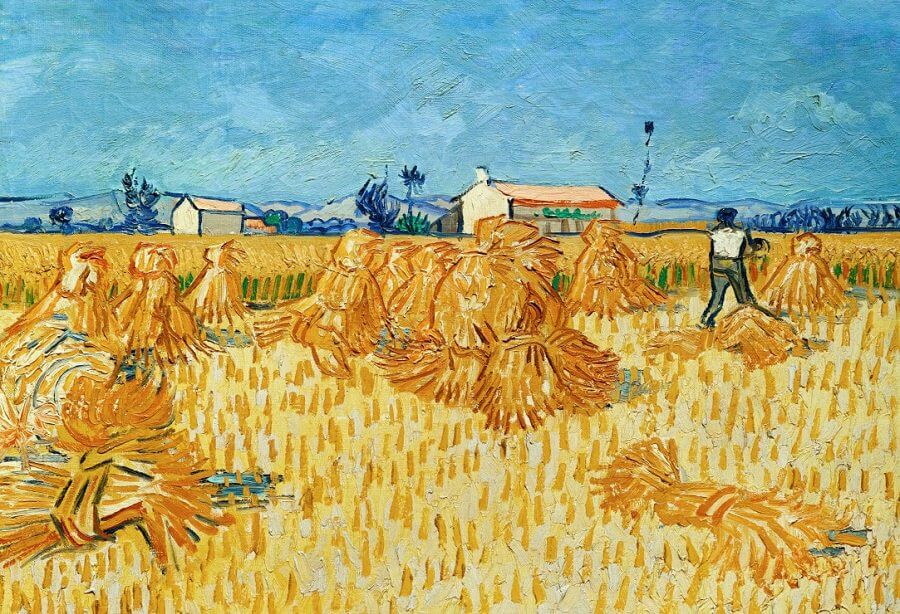
Harvest in Provence, by Vincent Van Gogh, 1888

People of every age struggle with the evil present in this world – and also within the church. For how do we make sense of those who profess Christ but have no fire and passion for their faith? How do we reconcile our own faith with folks in the church who seem to care more about getting their own way than about sacrificing themselves to reach people who do not know Christ. Jesus says, “He who has ears, let him hear.” In other words, listen!

Jesus has informed us that in this present evil age we live in, between his two advents of incarnation and Second Coming, not everything for Christians is going to be rainbows and unicorns.

There are competing pressures on the Church, and sometimes she will fail. The kingdom of God has broken into history and is present, but sin and evil is there, too. So, our focus must be on the hope we have when Christ comes again to judge the living and the dead.

In Christ’s parable of the weeds (or the parable of the wheat and the tares) the enemy of our souls seeks to distract the workers by overwhelming them with evil. If Satan cannot prevent God’s kingdom from being established in the human heart, the devil will try and corrupt the heart by throwing as much evil at it as he can. 

The devil has no problem with people saying they are Christians; the thing Satan has a problem with is people giving themselves unconditionally and unreservedly to God for kingdom business.

“Not everyone who says to me, ‘Lord, Lord,’ will enter the kingdom of heaven, but only the one who does the will of my Father who is in heaven.”

Jesus (Matthew 7:21, NIV)

Where did all these weeds come from?

I’ll frame this question in the modern form that many people have asked me over the years: “If God is a God of love, why is there so much evil in the world?” Or, “If this is Christ’s Church, why is it so messed up?”

Jesus is straightforward in his answer: An enemy did this. In other words, God didn’t plant evil – the source of evil comes from the devil, not God. God’s agenda is for the seed to take root in the human heart and grow into a full-fledged embodiment and commitment to the words and ways of Jesus.

When that growth doesn’t happen, the problem is not because God messed up; it’s because the devil has also done his own work of planting. And the devil wants the opposite of God: to have Christians nit-picking each other like a bunch of crazy chickens, and keeping a demonic pecking order; instead of being the continuing presence of Christ on this earth.

What do we do with all these weeds?

That is, how do we deal with wicked people?  The answer seems obvious: Pull the weeds up and get rid of them. Get rid of wicked people and their wicked behavior. Yet Jesus says in response to this line of reasoning in a clear and unequivocal answer of “No.” But why? Because doing violence to the weeds ends up doing violence to the wheat, as well.

Christ’s answer to the problem of evil is: Let God take care of it. Meanwhile, until that fully happens, we must co-exist with evil, rather than exterminate evil people.

There is always a temptation for believers to force people into the kingdom of God (e.g. the Spanish Inquisition). Yet, at the harvest (the final judgment at the end of the age) evil will be squarely dealt with. Judge Jesus will have the angels separate the wheat from the tares, and the weeds will be burned up.

This teaching from Jesus may open up a whole set of other questions, such as:

  • What am I supposed to do with evil? Just watch it happen? 
  • Am I to let that evil person just be evil? Shouldn’t I give them what they deserve?
  • Shouldn’t I at least tell evil people that they are no good rotten sinners? That they are going to hell because they are wicked?

This doesn’t mean we do nothing. Earlier in Matthew’s Gospel, Jesus has already said: Love your enemies and pray for those who persecute you. (Matthew 5:44)  We are to love and pray people into the kingdom, not force them in.

As for the evil, Jesus will decisively solve the problem of evil, not you, nor me! It isn’t our place to be judge, and if we make it our place, we’ll end up hurting and destroying our brothers and sisters.

Where is evil?

A sobering reality taught by Jesus in this parable is that it’s not a simple matter that we, the wheat are here, and they, the weeds, are over there. It is much more sinister than that; the enemy is within, not out there. 

We have no further to look than in our own hearts and within our own faith communities – which is why we need the lordship of Christ to completely overtake us. Evil is present in the Church, next to the good, seeking to:

  • discourage people in their commitment to Christ
  • offend and hurt others, particularly by overlooking and speaking ill of weaker people
  • step on others in order to get it’s way
  • be a stumbling block to those trying to do God’s will
  • promote ignorance of God’s Word, for no one can live by God’s will if they do not know what it is

The eventual end of sinister people is that, when Christ returns, they will be separated from the righteous and thrown into the fire, just like a harvester would do with a bunch of weeds. As the wicked went about their lives in anger, upsetting others in this life, so they will be tormented in the next.

Conclusion

We may expect God to handle evil in a hurry. But the kingdom of God doesn’t work that way; it’s intended to be planted in the ground, and takes time to grow. While it’s growing, evil is there, like a weed.

Whenever things go sideways because of wickedness, we might expect God to act quickly and drastically to uproot the evil. We may confuse God’s slowness as being uncaring, when in reality it means that God is patient, and desires people to change. And change always begins with you and me.

God Almighty, Creator of heaven and earth, we are a complacent people. While you desire us to be a beacon of light to a world in need, we are preoccupied with all the weeds in the field. We are sorry for the madness unleashed through our own selfish desires. May you plant the seed of love in our hearts for all people, not just our friends. And we shall commit to watering and nurturing that seed with your Word, through Jesus Christ our Lord. Amen.

One Grandfather’s Take on Marijuana

“Evil thrives on apathy and cannot exist without it.” Hannah Arendt

            Today is my birthday. I’m now 61 years old. I couldn’t have imagined, as a kid, that I’d be this old. But here I am – a husband for 38 years, a father of three precocious daughters, and, of all things, a grandfather of four boys. As a kid, I was largely clueless about a lot of things, which is the way it’s supposed to be. But, as an adult, if we aren’t aware of what’s happening – especially because of indifference – well then, we have the beginnings of real evil.

            The State of Wisconsin, the place I have lived for the past thirteen years, now stands out as what I describe as a marijuana desert. In every state of the union, either medical marijuana or recreational marijuana, or both, are now legal. But not Wisconsin. State Republican House Speaker, Robin Vos, has stated multiple times, “We are looking to say medical marijuana for people who have a truly awful long-term medical condition should be something we at least consider…. I don’t think recreational should ever happen.”

            My grandson is thirteen years old, and has had epilepsy his entire life. Every time my little buddy is hooked up to an EEG (used to measure the electrical activity of the brain, via electrodes applied to the scalp) the data shows that he, at times, experiences as many as three seizures per minute. 

Granted, they are rarely the grand mal, big-daddy-of-them-all, kind of seizures. Nevertheless, they are still seizures. The best pediatric doctors in the Midwest for this kind of thing tell us something that doctors aren’t prone to say, that they are stumped. Little buddy experiences up to seven different kinds of seizures, and he has defied any kind of solid diagnosis as to the nature of the epilepsy, let alone even thinking about a prognosis – other than that, if unchecked, he will not live to see adulthood. 

Yes, he is on medication – lots of it – with unimaginable side effects. Yet, without the meds, he would be having literally hundreds of seizures in any given day. Even on a good day, he has dozens. And even though most of his seizures last only a few seconds, each and every seizure damages the brain, if only a little bit. Add up the thousands of seizures over the span of a thirteen year old life, and factor the tens of thousands of them he will yet have in the next years and it, in my puny limited understanding, doesn’t look promising no matter how you examine it.

            When supposedly well-meaning politicians, pundits, religious folk, and faith communities rant about the ethics and morality of ungodly “potheads” having a legal avenue for their recreational smoking, what gets lost in the mix are children and families who could potentially be helped by legalizing marijuana – by a carefully genetically engineered strain administered medically and safely. 

In this grandfather’s mind (and heart) the greater risk is to keep doing what we’ve always done and hope that all will work out okay someday. When it pertains to a child’s life – that kind of thinking doesn’t cut it for me. It’s nothing more than the banality of evil, of keeping some political constituents happy, above thinking about the life of human beings in your own backyard.

            As a Christian Pastor, encountering this kind of ignorance amongst both politicians and parishioners is nothing new. Far too many of my denominational meetings have been given to angry persons upset about abortion and gays. Whereas there are those who believe this country is, in the words of one man, “trampling our Constitution and we are being judged as a nation for killing babies.” 

Without me even attempting to deal with any rightness or wrongness to that statement, the only kind of good that that kind of proclamation did was personal to the proclaimer – he just got something off his chest, and maybe he felt better for it. But I was left wondering: What about women who have had an abortion?  I cannot even begin to imagine that if there was a woman in the room who had an abortion in the past having to sit and listen to a guy put a label on her as a murderer. There is enough regret and grief in many a woman’s own heart without having someone twist the knife for her.

            There is a reason why many people often do not want others to know what they really think about certain issues, and why they want to keep all their skeletons in the closet. They do not want to be judged and condemned, and they have every reason to think that they will be – whenever they hear the raving of “Christians” who believe they are doing God a favor by effecting holiness through noise. 

It is imperative that we all, especially the Church, do the best we possibly can in order to create and sustain a culture of compassion and care through continual monitoring of what actually comes out of our mouths. When there are oft mentions of “the sin of homosexuality,” peppered with defamation upon LGBTQ+ folks; whenever there is a stream of hateful references to particular persons in poverty, or groups of black and brown people; and, when there is a blanket denunciation of marijuana as always being linked with persons getting high; then there is not an atmosphere of grace that leads to life, but a culture of fear that leads to death.

            Where some see the “issues” of gay marriage and transgendered inclusion, I see people created in the image of God who have the same needs of respect and equality that I do. Where some see political “issues,” I see persons in need of God’s justice and peace and basic human rights and decency.  Where some see the “issues” of poor lower class people versus upper class wealthy people; or Latin concerns versus Black concerns; or blue collar people’s agenda versus white collar people’s agenda; or plain (white) Americans versus all the other hyphenated Americans; instead, I see people – people in need of grace, mercy, and peace, just like me, who need a seat at the table and are heard in their own right with listening ears from me.

            My daughter needs support with her special needs son who happens to have epilepsy.  I am glad I can be there for her and for him. I am glad my church and many others care about them. This old sinful world has enough shame and pain in it without adding to the pile through ignorance and strife. Before we use our tongues, let’s have some working knowledge and some basic education about what we are talking about.  Most of all, let’s have some basic decorum and some working knowledge of God’s grace.

            So, this grandfather says to those in political power: “Do you consider this situation of a young boy with a terminal condition of epilepsy acceptable?” Evidently so since lawmakers have purposely dragged their feet for years about medical marijuana. There are times when individuals need to be called out, and a situation must be named for what it is. This grandfather, for one, is calling out the Wisconsin legislature, along with Speaker Vos, and naming this for what it is: indifference to human suffering.

            As of today, it is unfortunately too late for my grandson to have any significant assistance from medical marijuana in the form of cannabis oil for his condition. His epilepsy has come too far, and his brain has simply had far too many seizures. The hard reality is that, apart from a miraculous divine intervention, my grandson (who, I might add, is one of the nicest people of any age you’ll ever meet) will likely never see adulthood. But that wasn’t true 10 years ago, when I was writing letters and, evidently, speaking into the wilderness – getting form letter responses, if any response, at all.

            The time for consideration is past. Debate the “issue” of marijuana all you want. Meanwhile, there are people in Wisconsin who live with chronic pain and have to cross state lines just to get some help and a bit of relief from their chronic conditions. It is not supposed to be this way. And it does not have to be this way. Never mind that medical marijuana has been shown to significantly reduce and even eliminate some seizures in children. Ears have been stopped up and eyes wide shut for so long that hearts have become hard – and cannot even have compassion on children who are, frankly and literally, dying.

            There is a biblical proverb which states, “People who respect others will be blessed, but stubborn people will have plenty of troubles.” (Proverbs 28:14) We expect kids to be immature. And we expect the adults in the room to have the requisite growth over a period of time in order to make wise, responsible, and mature decisions. It looks like there are lot of politicians in need of remedial learning. Their stubbornness has already led to too much trouble for all of us.

*The Epilepsy Foundation exists to lead the fight to overcome the challenges of living with epilepsy and to accelerate therapies to stop seizures, find cures, and save lives. For more information, you may go to their website at epilepsy.com

**To learn more about epilepsy in Wisconsin, go to their website at epilepsywisconsin.org

***For information on medical marijuana and epilepsy: epilepsy.com/treatment/alternative-therapies/medical-marijuana

Leave and Go (Genesis 8:13-19)

In the six-hundred-first year of Noah’s life, on the first day of the first month, the flood had dried up. Noah opened the hatch of the ship and saw dry ground. By the twenty-seventh day of the second month, the Earth was completely dry.

God spoke to Noah: “Leave the ship, you and your wife and your sons and your sons’ wives. And take all the animals with you, the whole menagerie of birds and mammals and crawling creatures, all that swarming extravagance of life, so they can reproduce and flourish on the Earth.”

Noah disembarked with his sons and wife and his sons’ wives. Then all the animals, crawling creatures, birds—every creature on the face of the Earth—left the ship family by family. (The Message)

The ancient story of Noah recounts a devastating universal flood—a story that began with problems akin to those in our present contemporary world. (Genesis 6:5-7:24)

Violence, in the days of Noah, had become so common and widespread, that the very heart of God was pained.

The Lord saw how evil humans had become on the earth. All day long their deepest thoughts were nothing but evil. The Lord was sorry that he had made humans on the earth, and he was heartbroken. (Genesis 6:5-6, GW)

So, God decided to bring judgment, and laid plans to rid the earth of humanity. To start over, God instructed Noah to build an ark to preserve his family and a few of every animal species.

And then, it rained, day and night, for weeks on end. The flood destroyed everything. Yet, God remembered Noah and all the animals, and the waters eventually receded. Noah sent out a raven, and then a dove, to see if they could find land.

Finally, the day came when they could step out of the ark, and the Lord told Noah to step off the big ark of a ship, set the animals free, and start repopulating the Earth.

There are, indeed, a lot of ethical questions that bubble up for us as readers about the entire flood narrative. Why kill everyone, including children too young to know better, and animals who apparently weren’t the problem to begin with? And, if things are so bad, why spare anyone or anything? After all, people started the violence, and they don’t seem very changed after the flood. What’s up with that?

Yet, honestly, just asking those questions puts us on some supposed high ground of morality – something we cannot claim – as if we know better than God.

Perhaps we humans still do not yet have a collective sense of our depravity, that is, of our awful potential for acts of violence (both physical and psychological) as well as our penchant for saying and doing nothing in the face of such evil. We keep offloading the issue onto God, as if the Lord is the problem.

Keep in mind, that by God’s grace, the Lord promised to never again destroy the Earth, as in the days of Noah, and still preserved a remnant of humanity. Yet sadly, that hasn’t stopped us humans from keeping up our violent and destructive ways. Throughout the whole of human history, we seem to have to keep learning the same lesson over and over again: that our actions (and in-actions) have far-reaching consequences for both us and all the rest of creation.

The violence humans do to one another and the violence we do to the natural world come from the same place in the human heart. A good and wise God created us good. And although we are capable of great evil, as the flood story says, and as we know every day, God means for us to be transformed.

God promised not to destroy the world. Now it’s our turn to promise the same.

How can we keep such a promise? I believe we can do it by being obedient to leave the ship and step off the ark. In other words, it’s important that we leave where we presently are, and go where God calls us.

Realizing a better world, a changed life, and a blessed Earth involves our movement to leave something behind, and go to a place we’ve not been before.

The Lord said to Abraham:

Leave your country, your family, and your relatives and go to the land that I will show you.” (Genesis 12:1, CEV)

God said to Moses:

“I have heard the cry of the people of Israel. I have seen how the Egyptians are oppressing them. Now, go! I am sending you to Pharaoh so that you can bring my people Israel out of Egypt.” (Exodus 3:9-10, GW)

And, as a result of Moses obeying God, Pharaoh (eventually) said to the Israelites:

“Get out, you and your Israelites! Leave my country; go and worship the Lord, as you asked.” (Exodus 12:31, GNT)

Later, God clarified the instructions for heading to the Promised Land:

“Leave this place, you and the people you brought out of Egypt, and go to the land that I promised to give to Abraham, Isaac, and Jacob and to their descendants.” (Exodus 33:1, GNT)

Jesus instructed:

“So, what if you are offering your gift at the altar and remember that someone has something against you? Leave your gift there and go make peace with that person. Then come and offer your gift.” (Matthew 5:23-24, ERV)

Jesus said to his disciples:

“All authority in heaven and on earth has been given to me. Therefore go and make disciples of all nations, baptizing them in the name of the Father and of the Son and of the Holy Spirit, and teaching them to obey everything I have commanded you. And surely I am with you always, to the very end of the age.” (Matthew 28:18-20, NIV)

Why does God repeatedly tell us to leave and go? Because we tend to hunker down in our entrenched ways of bigotry and idolatry, which are the fodder for human violence, and refuse to see other people created in the image and likeness of God.

Leaving and going opens us to the possibility of connection, and thus, love. And love is the heat source which melts the polar ice cap of hate and violence.

Almighty Father, who gave your only Son to die for our sins and to rise for our justification: Give me grace to leave malice and wickedness behind, so that I may go and serve you in truth and holiness, through Jesus Christ, your Son, my Lord, who lives and reigns with you and the Holy Spirit, one God, now and forever. Amen.