Victory Over the Power of Evil (Luke 4:31-37)

He went down to Capernaum, a village in Galilee. He was teaching the people on the Sabbath. They were surprised and impressed—his teaching was so forthright, so confident, so authoritative, not the quibbling and quoting they were used to.

In the meeting place that day there was a man demonically disturbed. He screamed, “Stop! What business do you have here with us, Jesus? Nazarene! I know what you’re up to. You’re the Holy One of God and you’ve come to destroy us!”

Jesus shut him up: “Quiet! Get out of him!” The demonic spirit threw the man down in front of them all and left. The demon didn’t hurt him.

That knocked the wind out of everyone and got them whispering and wondering, “What’s going on here? Someone whose words make things happen? Someone who orders demonic spirits to get out and they go?” Jesus was the talk of the town. (The Message)

During his earthly life and ministry, Jesus was a Deliverer and a Liberator; he came to save people from their guilt and shame, and to free the world from the clutches of evil.

And so, it was inevitable that Jesus would come into conflict with the forces of darkness.

In today’s story, Jesus had a confrontation with an unclean spirit, that is, a demon who is an ally of the devil. The particular demon was not only speaking for himself, but also for his fellow band of wicked spirits.

Christ’s ministry put him in direct opposition to the hosts of Satan. The nub of the issue for the demon was whether Jesus had come for their immediate destruction. Jesus, however, wasn’t in the habit of answering questions from demons.

So, Christ rebuked the demon, told him to get out of the person he was influencing. And that is exactly what happened. The writer, Luke, pointed out that this demonstrated Christ’s authority, that it even includes the power to command unclean spirits, and out they go.

And that is how the liberating and saving ministry of Jesus began.

In the Gospel of Luke, this account of Jesus being confronted by a demon happens just after Christ’s 40 days of being tempted in the desert, even by Satan himself. So, the entire demonic realm was alert to beginning ministry of Christ. They went after Jesus right away, perhaps trying to trip him up before he could get any ministerial momentum.

Jesus was teaching on the Sabbath in the town of Capernaum. We ought not to be surprised that a demonized man was among those observing the Sabbath. The wise believer will be savvy to this reality.

Furthermore, we aren’t told who the man was or of any symptoms he may have had. Apparently, he presented himself as a normal Jewish villager. So, we ought not to think that anyone being demonized will necessarily demonstrate madness or illness of some sort.

The demon was perhaps more aware of who Jesus was than anyone else there on that Sabbath Day in Capernaum. He acknowledged Christ’s power and mission. Jesus indeed came to destroy the power and influence of evil in the world.

You believe that there is one God. Good! Even the demons believe that—and shudder.

James 2:19, NIV

Since Jesus Christ is the rightful authority over all, that means Satan and his wicked spirits are not; and they must submit to that true and real power.

Truth and doctrine are not only about objective facts and right belief. Even though our thinking is important and critical, there is more to it than that: Orthodoxy (right belief) requires orthopraxy (right actions).

A right truth that is only described is not the whole truth. In reality, a false witness and a liar may state the truth, but not entirely, withholding important information; thus, impairing any sort of right action from taking place.

Gaslighting relatives, oppressive bosses, and tyrannical rulers who tell some truth, and even support some good things, are still gaslighting and oppressing others with their narcissistic brand of leadership.

Truly, believers in and followers of Jesus can sometimes be duped into supporting evil leaders who use all sorts of unjust tactics, just because that leader tells the part of truth I want upheld.

Jesus saves; he is Savior of the world – but that is only part of the truth. We must also ask: What has Christ come to save us from? Not just our mistakes, mess-ups, and sins. Christ came to deliver us from the very power of evil that supports injustice and unrighteous behavior to begin with.

If we merely view Jesus as our personal Savior from hell after we die, then we will likely focus almost exclusively on heaven. But if we see all the freedom we need from unhealthy behaviors and unjust ways, then we view Christ as so much more than a fire insurance policy.

We need a more expansive understanding of Christ’s cross. Yes, Jesus died for our sins. Yet, he also died to conquer evil; Christ made it possible for us to become liberated from the shackles of systemic sin and structural evil, as well as personal guilt. In other words, Christ came to topple all evil, and not just human foibles.

And this was why the dark powers of Satan, and his demons, were so afraid of Jesus. They knew their time was short. There is yet another power that has a hold on us today – and that is the reality that many people no longer believe in demons and devils and dark forces.

Since we are a technically advanced people with great understanding of medical science, we now know all sorts of things which cause physical and mental illness. Ancient people did not know about human hormones and chemicals, and the impact of genetic codes on our health. They had no idea about bacteria and viruses, microbes and hygiene.

Therefore, we can jettison all this mumbo-jumbo about demons, right?… Not so much.

Even with all of our modern (and postmodern) explanations for the body and brain, we are still finding ourselves having to contend with the mystery of evil, and the malevolent suffering it causes us.

We modern folk can certainly provide a lot of insight into the cause and effect of particular symptoms a person has according to their biology. And yet, that doesn’t take away the presence of malevolent forces on this earth.

Even with all of our understanding, evil still resides within organizations, institutions, and even faith communities. The meanness and malevolence, the injustice and the ingratitude, and the profound violence (both verbal and physical) which one human being can exact on another is still here – and some would argue that it’s worse than ever.

Knowing something isn’t the same as doing it. If that were true, then education ought to deliver us from evil. Even some intelligent and objective people, who are fluent in facts and figures, still use their calculations for evil.

No matter our creeds or convictions, whether we are religious or not, all of us seem to have a collective sense that this old world of ours is profoundly broken.

All the research dollars in the world has not produced a solution to fix evil. And even if we could completely understand evil, that isn’t the same as ridding ourselves of it.

What’s more, those who put all their trust in changing things through modern means (which means without God) have been some of the worst offenders of producing wars, political tyranny, and gross injustice.

To put all of this perhaps more succinctly in the form of question: We know and understand a lot in combating disease, disaster, and death; but does all of that insight do away with the evil of it? Are things less tragic now?

I argue that is has not. Evil is still evil. Chronic pain, homelessness, poverty, injustice, and health inequities are still wreaking their evil on people.

I believe that evil really does exist, even if it has different language today than it did in the ancient world.

There is real opposition, conflict, and confrontation from evil today. The victory Christ has achieved over the forces of evil has a 2,000 year track record of helping people experience renewed lives, even when their bodies are wasting away.

In the end, the victory of Jesus Christ shall become evident to all the world. Overcoming evil doesn’t come from us, but from God. We can and we must deal with evil in this world. But we are not the Savior or the Liberator.

We need faith in the Son of God who loved us and gave himself for us. Amen.

Dealing with Another’s Evil Intentions (1 Samuel 19:18-24)

David and Saul, by He Qi

When David had fled and made his escape, he went to Samuel at Ramah and told him all that Saul had done to him. Then he and Samuel went to Naioth and stayed there. 

Word came to Saul: “David is in Naioth at Ramah;” so he sent men to capture him. But when they saw a group of prophets prophesying, with Samuel standing there as their leader, the Spirit of God came on Saul’s men, and they also prophesied. 

Saul was told about it, and he sent more men, and they prophesied too. Saul sent men a third time, and they also prophesied. Finally, he himself left for Ramah and went to the great cistern at Seku. And he asked, “Where are Samuel and David?”

“Over in Naioth at Ramah,” they said.

So Saul went to Naioth at Ramah. But the Spirit of God came even on him, and he walked along prophesying until he came to Naioth. He stripped off his garments, and he too prophesied in Samuel’s presence. He lay naked all that day and all that night. This is why people say, “Is Saul also among the prophets?” (New International Version)

King Saul was in the middle of a personal downward spiral of evil. And David was his target. Even though David served Israel and the king with distinction and bravery, his success aroused the jealousy of Saul.

It came to the point that David needed to flee for his life because Saul saw him as a threat and was out to kill him. Instead of trying to go it alone, feeling angry and defeated, David went to the one person he knew was wise, discerning, and could help: Samuel, the priest and prophet of Israel.

David was not looking to kill Saul, as Saul was trying to kill him. He just needed someone to talk to, some empathy and solid help in this very unwanted and awful situation.

As we move through the biblical narratives which tell of Saul and David, we will observe that God is with David and helps him through his travails; but God is not with Saul, who is continually haunted with a bad spirit whenever he descends into the dark path of jealousy, anger, even murder.

It is only human to wonder why people of faith, with good and genuine hearts, must contend with such self-absorbed narcissistic people like Saul. We can only answer it in part: the presence of evil in the world; the place of trials and tribulations in the believer’s life, etc. For the most part, it is a mystery for which we shall not have answers, this side of heaven.

But what we do know is that God is concerned for the godly, for those who seek to do right, have pure hearts, and think of the common good of all the people. And the Lord can deal with evil, while protecting the good, in quite unexpected ways.

We expect prophets to prophesy. We don’t expect anyone else to necessarily do so. Yet, in this story, we see God sending the spirit of prophetic speech not just upon the prophets and the good folk, but upon those who have ill intentions toward the godly ones.

Yes, the Lord sent a spirit upon people who were trying to kill David, and then even upon Saul himself; not to illumine, but to prevent. The power of prophecy in this instance was not a sign of being chosen by God, but a clear sign from God of rejection.

In stripping off his clothes and laying naked in prophetic utterance, Saul was being humbled, abased, and mortified. Decades later, King David would do so willingly as a repentant person. But here, King Saul does so unwillingly, as an unrepentant person who needs to let himself be among the penitent persons. But, alas, Saul did not do so, and was continually moved by other forces other than the Lord.

For the believer who is in the throes of a gaslighting boss, or a narcissistic leader, or a self-centered relative, today’s story is an encouragement: God’s will on this earth shall prevail; and the Lord will take care of those who desire to live a just, right, and good life.

Conflict and trouble must not necessarily result in one’s devastation and discouragement.

Whenever we find ourselves in the crosshairs of an evil person, we do not need to add to the madness with harsh and divisive words.

Instead, we can be sober-minded and good-hearted by handling the adverse situation with gentle words and a wise spirit. We can face the trouble, without wishing it away, by going to a wise person for counsel and help, if need be.

The mark of a truly good person is not whether they have conflict in their life, or not, but by how they handle the trouble when it comes. And as for the troublemakers and chaotic people themselves, the Lord knows how to deal with them.

You may be in an unwanted situation, dealing with a difficult person. Please don’t let that person steal your personal integrity and happiness from you. The one thing you can always control – that nobody can ever take away from you – is your own attitude and ability to respond.

“Everything can be taken from a man but one thing: the last of the human freedoms—to choose one’s attitude in any given set of circumstances, to choose one’s own way.”

Viktor Frankl, Man’s Search for Meaning

You and I really can deal with this. If the hurt was unintentional, then forgive and let it go. If the hurt was intentional, we need not be judge, jury, and/or executioner. That’s God’s job, not ours. Rather, we can choose to forgive and not hold onto bitterness; talk with a wise person to receive wise counsel, and not spread anger and slander; and determine to be joyful and godly, not sullen and irritable.

O Lord God almighty, listen to the prayer of the righteous! Direct the way of your servants in safety under your gracious divine protection, so that through all of the changes of our earthly pilgrimage, we may be guarded by your mighty help and power. Amen.

In the Middle of Trouble (1 Samuel 19:8-17)

Saul and David, by Rembrandt, c.1655

Once more war broke out, and David went out and fought the Philistines. He struck them with such force that they fled before him.

But an evil spirit from the Lord came on Saul as he was sitting in his house with his spear in his hand. While David was playing the lyre, Saul tried to pin him to the wall with his spear, but David eluded him as Saul drove the spear into the wall. That night David made good his escape.

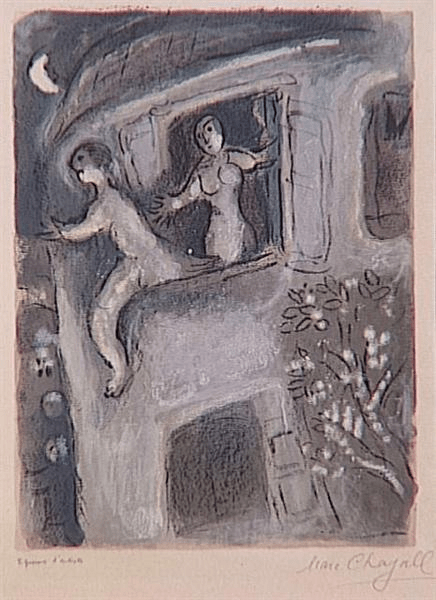
Saul sent men to David’s house to watch it and to kill him in the morning. But Michal, David’s wife, warned him, “If you don’t run for your life tonight, tomorrow you’ll be killed.” So Michal let David down through a window, and he fled and escaped. Then Michal took an idol and laid it on the bed, covering it with a garment and putting some goats’ hair at the head.

When Saul sent the men to capture David, Michal said, “He is ill.”

Then Saul sent the men back to see David and told them, “Bring him up to me in his bed so that I may kill him.” But when the men entered, there was the idol in the bed, and at the head was some goats’ hair.

Saul said to Michal, “Why did you deceive me like this and send my enemy away so that he escaped?”

Michal told him, “He said to me, ‘Let me get away. Why should I kill you?’ (New International Version)

We humans are living in a fallen world and a broken planet. Conflict and trouble is certain. It’s not a matter of if we are going to face it, but when. How will we handle conflict when it comes?

Saul’s Jealousy of David

King Saul had a growing jealousy of David. It became bad enough that Saul tried to arrange things so that David would be killed on a Philistine battlefield. But that plan completely backfired, and David became even more successful.

In Saul’s downward spiritual and emotional spiral, he brazenly created intentional conflict in order to do away with David altogether. Fortunately, Saul’s son Jonathan talked his father down peacefully. David was restored to the king’s court and out of trouble, at least for the moment.

Little did Jonathan realize how far gone his father had become. The incident of Saul telling his soldiers to kill David proved to still be an open case. It didn’t take Saul very long to renege on his promise to Jonathan, and actively went back to his old jealous ways.

David Eludes Saul’s Spear

Saul’s Attempt on David, by Gustave Doré, 1877

There was a direct relationship between David’s good spirit of integrity and success, and the wicked spirit which came upon Saul. King Saul, in his anger toward David and disobedience toward God, had clearly given ground to evil in his life.

Saul could not get a grip on his jealous feelings, and was ticked-off that David’s popularity kept growing, no matter the situation. In a fit of impulsive rage, Saul hurled his spear at David. Since David was agile, and Saul was a bad thrower, a tragic death was avoided.

At that point, David realized he needed to get out and stay away for good. David was in one of those rare situations in which a person may be so hell bent on damaging another person that drastic measures need to be taken.

Michal Helps David Escape

Most conflicts are, of course, complicated. And it’s not unusual for trouble to be a family affair. Michal was Saul’s daughter, which made David Saul’s son-in-law (and for Saul, David’s outlaw). It seems that the marriage arrangement was originally made so that Saul could keep a close eye on his rival.

Michal understood her father well enough to know that Saul meant business in handling David. So, she set up a plan for her husband’s escape, and covered for him to dear old dad.

Michal Saves David from Saul, by Marc Chagall, 1960

It appears we start to get a glimpse of insight into Michal’s character. Her possession of household gods, along with her ability to be an effective liar in order to save her own neck, ought to give us some pause. As the story of David develops in the biblical narratives, we will indeed see Michal’s true colors.

Thus far in the life of David, we see an innocent man treated unfairly and unjustly. Yet, we get no hint of bitterness or revenge from him. Instead, here is a guy who only tried to do what is best for his people Israel, and most of all, live faithfully to his God.

In contrast, Saul became increasingly frustrated and bitter, not looking to the Lord who put him on the throne. Instead, he made devious plans to destroy a man who was only trying to do him good.

Conclusion

Self-centered jealousy and bitter anger poisons a person’s spirit and turns it toward evil. If left unchecked and unchanged, it becomes gangrene of the soul. And when that happens, the only option is to cut off the affected damaged dead part. Like a withered tree or vine, it is uprooted and thrown into the fire.

Jesus said, “I am the vine; you are the branches. If you remain in me and I in you, you will bear much fruit; apart from me you can do nothing. If you do not remain in me, you are like a branch that is thrown away and withers; such branches are picked up, thrown into the fire and burned.” (John 15:5-6, NIV)

Please be encouraged to know that if you are in the middle of a conflict you didn’t cause with a person who seems not to care, it doesn’t have to result in you becoming despondent, damaged, or destroyed.

No matter the circumstance, the consistent path of the faithful person is humility, gentleness, righteousness, mercy, purity, and peace. Situations will change, and people may be fickle; but your consistent daily walk of faith need not deviate at all.

Because God is with us, and the Lord loves us, we can handle and endure anything from anyone.

Listen to my prayer.
    I am so weak.
Save me from those who are chasing me.
    They are stronger than I am.
Help me escape this trap,
    so that I can praise your name.
Then good people will celebrate with me,
    because you took care of me. Amen. (Psalm 142:6-7, ERV)

A Real Change of Life (Matthew 12:43-45)

“When an evil spirit leaves a person, it goes into the desert, seeking rest but finding none. Then it says, ‘I will return to the person I came from.’ So it returns and finds its former home empty, swept, and in order. Then the spirit finds seven other spirits more evil than itself, and they all enter the person and live there. And so that person is worse off than before. That will be the experience of this evil generation.” (New Living Translation)

Nature abhors a vacuum. A tilled plot of soil will be overtaken with weeds if nothing is planted and nurtured in the turned-over dirt. 

The pecking order of a brood of chickens cannot handle the death of the top hen without filling the position almost immediately. 

In the spiritual realm, the exorcising of a demon will not simply leave a person empty of evil – their life will be filled with something in its place.

Jesus told a story about a man who was delivered from an unclean (evil) spirit. It’s a powerful and simple narrative on the necessity of true repentance, that is, on what a real change of life is like. 

Genuine freedom is more than getting rid of something bad and destructive; the evil must be replaced with something good and useful. In other words, biblical repentance, a true transformation of a person, is both a turning away from ungodliness and an embrace of righteousness.

We are delivered from evil so that we can start living into right and peaceful relationships, as God intends for us.

For example, the Apostle Paul exhorted the Ephesian believers to not only stop stealing but also to get a job and start sharing with others. They were not only to stop lying and using their tongues for gossip and slander and start using their words to speak truth that builds up others. (Ephesians 4:25-32)

The spiritual principle is the same as the nature principle: A empty vacuum will always be filled. The man who did not fill his life with God ended up having a problem with evil seven times greater than when he started. If anything, or anyone, is emptied of its unhealthy elements and practices, it is imperative that the hole be immediately filled with healthy disciplines for life.

Whether dealing with addictions, bad habits, or any kind of evil influence, a two-pronged approach is needed for its eradication. We expel the evil by replacing it with godliness. 

For example, the man struggling with pornography or adultery must not only stop the behavior but take up the mantle of being a champion for women’s issues; or the woman who has no healthy boundaries and allows herself to be used and abused must not only separate from the problem or person but adopt her identity in Christ as a precious child of God and enforce righteous limitations. 

These examples are not meant to be simplistic answers to complex situations. Rather, they illustrate why so many people do not experience freedom and continue to have even greater enslavement to their passions and sufferings. Freedom is realized through replacing old practices with new disciplines that directly attack the old.

We all have needs. How we get those needs met is often a mixed bag of both legitimate and illegitimate ways. In a perfect world, everyone would be aware of their needs and be able to express them to one another without shame, anxiety, or anger. Since we live on a blemished fallen planet, we end up trying to meet our needs indirectly through hustling for love, hoarding resources, and controlling others – all harmful ways which destroys souls and relationships.

In order to focus on meeting our needs in a wise and healthy manner, we must take a step beyond ending a toxic relationship, cutting up a credit card, or saying “no” to another responsibility. We often get into our mess to begin with because we are out of touch with ourselves and our needs. We need affection and encouragement, and there is no shame in needing this. We need security and safety, and there is no problem in acquiring this. There are some things we need to control, and that is okay.

If we fail to address our needs, we might do the necessary work of deliverance, then turn right around and become worse off than before by filling the empty place of our lives with:

  • Being all things to all people, as if we were the Messiah.
  • Being successful so that we stay ahead of being needy.
  • Pulling inside ourselves and trusting nobody.
  • Distancing from our needs and pretending they are not there.
  • Being continually vigilant so that we are never hurt that way again.
  • Keeping a positive spin on everything, as if there is no negative stuff in the world.
  • Challenging other’s opinions and behaviors to keep the focus off our needs.
  • Becoming a wallflower so that we can never be the brunt of someone else’s vitriol or evil.

Instead, we can let Jesus fill the emptiness with love, purpose, peace, joy, attention, and grace. Christ is the Savior who delivers us from evil, and the Holy Spirit is the Sanctifier who carefully applies the work of salvation to our lives. When our hearts and minds are full of God, there is no place for the demons to get in.

True change and transformation equally forsakes evil and embraces righteousness; replaces the unhealthy with the healthy; jettisons the illegitimate and seeks the legitimate; and puts away unnecessary suffering and pursues peace and joy in the Spirit.

O God, I no longer want to live with saying I’m sorry and going right back to the old pig slop of sin. I cannot change on my own. I need Jesus to both take away the sin and give me a new life of living for him. Help me to make choices that put to death the old way of life, and the courage to live into my forgiveness in the power of the Holy Spirit. Amen.