Welcome, friends! Today we consider three important words to help us relieve our emotional and spiritual pain, as well as enabling us to experience joy and new life. Click the videos below and let us worship our risen Lord….
1 John 1:1-2:2, Pastor Tim Ehrhardt
O God, who in Jesus Christ called us out of darkness into your marvelous light; enable us always to declare your wonderful deeds, thank you for your steadfast love, and praise you with heart, soul, mind, and strength, now and forever. Amen, and amen.
All the hopes and expectations of Christians are realized in Christ’s resurrection. The good news of Easter cannot be contained or limited to a single day (Easter Sunday). That is why, according to the Church Calendar, Easter is only the first of fifty days of celebration called “Eastertide” which leads to the day of Pentecost. Eastertide is designed for exploring the new life we have in Jesus and the joyful Christian life we can all experience.
Yet, what if a new life has not been our experience? What do we do when, year after year, Easter comes and goes and all the old sins, failures, compulsions, and addictions remain unchanged? It is not sufficient to simply know the gospel of grace; there must be a careful and truthful application of the gospel to our lives. For the gospel is not just a message to believe; it is a powerful truth to be acted upon in our daily lives.
Too many folks are spiritually damaged from regrets or remorse over bad decisions. They have shame and guilt about the inability to overcome bad habits. There is a lack of courage in facing temptations and sins within. It all lies beneath the surface festering, irritating, and causing pain. In some cases, it is so deeply embedded in the soul that the cause of the discomfort is unknown.
Spiritual renewal is needed. To take a trip into our inner worlds, there are three words that bring to light three important theological themes. We need to know and apply these words so we will have the pain relieved and experience the joy of new life in Jesus Christ. (1 John 1:1-2:2)
Fellowship: Christians have a sharing bond of partnership in Christ with God and with one another.
We proclaim to you what we have seen and heard, so that you also may have fellowship with us. And our fellowship is with the Father and with his Son, Jesus Christ. (1 John 1:3, NIV)
Koinonia is a familiar word to many Christians. The image of “fellowship” might be of sitting around a table at a church potluck. Or maybe it evokes the picture of standing around after church and talking with each other over a cup of coffee. The biblical word is much more than this. Fellowship means we have deeply shared beliefs and behaviors with God and one another.
Fellowship means Christians have a vital union with Jesus which paves the way to cooperate with God’s purposes in the church and the world. Fellowship also means Christians share in Christ together through a common relationship with God and a common purpose of glorifying God. In Christ we partner together to live out the Great Commandment and the Great Commission. Biblical fellowship is an action based in the union we have with God in Christ. To live in fellowship is to live in the light and not in the darkness.
The way we view Jesus determines how we live the Christian life. Jesus was a real flesh-and-blood man. If Christians do not uphold the physical reality of Jesus, then the Christian life will be unconcerned for the material world and the ethics of bodily existence. The Christian life is very much about both body and soul.
Walk: The power of sin is very deceptive.
If we claim to be without sin, we deceive ourselves and the truth is not in us…. If we claim we have not sinned, we make him out to be a liar and his word is not in us. (1 John 1:8, 10, NIV)
The New Testament often pictures the Christian life as a walk down a road. Which road we are on and how we walk it is especially important. God is light and in him is no darkness at all. We are to walk with the light of Jesus illuminating our way.
Talk is cheap. The real muster is whether we live in the light of revealed truth. If a person claims a relationship with Jesus but lives how they want, that person is not an authentic believer. If a person claims to be without sin, that person is self-deceived by the power of sin. If a person claims they are okay and do not sin, such a person makes a mockery of Christ’s bodily existence, including his human suffering and death.
Photo by Paulo Mu00e1rcio Dos Santos on Pexels.com
If a person’s daily life is characterized by darkness, then no matter how sincerely or publicly they make a profession of Jesus, that proclamation is a sham. This is not about sinners in general making occasional lapses in judgment or behavior. This is about people who claim to be Christian but have daily on-going patterns of deliberately walking down a dark path and doing what they want. Their mantra is, “It’s my life, I do what I want, and nobody is going to tell me what to do.” Such a person is a poser. They only pretend to have a walk with Jesus.
To counter the bogus claims and pretensions, we are to walk in the light, and not hide in the darkness. This requires honesty, integrity, and the courage to allow God’s light to shine on the shadowy places of our lives. There cannot be new life without the light.
We counter the darkness by openly confessing our sins. There is a promise attached we need to take to heart: God is faithful to forgive and purify us. God’s light shining upon us might hurt, but it brings life and healing. Holding onto secrets only festers in the soul, while the snakes of sin slither around our feet. The result is spiritual blindness, darkness, and death. Confession is more than private and personal; it is also public and corporate. New life, renewal, revival, and revitalization come from real honest tell-it-like-it-is confession.
This really ought to scare the hell out of us. Jesus, in his Sermon on the Mount, said we should pluck our eyes out if they offend. Cut our hands off if they cause us to sin. It is better to be in God’s kingdom with no eyes and hands then to burn in hell with all our parts intact. (Matthew 5:29-30)
Repentance is more than mouthing words about being a sinner like everybody else. Repentance is a complete change of how we live our lives. If there is a besetting sin that dogs us every day and we do all the same things this year we did last year to deal with it, and it did not work, then we will be right back here at Eastertide next year – frustrated with the very same dark walk, carrying the very same burden of guilt, shame, and regret.
Remaining in the dark with no one knowing about our inner life is opposite of biblical fellowship because it forsakes the light. Walking away from the church will not deal with it. Walking away from God will not deal with it. Trying a new teaching or a new practice will not make it go away. Only agonizing, soul-rending, yet freeing, confession will allow God’s surgical knife to take out the offending sin and bring healing of both body and soul.
Patricia Raybon, in her book I Told the Mountain to Move confesses the regret and grief she carried after aborting two children. She writes, “I had told myself that an abortion would end my problems, not complicate them by bringing an innocent life into my own upheaval.” She shares the following letter, written to her two aborted children:
Dear Babies:
“This is Mama. You will know my voice, I think, even though we were together for such a short time. I did a bad thing. I did not trust God. I did not understand God would have made everything okay. I was like Peter, who looked at the waves, not at Jesus. And when he looked at the waves, he started to sink—down, down, down.
That’s how I felt, like I was sinking down. When the doctors said you were growing inside of me, that’s how I felt, so I didn’t know how to love you. I was afraid. I let fear convince me that more babies would just make things worse.
Instead, look what I did. I robbed us. First, I robbed you—taking your own lives. I didn’t think I was strong enough. So, I robbed myself of all the joy you would have brought me, too. Brought all of us, your sisters, your family, and for each of you, your daddy. I thought we would have more problems. That we did not have enough money. That we did not have enough time. That we did not have enough love. But I just did not know then that God is bigger. And God would make everything all right. I didn’t know.”
We are not left to unending remorse and sorrow.
Advocate: The atoning sacrifice of Jesus Christ purifies us from all unrighteousness.
My dear children, I write this to you so that you will not sin. But if anybody does sin, we have an advocate with the Father—Jesus Christ, the Righteous One. (1 John 2:1, NIV)
To advocate means to come alongside another in need, speaking and acting on their behalf. Jesus is our Advocate. Christ’s death atoned for all our sin, guilt, and shame. Christ’s propitiation satisfied all of God’s righteous wrath against every sin, including yours and mine. The Lord’s gracious intervention has saved us from ourselves. Jesus made it possible for us to experience forgiveness, restoration, and new life.
When we are so broken and full of tears that we cannot even speak, Jesus steps in and speaks on our behalf with meaningful words that have been backed up with the action of the cross and resurrection.
We have a few choices: We could pretend everything is okay and proceed with business as usual. Or we can come to Jesus, confess our sin and receive the grace of forgiveness and cleansing. We can allow the church to be a hospital for sinners through praying for one another. Throughout the New Testament we are called to be little advocates practicing the ministry of coming alongside and speaking on one another’s behalf before God and others.
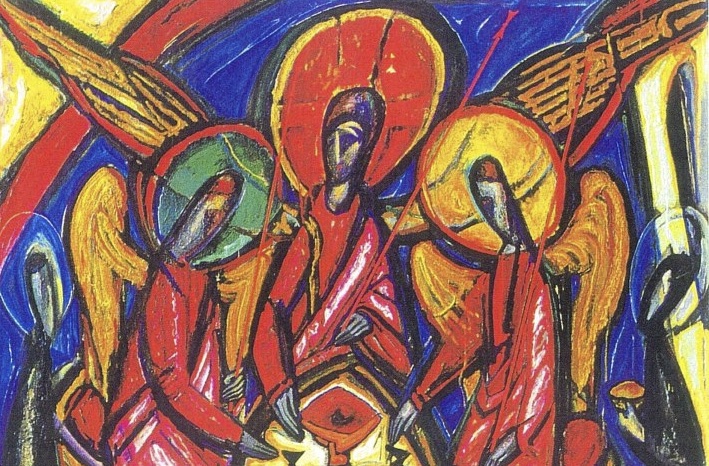
Trinity by Russian artist Alek Rapoport (1933-1997)
I wrote to the church, but Diotrephes, who loves to be first, will not welcome us. So, when I come, I will call attention to what he is doing, spreading malicious nonsense about us. Not satisfied with that, he even refuses to welcome other believers. He also stops those who want to do so and puts them out of the church.
Dear friends, do not imitate what is evil but what is good. Anyone who does what is good is from God. Anyone who does what is evil has not seen God. Demetrius is well spoken of by everyone—and even by the truth itself. We also speak well of him, and you know that our testimony is true. (NIV)
I believe in an egalitarian world. That is, humanity is meant to live, ideally, in equity with one another. Humility, meekness, and gentleness are to be the inner dispositions of a person’s life. These virtues work themselves out in being concerned for the common good of all, laboring toward just and righteous ways of living for everyone and sharing our lives as well as our resources with each other. In short, viewing one another as equals inevitably leads to gracious hospitality.
However, in a world of power disparities and privileged inequities are attitudes of seeking attention, a perceived need to always win and be first, and tight-fisted control of authority and money. The common good of all persons is scaled back to be the concern for the common good of some. There is a failure to regard the weak, poor, and vulnerable as legitimate members of the community.
The Apostle John wrote his short succinct letter in a concern that the church may be following a leader who was taking them down a bad path – a road leading to injustice where power and privilege remain with a few, and perhaps even one. John’s plainspoken exhortation was to judge rightly between what is good and bad, and then imitate the good while forsaking the bad.
Hospitality is the true litmus test between the good and the bad. An openness to the stranger, the immigrant, the migrant, the alien, the foreigner, the newcomer, and the outsider characterizes authentic fellowship. Being closed to such persons and having a xenophobic bent to others who are different is the mark of unwelcoming and inhospitable people. Hospitality serves others, whereas being inhospitable cajoles others to serve our needs.
Even Jesus, the Lord of all, did not come to this earth for people to serve him. He came to serve others and to give his life to save many people (Matthew 20:28; Mark 10:45; John 13:1-17). We are to imitate the loving service and radical hospitality of the Lord Jesus. He is our example. We are to imitate Christ.
We are to have both orthodoxy (right belief) and orthopraxy (right practice). Both go together like a hand in a glove. Good actions are to be the result of good and proper beliefs. The following are some thoughts about this nexus between belief and practice:
Hospitality (which literally means “love of the stranger”) is a way of life fundamental to orthodox Christianity, based in the person and work of Jesus.
God is hospitable and loves the outsider, welcoming them into the dance of the Trinity, and provides for them. Our human hospitality is to reflect this divine welcome.
Hospitality means extending to another a kindness typically reserved for family or friends.
The teaching of the New Testament emphasizes the practice of hospitality, i.e. Luke 14:12-14; Matthew 25:31-46.
The consistent witness of the Church in history is to lift and uphold Christian hospitality. For example, the Reformer John Calvin said, “Whatever person you meet who needs your aid, you have no reason to refuse to help them.” This was no mere theoretical advice for Calvin, whose ministry center of Geneva, Switzerland swelled with French Huguenot refugees fleeing persecution. Calvin, always the theologian, grounded his understanding of hospitality in the divine: “We should not regard what a person is and what they deserve but we should go higher – that it is God who has placed us in the world for such a purpose that we be united and joined together. God has impressed the divine image in us and has given us a common nature, which should incite us to provide one for the other.”
Hospitality is a practice which integrates both respect and care. St. John Chrysostom warned his congregation to show “excessive joy” when offering hospitality to avoid shaming the recipient of care.
Biblical hospitality does not need to know all the details of someone’s life before extending care. If Christ forgave and healed those who injured him, how could we neglect even a starving murderer?
True hospitality involves a face-to-face relationship of encouragement and respect – not just a distant giving of alms. Hospitable persons pay attention to others and share life with them.
The great twin concerns of hospitality are universalizing the neighbor and personalizing the stranger. One reason why many of the rich have little sympathy for the poor is because they seldom visit them. Hospitality depends on us recognizing our commonalities with strangers rather than our differences.
This is how we evaluate our hospitality: Did we see Christ in them? Did they see Christ in me?
Hospitable God:
Give us eyes to see the deepest needs of people.
Give us hearts full of love for our neighbors as well as for the strangers we meet.
Help us understand what it means to love others as we love ourselves.
Teach us to care in a way that strengthens those who are sick.
Fill us with generosity so we feed the hungry, clothe the naked, and give drink to the thirsty.
Let us be a healing balm to those who are weak and lonely and weary by offering our kindness to them.
May we remember to listen, smile, and offer a helping hand each time the opportunity presents itself. And may we conspire to create opportunities to do so.
Give us hearts of courage to risk loving our enemy.
Inspire us to go out of our way to include outsiders.
Help us to be welcoming and include all whom you send our way.
For this is the message you heard from the beginning: We should love one another. Do not be like Cain, who belonged to the evil one and murdered his brother. And why did he murder him? Because his own actions were evil and his brother’s were righteous. Do not be surprised, my brothers and sisters, if the world hates you. We know that we have passed from death to life because we love each other. Anyone who does not love remains in death. Anyone who hates a brother or sister is a murderer, and you know that no murderer has eternal life residing in him.
This is how we know what love is: Jesus Christ laid down his life for us. And we ought to lay down our lives for our brothers and sisters. (NIV)
It would be good for us to get a few words defined and explained before we look at the message of the Apostle John. “Death” and “life” are full of meaning in Holy Scripture. Whereas we tend to use death and life as referring chiefly to the body, they are primarily relational terms in the Bible. So, then, death is a separation from God and others; and, life is connection with God and others. In addition, death and life are biblically understood as forces or realms of being within or without. When someone moves from death to life, they are leaving the realm of separation with its loneliness, lostness, lethargy, and lack of meaningful and helpful interaction with God and others to a place of connection in which there is love.
There is no love in the realm of death. Love is not a solitary affair – it requires another. Death is awful in the sense that it places one outside of love. Like death and life, love is also a relational term and a force or power which exists. In fact, love is such a huge realm of being and such a large domain that it almost defies definition. We are mostly left to describe love because all attempts to nail down love with a precise definition will never do it justice. Therefore, the Apostle Paul, in his great ode to love, did not even try to define it, but merely attempted to characterize love:
Love is patient. Love is kind. Love isn’t jealous. It doesn’t sing its own praises. It isn’t arrogant. It isn’t rude. It doesn’t think about itself. It isn’t irritable. It doesn’t keep track of wrongs. It isn’t happy when injustice is done, but it is happy with the truth. Love never stops being patient, never stops believing, never stops hoping, never gives up. (1 Corinthians 13:4-7, GW)
Consistent with the force and relational nature of death, life, and love, hate is not primarily a feeling toward another but exists as a stance toward another within the domain of darkness and death. To hate is to deliberately and volitionally separate from another person and/or from God. It is to consider someone as the “other” who is not like me, and so, I will neither associate nor interact with “those” people.
Love, however, thrives in the vast multi-dimensional realm of life. Love seeks connection with another and desires to act through discovering needs and meeting them. Although emotions of love are very real, those feelings are the result of calculated actions and words which benefit humanity and the common good of all persons.
With all the understanding of hate and death, love and life, now plug that into the Apostle John’s message. We need to make clear decisions to pursue life and love others. And Jesus is our model for this. Christ is the ultimate Connector, bringing vibrant life, even eternal life, through loving actions. Jesus intentionally entered the dark realm of death and absorbed all the hate of the world for you and me. In a great and loving reversal, Jesus Christ’s death – his separation from God and others – brought connection with God and others.
Likewise, followers of Jesus will learn to take on the world’s hatred, not fearing death’s ability to disconnect, and love others as they themselves have been loved by Christ. Christians are known by the way they act toward those in the realm of death who use the tool of hatred to stay there.
On the flip side of love, the biblical character Cain is Exhibit A of modeling the way of hatred and death. He separated himself from his brother, Abel, in every way possible – relationally, emotionally, mentally, and finally, physically through outright killing of the body.
The message from John is this: Do not be like Cain. Be like Jesus. Love others, and not hate them. Live for others, die to self.
Murder is also a relational term in Scripture. It is, of course, a tool forged from the flames of hell to be used by the hand of hatred to bring death’s realm of separation. Jesus clearly understood murder in this manner:
You know that our ancestors were told, “Do not murder” and “A murderer must be brought to trial.” But I promise you that if you are angry with someone, you will have to stand trial. If you call someone a fool, you will be taken to court. And if you say that someone is worthless, you will be in danger of the fires of hell. (Matthew 5:21-22, CEB)
Christians are people who put love where love is not – which means they brave death’s door to pull others from the flames. As the little New Testament book of Jude says:
But you, dear friends, must build each other up in your most holy faith, pray in the power of the Holy Spirit, and await the mercy of our Lord Jesus Christ, who will bring you eternal life. In this way, you will keep yourselves safe in God’s love. And you must show mercy to those whose faith is wavering. Rescue others by snatching them from the flames of judgment. Show mercy to still others, but do so with great caution, hating the sins that contaminate their lives. (Jude 20-23, NLT)
May your soul be blessed with love’s kiss.
May the grace and kindness of love bring you life and continue to be life-giving for you.
May the hardness of hatred be far from you.
May death’s destructive power dwindle to nothing in the face of Christ’s love working in and through you to the glory of God.









 Rev. Tim Ehrhardt