The Lamb of God (John 1:29-34)

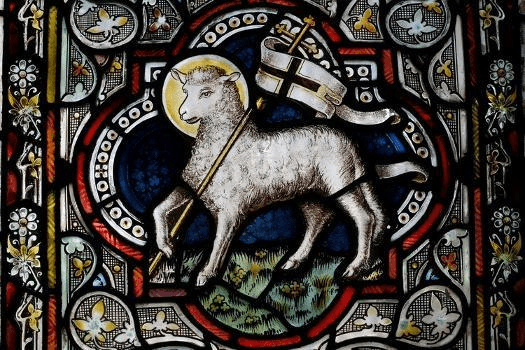
Stained glass of the Agnus Dei (Lamb of God), Chamonix, France

The next day John saw Jesus coming toward him and said, “Look, the Lamb of God, who takes away the sin of the world! This is the one I meant when I said, ‘A man who comes after me has surpassed me because he was before me.’ I myself did not know him, but the reason I came baptizing with water was that he might be revealed to Israel.”

Then John gave this testimony: “I saw the Spirit come down from heaven as a dove and remain on him. And I myself did not know him, but the one who sent me to baptize with water told me, ‘The man on whom you see the Spirit come down and remain is the one who will baptize with the Holy Spirit.’ I have seen and I testify that this is God’s Chosen One.” (New International Version)

The Gospel of John is all about finding and seeing Jesus – and then believing. Jesus is seen from various angles, namely because, as the embodiment of God, he requires a multi-perspectival look. In today’s lesson, we see John the Baptist exhorting everyone to take a look at Jesus as the Lamb of God.

Throughout the Apostle John’s Gospel, we see the gradual unfolding of belief amongst people, including the faith of John the Baptist. The Baptist’s initial understanding was that he was in the presence of someone of much greater worth than himself. Only by means of God’s Spirit is John able to gain increased insight concerning Jesus.

It’s important to point out that faith is never a static sort of thing. Rather, faith is always moving in a direction; it’s dynamic. Faith is more than a gift that’s put in a box and given and received. There is continual discovery to faith. It’s as if we’ve been given the gift of a Russian doll, and there are ever-increasing gifts within the gift. There are multiple levels of belief to explore and discover.

Spiritual insight is an initial gift of faith. There is, however, more. With insight there follows the ability to distinguish between material and immaterial realities. This is one reason why the Gospel of John can be difficult to understand – because within one verse, statement, or story, there are double, even triple, meanings to it.

John often invites us to see the spiritual reality that is there underneath the physical. It will take eyes of faith to see, because sheer physical sight will not see the entire reality. And at the end of faith is Jesus, to confess and believe that he is indeed the very Son of God.

The Holy Spirit in today’s lesson actually serves as the divine witness to John the Baptist’s burgeoning development of faith in Christ; John sees Jesus not only as coming from God, but as God.

The confirming voice of the Spirit at the baptism of Jesus lets everyone know that this Lamb of God, Jesus, the Son of God, will take away the sin of the world in his eventual Passover death.

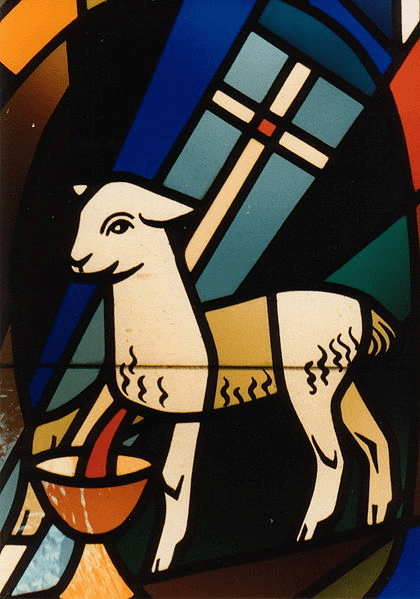
Stained glass of the Agnus Dei, El Cajon, California

To take away sin means to remove it and purify the person from it. John’s increased understanding discerns that his words and his baptism with water don’t bring this removal and purification; but they do point to Jesus. Christ as the one who is able to immerse people in the cleansing bath of grace.

Jesus Christ is qualified and able to call, gather, and cleanse not only Israel, but also the world and all the scattered children of God. Thus, John the Baptist’s ministry is to reveal Jesus to Israel; it’s directed to the entire world and to the taking away of the world’s great sin, once and for all.

The reference to Jesus as the “Lamb of God” is a familiar one to Christians. Lambs are common throughout the Bible. A lamb, however, that takes away sin is somewhat novel (although a scapegoat symbolically takes aways Israel’s sin into the desert, Leviticus 16:8-10). Passover lambs, lambs offered twice daily and in several offerings and acts of worship, were a part of many guilt and purification rituals in the Old Testament. (Leviticus 9:1-13; 14:1-13)

It seems to me that the Apostle John understood Jesus as the Lamb which removes sin by being the representative and once for all sacrifice to end all sacrifices. There is no longer any need to keep offering these various lambs day after day, festival after festival, year after year; Jesus is the efficacious one who ends it all and finally purifies and atones with potent deliverance from sin.

Day after day every priest stands and performs his religious duties; again and again he offers the same sacrifices, which can never take away sins. But when this priest [Jesus] had offered for all time one sacrifice for sins, he sat down at the right hand of God, and since that time he waits for his enemies to be made his footstool. For by one sacrifice he has made perfect forever those who are being made holy. (Hebrews 10:11-14, NIV)

And what is more, it’s this same Lamb of God who will again show up – even though slain, and yet lives – to gather together all the nations of the earth, lead them as the singular Good Shepherd, vanquish all the enemies who oppose goodness, and establish divine light in a sort of eternally lit menorah that blesses the world. (Revelation 5:6-12; 6:1; 7:17; 14:1: 1714; 21:22-23)

The baptism with water of Jesus by John the Baptist, therefore, confirmed and anticipated the baptizing (purifying) work of the Holy Spirit that only Jesus would accomplish. For John baptized with water, but Jesus baptizes with both water and Spirit – demonstrating his singular ability as Savior and Lord.

In this Christian season of Epiphany, Jesus – the Lamb of God who takes away sin and purifies with the Spirit – is Christianity’s eternal light and life.

The bright star still compels people to come and see, as well as leads the little Christs called “Christians” to take their light and let it shine wherever they go. It is a light of mercy and mystery, grace and goodness, wonder and wisdom. It is, I believe wholeheartedly, the light the world needs in order to bring an end to division and connect one another in peace and goodwill.

May it be so, to the glory of God. Amen.

Epiphany of the Lord (Isaiah 60:1-6)

Adoration of the Magi, Basilica of the National Shrine of the Immaculate Conception, Washington D.C.

“Arise, shine, for your light has come,
    and the glory of the Lord rises upon you.
See, darkness covers the earth
    and thick darkness is over the peoples,
but the Lord rises upon you
    and his glory appears over you.
Nations will come to your light,
    and kings to the brightness of your dawn.

“Lift up your eyes and look about you:
    All assemble and come to you;
your sons come from afar,
    and your daughters are carried on the hip.
Then you will look and be radiant,
    your heart will throb and swell with joy;
the wealth on the seas will be brought to you,
    to you the riches of the nations will come.
Herds of camels will cover your land,
    young camels of Midian and Ephah.
And all from Sheba will come,
    bearing gold and incense
    and proclaiming the praise of the Lord. (New International Version)

We are drawn to light. I don’t know if you have ever been in a situation with complete darkness surrounding you. When things are totally dark, we begin to fear and panic.

I grew up in a rural area in which there were no lights at night, other than the moon and the stars. More than once, I got myself into a situation, when the sky was overcast, in which I didn’t have a flashlight and could not see my hand in front of my face. I was groping to discern any little bit of light that I could see. Without the light, I was lost.

Our souls are also drawn to light. We no longer want to have darkness enveloping us; we cannot live with the darkness residing within our hearts. This is one reason why the Magi were attentive to the bright star over Bethlehem, and traveled toward it. We have a need for light because nobody can abide in darkness for too long.

The glory of the Lord is associated with bright light. Spiritually, we can find ourselves in such darkness that it’s impossible to discover light, unless God shows up displaying divine mercy and glory.

The Christian season of Epiphany has to do with this divine light. Each year on January 6, on the Church Calendar, and after the twelve days of Christmas, is the celebration of Epiphany. 

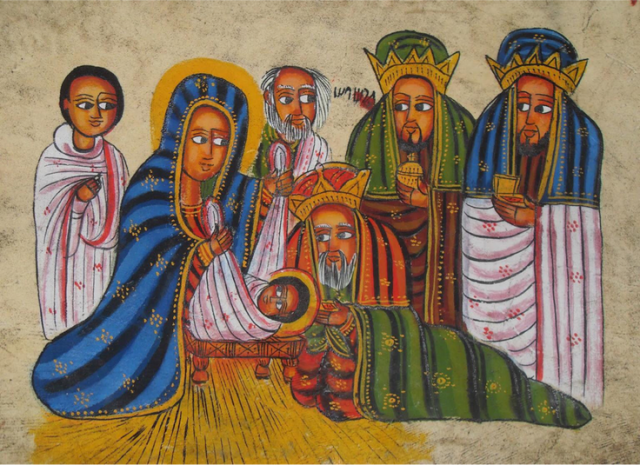
The Three Kings, Ethiopian Orthodox Church

It is a celebration of light – that Christ came to this earth as a child and became like us. Epiphany helps to bring a vision and understanding of God’s glory to all kinds of people in the world.

“Epiphany” literally means “manifestation” or “appearance.” The event most closely associated with this season is the visit of the Magi to Jesus. Included in this time of the year between the seasons of Christmas and Lent is a special emphasis on the teaching and healing ministry of Jesus. 

The people walking in darkness
    have seen a great light;
on those living in the land of deep darkness
    a light has dawned. (Isaiah 9:2; Matthew 4:16, NIV)

The great celebration and focus of these weeks is that salvation is not limited to Israel but extends to the Gentiles, as well.

“I will also make you a light for the Gentiles, that my salvation may reach to the ends of the earth.” (Isaiah 49:6; Luke 2:32; Acts 13:47, NIV)

In this season of Epiphany, the manifestation of God’s grace is one of the most scandalous truths of Christianity: God graces common ordinary people, who seem far from God, with the gift of Jesus. 

God grants repentance that leads to life for all kinds of people, no matter what their race, ethnicity, class, or background. It is a wondrous and astounding spiritual truth that God’s merciful concern is not limited to a certain type of person or a particular group of people.

Grace is (and ought to be) the guiding factor in how we interact with people. 

Losing sight of grace leads to being critical and defensive. Like King Herod of old, a graceless person becomes enamored with earthly power and control. But embracing grace, leads to humility, so that we see the image of God in people very different from ourselves. 

Like the Apostle Peter, who learned in a vision to bring the gospel to non-Jews, old legalisms begin to wear away so that people from all walks of life can have access to Jesus and his gracious saving and healing ministry. 

Grace brings down barriers and causes us to do away with unnecessary distinctions between others. And so, the appropriate response to such a grace is to glorify God for this marvelous and amazing work.

It is a gracious and merciful reality that the Magi, or Wise Men, who were really pagan astrologers, were directed to the Messiah. A light was provided to lead them to Jesus. Apart from God’s care and intervention they would have remained in darkness. 

And it is no less true for people today. This old broken world has a lot of shadowy places to it; there is darkness all around.  All kinds of people have no light at the end of the tunnel of their lives for hope and new life. But the gospel of Jesus Christ brings that light to those walking around with no ability to see. And Jesus exhorted his followers to be the reflectors of divine light for the world.

“Let your light shine before others, that they may see your good deeds and glorify your Father in heaven.”

Jesus (Matthew 5:16, NIV)

Sometimes, maybe oftentimes, the best way to bring resolution to our own troubles and problems is through helping others make sense of their lives through the gracious light of Christ so that they can see an appearance, an epiphany, of what their lives can be in the gracious rule of the kingdom of God. 

As we celebrate Epiphany and journey with Jesus through his earthly upbringing and into his gracious ministry to people, let us keep vigilance to not let our light grow dim. Instead, let us hunger and thirst after Christ’s righteousness so that our joy is full and our light is bright.

God of radiant light, your love illumines our hopes before we know them, and our needs before we ask. Kindle your flame within us, that in our prayers and service, we may know your transforming presence at work in the world around us. All this we ask through Jesus Christ, our Lord. Amen.

Good News for All (Acts 8:26-40)

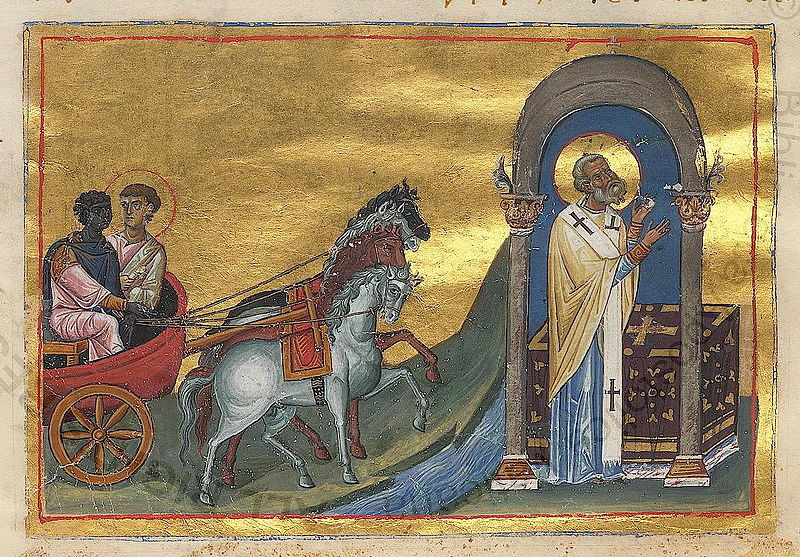
11th century Byzantine depiction of Philip and the Ethiopian eunuch

An angel from the Lord said to Philip, “Get up, and take the desert road that goes south from Jerusalem to Gaza.” So Philip went.

An Ethiopian man who had come to Jerusalem to worship was on his way home. The man was a eunuch, a high-ranking official in charge of all the treasures of Queen Candace of Ethiopia. As the official rode along in his carriage, he was reading the prophet Isaiah out loud.

The Spirit said to Philip, “Go to that carriage, and stay close to it.”

Philip ran to the carriage and could hear the official reading the prophet Isaiah out loud. Philip asked him, “Do you understand what you’re reading?”

The official answered, “How can I understand unless someone guides me?” So he invited Philip to sit with him in his carriage.

This was the part of the Scriptures that the official was reading:

“He was led like a lamb to the slaughter.
He was like a sheep that is silent
when its wool is cut off.
He didn’t open his mouth.
When he humbled himself,
he was not judged fairly.
Who from his generation
will talk about his life on earth being cut short?”

The official said to Philip, “I would like to know who the prophet is talking about. Is he talking about himself or someone else?” Then Philip spoke. Starting with that passage, Philip told the official the Good News about Jesus.

As they were going along the road, they came to some water. The official said to Philip, “Look, there’s some water. What can keep me from being baptized?”  The official ordered the carriage to stop. He and Philip stepped into the water, and Philip baptized him. When they had stepped out of the water, the Spirit of the Lord suddenly took Philip away. The official joyfully continued on his way and didn’t see Philip again.

Philip found himself in the city of Azotus. He traveled through all the cities and spread the Good News until he came to the city of Caesarea. (God’s Word Translation)

We are in the Christian season of Epiphany – a time of celebrating that the light of the Lord has been given not only to Jews but to Gentiles, as well. The good news of mercy, forgiveness, salvation, and peace in Jesus Christ is for everyone, and not just some.

So, we have a very appropriate story in today’s New Testament lesson illustrating God’s grace for those who have been typically the “outsiders” when it comes to the worship of God.

God’s grace is really a merciful divine intervention into another’s life, providing something a person or group needs, yet cannot obtain on their own.

Philip, one of the original twelve disciples of Jesus, received instructions from the angel of the Lord. Take a certain road. That’s it. No other explanation. The command is, however, full of grace. Most of us don’t do all that well with multiple instructions given at once. We do much better with a single imperative at a time.

And so, the next piece of guidance came as Philip was taking the road from Jerusalem south to Gaza. Go hang out around a certain carriage. Philip needed no more direction after that; he took to what was happening.

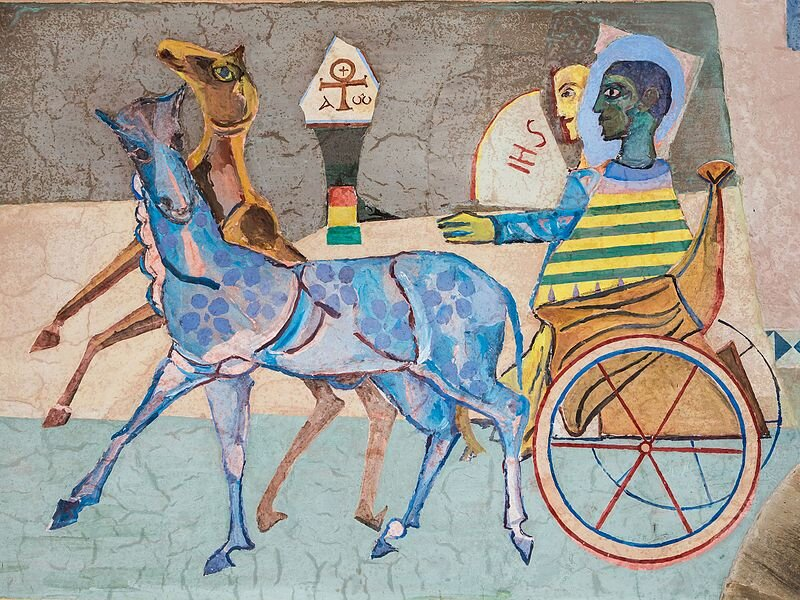
Philip and the Ethiopian Eunuch by Herbert Boeckl

Maybe reading the story from our contemporary perspective hinders us from seeing just how scandalous and unthinkable the story was for people in the first century. Jews and Gentiles didn’t hang out with each other; and, if they did, there were all sorts of rules regulating how the interaction would go.

We really don’t have any of this with Philip. He simply emulates his Lord and ignores societal and cultural mores to meet the need of someone very different than himself.

An Ethiopian man was in Jerusalem and heading back home. He was an official in the Queen of Ethiopia’s court, and a eunuch (a castrated official). He was a person of color with a mutilated body and could have very well been of a different gender than Philip was used to. In other words, he was about as foreign from Philip as one can get.

Yet, what better way to communicate that the gospel is for everyone? Philip had learned from Jesus not to adopt the divisions of race, religion, and gender that others did. See, instead, with spiritual eyes to the heart of a person.

And this Ethiopian eunuch had a heart curious about God, a mind trying to understand God’s words, and a gut that told him this guy approaching me for whom I don’t know and isn’t from my country is perhaps God’s messenger to me.

That’s what I call a divine appointment.

Those divine encounters always result in changed lives. I believe both the Ethiopian and Philip were changed that day. The only way that any of us truly changes is through the interaction with others different from ourselves.

The good news of Jesus is for all. If, however, we remain in a closed system which is not open to others of differing cultures and communities, then we harden into believing the gospel is for us, and not them.

Christianity is not, therefore, an exclusive club made up of insiders who demonize outsiders as not looking, acting, or thinking like we do. We already have plenty of that insidious junk in the world. At its inception, Christianity was different. And, I believe, it needs to keep that edge of reaching out to all persons with a life-giving message of salvation and peace – not a death-dealing sermon of Christian cultural hegemony.

Good news for all people everywhere means that proclamation of the gospel of Jesus Christ needs to occur for all nations and ethnic peoples. It’s a message of grace, not judgment; of mercy, not threats; of open love, not closed hate.

Philip and the Ethiopian show us the way through their sensitivity to the divine, their open dialogue with one another, and their shared commitment to doing what is right and serving the Lord. Philip was a guide, not a conqueror. And the Ethiopian became a follower of Jesus, not Philip.

Let’s make sure to keep it straight; and to keep reaching out.

Lord God, thank you that in love and mercy, you reached out to us – and that when we were dead in our sins, you sent Jesus to make us alive. Thank you that you have a heart that seeks the lost. Thank you for saving us.

Give us hearts that care for the people who are in darkness and need the light of Christ. Teach us to care for them as you do. Grow us to care for the common good of all humanity. 

Help your Church everywhere to know and love you; and to invite others into your divine dance. May our conversations with others be seasoned with salt and full of grace; may our relationships show people the love of Jesus. May our hearts reflect your own heart, through Jesus Christ our Lord, in the strength of the Holy Spirit. Amen.

You Have What You Need (1 Corinthians 1:1-9)

Paul, called to be an apostle of Christ Jesus by the will of God, and our brother Sosthenes,

To the church of God in Corinth, to those sanctified in Christ Jesus and called to be his holy people, together with all those everywhere who call on the name of our Lord Jesus Christ—their Lord and ours:

Grace and peace to you from God our Father and the Lord Jesus Christ.

I always thank my God for you because of his grace given you in Christ Jesus. For in him you have been enriched in every way—with all kinds of speech and with all knowledge—God thus confirming our testimony about Christ among you. Therefore you do not lack any spiritual gift as you eagerly wait for our Lord Jesus Christ to be revealed. He will also keep you firm to the end, so that you will be blameless on the day of our Lord Jesus Christ. God is faithful, who has called you into fellowship with his Son, Jesus Christ our Lord. (New International Version)

God has already provided for us everything we need to live the Christian life. We lack nothing in Jesus Christ; and possess the following five gifts….

God’s Light

Every year, after the 12 Days of Christmas, beginning on January 6 and going to Ash Wednesday, is the season of Epiphany. It is a celebration and recognition that Christ’s coming to this earth as a child is much more than a baby in a manger. Epiphany brings a vision and understanding of God’s glory to all kinds of people of the world.

Epiphany means “manifestation” or “appearance.” The focus of these weeks is that salvation is not limited to Israel but extends to the Gentiles, as well. In other words, the gospel is for everyone.

Epiphany illumines one of the most scandalous truths of Christianity: God gives the light of Christ to common ordinary people who seem far from God with the gift of Jesus. God grants repentance that leads to life for all kinds of people – no matter their race, ethnicity, class, gender, or background – even pagan astrologers like the Magi. It’s a glorious truth that God’s merciful concern is not limited to a certain type of person or a particular group of people.

This old broken world is wrapped in darkness. All kinds of people have no light at the end of the tunnel of their lives for hope and new life. The good news is that Christ brings light to those walking around with no ability to see. Jesus, in his teaching ministry in the Sermon on the Mount, exhorted his followers not to hide their light but to let it shine for all to see.

Oftentimes, the best way to bring resolution to our own troubles and problems is through helping others make sense of their lives through the gracious light of Christ so that they can see an appearance, an epiphany, of what their lives can be in the gracious rule of the kingdom of God. 

God’s Grace

The Church has struggled throughout its history to uphold this basic message of the gospel of grace for everyone. From the Council of Jerusalem in the book of Acts that met to decide whether one ought to become a Jew first in order to be a Christian; to the with-holding of membership to African Americans in many churches in the twentieth century; to ignoring the poor and least among us; we must be intentional and deliberate about reaching and ministering to all people.

The joy of salvation is that I do not need to jump through certain spiritual hoops to enter into Christianity, nor be a certain kind of person. The Church is not an exclusive club of people based in a particular spiritual pedigree or preferences. Through repentance and faith in Jesus, all may come to God.

In him we have redemption through his blood, the forgiveness of sins, in accordance with the riches of God’s grace that he lavished on us.

Ephesians 1:7, NIV

Everyone has intrinsic worth as individuals created in the image of God; and therefore need the attention of Christians in bringing the gospel to them. It is easy to ignore people we do not understand and who are different from us; or to look down on those who do not agree with me on disputable matters. To intentionally reach and minister to a different class or generation or race requires much love and many resources. It requires grace.

Jesus had a big enough inner space to accommodate prostitutes, drunkards, tax collectors, and a whole variety of “sinners.” How big is your inner space? Is it big enough to allow people in your life who are not like you without you feeling threatened and insecure?

In Christ’s day, some feared being contaminated if having table fellowship with such people; religious leaders were afraid of losing their power over people if the status quo was changed in ministering to such low life’s; and others feared continued Roman domination if Jesus kept up spending his time in graciousness to all kinds of sinners. So, all the religious people killed him.

God’s Peace

Because of Christ, we have wholeness and integrity; we have peace.

Therefore, since we have been justified through faith, we have peace with God through our Lord Jesus Christ (Romans 5:1, NIV)

Peace is a gift. Yet, we must unpack the gift in order to enjoy it – which is why we get encouragements to seek peace and pursue it – not because we don’t have it, but because we need to use it.

Finally, all of you, be like-minded, be sympathetic, love one another, be compassionate and humble. Do not repay evil with evil or insult with insult. On the contrary, repay evil with blessing, because to this you were called so that you may inherit a blessing. For,

“Whoever would love life
    and see good days
must keep their tongue from evil
    and their lips from deceitful speech.
They must turn from evil and do good;
    they must seek peace and pursue it.
For the eyes of the Lord are on the righteous
    and his ears are attentive to their prayer,
but the face of the Lord is against those who do evil.” (1 Peter 3:8-12, NIV)

God’s spiritual gifts of speaking and serving

We also need to unpack our spiritual gift(s). We have them. They’re there inside us. But we must let it out!

Each of you should use whatever gift you have received to serve others, as faithful stewards of God’s grace in its various forms. If anyone speaks, they should do so as one who speaks the very words of God. If anyone serves, they should do so with the strength God provides, so that in all things God may be praised through Jesus Christ. To him be the glory and the power for ever and ever. Amen. (1 Peter 4:10-11, NIV)

God’s eternal security

God will keep us firm till the end.

“I give them eternal life, and they shall never perish; no one will snatch them out of my hand. My Father, who has given them to me, is greater than all; no one can snatch them out of my Father’s hand.”

Jesus (John 10:28-29, NIV)

We might jump from finger to finger, but we aren’t getting out of God’s hand! The Lord has us in his loving and gracious grip. God’s faithfulness is what makes all the difference.

Insecurity comes from us trying to be our own Security Officer. We simply don’t know everything, or why some people say or do what they say and do. A believer’s security comes solely from the Good Shepherd, Jesus, taking ownership of the flock and protecting it from harm.

Conclusion

You already have what you need for the Christian life. Jesus is the Light of the World. The good news is the gospel of grace and peace. The Holy Spirit is within us. And the Father has us in his good strong hand.

Our triune God has given us provision to live life to the full. We need to affirm what we have in Jesus Christ:

  • No matter what gets done and how much is left undone, I am enough.
  • I am worthy of love and belonging.
  • I am brave and resilient.
  • I am blessed on this earth to be a blessing to others.
  • I am not my mistakes nor my successes, my illness nor my health, my idleness nor my work.
  • I am loved by God.

These are all things we already true of us. We cannot try and obtain any of them because we presently now possess them by a merciful God.

May the strength of God sustain us.

May the power of God preserve us.

May the hands of God protect us.

May the way of God direct us.

May the love of God surround us.

Now and forever. Amen.