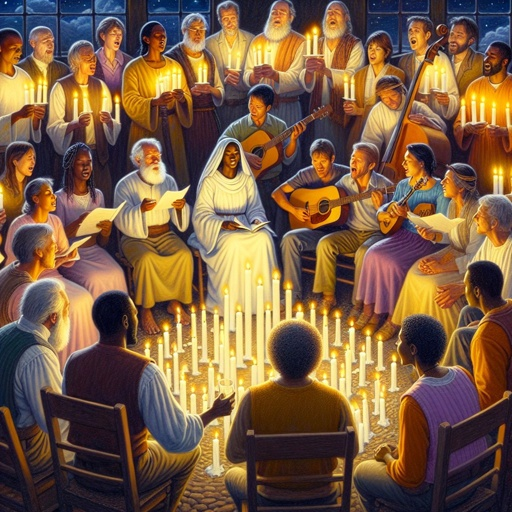
Sing Psalms and Hymns and Spiritual Songs to One Another (Ephesians 5:15-20)

By Bible Art

Be careful, then, how you live, not as unwise people but as wise, making the most of the time, because the days are evil. So do not be foolish, but understand what the will of the Lord is. Do not get drunk with wine, for that is debauchery, but be filled with the Spirit, as you sing psalms and hymns and spiritual songs to one another, singing and making melody to the Lord in your hearts, giving thanks to God the Father at all times and for everything in the name of our Lord Jesus Christ. (New Revised Standard Version)

It’s unlikely I need to tell anyone that the days are evil. The world is upside-down and topsy-turvy with injustice, waywardness, and narrow partisanship. In fact, there is a lot of similarity to the Apostle Paul’s time. Maybe that’s why Paul exhorted the church not to drown their sorrows in a bottle of spirits, but to be filled with the Spirit.

Perhaps, because of the times we live in, you don’t feel much like singing. You might not be finding much in your life right now to sing about. Yet, maybe singing is the very thing we need.

An inebriated person says and does things that they would not typically say or do when they’re sober. The Apostle’s point about being filled with the Spirit is that, instead of doing and saying foolishness, we are to be so filled with God that we do and say wisdom that we wouldn’t typically do and say, if not filled with God. 

Without the fullness of God’s Spirit, we end up mumbling, not singing; worrying, not making music in our hearts; complaining and arguing, not giving thanks. Half-filled Christians can only practice a half-hearted Christianity. And they’re only half-baked in their service and devotion to Christ.

Why sing? 

Because singing is part of being filled with the Spirit of God. Singing happens when we experience God’s overflowing grace in our lives through the blessings of being chosen, adopted, and redeemed into God’s new community. (Ephesians 1:3-11)

Music is powerful. It’s not only a means of expressing praise and commitment to Christ and each other, it is also a powerful means of remembering.

For example, when we first teach kids the alphabet, we teach it in a song. Trying to teach letters in a rote fashion doesn’t work well for pre-school kids. But words set to music is why we can still remember words from old TV shows, because those words were set to a catchy tune (alas, the lyrical theme from Gilligan’s Island will forever be in my head).  Music is why an Alzheimer’s patient doesn’t remember her daughter’s name, yet can flawlessly sing all four verses of Amazing Grace.

Singing is an offering and a sacrifice of praise to God (Hebrews 13:15). And singing is also a vehicle whereby we are taught, encouraged, and built up in the community of believers. We sing to God, one another, and even to ourselves.

Christian music, then, is to be both a means of praising God and a practice of encouraging each other. We accomplish this through singing psalms, hymns, and spiritual songs.

Sing Psalms

The word “psalm” helps us rightly think of the biblical book of Psalms. Singing the psalms is an ancient practice, going all the way back to the Israelites singing psalms in the temple and synagogue. The early church maintained this practice, especially as a means of being faithful to praying without ceasing. 

However, over time, medieval congregations began neglecting the practice. In fact, European congregations eventually gave up most singing altogether. Almost all the singing was done by church choirs and professional musicians employed by the king (there was no separation of church and state) to write, compose, and perform in worship services. 

Five-hundred years ago, during the Reformation, Martin Luther reinstituted congregational singing. He gave music back to the people. One of the results of this change was putting the book of psalms to song – the Psalter.  For many Protestant denominations, the Psalter became the primary means of singing. The Psalter chiefly set prayers to song. It was both a means of expressing prayer to God and learning Scripture.

Singing Hymns

There have always been hymns in the church. Yet, it was not until the Reformation that hymns began to be written and sung by congregations. For the Reformers, hymns were used to teach sound doctrine and theology, as well as a means of confessing the faith together

A mighty fortress is our God,
a bulwark never failing;
our helper he, amid the flood
of mortal ills prevailing.
For still our ancient foe
does seek to work us woe;
his craft and power are great,
and armed with cruel hate,
on earth is not his equal. (Martin Luther, 1529)

Singing Spiritual Songs

Spiritual songs are the present day equivalent of praise and worship choruses, or what some refer to as contemporary songs. These are songs purposefully designed to be emotional expressions of praise to God and to give powerful testimony for what God has done or is doing.

Remember When You Sing…

  • Psalms are used to pray and learn Scripture.
  • Hymns are used to teach us sound doctrine and confess the faith together.  
  • Spiritual songs are an important way of expressing praise to God and being encouraged in the faith. 

Therefore, church music is to serve as both a revelation from God, and as a response from God’s people.

There are two important deductions from the Apostle Paul’s exhortation:

  1. A variety of songs is inferred and expected
  2. Their use is commanded

The reason worship style seems always to be a controversial topic is because everyone has their personal preferences. And yet, if we are to be faithful to today’s New Testament lesson, we will do more than focus on what I want. 

Truth be told, we are selfish people when it comes to music. We want what we want, and we don’t care what somebody else wants. And we’ll persist in that self-absorbed spirit until somebody calls us on it… That somebody is the Apostle Paul. Scripture calls us to encompass psalms, hymns, and spiritual songs – all three of them – in our worship.

I have an old friend who is an accomplished church musician and worship pastor. I once asked him how I can lead a worship service among such a variety of preferences concerning music. He answered my question with a question:

“How highly do people, including and especially your musicians, value the unity of the church? Do they love each other so much that they can allow for a wider range of style, and do so without vocally complaining about it?”

My friend went on to say, “When I arrived at one church as their pastor, some people were in a rather bad habit of saying very openly, ‘Oh I hate that song,’ or, ‘If I hear this song one more time I’m walking out.’ What I tried to do was teach people that this is not the most loving or mature approach; and it does little to build up the rest of the Body of Christ.”

If a group of people are being faithful to Scripture, and doing their best musically, then – if the music seems lifeless, dull, or strange to us – the real issue isn’t style but our hearts.    

A heart filled with the Spirit of God will speak to others using the Psalter, time-honored hymns, and fresh new contemporary songs. The result is believers built up in the faith.

Gracious God, give us grace to take to heart the great dangers we are in by our unhappy divisions about all kinds of things, including music. Take away all hatred and prejudice, and whatever else may hinder us from godly union and harmony, so that as there is but one body and one Spirit, one hope of our calling, one Lord, one faith, one baptism, one God and Father of us all, we may from this time forward be all of one heart and of one soul, united in one holy bond of peace; and may with one mind and one mouth glorify you, through Jesus Christ our Lord. Amen.

Spiritual Blessings (Ephesians 1:7-14)

The Trinity, by Ukrainian artist Feodosiy Humeniuk, 1981

In him we have redemption through his blood, the forgiveness of our offenses, according to the riches of his grace that he lavished on us in all wisdom and insight.He did this when he revealed to us the mystery of his will, according to his good pleasure that he set forth in Christ, toward the administration of the fullness of the times, to head up all things in Christ—the things in heaven and the things on earth.

In Christ we too have been claimed as God’s own possession, since we were predestined according to the purpose of him who accomplishes all things according to the counsel of his will so that we, who were the first to set our hope on Christ, would be to the praise of his glory. And when you heard the word of truth (the gospel of your salvation)—when you believed in Christ—you were marked with the seal of the promised Holy Spirit, who is the down payment of our inheritance, until the redemption of God’s own possession, to the praise of his glory. (New English Translation)

The Apostle Paul wrote this letter to the Church at Ephesus. Believe it or not, the first chapter of Ephesians  comprises only two sentences in the Greek language for which he originally wrote. Ephesians 1:3-14 are one sentence, and Ephesians 1:15-23 is the other sentence. Thankfully, understandably, and mercifully, English translators have created multiple sentences for us so that we can better make sense of the text. 

It’s almost as if Paul was so excited to talk with the Ephesian believers about who they are in Jesus Christ and what they possess in him that he blurted out in writing with a flurry of enthusiasm and excited fervor without stopping to take a breath or a break.

Paul stacked word after significant word, on top of each other, in order to communicate the spiritual blessings that believers in Christ enjoy. Redemption, forgiveness, grace, wisdom, insight, predestination, faith, inheritance, and salvation are just some of the blessings given to those in union with Jesus Christ.

And, if that wasn’t enough, God has also graciously given us the Holy Spirit, the Paraclete, the one who comes alongside and helps us to live into the blessings we possess. Because God the Father predestined and elected us, God the Son redeemed us, and God the Spirit took possession of us, we are delivered from sin, death, and hell.

It’s as if we came to Christmas day expecting a package of underwear, and found instead a bunch of big boxes with some of the most lavish and expensive gifts we’ve ever seen!  This says much more about the giver than it says about us.

It was according to God’s good pleasure in Christ through the Spirit that believers in Jesus have such privileges.  Like the parent who sits back and watches the unpackaging of presents happen with great joy, so God delights and is pleased with the gifts given to us. The Lord absolutely delights in watching us unpack them and use them in this life.

These gifts, these blessings, are all lavishly provided because they are extensions of God, as if the Lord meticulously handmade each present with us in mind.

Throughout the entirety of Holy Scripture, all the stories and narratives, teachings and writings, are about God. The Lord of all creation is both the subject and object of each book of the Bible. Every good thing we have in this life is because of God’s gracious presence and power in this world.

Each positive experience we have is a direct result of God’s steadfast love toward people. All good gifts come from a good God who is delighted and pleased to give them.

Not a one of us purchased our own gifts and stuck them under the tree. God bought them all with the precious blood of Jesus and sent the Spirit to deliver them to us. 

Consider setting aside time today or tomorrow in a quiet place, and reflect on just one of the words in today’s New Testament lesson. Think about redemption or forgiveness, salvation, or grace, or any of the words which grab you.

Say the word repeatedly and meditatively, quietly and loudly, thoughtfully and with flavor. Consider what God did to bring you that gift. Contemplate the way(s) in which you have received the gift. 

Plan one way in which you might share your gift with another person. And make sure to give glory and praise to God for the grace lavishly given to you.

May your meditation lead to a deeper appreciation of what God has done for you; and may that revelation result in praise, honor, and glory to the One who accomplished so much on our behalf.

Gracious God, you have revealed and made known the way of deliverance from the power of darkness and brought me into your marvelous light. Help me to better understand all the ways you have acted on my behalf so that my life might reflect your grace and steadfast love to the world, through Jesus Christ, my Savior, in the enablement of the Holy Spirit. Amen.

“I Choose You!” (Ephesians 1:3-6)

Blessed is the God and Father of our Lord Jesus Christ, who has blessed us with every spiritual blessing in the heavenly realms in Christ. For he chose us in Christ before the foundation of the world that we should be holy and blameless before him in love. He did this by predestining us to adoption as his legal heirs through Jesus Christ, according to the pleasure of his will—to the praise of the glory of his grace that he has freely bestowed on us in his dearly loved Son. (New English Translation)

There is perhaps no greater sense of worth, security, and love, than stating with sincerity and conviction to another, “I choose you!”

That is exactly what God has done for us. In fact, the Lord chose us and included us before we were even born into this world. Our identity is secure in belonging to God because it isn’t based in any of the screw-ups I did yesterday or the bad decisions I made years ago. Christian identity is based solely and completely by the choice and action of God, in Christ, through the Spirit.

People tend to live up to how they view themselves, to how they self-identify. So, it is critical to our well-being how we truly understand self, others, and God.

If we see ourselves as never getting ahead and needing to lie, cheat, and steal to obtain anything in this life, then we will view ourselves as common thieves.

If we think the only way to have love and security in this life is to hustle for it – to make ourselves as presentable as we possibly can, then we will view ourselves as basically unlovely and search for love in all the wrong places by trying to keep up appearances.

If we look at ourselves as stupid, then we will tend to make poor decisions even when it’s in our ability to make good choices because we see ourselves as unable to compete with those smarter than us. 

The common theme in all these scenarios are people living apart from God. Without the Lord Jesus, we are like lost street children trying to survive from day to day. What we need, what we search for and long for, is to have a good, blessed life in a loving home, a place to belong in a world of disconnection.

To be “blessed,” to have “blessing” in the Holy Scriptures, is to have God’s stamp of approval on your life. It is to know, experience, and feel Divine favor resting upon you.

The picture being painted at the very beginning of Paul’s letter to the church at Ephesus is of wayward children roaming the streets as orphans. The Ephesians were ensconced in their idol worship of Artemis, the fertility cult goddess. They were going about life without a whim about the true and living God.

Out of sheer grace, God plucked them from their worthless condition and adopted them. God placed blessing upon them because of love and gave them a reason to rejoice and praise.

What’s more, the Ephesians were chosen and predestined for holiness and purity. God set them apart for divine blessing. It’s as if God brought them into the kingly palace, provided lavishly for them, and let them have the run of the place. They get to enjoy every privilege that comes with being children of the king.

The focus and orientation of today’s New Testament lesson is about how tremendously special the believer in Jesus really is. And it has nothing to do with how presentable we are to a holy God. Instead, out of the vast storehouse of blessed grace, God chose and adopted. The Lord looked upon you and me with googly divine eyes and said, “I choose you!”

God chooses from a place of divine pleasure. Yes, that’s right. God chooses, predestines, and adopts with a willing heart because it brings great pleasure and divine joy to do so!

There was no arm-twisting from the Father to the Son in securing redemption for lost humanity. And there was no persuasion necessary for the Father and Son to send the Spirit for our ongoing benefit and help in this life. Each redemptive event of Jesus was done out of the grace and love of God in Christ through the Spirit.

Do you see how God views you? Do you know how special you truly are?  Have you an understanding of the incredible position and majesty you have as a human being in God’s image and likeness?

As a child of the king, you live up to the position you know you possess. Freedom from worry and anxiety don’t come from willpower, but from an understanding that God owns all things, and we will never be in need. 

Deliverance from the power of darkness doesn’t come by trying to do better; it comes through the knowledge that God has redeemed us and chosen us to live in the gracious realm of divine love forever. There is no need to hustle for love with God because you and I already have it.

The believer has every spiritual blessing in Christ. God has your back. We belong to God. And to belong to Jesus Christ is to be blessed. It makes all the difference in the world. It is our reason for gratitude and praise, and for settled peace and glorious rest.

Gracious God, your loving activity has snatched me from the barren streets of sin and brought me into a realm of incredible blessing. Thank you for blessing me and giving me a place to belong forever; through Jesus Christ, my Lord and Savior, who with you and the Holy Spirit reign forever and ever in a celebration of redeeming love.  Amen.

Saved for a Reason (Ephesians 2:1-10)

At one time you were like a dead person because of the things you did wrong and your offenses against God. You used to live like people of this world. You followed the rule of a destructive spiritual power. This is the spirit of disobedience to God’s will that is now at work in persons whose lives are characterized by disobedience. At one time you were like those persons. All of you used to do whatever felt good and whatever you thought you wanted so that you were children headed for punishment just like everyone else.

However, God is rich in mercy. He brought us to life with Christ while we were dead as a result of those things that we did wrong. He did this because of the great love that he has for us. You are saved by God’s grace! And God raised us up and seated us in the heavens with Christ Jesus. God did this to show future generations the greatness of his grace by the goodness that God has shown us in Christ Jesus.

You are saved by God’s grace because of your faith. This salvation is God’s gift. It’s not something you possessed. It’s not something you did that you can be proud of. Instead, we are God’s accomplishment, created in Christ Jesus to do good things. God planned for these good things to be the way that we live our lives. (Common English Bible)

Humanity is spiritually hard-wired to do good in this world. 

From a Christian perspective, we live in a fallen world and experience the evils of disasters, diseases, and decision-making that is off, as well as personal and corporate corruption. However, this is not our original design. 

In the Christian tradition, believers in Jesus are not delivered from sin, death, and hell so that they can idly sit in a worldly holding tank until Christ returns. Deliverance is the initial dimension of God’s plan – and not the end game. We are saved for good works to be done in the here-and-now.

Christians know that they are saved from individual and systemic sin through the forgiving work of Jesus Christ. It’s an act of sheer grace on God’s part. A believer in Jesus is not spiritually reborn through her effort any more than a baby’s birthed because of her own doing. It is thoroughly the work of God. Even the faith needed to believe is a gift graciously provided by God.

This, however, is far from the whole story. God has plans and purposes in mind for people. Christians are birthed into a new spiritual community with new commitments to do all kinds of good deeds. It’s as if sin is a weight or an obstacle that has been removed, so that living a life full of goodness can now move forward and do its work. 

To be saved is to be freed for a vigorous moral life that is deeply concerned with altruistic actions in a world full of need.

There is a profound spiritual wound which underlies the great problems of our world. Behind so many of our world issues are matters of the spirit. The unseen world is just as real as the world which is seen. Just as we know germs are present, are real, and we must account for them – so there is spiritual world very much real, and we ignore it at our great peril. 

And so, it seems to me that spiritual people, including Christians delivered for the purpose of good deeds, are to agitate for earthly change graciously, wisely, and lovingly. Expecting human governments or corporate systems to take the lead in moral transformation is like asking the fox to guard the hen house.

I will admit to you that I don’t much have the stomach for what seems to me to be useless emotional debates amongst some Christian communities about all sorts of political issues and religious dogmatic opinions. As redeemed people, delivered for a purpose, I believe it is sage to put our focus on discovering how we can support and bless the essential services laboring to keep humans surviving, and hopefully, thriving. God has raised us up for this, that is, if we have the spiritual eyes to see.

Christians, churches, and spiritual communities must labor at the gates of hell for the lives of women caught in sex trafficking; provide uplift and the tools to a better life for those in grinding poverty and hunger; challenge the idolatry of a materialist culture; and, hundreds of other realities of living in a fallen broken world.

As Christians, God has delivered us from sin, death, and hell so that we will do good in this world. God has sovereignly placed you and I in places and positions for just this time so that we will do good works, both big and small, tackling immense issues as well as little acts of kindness. 

Doing good comes in all sizes, and all of us are to share our lives for the betterment of humanity. After all, we really are our brother’s and our sister’s keeper.

God Almighty, I pray that your people may not lose heart in this world. May you strengthen your church with spiritual power so that the words and ways of Jesus will ground them for faithful service to this planet you have created. May Christians everywhere be rooted and established in the divine love which supports good works done in the humility of a gentle spirit; through Jesus Christ our Lord, who lives and reigns with you and the Holy Spirit, one God, now and forever.  Amen.