Proverbs 30:1-10 – Live Wisely and without Envy

These are the solemn words of Agur son of Jakeh:

    “God is not with me, God is not with me,
    and I am helpless.
I am more like an animal than a human being;
    I do not have the sense we humans should have.
I have never learned any wisdom,
    and I know nothing at all about God.
Have any ever mastered heavenly knowledge?
    Have any ever caught the wind in their hands?
    Or wrapped up water in a piece of cloth?
    Or fixed the boundaries of the earth?
Who are they, if you know? Who are their children?

“God keeps every promise he makes. He is like a shield for all who seek his protection. If you claim that he said something that he never said, he will reprimand you and show that you are a liar.”

I ask you, God, to let me have two things before I die: keep me from lying and let me be neither rich nor poor. So, give me only as much food as I need. If I have more, I might say that I do not need you. But if I am poor, I might steal and bring disgrace on my God.

Never criticize servants to their master. You will be cursed and suffer for it. (Good News Translation)

These are the raw expressions of a man who has awareness of his own envious nature. He realizes his profound lack of wisdom. The man, Agur, discerns how helpless and pathetic he really is, apart from wise living.

The wise person knows that a heart at peace gives life to the body, but envy rots the bones. Possessing too much or too little tends to awaken the eye of envy within us. Agur wants to avoid thinking that people, even God, owes him. He is concerned he might slip into the disposition of what the Lord and others can do for him, rather than vice versa.

“The secret of success is that it is not the absence of failure, but the absence of envy.”

Herodotus

Today, envy manifests itself in moving-on to another church, or friendship, or marriage, or job when perceived needs and wants are not met. Certainly, ties need to be severed in the case of abusive treatment. Yet, when we simply do not like something, and aspire to more and more hoarding of emotional and spiritual resources, there is little to no awareness of the shadowy places in our hearts.

Perhaps, through the difficulty, the Lord was attempting to reveal something important to us or working to bring about positive transformation. However, we bailed from the situation too quickly, not wanting to deal with the pain or inconvenience of it all. And, all the while, our real motivations remain hidden and unaddressed.

It is necessary to see envy for what it is – not just a common predilection everyone has – but a malady of believing I deserve things no one is giving me. It’s the age old endemic problem, much like Adam and Eve’s original sin, of grabbing a forbidden fruit in the belief G-d is not providing everything I need. And we then cannot, or will not, see all the vast resources and blessings already possessed.

Gratitude is a spiritual practice, when engrafted into a daily spiritual walk, provides a strong antidote to keeping envy at bay. Instead of wondering why G-d is not blessing my life and work in ways I think it should happen, perhaps we ought to identify and count the blessings we already possess and enjoy. 

Some of the greatest joys around us are the simple pleasures of everyday life – holding and sipping a hot cup of coffee; a quick kiss good-bye to my spouse on the way out the door; the opportunity to curl up with a good book on a rainy day; these and many more are blessings given to us by a heavenly Father who cares for us deeply.

“Gratitude turns what we have into enough.”

Aesop

It might be a good thing to spend some intentional time saying and/or writing out many of the blessings currently existing in your life. 

For example, rather than wishing a loved one would not have to endure disease or surgery and envying healthy people, rejoice that he/she is with you, that you enjoy one another’s love and companionship, whether it is in times of health or in seasons of illness.

And instead of envying the rich or worrying about becoming poor, give thanks for this current place in your life. Simple thanksgiving to G-d for every meal, each possession obtained, and even all things lost forever, fortifies the spirit for resilience over the long haul of life.

Much of our life on this earth comes down to mystery. We simply do not know, and are not privy, to the myriad ways G-d is working in the world. We may never know why we must face and deal with our particular and personal pains, disappointments, and sorrows.

So, when we pray, much like Agur, it might be wise to ask for continual help with never-ending problems, rather than constantly praying for deliverance from unwanted situations. It is best we pray as Jesus taught us saying, “Give us this day our daily bread.” (Matthew 6:11)

“I’ve learned by now to be quite content whatever my circumstances. I’m just as happy with little as with much, with much as with little. I’ve found the recipe for being happy whether full or hungry, hands full or hands empty. Whatever I have, wherever I am, I can make it through anything in the One who makes me who I am.”

The Apostle Paul (Philippians 4:11-13, MSG)

Wise persons know the frailty of their own hearts. Prayer, for them, is an organic practice arising from vulnerable and forthright discussions with G-d about doubt and disbelief. Indeed, people come to know the Lord not through speculating or imposing their own personality on G-d but by daily calling upon the Divine Being for practical help at the neediest points of life.

Blessed Lord, take me to the place where I am saved from my pride and arrogance and humility takes center stage, where I’m lifting up clean hands and a pure heart to you. Take me to the place where I’m no longer looking at the mountains I face but looking down upon them, where I can clearly see, and my decisions are flooded with your light, truth and justice. I bend my knee and receive your truth. I open my ears to receive your counsel. I open my heart to receive your eternal wisdom. Amen.


1 Thessalonians 5:12-18 – Give Thanks

Now we ask you, brothers and sisters, to acknowledge those who work hard among you, who care for you in the Lord and who admonish you. Hold them in the highest regard in love because of their work. Live in peace with each other. And we urge you, brothers and sisters, warn those who are idle and disruptive, encourage the disheartened, help the weak, be patient with everyone. Make sure that nobody pays back wrong for wrong, but always strive to do what is good for each other and for everyone else.

Rejoice always, pray continually, give thanks in all circumstances; for this is God’s will for you in Christ Jesus. (NIV)

A lot of problems would resolve themselves if gratitude was a default way of life. Giving thanks in all circumstances creates peace; causes encouragement to flow freely; warns those who are busybodies; builds patience; and spreads goodness.

It can be easy to give thanks when things go our way.  It is quite another matter when circumstances are difficult, and our expectations are not realized.  The Apostle Paul’s letter to the church at Thessalonica was written to people caught between a rock and a hard place.  In fact, it was so hard that the believers focused completely on the return of the Lord. 

When times are tough, Christ’s second coming comes forth from the recesses of our minds and straightaway to the forefront of our thinking.  Gratitude is typically not a first response to trouble and hardship. Instead, we may look to escape. We long for Christ’s return as a way out of trouble.

Although we know we should be thankful, we often are not.  Envy and resentment are the twin enemies continually looking to subvert our gratitude. In our frustration of missed expectations and unwanted situations, ingratitude can easily slip into our spirits.

A life of unhappiness awaits those who are resentful of what they do not possess. Those who envy shall never be satisfied because they are always dreaming about how much better life would be without their troubles.

No matter how good we have it, someone else has it better.  To envy is to be overly future-oriented, like the Thessalonians, always thinking about how the grass is greener on the other side of the fence. And it squelches gratitude. For example, according to a study by the Templeton Foundation, gratitude has all but gone missing from the workplace.  Their research found that only 39% of people are grateful for their current employment; 74% of employees have rarely or never expressed gratitude to their bosses; and, 60% have rarely or never expressed gratitude to anyone of their fellow employees.  Workplace dissatisfaction is nearly a guarantee apart from gratitude.

If we want to live happy contented lives, then we will observe the biblical exhortation to give thanks in any kind of circumstance.  It can be a challenge to give thanks during hard times.  Yet, that might be the most important time to do it.

In her book, The Hiding Place, the late Corrie ten Boom tells about an incident that taught her the principle of giving thanks in all things. It was during World War II. Corrie and her sister, Betsy, had been harboring Jewish people in their home, so they were arrested and imprisoned at a concentration camp.  The barracks was extremely crowded and infested with fleas.

One morning they read in their tattered Bible the reminder to give thanks in all things.  Betsy said, “Corrie, we’ve got to give thanks for this barracks and even for these fleas.”  Corrie replied, “No way am I going to thank God for fleas.” But Betsy was persistent and persuasive, and they did thank God even for the fleas.  During the months that followed, they found that their barracks was left relatively free, and they could do Bible study, talk openly, and even pray in the barracks. It was their only place of refuge. Several months later they learned that the reason the guards never entered their barracks was because of those blasted fleas.

Sometimes we neither understand what God is doing nor perceive that the Lord is up to anything.  You may feel as if you are sitting still right now, yet, planet Earth is spinning around its axis at a speed of 1,000 miles per hour.  We are also hurtling through space at an average velocity of 67,108 miles per hour. Even on a day when you feel like you did not get much done, remember you traveled 1,599,793 miles through space!

That is amazing, yet we do not feel it. So, it is off our spiritual radars.  When was the last time you thanked God for keeping us in orbit? I am guessing you likely never prayed, “Lord, I wasn’t sure we’d make the full rotation today, but you did it again!” Yet, we are to learn to thank God in every circumstance, both big and small.  If we can trust God to keep our feet on the ground with a big thing like gravity, then we can have faith in any and every situation we experience.

Here are three simple ways of being intentional about gratitude

Pray with prayers of thanksgiving. 

I am a believer in using biblical prayers for ourselves rather than just saying what is always on our minds and hearts – because we might never get around to gratitude. But Scripture does. The Apostle Paul typically began every discussion with gratitude. For example, when beginning his letter to the problem filled church at Philippi, he said: 

I thank my God every time I remember you.  In all my prayers for all of you, I always pray with joy because of your partnership in the gospel from the first day until now, being confident of this, that he who began a good work in you will carry it on to completion until the day of Christ Jesus….  And this is my prayer:  that your love may abound more and more in knowledge of depth of insight, so that you may be able to discern what is best and may be pure and blameless until the day of Christ, filled with the fruit of righteousness that comes through Jesus Christ – to the glory and praise of God” (Philippians 1:3-4, 9-11, NIV).

Write your thanksgiving.

Cards, letters, emails, social media messages, and whatever other ways are available, use them to express thanksgiving to God and others. Again, Paul ended his letter to the Philippians just as he began it, with gratitude:

It was good of you to share in my troubles.  Moreover, as you Philippians know, in the early days of your acquaintance with the gospel, when I set out from Macedonia, not one church shared with me in the matter of giving and receiving, except you only; for even when I was in Thessalonica, you sent me aid again and again when I was in need” (Philippians 4:14-16, NIV).

Keep a gratitude journal.

Identifying and writing down at least three things you are thankful for everyday has healing power. Any common fool can bellyache about how bad things are and play armchair Deity about how to fix all the world’s ills.  However, it takes a wise person to find gratitude and choose to give thanks for all the good things God has done and is doing, being careful to give thanks in all circumstances for this is God’s will in Christ Jesus.

Almighty God, we give you humble thanks for all your goodness and kindness to us and to all whom you have made. We bless you for our creation, preservation, and all the blessings of this life. Above all, we are grateful for your immeasurable love in the redemption of the world by our Lord Jesus Christ, for grace and the hope of glory. Give us such an awareness of your mercies, that with truly thankful hearts we may show forth your praise, not only with our lips, but in our lives, by giving ourselves to your service, and by walking before you in holiness and righteousness all our days. We pray with thanksgiving through Jesus Christ our Lord, to whom, with you and the Holy Spirit, be honor and glory throughout all ages. Amen.

Don Moen – Give Thanks | Live Worship Sessions

Matthew 20:1-16 – The Parable of the Vineyard Workers

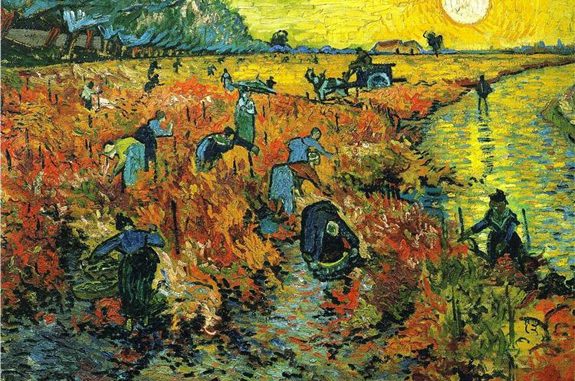
The Red Vineyard by Vincent Van Gogh, 1888

“For the kingdom of heaven is like a landowner who went out early in the morning to hire workers for his vineyard. He agreed to pay them a denarius for the day and sent them into his vineyard.

“About nine in the morning he went out and saw others standing in the marketplace doing nothing. He told them, ‘You also go and work in my vineyard, and I will pay you whatever is right.’ So, they went.

“He went out again about noon and about three in the afternoon and did the same thing. About five in the afternoon he went out and found still others standing around. He asked them, ‘Why have you been standing here all day long doing nothing?’

“‘Because no one has hired us,’ they answered.

“He said to them, ‘You also go and work in my vineyard.’

“When evening came, the owner of the vineyard said to his foreman, ‘Call the workers and pay them their wages, beginning with the last ones hired and going on to the first.’

“The workers who were hired about five in the afternoon came and each received a denarius. So, when those came who were hired first, they expected to receive more. But each one of them also received a denarius. When they received it, they began to grumble against the landowner. ‘These who were hired last worked only one hour,’ they said, ‘and you have made them equal to us who have borne the burden of the work and the heat of the day.’

“But he answered one of them, ‘I am not being unfair to you, friend. Didn’t you agree to work for a denarius? Take your pay and go. I want to give the one who was hired last the same as I gave you. Don’t I have the right to do what I want with my own money? Or are you envious because I am generous?’

“So, the last will be first, and the first will be last.” (NIV)

We as humans have an innate sense of right and wrong, justice and injustice. We want life to be fair. It disturbs us when there is favoritism, discrimination, and preferential treatment. When things seem askew and others seem more privileged, envy can creep in and settle in our bones.

The envy can go even deeper. For example, is it fair that any child should struggle with health issues like cancer, epilepsy, and mental disorders?  Is it fair to have healthcare disparities? Is it fair to have a spouse taken from you before their time?  Is it fair to lose your job because of a pandemic? Is it ever fair to be treated like a second-class citizen?

Pat answers to people’s genuine struggles will not do, such as “Well, you just need to work hard and hope for the best;” “We have to take what is given us and accept these things;” “Think of all those starving children in India;” or the more crass, “Suck it up buttercup; life was never meant to be a rose garden.”  Those statements simply do not help.

At the heart of envy is the belief that others are getting something that I deserve.

Plenty of jerks have healthy grandkids, grow old with their spouses, and retire in comfort with plenty of money. “It isn’t fair!” we cry.

God does not always operate according to our standards of fairness. God’s very nature is to be generous and full of grace. The parable which Jesus told about the vineyard workers is a story not of unfairness, but a story of generosity and grace. It is all in how you look at it.

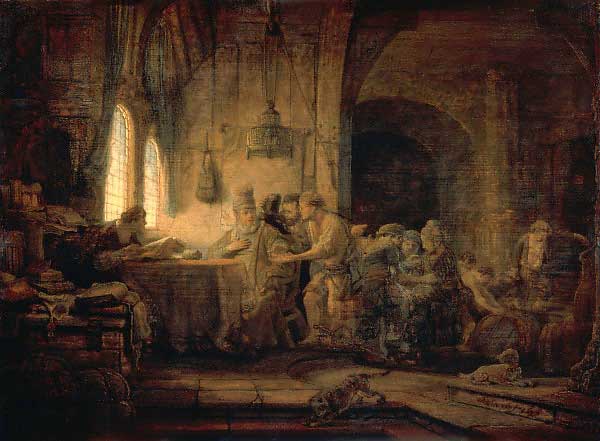
Parable of the Workers in the Vineyard by Rembrandt, 1637

A normal workday in the ancient world was ten hours, not counting breaks. The workday began at 6:00am. A denarius was a typical day’s wage for laborers. The landowner went out at the third hour, 9:00am; the sixth hour, noon, etc. He kept returning to hire more workers even up to the last hour of the workday. Laborers were always paid at the end of the day. In this parable, the last workers were paid first, which prompted the first workers hired to think they would be getting more, even though they had been promised a denarius. So, they grumbled about not getting more. They thought the landowner was not being fair.

Grumbling. Complaining. Murmuring. It is the bane of our existence. Decades ago, when gas station attendants still filled tanks for customers, I was working at a station and had a lady go berserk on me for not checking her oil and cleaning her windshield, because I did it for the car in front of her. Even though there was a sign right in front of her that said checking oil and cleaning windshields is only done upon request, the lady thought she was getting gypped. 

In truth, the landowner did not cheat or defraud the workers in any way. He paid the agreed upon wage, just like he promised. Should he want to pay everyone the same even though the amount of work was different was his own business. The problem was not with the owner, it was with the worker’s envy of the owner’s generosity toward the others. God distributes gifts because he is gracious, not because we have earned anything.

Our standard of fairness is not the rule of the kingdom of God – grace is.

The founder of Methodism, John Wesley, was physically thrown out of a church one Sunday because of a sermon he was preaching on the grace of God. Afterwards, when Wesley wrote about this to a friend, he said, “There is no Christian Doctrine more repugnant than the affirmation that we are saved by the grace of God through faith.”

Deep down many believe we control our destiny, and that we save ourselves by what we do. We discern that if we serve God all our lives, in the end, God will reward us. We believe that our pious activities, our acts of service and our work for the Lord, will bring us salvation, or, at least a leg up in the kingdom of God over others who have not worked as hard or as long as we have. After all, we do the right thing.

So, what about those who have not figured out Christianity… those who do not have the correct or proper beliefs… or those who have not straightened out their lives? According to a worldview of human fairness, they are out of luck. They should be in church. They should work harder, faster, and better. Then, they could get their lives in order. If they would only understand fairness, we reason, then all would be well.

Parable of the Vineyard Workers from unknown artist in the Middle Ages

But there is a problem, because the parable of the workers told by Jesus seems to be saying that is not how it works, at all.  Jesus seems to be saying that grace and grace alone saves, that God’s amazingly naive and irresponsible grace is available to anyone and everybody. And that troubles the workers to no end. 

Whenever we run headlong into God’s unfair grace and see that God’s way of doing things is so far removed from our way, there is bound to be grumbling.  After all, if God is going to run a vineyard like the one in the gospel lesson and give everybody the same pay regardless of their actual work hours, then what’s the use of getting up early in the morning to work? 

What is the good of sitting in church, listening to sermons from a crazy preacher who is no better than us, if these outsiders, these Johnny-and Jane-come-lately’s can waltz in at the last minute and receive the same treatment as the rest of us?  For many church folks who diligently serve, it is not fair to pay so much attention to outsiders and build ministry around people who aren’t even here, who don’t yet know Jesus.

The conclusion and point of the parable: The last will be first, and the first will be last. In Luke’s prodigal story, the elder brother grumbles and gripes: “All these years I’ve been slaving for you and never disobeyed your orders.  But when this son of yours who has squandered your property with prostitutes comes home, you kill the fatted calf!”  It is the firstborn son that complains. (Luke 15:11-32)

In both the parable of the prodigal son and the parable in today’s lesson, “good” people are the ones who fail to see the heart of the Father and of the landowner. The “firsts” got off track because, over time, they forgot the kingdom hinges on grace, not effort, on not simply doing the right things over a long period of time.

God controls the flow of mercy, not us. 

We will likely be surprised in heaven with those already sitting at God’s banquet table, and equally surprised with who is not there. Resentment can move us away from the table of mercy God is preparing. The problem comes whenever we think we are above other people.  We might be sinners, but we are not as bad as some other people are!  We commit ordinary sins, not mass murder!

Here is the unvarnished truth: God does not owe you or I a thing, and God cares about all kinds of people, not just us and people who think and live like we do. Our hearts need to be big enough to center ministry around other people who are different than us.

If our hearts are small, we easily get jealous when God pays attention to prodigals and profligates. Grace becomes too repugnant a doctrine for us.

The gospel of Jesus Christ is about grace. Life is not all about being decent. It is not all about morality, and it is certainly not about our own goodness. The gospel is about being steeped in and surrounded by the grace of God in Christ, so that we, in turn, can show others grace. Grace is the way God deals with us beyond what we deserve or feel we have earned. 

Grace is unfair; we get what we do not deserve. 

May we allow God’s grace to so permeate our hearts and lives so that we will give it to others as freely as we have received.Praise be to you, almighty and everlasting Father of our Lord Jesus Christ. In Christ, you have given us every spiritual blessing in heaven. In Christ, you chose us before the world was made. You chose us in love to be your holy people—people who could stand before you without any fault. And before the world was made, you decided to make us your own children through Jesus Christ. It pleased you to do it. And this brings praise from us because of your wonderful grace, given to us freely, in Christ, the one you love. We have forgiveness of sins because of this lavishly rich grace. Thank you, O my Father, for your grace extending to me in Christ! Amen

James 3:13-18 – Living Wisely

Geschftsmann muss sich bei einer Weg-Gabelung entscheiden

Who is wise and understanding among you? Let them show it by their good life, by deeds done in the humility that comes from wisdom. But if you harbor bitter envy and selfish ambition in your hearts, do not boast about it or deny the truth. Such “wisdom” does not come down from heaven but is earthly, unspiritual, demonic. For where you have envy and selfish ambition, there you find disorder and every evil practice. But the wisdom that comes from heaven is first pure; then peace-loving, considerate, submissive, full of mercy and good fruit, impartial and sincere. Peacemakers who sow in peace reap a harvest of righteousness. (NIV)

The great challenge of life for everyone is to respond to it rightly – to handle the people, situations, and responsibilities of life well.  We all need wisdom.  Wisdom is doing right and just things in the concrete actual situations of life.

Wisdom is much like driving a car.  There is a certain body of knowledge that you need to drive. Driving is much more than knowing the driving manual and passing the driving test.  The purpose of knowing the laws and how to drive a car is so that you can drive well on actual roads under all kinds of traffic and weather situations.  Driving wisely means you keep your eyes on the road and are mindful of all that is going on around you and even within you.  You do not fret about why there is a curve in the road or a stop sign in a certain location.  You do not try and figure out the mechanics of a stoplight, or the philosophy behind the engineering layout of the road system.  You just try to do what needs to be done on the road to get where you need to go by responding to the conditions as they come.  In Midwest America where I live, if you drive a car, you will face snow and ice conditions; you will have to respond to a deer in the road; you will have to deal with other drivers and practice wise defensive driving skills.  And you must come to grips with your own road rage when getting from point A to point B when it does not go as you think it should.

Wisdom in the Christian life includes and is more than knowledge. The Bible is not a three-ring binder that covers every single life situation that you can simply look up and follow the three steps.  Rather, Holy Scripture has a body of knowledge contained in differing kinds of literary genres to give us wise guidance for all of life.  Like driving a car, Christian wisdom involves being attentive and mindful of the people and circumstances around us as we move through life by responding with gracious practical knowledge to everything and everyone.  So, then, wisdom is the practical application of biblical truth to all of life.

Wise people possess two distinguishing marks: a good life, and a humble life. 

A wise person is the same inside and out, with integrity between the inner attitude and outward behavior.  The motive for being good springs from a disposition of meekness and gentleness.

The distinguishing mark of the unwise person is hidden agendas. 

The unwise are continually doing something, which on the surface seems altruistic and good, yet something else is driving them: bitter envy and selfish ambition. If we want to live the good life, it begins with identifying the envy that will sometimes arise within us and the selfish ambition that goes with it – then choose a path of true wisdom by embracing the good gifts and abilities of others and delight in them.  At the same time, we focus on our own gifts and abilities and are at peace with them, able to express them.  There is real beauty when this happens.

False wisdom (selfish pride) is earthly, unspiritual, and evil.  It relies on tactics of manipulation, power politics, parking lot conversations, and passive-aggressive behavior. Having good intentions but utilizing bad methods to get it is false wisdom.  Having an evil intention but cloaking it in good words is demonic. Our words and our behavior both need to be good.

The unwise person has a pathological progression occurring within them:

  1. Envy over not having something someone else has or losing something that was once possessed.
  2. Devious plans for dealing with it.
  3. Using pious language to cloak that plan in religious garb.
  4. Strife, division, and disharmony to get what they want.
  5. Unhealthy practices and habits of life which damage others.

The wise person, in contrast to the unwise, possesses seven characteristics which enables them to live well and enjoy a good life:

  1. Pure. There are no mixed motives with purity – no hidden agendas, no secret desires that are self-serving. It is a purification through repentance of the old unwise person and embrace of the new through the cross of Jesus.

“Create in me a pure heart, O God, and renew a steadfast spirit within me” (Psalm 51:10).  “Blessed are the pure in heart, for they shall see God” (Matthew 5:8).

  1. Peace-loving is more than the absence of conflict. Peace is to embrace harmony, to work well together, and to enjoy full relational experiences. Wise and godly people are healers, active in bringing unity and integration.

“Blessed are the peace-makers for they will be called children of God” (Matthew 5:9).  “Whoever of you loves life and desires to see many good days, keep your tongue from evil and your lips from speaking lies.  Turn from evil and do good; seek peace and pursue it” (Psalm 34:13-14).

  1. Considerate of others is to be flexible, open to reason, level-headed in anxious situations, gentle, non-combative, non-retaliatory, and generally understanding. It is the wisdom to make allowances for the weaknesses and shortcomings of others and takes the kindest possible perspective.

“Remind the people… to be ready to do whatever is good, to slander no one, to be peaceable and considerate, and always to be gentle toward everyone” (Titus 3:1-2).

  1. Submissive attitudes and actions are a choice. If a person is coerced into submission, that is slavery, not submission. To submit means to willingly place oneself under someone else’s authority. The submissive person is teachable and humbly receives correcting wisdom.

“Submit to one another out of reverence for Christ” (Ephesians 5:21).

  1. Merciful. Mercy is compassion in action. It is to empathize with the needs of others, and then do something about it.  There is always good fruit that results from mercy.

“Blessed are the merciful, for they will be shown mercy” (Matthew 5:7).

  1. Impartial people are without favoritism. It is to be the same person toward everyone. They are steady, consistent, and not swayed by the crowd; and, do not act one way with a certain group of people, and then act different with another group. Impartial people have a passion for justice and despise injustice, believing that all people’s needs must be met with equity.

“Do not pervert justice; do not show partiality to the poor or favoritism to the great but judge your neighbor fairly” (Leviticus 19:15). 

  1. Sincere hearts are without hypocrisy. The sincere person is the same both inside and out, having no ulterior motives and no skeletons in the closet.

“Now that you have purified yourselves by obeying the truth so that you have sincere love for you brothers, love one another deeply, from the heart” (1 Peter 5:22).

The telltale signs of false wisdom are envy and selfishness – resulting in disorder and all kinds of unhealthy practices.  Conversely, the signs of true heavenly wisdom are good deeds done from a devoted heart to God and a humble attitude – resulting in righteousness and peace. This, my friends, is the good life.

Heavenly Father take me to the place where I am saved from my pride and arrogance and where Christ’s humility is center stage, where I am lifting clean hands and a pure heart to you. Take me to the place where I am no longer looking at obstacles but looking down upon them, where I can see clearly, and my decisions are flooded with your divine light, truth, and justice. I bend my knee and receive your truth. I open my ears to receive your counsel. I open my heart to receive your godly wisdom through Jesus Christ in the power of the Holy Spirit. Amen.