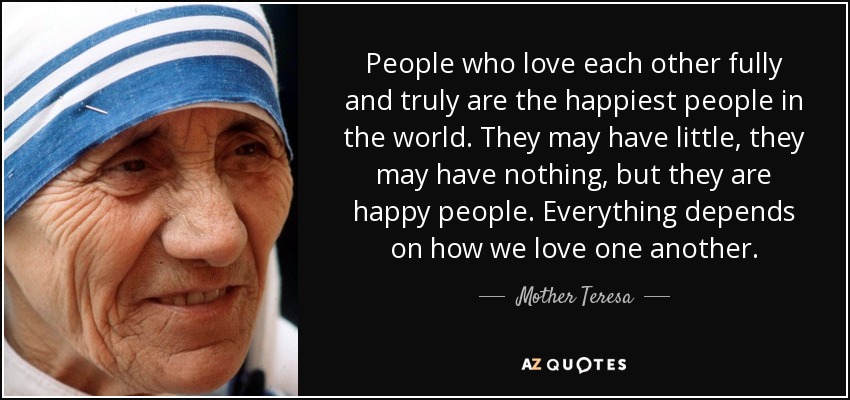
1 Peter 1:17-2:1 – Real Love Is…

Since you call on a Father who judges each person’s work impartially, live out your time as foreigners here in reverent fear. For you know that it was not with perishable things such as silver or gold that you were redeemed from the empty way of life handed down to you from your ancestors, but with the precious blood of Christ, a lamb without blemish or defect. He was chosen before the creation of the world but was revealed in these last times for your sake. Through him you believe in God, who raised him from the dead and glorified him, and so your faith and hope are in God.

Now that you have purified yourselves by obeying the truth so that you have sincere love for each other, love one another deeply, from the heart. For you have been born again, not of perishable seed, but of imperishable, through the living and enduring word of God. For,

“All people are like grass,
    and all their glory is like the flowers of the field;
the grass withers and the flowers fall,
    but the word of the Lord endures forever.”

And this is the word that was preached to you.

Therefore, rid yourselves of all malice and all deceit, hypocrisy, envy, and slander of every kind. (New International Version)

Love makes the world go round. The cycle of life brings an end to all things. Yet, the permanence of love has always existed, and will never cease to exist. (1 Corinthians 13:8-13)

Biblical godly love comes not because we first loved God, but because God first loved us and gave his Son, Jesus Christ, as an atoning sacrifice for our sins. (1 John 4:7-12)

So, the Christian’s faith and hope are completely grounded in the person and finished work of Jesus. People are so valuable to God that we were purchased from the slavery auction block with the costliest price ever: the precious blood of Jesus. 

To know this love of God in Christ, to be thoroughly captured and enraptured by it, results in a profound and deep love for others. And I’m not just referring to a nice touchy-feely love, but also a steadfast love which is committed to love regardless of what another person says or does.

Love is wonderful. But that doesn’t mean its easy. Being on the receiving end of love is a beautiful thing. Giving love, however, can sometimes get dicey.

You see, although we Christians really do believe that everything in life and ministry centers around the grace and love of God in Christ, our boots-on-the-ground loving sometimes seems compromised and conditional. That’s because it’s easy to love those who love us back. Yet, what if our love is not reciprocated or requited?

This situation brings us face-to-face with our own selves. The painful reality is that we all discover that our love is sometimes, maybe oftentimes, dependent on an assurance that we will be loved in return.

There is perhaps no more transcendent and glorious thing than mutual love. However, what happens when only one of the persons is able to give love? What do we do when grace is our only option, when we must choose to love, knowing that love won’t have a response?

Christians everywhere must come to the point of giving the same kind of love that God shows to us in Christ. We need to decide that grace is going to be our lifestyle. It comes down to this: It simply doesn’t matter what condition the other person is in. It doesn’t matter what another is going to say, or not say. Nothing on the other party’s side doesn’t matter. It…just… doesn’t… matter.

What really matters is our own loving another person deeply from the heart, regardless and in spite of everything else. That, my friends, is real Christian love.

“Love your enemies. Let them bring out the best in you, not the worst. When someone gives you a hard time, respond with the supple moves of prayer, for then you are working out of your true selves, your God-created selves. This is what God does. He gives his best—the sun to warm and the rain to nourish—to everyone, regardless: the good and bad, the nice and nasty. If all you do is love the lovable, do you expect a bonus? Anybody can do that. If you simply say hello to those who greet you, do you expect a medal? Any run-of-the-mill sinner does that.”

Jesus (Matthew 5:43-47, MSG)

Since we are redeemed people; since we have acknowledged the truth of Christ’s redemptive events of crucifixion and resurrection; since we are recipients of God’s great love to us in Jesus; we all must make the decision to live our lives full of grace and love, no matter what.  As God’s redeemed people, purchased by the precious blood of Christ, we will love one another unconditionally.

Unfortunately, over time, many Christians slowly become disconnected from this fountain of grace and love. It is likely that, at some past point, they were deeply touched by a gracious encounter with Jesus Christ. They found peace, love, and joy. Minds were swept up in the awe and wonder of God. Hearts were deeply moved for a few hours, days, or weeks. 

But then, there was a return to the routine grind of daily existence. Gradually, the demands of work and family took over. Jesus began to be treated like some old friend from another town whom we dearly loved in years past but have just lost track of. 

Of course, it was unintentional.  We simply allowed circumstances to drift us apart. We became preoccupied with something else. Now, we find ourselves with a low level irritation, frustrated with others and unable to love as we ought. We become what the late author Brennan Manning called “Christian agnostics” – people who do not deny Jesus, but just ignore him.

If your days are trivial and hectic…

If the clock determines what you do…

If you are numb to the news and headlines around you…

If you are all jangled and jittered by life’s circumstances…

If phones and computers and gadgets rule your day…

If there is little room for responding to humanity humanely…

If you have settled into a comfortable piety and a well-fed virtue…

If you have grown complacent and lead a practical life…

Then you need to be touched again by the grace and love of God in Christ by treating Jesus as if he were your very best friend as well as the awesome Son of God.

We are all still here walking on this earth because none of our failures and lack of faith have proved terminal.  We are here today because of God’s radical grace. 

The forgiveness of God is a gratuitous liberation from guilt and regret. It is an extreme amnesty. Through looking in the mirror, and seeing personal sinfulness, we amazingly end up encountering the merciful love of the redeeming God. 

The grace of God says to us, “Hush, child, I don’t need to know where you’ve been or what you’ve been up to; just let me love you.” 

When we have experienced that kind of love, we are then finally able to love one another deeply from the heart.  It is a new life of love, the kind of love that comes from God – an unconditional love that is permanent and will never go away – it is imperishable.

Therefore, as Christians loved by Christ and belonging to God:

  • We will not just show love when we are assured that we will be loved in return.
  • We will not just wait for others to show love to us first.
  • We will not expect to reach some higher level of knowledge or spirituality in order to be gracious and loving.
  • We will simply love with the love given to us by Jesus.
  • We will love with a gracious, sacrificial, vulnerable, and desperate kind of love. 

It is the kind of love that is like the waiting room in a hospital burn unit. Many years ago, I spent some time with a person in such a waiting room after her brother had been severely burned in a farm accident. In the waiting room we were all strangers. Yet, there was a loving vulnerability to our being together. I sat watching and waiting with anguished people, listening to their urgent questions: Will my husband make it? Will my child walk again even she survives? How do you live without your companion of thirty years? 

The burn unit waiting room is different from any other place in the world. And the people who wait are different. They can’t do enough for each other. No one is rude. The distinctions of race and class melt away. Each person pulls for everyone else. Vanity and pretense vanish. No one is embarrassed about crying or asking tough questions. In that moment their whole world is focused on the doctor’s next report. If only it will show improvement.

Everyone intuitively knows that loving someone else is what life is all about. 

By God’s amazing grace we will all learn to live like that without having to learn it the hard way in a place of intense anxiety and suffering.

Christ’s resurrection is not some flash-in-a-pan – it has staying power – it is real and permanent. Christ is the Christian’s hope of living a new life of gracious unconditional love. 

Jesus actually expects more failure from you than you expect from yourself. And he gives grace. So, all of our failures to love as we ought can be laid before Jesus because there is grace that covers it all – a deep love that forgives, redeems, and makes new.

Hallelujah. Thank you, Jesus.

Romans 12:17-21, 13:8-10 – Let Love Be Your Only Debt

Don’t mistreat someone who has mistreated you. But try to earn the respect of others and do your best to live at peace with everyone.

Dear friends, don’t try to get even. Let God take revenge. In the Scriptures the Lord says,

“I am the one to take revenge
    and pay them back.”

The Scriptures also say,

“If your enemies are hungry,
    give them something to eat.
And if they are thirsty,
give them something
    to drink.
This will be the same
as piling burning coals
    on their heads.”

Don’t let evil defeat you but defeat evil with good….

Let love be your only debt! If you love others, you have done all that the Law demands. In the Law there are many commands, such as, “Be faithful in marriage. Do not murder. Do not steal. Do not want what belongs to others.” But all of these are summed up in the command that says, “Love others as much as you love yourself.” No one who loves others will harm them. So, love is all that the Law demands. (Contemporary English Version)

Not everybody is likable. We all have others that drive us crazy on the inside with their annoying habits or ungodly ways of life. 

Sometimes we might experience much more than being irritated. Raging vitriol that results in verbal persecution; becoming the targets of evil intent; and, in some cases, finding ourselves victims of violence done to us or a loved one can stretch our Christian sensibilities to their maximum. It is understandable that in such cases we would be upset, angry, in grief, and desire justice.

As we reflect back on Reformation Day and the great truth that we are justified apart from any work of our own but by grace alone through faith, this helps to give understanding as to why we do not take vengeance into our own hands. 

We are clearly exhorted in today’s New Testament lesson to repay no one evil for evil because vengeance belongs to God alone, not us. 

If justification is a work of God to rescue and redeem sinners from their plight, then wrath is also a work of God. Just as justification is initiated and made possible through Christ by faith, so vengeance belongs to God, as well. Our part in the whole affair is to trust God to take care of judging the world. Judgment is way above our pay grade.

Our responsibility is showing love, even to those whom we consider enemies. If we are to love our neighbors as ourselves, then we will leave plenty of room for God to do what God does best: either show mercy to sinners or execute judgment upon them. It’s all God’s business what happens with humanity. Our business is coming under the lordship of Christ and allowing God’s new creation to work itself out through us. 

We are to work for the kind of justice that provides others with what they need, not what they deserve. The world cannot become a better place if we keep insisting on playing judge, jury, and executioner. Sometimes the best way to show love is to sincerely pray for the person for whom we have such difficulty loving. 

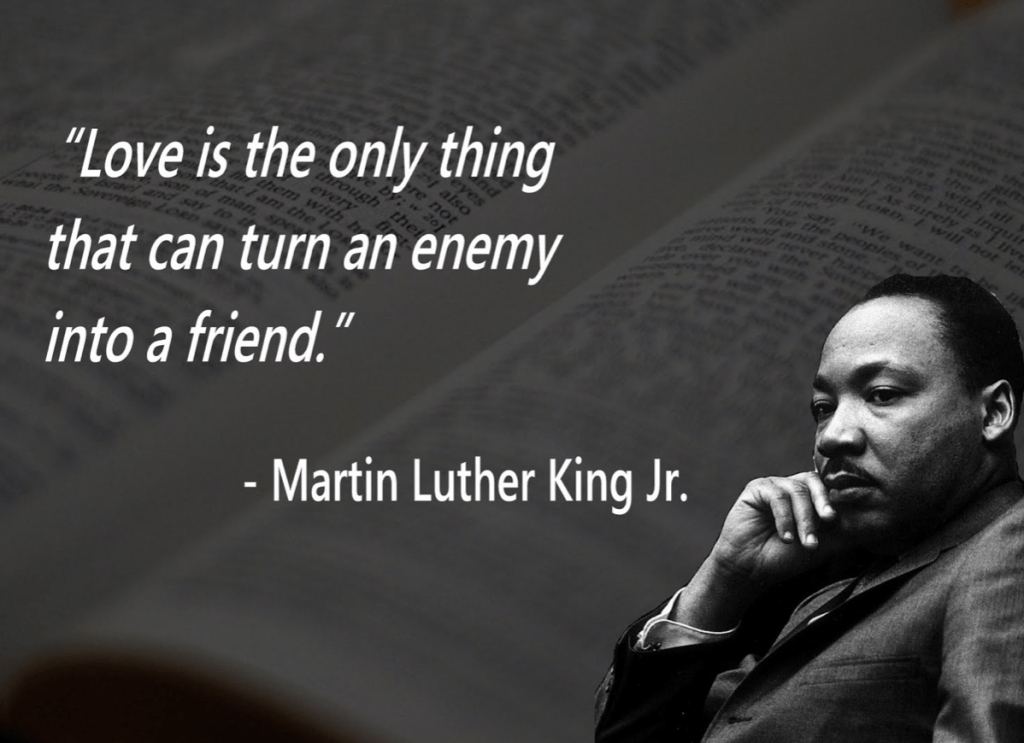
Who do you need to love today? Here is an excerpt from a sermon by Dr. Martin Luther King Jr., delivered at the Dexter Avenue Baptist Church, Montgomery, Alabama, on November 17, 1957:

“Love has within it a redemptive power. And there is a power there that eventually transforms individuals. That’s why Jesus says, ‘Love your enemies.’ Because if you hate your enemies, you have no way to redeem and to transform your enemies. But if you love your enemies, you will discover that at the very root of love is the power of redemption. You just keep loving people and keep loving them, even though they’re mistreating you.

Here’s the person who is a neighbor, and this person is doing something wrong to you and all of that. Just keep being friendly to that person. Keep loving them. Don’t do anything to embarrass them. Just keep loving them, and they can’t stand it too long. Oh, they react in many ways in the beginning. They react with bitterness because they’re mad because you love them like that. They react with guilt feelings, and sometimes they’ll hate you a little more at that transition period, but just keep loving them.

And by the power of your love, they will break down under the load. That’s love, you see. It is redemptive, and this is why Jesus says love. There’s something about love that builds up and is creative. There is something about hate that tears down and is destructive. So, love your enemies.”

Just and merciful God, you are the rightful Judge of all the earth. Help me to trust in you so that I can give room for you to do whatever you want to do in others’ lives. I pray you will grace many people with the repentance that leads to new life in Jesus. Amen.

1 John 2:18-25 – Who Is Really the Enemy?

Ethiopian Orthodox Church depiction of St. John the Apostle and Evangelist, c.1540 C.E.

My dear children, the end is near! You have heard that the enemy of Christ is coming. And now many enemies of Christ are already here. So, we know that the end is near. These enemies were in our group, but they left us. They did not really belong with us. If they were really part of our group, they would have stayed with us. But they left. This shows that none of them really belonged with us.

You have the gift that the Holy One gave you. So, you all know the truth. Do you think I am writing this letter because you don’t know the truth? No, I am writing because you do know the truth. And you know that no lie comes from the truth.

So, who is the liar? It is the one who says Jesus is not the Messiah. Whoever says that is the enemy of Christ—the one who does not believe in the Father or in his Son. Whoever does not believe in the Son does not have the Father, but whoever accepts the Son has the Father too.

Be sure that you continue to follow the teaching you heard from the beginning. If you do that, you will always be in the Son and in the Father. And this is what the Son promised us—eternal life. (ERV)

Throughout Christian history there have been churches, ministers, and individuals who have advanced certain persons as being the “antichrist,” enemies of Christ and his followers.

Attempting to identify a particular enemy comes from a theological disposition that believes an antichrist is the first link in a chain of end-times events. Typically, a ruthless or dictatorial ruler, like Mussolini, Hitler, or Stalin received the label of “antichrist.”  For some Protestants, the papacy continually gets set apart as being the antichrist. Even recently, Pope Francis received the dubious title from a group of end-times watchers because they claimed he allowed people to treat him as if he were Jesus, accepting worship and praise.

Yet, the term “antichrist” has not typically been used as a title for one enemy setting-off a bomb of world-ending trauma. The earliest church, following the teaching of the Apostle John, understood antichrist not as an individual, but as a class of people who deny Jesus is the Christ. Indeed, John plainly said the antichrist is anyone who forsakes the Father and the Son. What is so disturbing about John’s talk of antichrist is that these persons arise from within the church, not outside of it.

It has become much too vogue in some circles of Christian evangelicalism to identify and label enemies outside their small groups, leading to a xenophobic attitude of distrust and finger-pointing toward all kinds of people. 

The fingers, however, must first be directed within our own house. It behooves us all to take up the instruction of John to let what we have heard from the beginning abide in us. If what you heard from the beginning abides in you, then you too will abide in the Son and in the Father. 

We are to embrace basic core cardinal truth given us. Then we will not be deceived by some supposed enlightened teacher who detracts from Trinitarian theology.

It is the last hour – but not because of some politician, tyrant, or even religious figure. It is the end-times because Jesus has accomplished redemption for us, and the only event left is the return of Jesus to judge the living and the dead. 

Therefore, we must all live with the possibility and tension that it could be today. We are to be prepared. That preparation comes through proclaiming Jesus in all we say and do – not by obnoxiously ginning up fearmongering through pointing fingers at those we don’t like. Rather, we emulate our Lord in the way of loving God and neighbor.

When a person or group gets labeled by us as “enemy” or “antichrist” then our hate for them seems divinely justified and sanctioned. God, however, is the judge; not us. We are to follow the ethical instruction of Jesus to love our enemies, not curse them through slapping a moniker of “monster,” “devil,” “animal,” or some other non-human label on them.

Weaponizing words in a verbal war which supposedly defends Christianity only shifts the focus off Jesus and onto how horrible another is. One of the great problems of our world, including many corners of Christianity, is that we assume we already know what another believes. So, we fail to listen. We cannot care as we ought because we’ve already formed our judgment.

“The moment someone attaches you to a philosophy or a movement, then they assign all the baggage and all the rest of the philosophy that goes with it to you. And when you want to have a conversation, they will assert that they already know everything important there is to know about you because of that association. And that’s not the way to have a conversation.”

Neil deGrasse Tyson

Within Christianity, there is much more we have in common with one another across the various traditions than that which is different. Yes, spiritual charlatans exist. Let’s just make sure we have done our due diligence in listening to another and being curious before we form our opinions.

Despite our differences, the exchange of ideas and debate among various Christian groups in the early centuries of the church helped to clarify and form a sound Christology. While it may be difficult to avoid labeling individuals in an increasingly complex society, we must act in good faith.

Mighty God, you sent the Son to this earth to fulfill all your good promises. Let me embrace Jesus so fully and completely that the truth of his reality comes pouring out of me in every area of my life.  In his name I pray. Amen.

Luke 6:27-31 – Love Your Enemies

“But to you who are listening I say: Love your enemies, do good to those who hate you, bless those who curse you, pray for those who mistreat you. If someone slaps you on one cheek, turn to them the other also. If someone takes your coat, do not withhold your shirt from them. Give to everyone who asks you, and if anyone takes what belongs to you, do not demand it back. Do to others as you would have them do to you.” NIV)

“Maturity is looking at every person we meet and saying to yourself, ‘I will never, God helping me, do anything to harm you: not by angrily lashing out at you, lusting over you, faithlessly slipping away from you, verbally hitting back at you, or even justifiably disliking you.’”

–Frederick Dale Bruner

Here are a few rhetorical questions, considering the astounding words from Jesus to love enemies: Have you ever had someone not like you?  Offend you? Purposely say or do things that upset you? I once had a next-door neighbor who was plain mean. Once, when my dog accidentally strayed into her yard and left a package, she picked it up and placed the package directly in front of my backdoor. 

When such things happen, it is tempting to respond in kind with the same behavior as the obnoxious person.  Many of us have sly passive aggressive tendencies of getting back at others when they do or say offensive things, and we consider them an enemy.

The situation with my neighbor was frustrating, yet quite benign. It is an entirely different matter trying to love someone who has deeply hurt us. Their words of malice or actions of abuse are evil, and we naturally seek to defend and respond by hurting them back. This is no trite saying of Jesus to proclaim that we are to love the enemy. It will be hard to love a villain apart from the grace of God, and Jesus knew what he was asking of us.  He does not ask of us anything that he himself has not already done.

We are often pleased with ourselves if we love our family and friends, because even that is a struggle for us, at times. We need to treat all people with respect and kindness, even active love, because that is what God does.

Jesus did not say anything new in calling for neighbor love. The Old Testament clearly says to do so: 

You must not take revenge nor hold a grudge against any of your people; instead, you must love your neighbor as yourself; I am the Lord. (Leviticus 19:18, CEB)

Nowhere in the Old Testament does it say to hate your enemy. However, over time, the idea became popular that if we are told to love our neighbor, then we must hate our enemy (who is not our neighbor). Jesus was once asked, “Who is my neighbor?” He responded by telling the parable of the Good Samaritan. The conclusion to that parable is that everyone I encounter is my neighbor, and so must be shown mercy when they are in need. (Luke 10:25-37)

Jesus let us know that when we walk in the way of love, we will sometimes be treated harshly by the world (Matthew 5:10-12).  When that happens, Christ says we must not exact revenge or retaliate. Even more, we are to respond with overt gestures of love, rather than simply ignoring them.

We are to pray for our enemies. It is hard to hate someone or a group of people when we are devoted to praying for them. Pray the Spirit would open their eyes so they can see the error of their way. Make sure to leave the judgment to God, for that is divine business, not ours.

We are to love because God loves. To love those who offend us emulates God’s benevolence. When we love our enemies, without expecting anything in return, we imitate God’s character as children of God:

Watch what God does, and then you do it, like children who learn proper behavior from their parents. Mostly what God does is love you. Keep company with him and learn a life of love. Observe how Christ loved us. His love was not cautious but extravagant. He did not love to get something from us but to give everything of himself to us. Love like that. (Ephesians 5:1-2, MSG)

If we have no love for our enemies, then we are no different from them. Christians are to be distinctive because of the way they treat others, especially outside the faith. We are to model our lives after God’s love, not by the standard of niceness to those who are nice to us. God does not expect us to live as followers of Jesus by only showing reciprocity, that is, just giving back to those who already have given something to us. Instead, we give even when we are persecuted. We do this because God shows no distinction in the distribution of sunshine and rain. Showing basic respect and goodness to all people, no matter who they are, can be God’s rain and sun toward others.

“To return evil for good is devilish. To return good for good is human. To return good for evil is divine. To love as God loves is moral perfection.” Alfred Plummer

Grace, undeserved kindness, is not something we can just conjure up, as if we might will ourselves to love our enemies. It is not natural – it is supernatural, and so must come from a supernatural Being. 

During World War II, a Lutheran pastor, imprisoned in a German concentration camp, was tortured by an S.S. officer who wanted to force him to a confession.  The pastor did not respond to the torture.  His silence only enraged the officer to such a degree that he hit the pastor harder and harder until he finally exploded and shouted at him, “don’t you know that I can kill you!?”  The pastor looked him the eye and said, “Yes, I know – do what you want – but I have already died.”  At that point, the officer lost power over the pastor.  All of the officer’s cruelty had been based on the idea that the pastor would hold onto his life as his most valuable property and would be willing to give a confession in exchange for his life.  But with the grounds for his violence gone, torture had become a ridiculous and futile activity.

Our human relationships may easily become subject to verbal violence, bitterness, and destruction, when we make enemies of each other and treat people as properties to be defended or conquered instead of precious gifts to be received. If we have nothing to defend, then we have no enemies who can harm us.

Jesus, Prince of Peace,
you have asked us to love our enemies 
and pray for those who persecute us.
We pray for our enemies and those who oppose us.

With the help of the Holy Spirit, 
may all people learn to work together 
for the justice which brings true and lasting peace.
Holy Spirit of God, we ask you for the strength and the grace to love those who harm us, that we may shine as beacons of Christian light in a world of revenge, retaliation, and darkness.

We pray for those who have hurt us.
Bless them always and in every way, Lord.

We pray for those who hate us.
Bless them always and in every way, Lord.

We pray for those who insult us.
Bless them always and in every way, Lord.

We pray for those who have stolen from us.
Bless them always and in every way, Lord.

We pray for those who will not hear us.
Bless them always and in every way, Lord.

We pray for those who have hurt our church.
Bless them always and in every way, Lord.  Amen.