Remember… (1 Thessalonians 2:9-13)

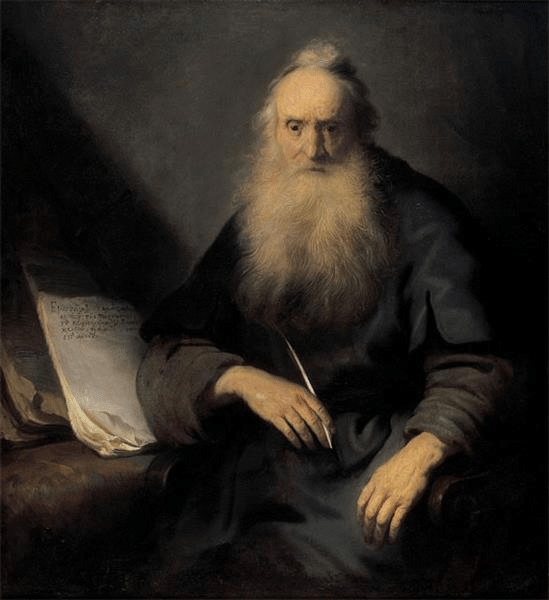
St. Paul writing to the Thessalonians, by Jan Lievens, c.1629

Surely you remember, brothers and sisters, our toil and hardship; we worked night and day in order not to be a burden to anyone while we preached the gospel of God to you. You are witnesses, and so is God, of how holy, righteous and blameless we were among you who believed. For you know that we dealt with each of you as a father deals with his own children, encouraging, comforting and urging you to live lives worthy of God, who calls you into his kingdom and glory.

And we also thank God continually because, when you received the word of God, which you heard from us, you accepted it not as a human word, but as it actually is, the word of God, which is indeed at work in you who believe. (New International Version)

The Christian believers in Thessalonica were becoming discouraged. The church sincerely believed that Jesus was coming soon… any day he could show up!

But as time went on, and Jesus was still nowhere to be seen…

the Thessalonians began losing their spiritual resolve…

started wondering if they had missed out on something…

began doubting if it was all real…

started slipping spiritually.

Missed expectations can be difficult to deal with. Maybe we have been praying for someone or something for so long that we wonder if it will really happen; or secretly question if something is wrong with us. Yet, maybe God simply wants us to wait… to be patient and to persevere… maybe the answer is closer than we think.

Since the church was becoming discouraged, the Apostle Paul reminisced with them. He wanted them to remember and not forget about what God had done in their lives. The Thessalonians desperately needed a faith for the long haul.

Remembering is a prominent theme in Scripture. Well over a hundred times we are told to remember:

  • God’s covenant and actions on behalf of people
  • Those less fortunate than us
  • Important people in our lives who influenced us in our journey of faith

In order to steel the church for a faith that lasts a lifetime, Paul reminded them of his own example, his own character, his ministry among them, and how they initially came to faith.

Paul was trying to inspire the believers with his own model of faithfulness, so that they would persevere in their Christian lives and not give up. He reminded them of his hard work in order to preach the gospel to them. The picture that Paul painted for them is having done whatever it took to make the good news of Jesus Christ known to the Thessalonians. 

Who were the people in your life that went out of their way to communicate the gospel to you both with words and with actions? 

Who were those persons who labored behind the scenes in prayer so that you and others would know Jesus? 

If any of those persons are still around, and you know where they are, remember them. Drop them a note. Express to them a simple thank you for their influence in your life. In doing so, you will not only encourage that person, but it will help you remember and re-engage with something in your life that you may have forgotten or taken for granted.

Paul was not shy about reminding the Thessalonians concerning the way in which he interacted with them. He did this not because he was trying to illicit some praise for himself, but because he wanted the church to emulate his character. 

That particular character is described as holy, righteous, and blameless. And we are to emulate Paul in these character qualities. These three words refer to the full range of relationships we encounter on a daily basis: with God, the church, and the community. 

Holiness in our relationship with God means that we have been set apart completely in Christ, so that we say and do nothing impure. 

Righteousness in our interactions with fellow believers in Jesus means we are in right relationship with them, so that there is nothing that hinders or stands between us. 

Blamelessness in our relations with the world means that the ways we live and work among outsiders are ethical and consistent with being a Christian.

Paul described his ministry as one of encouraging, comforting, and urging the believers to live lives worthy of God. He expected the Thessalonians to live into their callings as believers in Jesus. 

Encouragement refers to the ministry of coming alongside others and telling them what they need to do both in teaching and by example. Comfort refers to consoling others with the gospel. The word “urge” in the NIV is the word for “witnessing” which is a reference to the reality that Paul was constantly living his life in such a way that proclaimed Jesus to others.

The Thessalonians had received the Word of God; and this was an occasion to thank God for it. Each time we recall and remember what God has done for us through others and through God’s Word, we need to offer thanks. God’s Word is implanted within us, then takes root, grows, and produces a harvest of righteousness for those who have been disciplined by it.

We must remember those who brought us the Word of God; and to remember how they treated us, and what they did for us. Then, we must be obedient to what we learn. 

There are several needs we have as followers of Christ: 

  • intimate relationships in the church
  • to be mentored, and mentor others, in the faith
  • the power of God’s Word
  • our callings as Christians 

We forget these needs too easily – which is why repetition is a good thing. For example, each time we celebrate a baptism, it causes us to remember our own baptisms, and to live into our callings as Christians. Or when we move through the worship liturgy, we remember our sinfulness, God’s forgiveness, and our responsibility to live according to God’s Word. 

Our lives, our work, and our worship might seem plain and ordinary. However, the majority of life is lived in the mundane. The tangible reminders we can put in front of us are important, so that we never forget the spiritual experiences God has given us. (i.e. Deuteronomy 27:2-3)

We are meant to live our Christian lives in a vital connection with Christ and other believers. We will continue to persevere and thrive in the faith, when we remember those who have gone before us, and allow those here in the present to journey with us along this road of faith.

Blessed God, continue the good work begun in me; that increasing daily in wholeness and strength, I may rejoice in your goodness; and so order my life always to think and do that which pleases you, through Jesus Christ our Redeemer. Amen.

Good vs. Evil (2 Thessalonians 2:7-12)

For the mystery of lawlessness is already at work, but only until the one who now restrains it is removed. And then the lawless one will be revealed, whom the Lord Jesus will destroy with the breath of his mouth, annihilating him by the manifestation of his coming. The coming of the lawless one is apparent in the working of Satan, who uses all power, signs, lying wonders, and every kind of wicked deception for those who are perishing because they refused to love the truth and so be saved. For this reason God sends them a powerful delusion, leading them to believe what is false, so that all who have not believed the truth but took pleasure in unrighteousness will be condemned. (New Revised Standard Version)

There are two opposing forces which are operating in this world. One is the power of evil, manifested through lawlessness, selfishness, and wickedness. The other power is good, and it is seen wherever there is a concern for the common good of all people. Labors of love for all humanity and right relations with everyone are a demonstration of the peaceable fruit of righteousness existing in the world.

To put it succinctly, a spirit of merciful grace and a spirit of careless judgment both exist throughout the world.

Hate what is evil; cling to what is good.

The Apostle Paul (Romans 12:9, NIV)

The Apostle Paul wrote his letter to the church in Thessalonica because the believers there were confused. Somebody had told them that the end of the age already happened. Paul sought to set the record straight, that we are still anticipating the return of the Lord and the final judgment of all things.

The great Day of the Lord will not come until the faithless one, the person of lawlessness, the son of destruction, is revealed. Such a person opposes God and has the force of evil behind them. So, who is this person?

The person is not a single individual. Paul was helping the Thessalonian believers understand the actual situation by wrapping the abstract concept of evil into human form, so that they could visualize its reality and sinister nature. In truth, there will be lots of individual humans who manifest themselves through evil intent and actions, until the Lord’s return.

Grace is the operative power which restrains all the evil. A lot of people have questions about God and evil. Why is there so much evil? How come God doesn’t snuff it all out? Is the Lord not able to do anything? What’s going on?

Those are honest questions. And they come from a place of limited human perspective. Let’s turn this on it’s head. It’s not that God is impotent or isn’t doing anything about evil. Think of it this way: When you scoop up a bunch of sand in your hands, there are a lot of sand grains which fall to the ground. If the sand is evil, and the hands are God’s, the reality of the situation is that the Lord has most of the evil kept at bay.

In other words, if God were not involved in this world, at all, we would be living in a real dystopian society – people staying up at night to guard their homes with guns, and anxious folks attacking each other with impunity. As bad as some things are, it could be infinitely worse than it is.

The grace of God is active in restraining evil and providing believers with what they need to not only survive, but also to thrive in this world.

His divine power has given us everything needed for life and godliness, through the knowledge of him who called us by his own glory and excellence. Thus he has given us, through these things, his precious and very great promises, so that through them you may escape from the corruption that is in the world because of lust and may become participants of the divine nature. (2 Peter 1:3-4, NRSV)

A reversal occurs because of God’s grace. The wickedness which exists, especially within the human heart, is dealt with and transformed into a force for good in the world.

Once we, too, were foolish and disobedient. We were misled and became slaves to many lusts and pleasures. Our lives were full of evil and envy, and we hated each other. But—when God our Savior revealed his kindness and love, he saved us, not because of the righteous things we had done, but because of his mercy. (Titus 3:3-5, NLT)

Grace is wonderful for those who believe. However, for those who are faithless, grace is inoperative – simply because the wicked consider virtues like mercy and grace as weak and useless; they have no intention of either giving or receiving such drivel.

From a certain angle, it may seem that God is harsh. The Lord hardens hearts, sends powerful delusions, and entertains mysteries which some people will never discover. Yet, from another point of view, these are all necessary divine tools in dealing with unjust humanity and their systems of oppression.

Justice and righteousness are championed by God, and therefore, injustice and unrighteousness will not be put up with by the Lord. And that is a good thing. Love not only gives, but it also protects and withholds. Evil will be dealt with according to God’s good grace and in God’s good time – and not according to a limited human perspective or any person’s impatience.

The time is short, and the time is near; everything shall not continue, as it presently is, forever. This is why the author of Hebrews exhorted people to pay attention to “Today” with a capital “T.” Today won’t be here tomorrow. Tomorrow is the Day of the Lord. So, while it’s Today, we must be responsive.

My friends, watch out! Don’t let evil thoughts or doubts make any of you turn from the living God. You must encourage one another each day. And you must keep on while there is still a time that can be called “Today.” If you don’t, then sin may fool some of you and make you stubborn. (Hebrews 3:12-13, CEV)

We must encourage each other with continued faith and patience until the end of the age. We can do this. We are all in this life together, so let us keep on holding up one another and carrying each other’s burdens. In so doing, we will not be lawless, but fulfill the Law of Christ. (Galatians 6:2)

Keep on being brave! It will bring you great rewards. Learn to be patient, so you will please God and be given what he has promised. As the Scriptures say,

“God is coming soon!
    It won’t be very long.
The people God accepts
will live because
    of their faith.
But he isn’t pleased
with anyone
    who turns back.”

We are not like those people who turn back and get destroyed. We will keep on having faith until we are saved. (Hebrews 10:35-39, CEV)

May it be so, to the glory of God. Amen.

Some Needed Encouragement (Revelation 15:1-4)

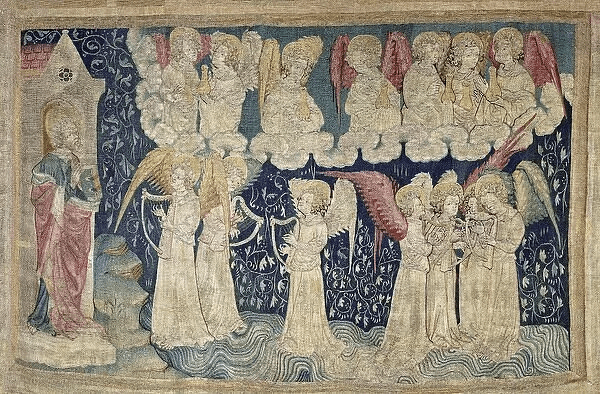
The Seven Last Plagues and the Harps of God, by Nicolas Bataille, c.1380 C.E.

I saw in heaven another great and marvelous sign: seven angels with the seven last plagues—last, because with them God’s wrath is completed. And I saw what looked like a sea of glass glowing with fire and, standing beside the sea, those who had been victorious over the beast and its image and over the number of its name. They held harps given them by God and sang the song of God’s servant Moses and of the Lamb:

“Great and marvelous are your deeds,
    Lord God Almighty.
Just and true are your ways,
    King of the nations.
Who will not fear you, Lord,
    and bring glory to your name?
For you alone are holy.
All nations will come
    and worship before you,
for your righteous acts have been revealed.” (New International Version)

Let’s keep in mind that the book of Revelation (also known as The Apocalypse of John) is a vision of the Apostle John about how things shake out in the end. The purpose of the vision is not for us to get lost in esoteric speculations about the future and try to figure out specific dates and times of God’s judgment.

Rather, John’s Revelation was primarily meant to give believers a future hope that their hardships and suffering will not last forever; there is a time coming, soon, when Judge Jesus will make all things right and all things new. In other words, the vision of John was designed to provide needed encouragement to followers of Jesus.

The believers needed a connection to their spiritual heritage – a way to see that they weren’t an isolated faith island in the middle of the world’s crud. The heavenly beings were singing a song of Moses and of the Lamb (Jesus). The two are connected, thus bringing together the saints of ages past with the struggling Christians of the present.

The song of Moses is a song of triumph, sung after the Israelites passed through the Red Sea unharmed and the Egyptian army was eradicated:

“I will sing to the Lord,
    for he is highly exalted.
Both horse and driver
    he has hurled into the sea.

“The Lord is my strength and my defense;
    he has become my salvation.
He is my God, and I will praise him,
    my father’s God, and I will exalt him.
The Lord is a warrior;
    the Lord is his name.
Pharaoh’s chariots and his army
    he has hurled into the sea.
The best of Pharaoh’s officers
    are drowned in the Red Sea.
The deep waters have covered them;
    they sank to the depths like a stone.
Your right hand, Lord,
    was majestic in power.
Your right hand, Lord,
    shattered the enemy.

Flee From Egypt, by Rev. Albert Lee Wagner, 1975

“In the greatness of your majesty
    you threw down those who opposed you.
You unleashed your burning anger;
    it consumed them like stubble.
By the blast of your nostrils
    the waters piled up.
The surging waters stood up like a wall;
    the deep waters congealed in the heart of the sea.
The enemy boasted,
    ‘I will pursue, I will overtake them.
I will divide the spoils;
    I will gorge myself on them.
I will draw my sword
    and my hand will destroy them.’
But you blew with your breath,
    and the sea covered them.
They sank like lead
    in the mighty waters.
Who among the gods
    is like you, Lord?
Who is like you—
    majestic in holiness,
awesome in glory,
    working wonders?

“You stretch out your right hand,
    and the earth swallows your enemies.
In your unfailing love you will lead
    the people you have redeemed.
In your strength you will guide them
    to your holy dwelling.
The nations will hear and tremble;
    anguish will grip the people of Philistia.
The chiefs of Edom will be terrified,
    the leaders of Moab will be seized with trembling,
the people of Canaan will melt away;
    terror and dread will fall on them.
By the power of your arm
    they will be as still as a stone—
until your people pass by, Lord,
    until the people you bought pass by.
You will bring them in and plant them
    on the mountain of your inheritance—
the place, Lord, you made for your dwelling,
    the sanctuary, Lord, your hands established.

“The Lord reigns
    for ever and ever.” (Exodus 15:1-18, NIV)

Throughout the millennia, this deliverance from harsh slavery to freedom is annually recalled and remembered in the Passover. The original Passover in Egypt involved a lamb being slain and it’s blood applied to the doorposts of each Jewish home. The avenging angel “passed over” those homes and instead dealt with the Egyptian houses which had no lamb’s blood over the door.

The song of Moses and the song of the Lamb (Jesus) are really the same song. Both the deliverance out of Egypt and through the Red Sea, as well as the deliverance from guilt and shame through the cross and resurrection, was real salvation from all that oppressed and hindered the people from living into their true selves.

This connection to salvation history was a great boon to the early believers undergoing their own brand of injustice, oppression, and persecution – just for being followers of Jesus.

So, we all need to apply the death of the Lamb to our present situations, so that we can endure through hardship and not give up and experience a failure of faith. We continually need a strengthening of faith, to recall and remember who we are and to whom we belong, so that we will sing our own song of hope and deliverance.

“Awake and Sing the Song,” by English hymnist William Hammond (1719-1783)

Awake, and sing the song
Of Moses and the Lamb;
Tune every heart and every tongue
To praise the Savior’s name.

Sing of His dying love;
Sing of His rising power;
Sing how He intercedes above
For those whose sins He bore.

Tell, in seraphic strains,
What He has done for you;
How He has taken off your chains
And formed your hearts anew.

His faithfulness proclaim
While life to you is given:
Join hands and hearts to praise His name
Till we all meet in heaven.

Amen.

Learn the Lesson of Christ’s Coming (Matthew 24:23-35)

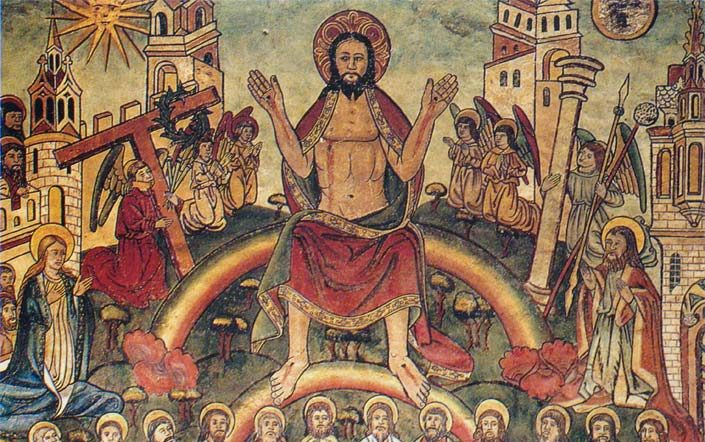
“He ascended to heaven and is seated at the right hand of God the Father almighty. From there he will come to judge the living and the dead.” Apostles’ Creed

Then if anyone says to you, ‘Look! Here is the Messiah!’ or ‘There he is!’—do not believe it. For false messiahs and false prophets will appear and produce great signs and wonders, to lead astray, if possible, even the elect. Take note, I have told you beforehand. So, if they say to you, ‘Look! He is in the wilderness,’ do not go out. If they say, ‘Look! He is in the inner rooms,’ do not believe it. For as the lightning comes from the east and flashes as far as the west, so will be the coming of the Son of Man. Wherever the corpse is, there the eagles will gather.

“Immediately after the suffering of those days

the sun will be darkened,
    and the moon will not give its light;
the stars will fall from heaven,
    and the powers of heaven will be shaken.

“Then the sign of the Son of Man will appear in heaven, and then all the tribes of the earth will mourn, and they will see ‘the Son of Man coming on the clouds of heaven’ with power and great glory. And he will send out his angels with a loud trumpet call, and they will gather his elect from the four winds, from one end of heaven to the other.

“From the fig tree learn its lesson: as soon as its branch becomes tender and puts forth its leaves, you know that summer is near. So also, when you see all these things, you know that he is near, at the very gates. Truly I tell you, this generation will not pass away until all these things have taken place. Heaven and earth will pass away, but my words will not pass away. (New Revised Standard Version)

I live in the upper Midwest of the United States. The summers can be brutally hot and humid. The winters can be incredibly frigid and full of snow. Having worked with college students for many years, every Fall there’s always at least one international student, or a student from the South, that has never experienced a Midwest winter and snow. 

I can tell them over and over again that they need a sturdy winter coat before the snow flies. But, having never known sub-zero and sub-freezing temperatures, it’s difficult to imagine such cold when the weather is currently warm. I, or someone else, usually have to help them get a suitable coat. And even then, they shake all winter and never take their scarves off.

It might be difficult to imagine that someday Jesus is coming back to judge the living and the dead. Having never been through an apocalypse, it’s hard to imagine that everything will change.

That’s why Jesus told his disciples to learn a lesson from the fig tree (fig trees were abundant in ancient Palestine). When you see the tree beginning to change, know that something is about to happen. The tree will become altogether different than how you see it now. 

Sometimes, even for myself who has lived through so many hard winters, it is incredible to know that the weather and landscape as it is right now will be completely different in January and February.

The trees, the grass, the mountains, the valleys, the waterways, the oceans, the sky, and the earth won’t last forever – as it now exists. Yet, the words of Jesus Christ will endure for all time. 

Whenever circumstances are a particular way for so long, of course it’s hard to believe that seeing everything as it is right now is not how it is going to be forever. However, know that a time is coming when it will all cataclysmically change. If we are attentive and alert, we will be ready. And we won’t be left out in the cold with no warm winter coat. 

We are to be ready for Christ’s return. That means taking off the old clothes of fear, insecurity, hopelessness, and hate, and putting on the new clothes of righteousness, peace, and love in the Holy Spirit. 

You were taught, with regard to your former way of life, to put off your old self, which is being corrupted by its deceitful desires; to be made new in the attitude of your minds; and to put on the new self, created to be like God in true righteousness and holiness. Therefore each of you must put off falsehood and speak truthfully to your neighbor, for we are all members of one body. (Ephesians 4:22-25, NIV)

Concerning the great change that is about to occur with the entire earth changing…

Since everything will be destroyed in this way, what kind of people ought you to be? You ought to live holy and godly lives as you look forward to the day of God and speed its coming. That day will bring about the destruction of the heavens by fire, and the elements will melt in the heat.But in keeping with his promise we are looking forward to a new heaven and a new earth, where righteousness dwells. (2 Peter 3:11-13, NIV)

Learn the lesson of Christ’s coming. Winter is nearly here. Are you ready?

O God our King, by the crucifixion, death, and resurrection of your Son Jesus Christ, you conquered sin, put death to flight, and gave us the hope of everlasting life. Redeem all our days by this victory; forgive our sins, banish our fears, make us bold to praise you and to do your will; and steel us to wait for the consummation of your kingdom on the last great Judgment Day, through Jesus Christ our Lord. Amen.