The Time Is Near (Luke 21:5-19)

The Siege and Destruction of Jerusalem, by David Roberts, 1850

When some were speaking about the temple, how it was adorned with beautiful stones and gifts dedicated to God, he said, “As for these things that you see, the days will come when not one stone will be left upon another; all will be thrown down.”

They asked him, “Teacher, when will this be, and what will be the sign that this is about to take place?” And he said, “Beware that you are not led astray, for many will come in my name and say, ‘I am he!’ and, ‘The time is near!’ Do not go after them.

“When you hear of wars and insurrections, do not be terrified, for these things must take place first, but the end will not follow immediately.” Then he said to them, “Nation will rise against nation and kingdom against kingdom; there will be great earthquakes and in various places famines and plagues, and there will be dreadful portents and great signs from heaven.

“But before all this occurs, they will arrest you and persecute you; they will hand you over to synagogues and prisons, and you will be brought before kings and governors because of my name. This will give you an opportunity to testify. So make up your minds not to prepare your defense in advance, for I will give you words and a wisdom that none of your opponents will be able to withstand or contradict. You will be betrayed even by parents and siblings, by relatives and friends, and they will put some of you to death. You will be hated by all because of my name. But not a hair of your head will perish. By your endurance you will gain your souls. (New Revised Standard Version)

The Arch of Titus in Rome, depicting the Roman triumphal march after victory against the Jewish revolt

The temple, central in today’s Gospel lesson, had undergone an impressive and beautiful refurbishment by Herod the Great (appointed as King of Judea by the Roman Emperor).

It took eighty years for the rebuilding project to be completed. It was significantly enlarged; and generous amounts of gold and silver were used to refurbish it, along with ample use of white marble.

So, it was no wonder that people coming to Jerusalem and approaching the temple admired the massive and impressive edifice. In their awe, they commented so to Jesus.

But Jesus was less impressed with all the architectural rebuilding and expansion of grounds, and more concerned about what would be coming soon concerning the temple and the inhabitants of Jerusalem.

Jesus became the wet washrag to the awe of viewing the Jerusalem temple. He stated that the temple would be destroyed; and it would happen soon.

Imagine if you were one of the persons in the crowd listening to Jesus. “What are you talking about? Why in the world would you even bring that up? It’s obvious that God won’t let this temple be destroyed. It’s his house!”

To their credit, Christ’s disciples did not question the words of Jesus. They only asked a follow up question of when this imminent destruction was going to take place. Unlike the crowd, their query was: “When can we expect this to happen?”

Christ responded by warning his disciples not to believe every apocalyptic preacher who comes along trying to tell everyone when the event will happen. Because some of those preachers will be false prophets who only lead people astray.

False prophets tend to prophesy peace and abundance when God has already proclaimed doom. I find it curious and interesting that the current U.S. President keeps up a steady stream of telling the American people that the economy is booming and that everyone can trust him to keep them safe and secure – even though there is zero evidence for such bluster.

(In in fact, there is contrary evidence to his words; which begs the question why anyone would listen to him…). Prophets who ignore truth and proclaim error tend to downplay any sort of doom on the horizon, especially when they are in power.

Yet, with all the doom and gloom proclaimed by Christ, let’s keep in mind that although the temple was indeed destroyed as Jesus said it would in the year 70 C.E., neither Christianity nor Judaism was destroyed along with it.

God transcends any physical sacred religious space in the form of temples and church buildings.

After the temple’s destruction, both religions kept on, with Christianity growing and becoming the world’s most populous religion. Today, Judaism and Christianity have adherents across the entire earth in every nation, and among all sorts of races and ethnicities.

Sometimes the modern church forgets these things. There are many congregations today who identify themselves chiefly by their church building. For them, everything revolves around maintaining the physical plant, keeping the lights on, and having enough people in the pew to pay for it all.

All of this focus on the building means that congregants too often get excited about new people because they see them as potential givers who can help shoulder the load of paying bills and keeping up the building’s maintenance.

It’s no wonder that these same churches are continuing to decline. They are closing their doors at the rate of about 10 churches every day in the United States (nearly 4,000 churches per year).

When a church is struggling, it’s easy to believe that some gifted pastor will come along to renew and refurbish them; or that God will magically intervene and bring dozens if not hundreds of people to fill their empty pews.

They don’t want to hear any message that their building will be demolished by a wrecking crane. Yet, in many circumstances, Jesus has communicated to them what will happen. But the people continue believing the false prophesies of renewed glory days and the building busting at the seams with fresh converts.

If I’m coming across as a wet washrag, I’ll gently point us back to the Gospel story of Jesus for today.

Sometimes grief and lament are more biblical than overt positive thinking which is guised in the language of faith.

However, no matter what, the worldwide church will continue to go on, and the gates of hell shall not prevail upon it. The church will keep going, albeit in new places and in all sorts of new forms. Our task is to be sensitive to the Spirit’s leading, and have discerning men and women of faith who are true prophets with helpful information.

Back to the story, Jesus was even more gloomy about what would happen after the temple was destroyed. Believers would be arrested and persecuted. Circumstances would be dire. Christians would continually be at risk. And yet, a look back at history tells us that the church did not die; rather, it grew and flourished.

I am reminded today that hard circumstances and difficult situations – even including death and destruction – are not the end. In God’s kingdom, up is down and down is up; first is last and last is first. All is not lost, even though it may look that way today.

I am reminded of the words of the medieval priest, Thomas à Kempis, who wisely had his mind and heart in the right place when it came to hardship and persecution:

“Sometimes it is to our advantage to endure misfortunes and adversities, for they make us enter into our inner selves and acknowledge that we are in a place of exile and that we ought not to rely on anything in this world.

“And sometimes it is good for us to suffer contradictions and know that there are those who think ill and badly of us, even though we do our best and act with every good intention. Such occasions are aids in keeping us humble and shield us from pride.

“When men ridicule and belittle us, we should turn to God, who sees our innermost thoughts, and seek His judgment…

“It is when a man of good will is distressed, or tempted, or afflicted with evil thoughts, that he best understands the overwhelming need he has for God, without whom he can do nothing.

“While enduring these afflictions he takes himself to prayer with sighs and groans; he grows tired of this life and wishes to die so that he could be undone in order to live with Christ. It is in such times of trial that he realizes that perfect security and full peace are not to be found in this world.”

May we put our eggs not in the earthly basket of architectures, buildings, and physical plants, but in the heavenly basket of compassionate ministry, uplift for the poor and needy, and proclamation of the gospel of grace to all.

O God, in Christ you give us hope for a new heaven and a new earth. Grant us wisdom to interpret the signs of our times; encourage us to stand in the time of trial; and have faith to witness to your truth and love. Amen.

The Coming Judgment (Revelation 11:1-14)

Then I was given a measuring stick, and I was told, “Go and measure the Temple of God and the altar, and count the number of worshipers. But do not measure the outer courtyard, for it has been turned over to the nations. They will trample the holy city for 42 months. And I will give power to my two witnesses, and they will be clothed in burlap and will prophesy during those 1,260 days.”

These two prophets are the two olive trees and the two lampstands that stand before the Lord of all the earth. If anyone tries to harm them, fire flashes from their mouths and consumes their enemies. This is how anyone who tries to harm them must die. They have power to shut the sky so that no rain will fall for as long as they prophesy. And they have the power to turn the rivers and oceans into blood, and to strike the earth with every kind of plague as often as they wish.

When they complete their testimony, the beast that comes up out of the bottomless pit will declare war against them, and he will conquer them and kill them. And their bodies will lie in the main street of Jerusalem, the city that is figuratively called “Sodom” and “Egypt,” the city where their Lord was crucified. And for three and a half days, all peoples, tribes, languages, and nations will stare at their bodies. No one will be allowed to bury them. All the people who belong to this world will gloat over them and give presents to each other to celebrate the death of the two prophets who had tormented them.

But after three and a half days, God breathed life into them, and they stood up! Terror struck all who were staring at them. Then a loud voice from heaven called to the two prophets, “Come up here!” And they rose to heaven in a cloud as their enemies watched.

At the same time there was a terrible earthquake that destroyed a tenth of the city. Seven thousand people died in that earthquake, and everyone else was terrified and gave glory to the God of heaven.

The second terror is past, but look, the third terror is coming quickly. (New Living Translation)

There are many people who look upon Christians as oppressors and persecutors in history. And they aren’t wrong. From calls to war for the Crusades, to the Spanish Inquisition, and much more, a great deal of blood has been spilled in the name of Christianity.

The Book of Revelation, however, knows nothing of that history, simply because it pre-dates all of it. Many people forget, in it’s first few hundred years, that Christianity was a persecuted religion by all sorts of people.

Christians were often the scapegoats to many a leader’s problems. From throwing Christians to the lions in the Roman Coliseum, to burning them at the stake because of their faith, many a martyr has faced a bloody death.

The Apostle John’s Apocalypse, which is known to us as the Book of Revelation, was a vision given to John in order to encourage the persecuted Christian Church that God knows their suffering; and that Jesus will return to judge the living and the dead.

John’s vision had a message of judgment on those who were persecuting Christians for their faithful witness of Jesus. The believers in Jesus who were suffering at the hands of oppressors, cried out for vindication and retribution against their persecutors.

Today’s portion of Revelation is situated between the sixth and seventh trumpets of God’s judgment (which are the second and third woes upon the earth). This interlude has to do with two godly witnesses. And the whole world is able to see them.

The space which the two witnesses occupy is in the outer courtyard of the Temple. The two of them symbolize all the faithful people of God in the world. They are attacked and killed, having carried out their witness for 1,260 days (42 months).

This is a time, related to the Old Testament prophecy of Daniel, appointed for the godless to overcome the city. But this time of suffering and woe will not last.

The two witnesses are not named or identified. The point is that whomever they are, these two maintain their prophetic witness to the Lord consistently to their martyrdom.

Like their Lord before them, the two witnesses lay dead for three days. Their bodies visible for all to see. The godless inhabitants of earth gloat over them, and celebrate their demise.

But again, like Jesus, the two are raised from death and ascend to heaven. This evokes a mass of fear throughout the world. The fact that the event causes fear and terror, instead of repentance  and penitence, speaks to how warped the people of earth have become.

Indeed, the Book of Revelation is highly symbolized reading, and John’s vision is not easy to understand. Yet, there are a few things we can reflect upon in light of this passage; and some questions we can ask of ourselves:

  1. It is important to be faithful and persevere to the very end of our lives. How will we respond to this present darkness in the world?
  2. The way in which we live our lives is the legacy we leave for others when we are gone. What will we be remembered for?
  3. Our lives speak to others about who the God of heaven is. Therefore, it is profoundly important how we go about living our current mundane daily existence. How, then, shall you and I live?
  4. Our short lives have eternal ramifications, not only for ourselves, but for future generations. In what ways will you build into the next generation and help them persevere in faith?
  5. Everything you and I see today will change. There is a Judgment Day coming, just as sure as summer will transition to autumn and then into winter. What will you do today that prepares for the final season of the earth as we know it?

Although much of John’s apocalyptic vision deals with wickedness reaching a ripeness which releases the wrath of God’s judgment; it is also simultaneously the church’s entrance into her eternal inheritance. Systemic sin, structural evil, and devilish deeds shall be no more.

Even so, come Lord Jesus. May peace soon come to this world, and within our hearts. Amen.

Be Ready (Mark 13:9-23)

Art by Mark Keathley

“As for yourselves, beware, for they will hand you over to councils, and you will be beaten in synagogues, and you will stand before governors and kings because of me, as a testimony to them. And the good news must first be proclaimed to all nations. 

“When they bring you to trial and hand you over, do not worry beforehand about what you are to say, but say whatever is given you at that time, for it is not you who speak but the Holy Spirit. 

“Sibling will betray sibling to death and a father his child, and children will rise against parents and have them put to death, and you will be hated by all because of my name. But the one who endures to the end will be saved.

“But when you see the desolating sacrilege set up where it ought not to be (let the reader understand), then those in Judea must flee to the mountains; the one on the housetop must not go down or enter to take anything from the house; the one in the field must not turn back to get a coat. Woe to those who are pregnant and to those who are nursing infants in those days! Pray that it may not be in winter. 

“For in those days there will be suffering, such as has not been from the beginning of the creation that God created until now and never will be. And if the Lord had not cut short those days, no one would be saved, but for the sake of the elect, whom he chose, he has cut short those days. 

“And if anyone says to you at that time, ‘Look! Here is the Messiah!’ or ‘Look! There he is!’—do not believe it. False messiahs and false prophets will appear and produce signs and wonders, to lead astray, if possible, the elect. But be alert; I have already told you everything. (New Revised Standard Version)

The genuineness and strength of one’s faith is demonstrated through the testing of it. A believer’s faith must and will be tried. How will that faith hold up when the world is angry and pours out its hate against them?

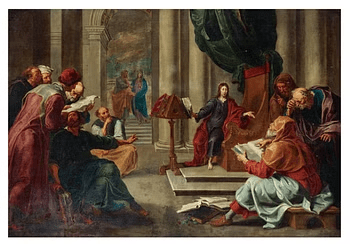
Jesus teaching in the Temple, by Willem van Herp (1614-1677)

The follower of Jesus will undergo afflictions and be oppressed by others. They will suffer.

Since that is true, the Christian must ensure that whatever suffering they endure is not because they have been obnoxious and unhelpful to people in this world; but that they are suffering because of their commitment to the words and ways of Jesus, because of their humility, gentleness, righteousness, purity, mercy, and peace.

Christians are meant to bear the cross, so that they may be conformed to the image of their Lord Jesus. There will be times when believers are the brunt of ungodly rage and fury, gossip and slander, opposition and injustice.

Jesus was warning his disciples that they needed to be prepared for endurance, to persevere over the long haul for their faith in him. Otherwise, they might be overwhelmed by temptation.

Christ followers are to remain steady in their purpose of living into the words of Jesus, and living out his ways in a world that prizes the opposite of Christian values.

The godly person values humility. The ungodly persons values pride.

The godly grieve and mourn over injustice in the world. The ungodly celebrate getting ahead by any means possible in this world.

The godly are meek. The ungodly are mean.

The godly seek right relationships with God and others. The ungodly leverage relationships to get what they want.

The godly prize mercy. The ungodly champion being merciless.

The godly are pure in heart. The ungodly have spiders in their heart, and garlic in their soul.

The godly engage in peacemaking. The ungodly engage in warmongering.

The godly end are persecuted for embracing the virtues of Jesus. The ungodly are the persecutors of good people.

The godly will be comforted, inherit the earth, receive mercy, see God, and belong to the kingdom of heaven. The ungodly will be judged, inherit the wind, receive condemnation, see nothing, and belong to the kingdom of darkness.

Sermon on the Mount, by Jorge Cocco Santángelo

The Lord wants us relieved of anxiety, and cheerfully living life with our burdens laid upon Jesus, for he gently and ably carries them. We can cast all our cares on him, because he cares for us. (Matthew 11:28-30; 1 Peter 5:7)

Whenever we are in the position of being afflicted by others, wisdom shall be granted to the godly who follow in the way of Christ.

The grace of God exists for those who seek to do justice, love mercy, and walk humbly. But there is nothing for the proud and arrogant, who believe they themselves are sufficient – because they refuse to receive any gift of God being offered to them.

All sorts of false prophets come along to try and deceive the godly into listening and following them. They make empty promises and blame others for unwanted situations. Know that whatever they say about others, is actually true of themselves.

So, when they accuse another of lying, cheating, stealing, murdering, etc. you can be sure that this is precisely what they themselves do to get ahead and get what they want in this life. Therefore, don’t be tempted by any rhetoric which demeans others.

Love of God and humanity is to be kindled hot, and not cooled through ingratitude and treachery. For whenever courage is weakened, a flood of violent speech and behavior follows.

We must strive against anything which harms the whole of humanity, and puts God at a distance. Instead, good news needs to be proclaimed.

The end will eventually come. Yet, we need not wander around in darkness, as if we don’t know what to do or where to go. We will indeed go through testing and many trials to our faith.

The desolating sacrilege, the abomination of desolation, will appear – which will be the sign that the time is short. An abomination, or desolation, means to profane something, to make it unclean or impure, to treat a holy thing as if it were simply not significant nor important.

In other words, whenever and wherever corruption is rife, and people (and God) are treated as disposable, then you know destruction is at hand. Thus, you must flee, because there is danger.

In such a situation, the rule of law will not help you. Services which were once helpful will be abolished and thrown away like garbage. And it could all happen rather quickly. So, don’t run back and try to save pieces of that previous life and existence; it isn’t worth it. You life is on the line.

Malicious motives and meanness of heart have no intention for the common good of all persons on this earth. A few people want what they want, and they don’t care who gets hurt in the process.

None of this awful behavior will go on forever. God’s judgment can and will deal with it. Yet, no one knows the time or date when that judgment will be rendered. For the sake of the godly, those days will be shortened.

Jesus was not attempting scare his disciples, but to exhort and arouse them to beware of the ungodly; and to keep watch, so that they would not fall into temptation and have their faith weakened.

As believers, we may experience troubles, but we need not be troubled.

The Good Shepherd of the sheep, Jesus Christ, is watching over us so that we don’t need to become distressed and discouraged.

My sheep hear my voice. I know them, and they follow me. I give them eternal life, and they will never perish. No one will snatch them out of my hand. My Father, in regard to what he has given me, is greater than all, and no one can snatch them out of the Father’s hand.  (John 10:27-29, NRSV)

The permanence of our deliverance from guilt, shame, sin, death, and hell does not depend on any of us. It is relies firmly upon the grace of God in Christ. And none who have been given to God shall perish. (John 17:12)

Be encouraged. But also be ready.

Keep watch, dear Lord, with those who work, or watch, or weep this night, and give your angels charge over those who sleep. Tend the sick, Lord Christ; give rest to the weary, bless the dying, soothe the suffering, pity the afflicted, shield the joyous; and all for your love’s sake. Amen.

Beware of Your Fear (Mark 13:1-8)

As he came out of the temple, one of his disciples said to him, “Look, Teacher, what large stones and what large buildings!” Then Jesus asked him, “Do you see these great buildings? Not one stone will be left here upon another; all will be thrown down.”

When he was sitting on the Mount of Olives opposite the temple, Peter, James, John, and Andrew asked him privately, “Tell us, when will this be, and what will be the sign that all these things are about to be accomplished?” 

Then Jesus began to say to them, “Beware that no one leads you astray. Many will come in my name and say, ‘I am he!’ and they will lead many astray. When you hear of wars and rumors of wars, do not be alarmed; this must take place, but the end is still to come. For nation will rise against nation and kingdom against kingdom; there will be earthquakes in various places; there will be famines. This is but the beginning of the birth pangs. (New Revised Standard Version)

In my undergraduate college days, decades ago, springtime brought a regular staple of sidewalk preachers calling for people to repent, because the end of the world is imminent.

That was in the days of the Cold War; the specter of a nuclear holocaust was a real fear among many. The outdoor preachers got a serious hearing with some.

Although religious end times preaching gets little attention anymore, the idea of a cataclysmic apocalypse is still very much a part of the culture. Dystopian novels are widely read; and stockpiling for a zombie apocalypse is a real thing.

End of the world stuff is, at the least, interesting and/or fascinating to many; and, at the most, there are folks fully prepared for an apocalypse of the world to happen in their lifetime.

Christ’s disciples asked him a question. And Jesus went directly to talking apocalypse.

In the Gospel of Mark, Jesus takes on demons and all sorts of other-worldly opposition. Christ is certainly presented by Mark as one who discerns there is much more going on – and will go on – in this world than what it may seem on the surface of things.

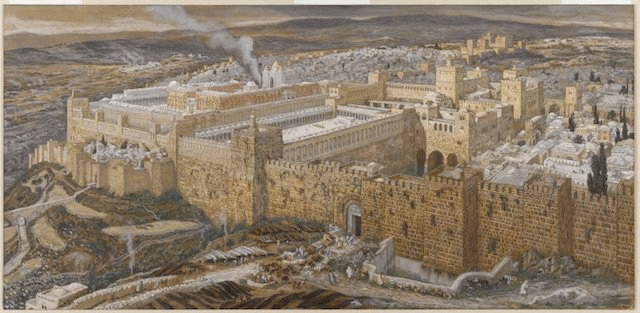
Jerusalem and Herod’s Temple, by James Tissot, c.1890

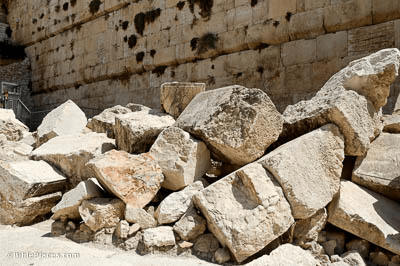
The disciples saw large and wonderful stones which were part of the temple. They marveled at what their physical eyes perceived. But Jesus saw further, into the future, and was not at all impressed; he saw a time of apocalypse. All of those stones in a heap. No one marveling over the temple.

Christ’s disciples wanted to know when such a time would happen. As was often the case with Jesus, he didn’t answer their question, at least not directly. He used it as an opportunity to teach about things to come.

The gist of Christ’s words to his disciples was to communicate that things are going to get worse than what they already are. The Roman occupation they were experiencing is nothing compared to what’s coming.

The apocalyptic language had been around in ancient Judea for a long time. There had been centuries of people talking about the world’s end.

Apocalyptic stuff is nothing new to contemporary folk, as well. Just mention the Book of Revelation and heads pop up, eyebrows raise, and imagination goes to seed.

We as biblical readers, however, need to observe that Jesus didn’t answer the question of his disciples. Which is perhaps something we must become more alert to.

Nobody knows when the end of the world will come. Not even Jesus. But that doesn’t seem to stop folks from asking anyway. Perhaps we need to ask a different question. Instead of asking “When will these things happen?” maybe we ought to ask, “What must I watch out for?”

The change of question orients us in a different way. Rather than end times speculation, we begin watching for things which are dangerous to humanity, things that bring upheaval to our world.

We start valuing awareness and observance, listening and contemplating. We learn to place our energies wisely into the things we believe truly matter in this life for the common good of all.

God is up to all sorts of kingdom business that is beyond our purview, and frankly, even beyond our ability to perceive or understand.

When we accept the exhortation of Jesus to “beware,” then we watch and look for things that are already here among us, and not get lost in a future we cannot predict. That type of future orientation only produces the kind of worry and anxiety that leads to fear.

And when fear takes root, it spawns the evils of hate and injustice. We become vulnerable to selfish incompetent leaders who make promises to take our fears away. We end up doing terrible acts against others, like imprisoning political opponents, denaturalizing and deporting citizens we don’t like, and creating fascist states that oppress others.

Fallen stones from the destruction of the Temple

But if we will wake up, hear the call of Jesus to beware, and awaken to our true commitment to the kingdom of God, we will then forsake fear-based tactics, and courageously help others in both body and soul.

It also means that, at times, we are off somewhere in centering and contemplative prayer, just like our Lord in the Garden of Gethsemane, knowing that the real source of power and authority is outside of us.

A true biblical view of the end times is about God working out divine purpose on behalf of all humanity. It isn’t about us and all of our fears and anxieties getting worked out in harmful ways.

The realization of a coming apocalypse must lead us toward faith and trust in the God who holds justice, righteousness, and mercy in good divine hands.

God has no limitations because of our questions. God will be God. God is who God is. Our task is to watch, remain faithful, and persevere until Christ returns to judge the living and the dead.

May it be so, to the glory of God.