Resurrection of the Lord (John 20:1-18)

Mosaic of Mary Magdalene in the garden with Jesus, Resurrection Chapel, Washington National Cathedral, Washington D.C.

Early on the first day of the week, while it was still dark, Mary Magdalene came to the tomb and saw that the stone had been removed from the tomb. So she ran and went to Simon Peter and the other disciple, the one whom Jesus loved, and said to them, “They have taken the Lord out of the tomb, and we do not know where they have laid him.” 

Then Peter and the other disciple set out and went toward the tomb. The two were running together, but the other disciple outran Peter and reached the tomb first. He bent down to look in and saw the linen wrappings lying there, but he did not go in. 

Then Simon Peter came, following him, and went into the tomb. He saw the linen wrappings lying there, and the cloth that had been on Jesus’s head, not lying with the linen wrappings but rolled up in a place by itself. 

Then the other disciple, who reached the tomb first, also went in, and he saw and believed, for as yet they did not understand the scripture, that he must rise from the dead. Then the disciples returned to their homes.

But Mary stood weeping outside the tomb. As she wept, she bent over to look into the tomb, and she saw two angels in white sitting where the body of Jesus had been lying, one at the head and the other at the feet. They said to her, “Woman, why are you weeping?” She said to them, “They have taken away my Lord, and I do not know where they have laid him.” 

When she had said this, she turned around and saw Jesus standing there, but she did not know that it was Jesus. Jesus said to her, “Woman, why are you weeping? Whom are you looking for?” Supposing him to be the gardener, she said to him, “Sir, if you have carried him away, tell me where you have laid him, and I will take him away.” 

Jesus said to her, “Mary!” She turned and said to him in Hebrew, “Rabboni!” (which means Teacher). Jesus said to her, “Do not touch me, because I have not yet ascended to the Father. But go to my brothers and say to them, ‘I am ascending to my Father and your Father, to my God and your God.’” 

Mary Magdalene went and announced to the disciples, “I have seen the Lord,” and she told them that he had said these things to her. (New Revised Standard Version)

Do Not Hold On To Me, by He Qi

Although Peter and John have a role in this story about Christ’s resurrection, the main character is Mary Magdalene. This is significant and symbolic for several reasons:

  1. It was Mary who experienced one of the most profound and deep changes of life due to the ministry of Jesus. Mary had been an immoral woman and spiritually enslaved to the machinations of seven demons. Jesus thoroughly delivered her from her personal hell.
  2. Mary was forever thankful to Jesus for changing her life, and so, she followed Christ and supported him in any way she could. 
  3. Mary was at the foot of the cross when Jesus died. While other disciples were keeping their distance out of fear, Mary was bold in standing with the other women for all to see that they were completely devoted to Jesus. Mary never turned her back on Jesus. 
  4. It was Mary who was there on the Sunday morning of Christ’s resurrection. Whereas the other followers were nowhere to be found, Mary came to the grave, still with a heart given to Jesus and grieving over his death. 

Because Mary had been given a new chance at life, she was deeply thankful and everything she had belonged to Jesus. Mary Magdalene was forgiven much, and, so she loved much. Here she is, after her Lord’s crucifixion, death, and burial, at the grave of Jesus. 

Mary came to the tomb on Easter Sunday still living in a Good Friday world – grieving, sad, and discouraged.  She soon discovered, however, that Christ is risen!

In the midst of your days of disappointment, loss, or sadness, how have you been surprised by joy and the presence of the risen Christ?  How has your grief been turned to gratitude?  Have you seen the risen Lord?  

Let Mary Magdalene’s experience be of encouragement to you. Mary was given new life and was transformed by the Lord. Yet, on Easter Sunday she did not immediately get what the heck was going on. Jesus rising from death was not anywhere on her radar. 

The empty tomb and the angels did not immediately lead her to faith – not until she saw Jesus, and even then, she did not recognize him. Only when Jesus called her name did Mary recognize him and respond, believing it was her Lord. 

And Jesus is still calling out names. He is calling your name. Jesus had said to his disciples that the sheep listen to the shepherd’s voice; he calls his own sheep by name and leads them out (John 10:3-4). One little word can change our lives forever: our name.

Easter opens a whole new world for us, as it did for Mary – a future of announcing good news and proclaiming resurrection.

There is a simple reason why the grave clothes were left in the tomb just lying there – they were not needed anymore! We no longer need the grave clothes of discouragement, defeat, and despair. We no longer need to weep and wonder because Christ is risen! Jesus Christ has called us by name, and we hear his voice.

The twentieth century theologian, Karl Barth, said that what brings people to worship God – not just on Easter, but any day – is an unspoken question clinging to our minds and hearts: Is it true? Is it true that God lives? Is it true that Jesus is alive? Could it be true that I can live a new life in Christ? Is it true that I can rebuild my life?  Is it all true? 

Mary Magdalene approached the tomb and found that it was true: Christ Jesus is risen from death!

Today, all over the world, followers of Jesus are testifying that this day and it’s deep implications for life is real: Christ is risen, and there is new life in Jesus. Believers across the globe are worshiping the risen Lord because they declare along with us, “I have seen the Lord!”

God has always been in the business of changing lives. British author A. N. Wilson, used to be known for his scathing attacks on Christianity and proclaimed the death of God. Yet he celebrated Easter in 2009 at a church with a group of other church members, proclaiming that the story of Jesus is the only one that makes sense out of life and its challenges. Wilson said:

“My own return to faith has surprised none more than myself…. My belief has come about in large measure because of the lives and examples of people I have known—not the famous, not saints, but friends and relations who have lived, and faced death, in light of the resurrection story, and in the quiet acceptance that they have a future after they die.”

The moment Jesus calls a person’s name, the power of the resurrection is enabled—the same power that raised Jesus from the dead. 

Come now, see what you consider as immovable slabs of stone in your life—bitterness, insecurity, fear, self-doubt or cynicism. Those immense rocks can be rolled away. To know Jesus is to know the power of the resurrection. 

We don’t need to merely hear testimonies of changed lives like Mary Magdalene’s; we can experience new life ourselves.

There is one word, one name, which has forever changed the world: “Jesus.”  And Jesus wants to change the world by uttering one simple word, one name, your name, so that you can exclaim with great joy, “I have seen the Lord!”

Loving Lord Jesus, you are our freedom. When I was lost in a dark hole of guilt and shame, you liberated me. You lifted me from sin, death, and hell.

Almighty God, hear today our prayers for the salvation of the world. Grant mercy to everyone who has turned away from you. Open their hearts and minds with your gracious light. Gather your children from the east and the west, from the north and the south. 

O God, bring people everywhere out of the darkness of disease and death, and into your marvelous light. Hear our prayers and answer us. May the benevolent way of Jesus be the hope of the world; among all nations may your salvation come.

Gracious Lord, our neighbors, relatives, friends, and co-workers, along with the sick, the poor, the prisoner, the widow, and all creation are in your hands. Therefore, fill us all with your love and your mighty resurrection power! And, grant us peace through Jesus Christ, our risen Lord. Amen.

Luke 24:36-40 – Peace Be with You

Jesus Shows Himself to Thomas by Rowan and Irene LeCompte, National Cathedral, Washington, D.C.

While they were still talking about this, Jesus himself stood among them and said to them, “Peace be with you.”

They were startled and frightened, thinking they saw a ghost. He said to them, “Why are you troubled, and why do doubts rise in your minds? Look at my hands and my feet. It is I myself! Touch me and see; a ghost does not have flesh and bones, as you see I have.”

When he had said this, he showed them his hands and feet. (New International Version)

Christ’s disciples were abuzz. Two dudes showed up and told eleven of the original disciples that they had seen and talked to Jesus himself! This was a lot to wrap both their heads and their hearts around. Maybe they dared to hope it was true.

Peter and John encountered an empty tomb. Now these guys from Emmaus are giving this wild testimony of a risen Savior. Into the weird mix of doubt, curiosity, grief, hope, wondering, and outright confusion, Jesus materializes out of the blue and says, “Peace be with you.”

Already feeling unsettled and uncertain, the disciples had anything but a peaceful response to the presence of their Lord. Startled, troubled, and frightened they were, as if somebody had just dropped a skunk into the room.

Why the fear? Why not be overjoyed or overcome with sheer delight at seeing Jesus?

The disciples were caught off guard, as if they had zero expectation of seeing Jesus. Believing him to be dead, they immediately went to thinking this was some ghost. After all, the door was locked. Nobody could have gotten into the room without the disciples knowing it. (John 20:19)

As it turns out, faith and belief are not uniform static terms. There are layers to faith. Yes, the disciples really did believe, and their faith developed over time with Jesus. However, their belief had not yet come to full bloom. So, in this sense, they still possessed a lack of faith and were rebuked by Jesus for it. (Mark 16:14)

A full-orbed belief in the Lord Jesus Christ is more than words, more than making professions, and more than signing-off on a doctrinal statement of faith. Faith is shown for what it is through our actions. (James 1:19- 2:26)

Faith comes to fruition when the head, the heart, and the hands all align together and conspire to proclaim the gospel in thought, word, and deed. If they are misaligned or incongruent with each other, then that faith is inadequate. There is yet another level to the belief which needs to emerge.

Perhaps this is instructive for people today. While maintaining beliefs about the person and work of Jesus, and acknowledging Christ’s death and resurrection, some Christians live as though he had never risen from the grave. If Jesus were to suddenly show up and say, “Peace be with you,” like a startled puppy, they’d likely have an accident on the floor.

As Jesus had done so many times before in his earthly ministry, he invited the disciples to experience him in a real, tangible, visceral way. This is no ghost. This is a Christ who has physical flesh and bones. You can eat with this Jesus, real food and drink. Look at his hands and feet. Touch and feel them if you must. But, by all means, believe!

Jesus came to give them, and us, peace. Peace is more than a greeting, more than the absence of conflict or anxiety. It is to enjoy harmony with self, others, and God. Peace is wholeness and integrity of being, even when all is going to hell around us.

A child is born to us, a son is given to us,
    and authority will be on his shoulders.
    He will be named
    Wonderful Counselor, Mighty God,
    Eternal Father, Prince of Peace.
There will be vast authority and endless peace
    for David’s throne and for his kingdom,
    establishing and sustaining it
    with justice and righteousness
    now and forever. (Isaiah 9:6-7, CEB)

The peace of God is closely associated with the presence of God. And so, conversely, the lack of peace is to experience a sense of divine absence. God’s peace and presence are inseparable. It is, therefore, no surprise that Jesus demonstrated his actual physical presence and spoke to the disciples about peace.

On the evening of that first day of the week, when the disciples were together, with the doors locked in fear of the Jewish leaders, Jesus came and stood among them and said, “Peace be with you!” After he said this, he showed them his hands and side. The disciples were overjoyed when they saw the Lord.

Again, Jesus said, “Peace be with you! As the Father has sent me, I am sending you.” And with that he breathed on them and said, “Receive the Holy Spirit. If you forgive anyone’s sins, their sins are forgiven; if you do not forgive them, they are not forgiven.” (John 20:19-23, NIV)

Chronic spiritual anxiety usually arises from the inability to perceive a generous and hospitable God having our backs and working on our behalf. Knowing God, who is gracious and compassionate, slow to anger and abounding in steadfast love, leads to peace and settled rest. 

May the Lord bless you
    and protect you.
May the Lord smile on you
    and be gracious to you.
May the Lord show you his favor
    and give you his peace. Amen. (Numbers 6:24-26, NLT)

2 Samuel 6:1-15 – Be Careful How You Celebrate

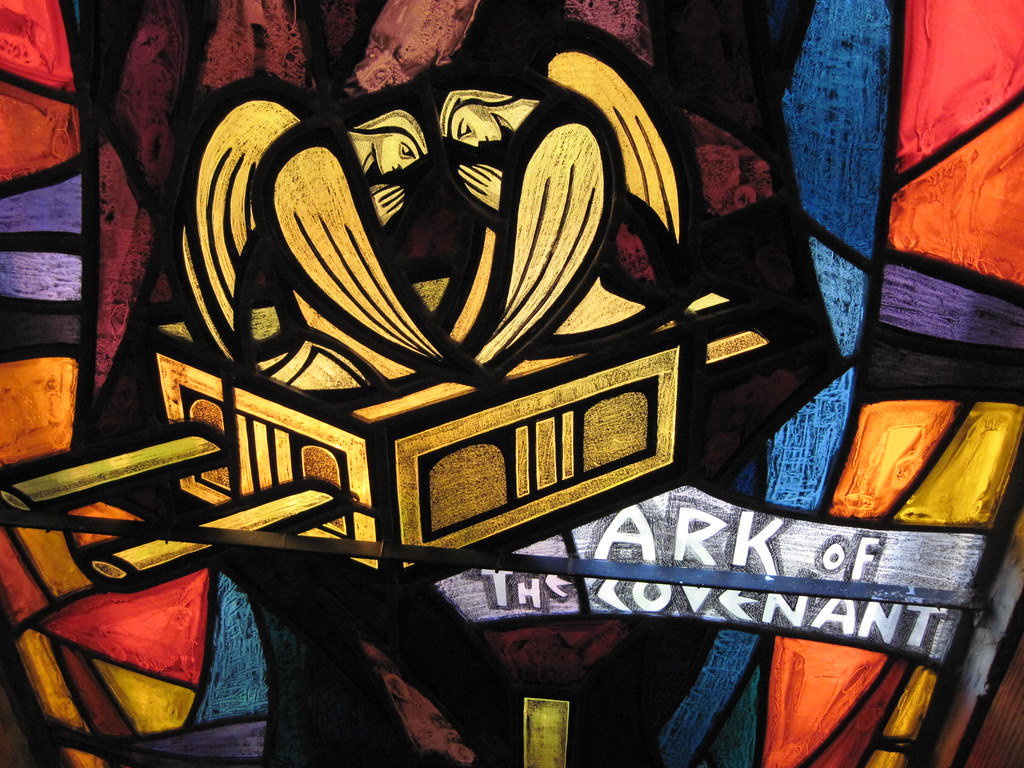
Ark of the Covenant by Isabel Piczek 1982, St. Norbert Catholic Church, Orange, California

David again assembled all the best men in Israel, 30,000 in number. David and all the men who were with him traveled to Baalah in Judah to bring up from there the ark of God which is called by the name of the Lord of Heaven’s Armies, who sits enthroned between the cherubim that are on it. They loaded the ark of God on a new cart and carried it from the house of Abinadab, which was on the hill. Uzzah and Ahio, the sons of Abinadab, were guiding the new cart. They brought it with the ark of God from the house of Abinadab on the hill. Ahio was walking in front of the ark, while David and all Israel were energetically celebrating before the Lord, singing and playing various stringed instruments, tambourines, rattles, and cymbals.

When they arrived at the threshing floor of Nacon, Uzzah reached out and grabbed hold of the ark of God, because the oxen stumbled. The Lord was so furious with Uzzah, he killed him on the spot for his negligence. He died right there beside the ark of God.

David was angry because the Lord attacked Uzzah; so, he called that place Perez Uzzah, which remains its name to this very day. David was afraid of the Lord that day and said, “How will the ark of the Lord ever come to me?” So, David was no longer willing to bring the ark of the Lord to be with him in the City of David. David left it in the house of Obed-Edom the Gittite. The ark of the Lord remained in the house of Obed-Edom the Gittite for three months.

The Lord blessed Obed-Edom and all his family.King David was told, “The Lord has blessed the family of Obed-Edom and everything he owns because of the ark of God.” So, David went and joyfully brought the ark of God from the house of Obed-Edom to the City of David. Those who carried the ark of the Lord took six steps and then David sacrificed an ox and a fatling calf. Now David, wearing a linen ephod, was dancing with all his strength before the Lord. David and all Israel were bringing up the ark of the Lord, shouting and blowing trumpets. (New English Translation)

The Christian season of Eastertide is a grand celebration of Christ’s resurrection and the new life we enjoy in Jesus Christ. Since God is the center of all things, celebrations need to be mindful. Nothing in life is a matter of doing whatever the heck we want to do.

Even celebration has its boundaries and limits.

The narrator who originally compiled, told, and wrote the today’s Old Testament lesson wanted to communicate something significant about God and how to relate to the Lord.

God put the big kibosh on David’s hoedown. At that time in the history of Israel, the ark was the foremost symbol of God’s presence with the people. Within the ark contained the tablets of the Ten Commandments (the symbol of God’s Word); the staff of the first priest, Aaron, (the symbol of God’s choice); and a pot of manna (the symbol of God’s provision). Thus, the ark was a holy object, pointing to a holy God.

The ark of the Lord was built during the time of Moses, when the ritual laws were established concerning offerings and how to approach God in worship. There were detailed prescriptions for how to construct all the sacred articles for worship. (Exodus 35:30-40:33) 

The ark was at the center of worship, representing the presence of God among the people. For nearly five-hundred years before David, the ark had become a familiar object in the life of Israel, always there, continually the symbol of God to the people.

I’ve been a Christian for many decades. One reason I refer to the seasons of the Christian Year in the present tense, is so that it doesn’t become old hat to me. Although I just presided over yet another Easter Sunday in my long tenure as a pastor, I am still in awe of Christ’s resurrection and am eternally grateful and full of joy over new life in Jesus Christ. I always want it to be fresh, as if I’m stepping up to the empty tomb for the first time.

Stained glass in the First Lutheran Church of
Washburn, North Dakota

Yet, we have all likely had the experience of something becoming so familiar, that we begin to lose sight of how important and valuable it really is. Not until we lose it, or something traumatic happens, do we wake up and take stock of its true significance. 

The Israelites had become lethargic and apathetic toward the worship of God, and it led to some disheartening and tragic circumstances. The people of God throughout the ages have always needed to be vigilant against the opiate of familiarity, dulling the senses to the importance of worship.

Moving the ark of the Lord to Jerusalem was one of the first acts David did as the king of Israel and Judah.  God was with David and brought him success against his enemies. David enjoyed a close relationship with God.  Even though David’s heart was in the right place, he made a huge miscalculation, which ended up offending God. 

David had the best of intentions in bringing the ark to Jerusalem and giving it a prominent place in the center of Jewish life. This was an exceptionally good plan. The problem, however, came in the manner the ark was carried from one place to another. 

God’s law laid out in careful detail how the ark was to be transported. Uzzah and Ahio were Levites charged with the ark’s care. Only the Levites could handle the ark and the holy objects of worship that went along with it.

Since it was the job of the Levites for hundreds of years, they knew better than to carry the ark of the Lord on a cart. God clearly told Moses that the ark was to have two long poles of acacia wood overlaid with gold inserted into four gold rings of the ark. The ark was to always be carried on the shoulders of the Levites with the two poles.

We are not told why Uzzah and Ahio were pulling the ark on a cart with oxen instead of carrying it in the prescribed way. Perhaps it was because the ark was incredibly heavy and no easy task to carry.  Maybe they decided it would be easier and more expedient to have the much stronger oxen pull the ark on a nice new cart; it would save a lot of energy transporting it over a long distance.

Or it could be that they were tired of moving the ark in the same old way they had always done it. Maybe it was old hat to them, and they were ready for something different.

For pragmatic people, Uzzah and Ahio’s approach makes a lot of sense. However, God was not okay with this arrangement. When the oxen stumbled and the ark was in danger of falling off the cart, Uzzah reflexively reached out to steady it.  That was the last act Uzzah ever did on this earth. God immediately put him down for his “irreverent act.”

So, here is the not so good idea: Evaluating the worship of God by common sense pragmatism, what we think will work best, and how we feel it ought to be done. Everything about worship is to pay attention to the holiness of God through our obedience. 

Whenever we avoid the prescriptions of Holy Scripture, however best the intentions might be, is not a good thing and people will get hurt. One can never justify an action that goes against God’s Word because people are praising God. Just because the heart is in the right place does not mean what is being done is okay.

David’s first response was anger, then fear. He gave his best effort, and it resulted in God’s disfavor. Perhaps David took for granted that the ark could be moved any old way he wanted to move it. 

Trouble with God happens whenever we value efficiency and expediency over obedience and submission.

The great error of Uzzah, resulting in his death, was trying to manage God. We do not take care of God; God takes care of us. God does not bow to us. The Lord doesn’t allow the creature to manage the Creator.

God wants a pure, unadulterated, and obedient worship celebration from people in the way God wants it to be done, period. It is not up for negotiation.

Holy God, we confess that we have too often forgotten we are yours. Sometimes we carry on our lives as if there was no God and we fall short of being a credible witness to you. For these things we ask your forgiveness and for your strength. Give us clear minds and open hearts so we may bear witness to you in our world. Remind us to be who you would have us to be regardless of what we are doing or who we are with. Hold us close and build our relationship with you and with those you have given us on earth, through Jesus Christ our Lord. Amen.

The Wonder of Christ’s Resurrection

Welcome, friends! In the New Testament Gospel of Luke 24:1-12, we find an account of women approaching the grave of Jesus, only to find an empty tomb. Today, people search for reality in all kinds of empty places. There is, however, hope, because Christ is risen! He is risen, indeed! Click the videos below and let us enjoy and be in awe that Jesus is alive!

Pastor Tim Ehrhardt, Luke 24:1-12

May the glory and the promise of this joyous time of year bring peace and happiness to you and those you hold most dear.

And may Christ, Our Risen Savior, always be there by your side to bless you most abundantly and be your loving guide. Amen.