
Acceptance (Acts 7:17-40)

“As the time drew near for God to fulfill his promise to Abraham, the number of our people in Egypt had greatly increased. Then ‘a new king, to whom Joseph meant nothing, came to power in Egypt.’He dealt treacherously with our people and oppressed our ancestors by forcing them to throw out their newborn babies so that they would die.

“At that time Moses was born, and he was no ordinary child. For three months he was cared for by his family. When he was placed outside, Pharaoh’s daughter took him and brought him up as her own son. Moses was educated in all the wisdom of the Egyptians and was powerful in speech and action.

“When Moses was forty years old, he decided to visit his own people, the Israelites. He saw one of them being mistreated by an Egyptian, so he went to his defense and avenged him by killing the Egyptian. Moses thought that his own people would realize that God was using him to rescue them, but they did not. The next day Moses came upon two Israelites who were fighting. He tried to reconcile them by saying, ‘Men, you are brothers; why do you want to hurt each other?’

“But the man who was mistreating the other pushed Moses aside and said, ‘Who made you ruler and judge over us? Are you thinking of killing me as you killed the Egyptian yesterday?’ When Moses heard this, he fled to Midian, where he settled as a foreigner and had two sons.

Moses and the Burning Bush, by Marc Chagall

“After forty years had passed, an angel appeared to Moses in the flames of a burning bush in the desert near Mount Sinai. When he saw this, he was amazed at the sight. As he went over to get a closer look, he heard the Lord say: ‘I am the God of your fathers, the God of Abraham, Isaac and Jacob.’ Moses trembled with fear and did not dare to look.

“Then the Lord said to him, ‘Take off your sandals, for the place where you are standing is holy ground. I have indeed seen the oppression of my people in Egypt. I have heard their groaning and have come down to set them free. Now come, I will send you back to Egypt.’

“This is the same Moses they had rejected with the words, ‘Who made you ruler and judge?’ He was sent to be their ruler and deliverer by God himself, through the angel who appeared to him in the bush. He led them out of Egypt and performed wonders and signs in Egypt, at the Red Sea and for forty years in the wilderness.

“This is the Moses who told the Israelites, ‘God will raise up for you a prophet like me from your own people.’ He was in the assembly in the wilderness, with the angel who spoke to him on Mount Sinai, and with our ancestors; and he received living words to pass on to us.

“But our ancestors refused to obey him. Instead, they rejected him and in their hearts turned back to Egypt. They told Aaron, ‘Make us gods who will go before us. As for this fellow Moses who led us out of Egypt—we don’t know what has happened to him!’ (New International Version)
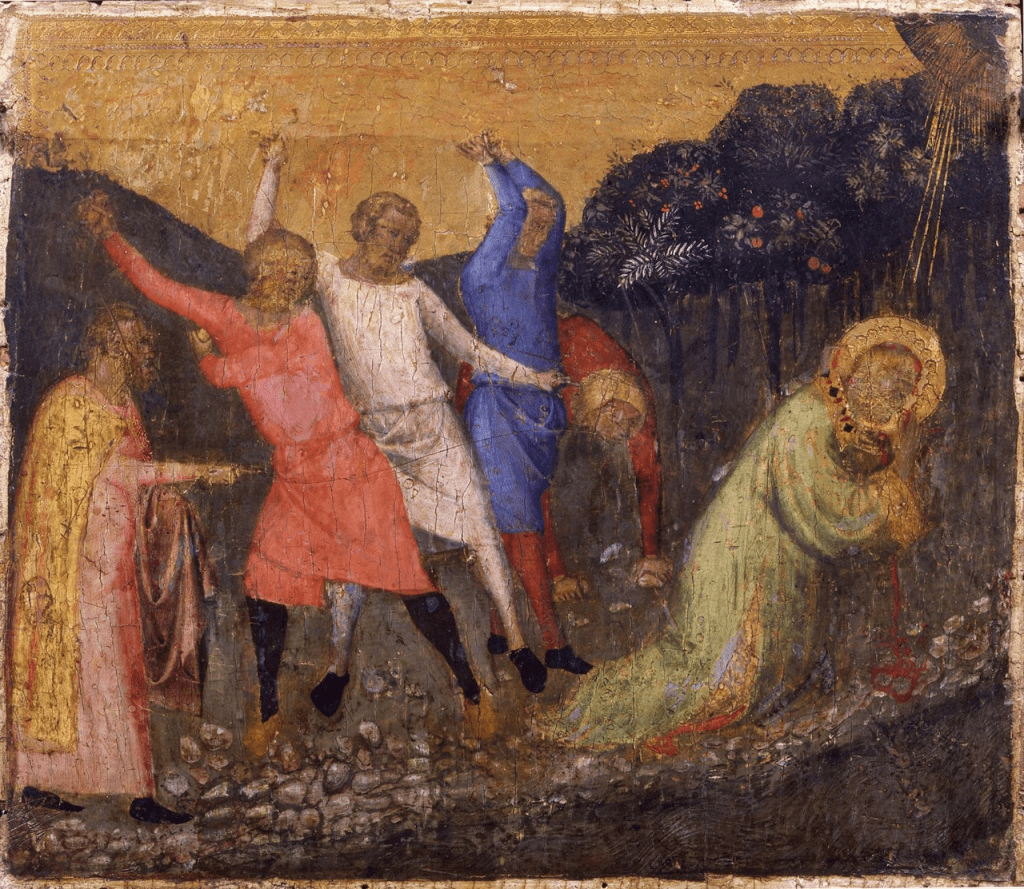
Martyrdom of St. Stephen, by Bernardo Daddi, 1345

We humans are a confusing paradox of sinner and saint. We are majestic people, created in the image and likeness of a good God.

And we are also profoundly fallen, touched by the power of sin in every area of our lives. Our hearts exist with both light and darkness, having the capacity for both incredible altruism as well as inexplicable evil.

So then, it will do no good to retreat into binary definitions of people as being either good or bad. No, we shine and shadow at the same time. The thing that really gets us into a terrible mess is when we ignore or deny our shadow selves. We then demonize the other while claiming purity for ourselves.

This is precisely what occurred with Stephen and a group of his fellow Jews who refused to acknowledge their shadow side. And it resulted in Stephen’s stoning and death. Whereas Stephen lifted and brought to light the unseemly aspects of their collective heritage, the people wanted nothing to do with it.

In our present day, the response might be something like, “Quit being so negative. We focus on the positive. Expel this recalcitrant troublemaker once and for all!”

Oy. Acceptance cuts two ways. We must accept both our blessings and our curses. And the acceptance of what is will not occur apart from a solid self-acceptance of who we are and how we are feeling in any given situation. On the practical level, it works something like the following story…

Several years ago, I went on a leadership retreat in the Canadian wilderness. We were so far out in the sticks that we needed special first aid training before leaving – because if someone got severely injured it would be hours before any medical attention could be received. There was no cell phone service, no towns, no anything except mile after square mile of wilderness. 

One day, it was very windy and several of us were on a lake canoeing to a destination. It was late May, which means the water was still ice cold in Canada. One of the canoes capsized and we had to act quickly and deliberately – which was no small feat in a stiff wind. More than fifteen minutes would result in hypothermia for the two people in the water.

I did not like being in that situation. In fact, I didn’t much like the Canadian wilderness. Too many black flies and giant mosquitoes for me. My shadow side was coming out. But here I was, and I had to accept the reality I was in. One of the lessons I learned in that moment was that acceptance can sit alongside other reactions and emotions.

For example, a person can be outraged by an injustice, as Stephen was, and accept that it is a reality. Acceptance does not mean complacency or giving up. We can accept something while at the same time trying to make it better.

I also needed to accept what was happening inside of me. I was cold and worried. Trying to push those feelings away would have only added to the stress of the situation. If I failed to accept what was true about myself, I would be less able to deal with the situation, and so, would compromise my ability to help two people at risk.

I needed to accept the whole circumstance, including myself. Accepting what is inside gave me more influence over the situation, not less. Self-acceptance became the key to acceptance of unwanted conditions, and more importantly, acceptance of one another as human beings.

In that moment of rescuing two people (which ultimately proved successful) I became aware of a part of myself – the part that gets afraid and irritated – and chose not to stuff it or deny its existence. I became the guy who talked to the panicked people in the water and kept them as calm as possible so that the others could get them out. I was able to do my part to help fearful people because I acknowledged and accepted my own fear.

Unlike my situation, however, Stephen’s experience ended in martyrdom. Just because we respond rightly is no guarantee that everything will work out for our benefit. Rather, we say and do the things we must say and do, while leaving the results to a sovereign Lord.

It is our responsibility to work on ourselves, not others. And acceptance is the path to get there, all of it, not just part of it.

Jesus, let your mighty calmness lift me above my fears and frustrations. By your deep patience, give me tranquility and stillness of soul in you. Make me in this, and in all things, more and more like you. Amen.


Expressing Grief (Lamentations 3:55-66)

An engraving of the prophet Jeremiah lamenting, 1937

I called on your name, Lord,
    from the depths of the pit.
You heard my plea: “Do not close your ears
    to my cry for relief.”
You came near when I called you,
    and you said, “Do not fear.”

You, Lord, took up my case;
    you redeemed my life.
Lord, you have seen the wrong done to me.
    Uphold my cause!
You have seen the depth of their vengeance,
    all their plots against me.

Lord, you have heard their insults,
    all their plots against me—
what my enemies whisper and mutter
    against me all day long.
Look at them! Sitting or standing,
    they mock me in their songs.

Pay them back what they deserve, Lord,
    for what their hands have done.
Put a veil over their hearts,
    and may your curse be on them!
Pursue them in anger and destroy them
    from under the heavens of the Lord. (New International Version)

Over the years of ministry, I’ve encountered a host of confessing Christians who did not know the book of Lamentations even existed in the Bible. Even more people, I have discovered, are unfamiliar with the word “lament.”

This anecdotal evidence is quite telling: It tells me that a large chunk of people in society don’t know what to do with themselves whenever they experience or encounter trauma, abuse, unwanted circumstances, death, or overwhelming situations.

It’s no wonder that so many of us are anxious, depressed, and emotionally struggling. To be overwhelmed means that we don’t have enough internal resources to match what’s going on with us externally. Being overwhelmed means being devastated or overpowered by several circumstances at once; and experiencing several emotions at once, including the feeling of estrangement from God and/or others.

The book of Lamentations is the prophet Jeremiah’s public expression of grief over the destruction of his home city of Jerusalem. King Nebuchadnezzar and the Babylonian army invaded the land, broke down the city walls, razed the temple, killed many people, and took most of the rest into captivity. The experience, along with the atrocities committed, were overwhelming.

On top of all that, Jeremiah had proclaimed a message of judgment, prophesying what would happen – and it did. And after the Babylonians took over, the remaining people put much of their misplaced anger and grief on Jeremiah, making his situation even worse.

Lamentations of Jeremiah, by Marc Chagall, 1956

What would you do if you were Jeremiah?

In whatever way you might respond, I believe Jeremiah did precisely what was most needed: He called on the name of the Lord, he expressed his lament, and it was all more than a private affair – because we are able to still read his lamentation all these many centuries later.

To lament is to express our feelings and story of grief to another. Without doing so, we are spiritually and emotionally stuck. And if we remain stuck for too long, our grief comes out sideways, either hurting others or ourselves.

The general populace of the people didn’t deal with their grief, and didn’t lament their loss. Instead, they mocked Jeremiah, plotted against him, and insulted him. That’s what happens when we don’t grieve and lament.

Jeremiah, however, left the people in God’s hands, and didn’t take matters into his own hands. He did what he was supposed to do instead of lashing out on others: Crafted this book of Lamentations, which we have access to, and can read.

So, why don’t we?

There’s lots of reasons we don’t examine the book of Lamentations (and explore our own lament). The primary reason is fear:

  • Fear of our own emotions – getting lost in them and afraid we’ll never get out of them – so we construct elaborate thoughts and words of positivity, believing that it will shoo the difficult feelings away. But the truth is, it won’t. It only makes it worse. We can choose to courageously tell our story, to whomever we want, in as much or as little detail as we want.
  • Fear of getting hurt. We’ve already experienced a level of hurt we never thought was possible. It’s only human to want to keep as far away from hurt as we can. So, we keep tight-lipped, tell others that we’re fine (when we’re not), all in the belief that if we can shut others out, we can keep any more hurt from touching us. The problem is that when we do that, we also keep the love out that could and would come to us.
  • Fear of connection. Examining myself and exploring relationships with others sounds too risky. It’s fraught with emotion. Besides, we might reason, I don’t want to put my burdens onto someone else. So, we don’t face our grief. The feelings get buried and, over time, become gangrene of the soul, poisoning us. Like a nasty boil, our grief needs to be lanced, and plenty of peroxide put on the wound. And the right medicine is doing what Jeremiah did: lament our loss.
  • Fear of losing control. I might cry in front of others. I may get really angry and yell. I could go absolutely ape and do weird stuff around people. If I open up, it will be a Pandora’s box of releasing myself. In reality, this is a fear of vulnerability, of letting others see the true self. And since we may not like our true self to begin with, this makes things quite complicated. However, there is not another way. Yet, if we go down the narrow path of lament, we will find many comforters who are able to empathize with us in our suffering.

“Sometimes you have to get your behind in the past before you can put your past behind you.”

Mit Tdrahrhe

The place to begin is in offering our feelings of grief, and our emotional words of lament, to the God who is always ready and available to hear it. And, from there, we reach out to a trusted friend, relative, or faith leader and tell them our story. Eventually, we discover enough healing that we can then comfort others with the comfort we ourselves have received. (2 Corinthians 1:3-11)

You can do this.

Almighty God, Father of mercies and giver of comfort: Deal graciously, we pray, with all who mourn; that, casting all their care on you, they may know the consolation of your love; through Jesus Christ our Lord. Amen.

Dealing with Depression (1 Kings 19:9-18)

There he went into a cave and spent the night.

And the word of the Lord came to him: “What are you doing here, Elijah?”

He replied, “I have been very zealous for the Lord God Almighty. The Israelites have rejected your covenant, torn down your altars, and put your prophets to death with the sword. I am the only one left, and now they are trying to kill me too.”

The Lord said, “Go out and stand on the mountain in the presence of the Lord, for the Lord is about to pass by.”

Then a great and powerful wind tore the mountains apart and shattered the rocks before the Lord, but the Lord was not in the wind. After the wind there was an earthquake, but the Lord was not in the earthquake. After the earthquake came a fire, but the Lord was not in the fire. And after the fire came a gentle whisper. When Elijah heard it, he pulled his cloak over his face and went out and stood at the mouth of the cave.

Then a voice said to him, “What are you doing here, Elijah?”

He replied, “I have been very zealous for the Lord God Almighty. The Israelites have rejected your covenant, torn down your altars, and put your prophets to death with the sword. I am the only one left, and now they are trying to kill me too.”

The Lord said to him, “Go back the way you came, and go to the Desert of Damascus. When you get there, anoint Hazael king over Aram. Also, anoint Jehu son of Nimshi king over Israel, and anoint Elisha son of Shaphat from Abel Meholah to succeed you as prophet. Jehu will put to death any who escape the sword of Hazael, and Elisha will put to death any who escape the sword of Jehu. Yet I reserve seven thousand in Israel—all whose knees have not bowed down to Baal and whose mouths have not kissed him.” (New International Version)

The prophet Elijah was downright exhausted – so much so, that he became debilitatingly depressed.

After being alone for long stretches of time, always vigilant to watch out for those who sought his life, experiencing an intense victory against some truly evil folks, and then back to being on high alert, Elijah was done.

Depression is real. It isn’t limited to a certain personality trait, and it isn’t in itself sin. It just is. More than half of people in the United States with serious depression, and even more worldwide, do not receive or will not get adequate help. 

So, if you are reading this as a depressed person, or are wondering how to help someone you care for who is depressed, it is imperative that you get help immediately. A blog post on such an important subject can really only encourage you, and somehow inspire you, to take the brave and bold step of seeking the assistance you need. 

Severe depression is profoundly crippling and is as important to deal with as prostate cancer; both can kill you on the inside even though no one knows on the outside.

I myself have experienced two major depressions in the course of my life. I’ve also had a few kidney stones. I’m told the pain of a kidney stone is like childbirth.  I don’t know about the childbirth thing, but I do know that I would rather experience a dozen kidney stones, at once, than go through another severe depression. I got help, and it changed my life. 

Depression is exactly what the name implies: a depressing or a stuffing of feelings – particularly the emotion of anger. I was so good at packing down my emotions that one night, many years ago when our neighbor had a blow-out of a party at 2am in the morning, I actually felt no anger. Just so you know: that’s not healthy. I had an anger problem. Not the kind where you explode, but just the opposite – the kind where you stuff every negative feeling in the book.

Recovery for me looked a lot like what Elijah experienced. I needed to acknowledge what was actually inside of me and begin sitting with those unwanted emotions. And I need to tell you that what was inside me wasn’t at all pretty. 

Like a wound that needs peroxide, dealing with depression hurt like hell. But I couldn’t heal without it. I couldn’t go around it, or avoid it; I had to go through it. Eventually, I learned to not only identify my feelings, but to own them and take charge of them. 

I discovered I could choose to say how I feel without apology, and I could say it all in a way that helped others, as well as myself. Holy Scripture calls it speaking the truth in love.

I will instruct you and teach you in the way you should go;
    I will counsel you with my loving eye on you.

Psalm 32:8, NIV

Waiting for the perfect time to deal with depression will only result in deeper despondency. You are not responsible for what others may say or do, and you cannot control other people’s decisions and responses to you – trying to do so is manipulative and only creates more problems. 

Elijah wasn’t alone in dealing with depression. David and Jeremiah went through some very difficult days of being depressed. Even Jesus became stressed and despondent. But none of them stayed there, and their experiences changed not only themselves but readers of God’s Word throughout history. 

It only makes sense to tell a trusted spiritual leader, friend, or relative how you are really feeling. One does not crawl out of the abyss of darkness that is depression without some sage people surrounding the person. They can offer wise counsel, focused prayer, and careful application of Scripture. 

This is one reason why church ministry exists, so let the church do its redemptive work. So, may the clouds roll away into the hope of a new tomorrow.

Almighty God, whose Son took upon himself the afflictions of your people: Regard with your tender compassion those suffering from depression; bear their sorrows and their care; supply all their needs; help them to put their whole trust and confidence in you; and restore them to strength of mind and cheerfulness of spirit; through Jesus Christ our Lord. Amen.

How Can I Live a Pure Life? (Psalm 119:9-16)

Statue of Saint Valentine in Terni, Umbria, Italy

How can a young person live a pure life?
    By obeying your word.
I try with all my heart to serve you.
    Help me obey your commands.
I study your teachings very carefully
    so that I will not sin against you.
Lord, you are worthy of praise!
    Teach me your laws.
I will repeat the laws we have heard from you.
I enjoy following your rules
    as much as others enjoy great riches.
I will study your instructions.
    I will give thought to your way of life.
I enjoy your laws.
    I will not forget your word. (Easy-To-Read Version)

There was an actual Saint Valentine (c.226-269 C.E.) who lived and served as a Bishop in Rome. The Roman Emperor of the time, Claudius II, was vehemently opposed to Christianity. Claudius forbad Christian marriages from taking place – which was something Bishop Valentine was unwilling to do, and was supposedly jailed for his refusal to stop performing Christian weddings. Hence, one of the reasons for Valentine being the patron saint of lovers.

That’s certainly one way of helping to keep young Christians pure. I, in fact, have more than once advocated on behalf of a young couple in love. Their parents, who wanted a large wedding and plenty of time to prepare for it, simply didn’t realize what they were asking of their kids and how much that put them in an awkward position.

To be pure means to be holy or set apart for a special or specific purpose. Christians are to be completely devoted to their Lord and Savior, Jesus Christ. In order to do that, they will need to pay particular attention to God’s commands and Christ’s teachings.

The Will

The whole person must be involved in obeying the teachings given to us. It begins with our will. Notice that the psalmist sets his resolve toward this great task by stating:

  • I will repeat (out loud) the divine laws I hear
  • I will study God’s instructions
  • I will give thought to my way of life with Yahweh
  • I will not forget the Lord’s words

I have considered my ways
    and have turned my steps to your statutes.
I will hasten and not delay
    to obey your commands. (Psalm 119:59-60, NIV)

We need strong affirmations toward engaging our will toward reading aloud, studying, and remembering biblical commands, so that we will succeed in our quest for purity and holiness.

The Emotions

Our affections also need to be involved. We are emotional creatures, having been formed by a Creator with deep feelings. Therefore, our own emotions are meant to be acknowledged and engaged. The psalmist enjoys God’s Law and is emotionally draw to it’s beauty and light.

Oh, how I love your law!
    I meditate on it all day long.
Your commands are always with me
    and make me wiser than my enemies. (Psalm 119:97-98, NIV)

We need strong feelings toward desiring God’s Word, so that there will be effective action toward a life of purity. Overall, we do what we want. Continually doing something we don’t really want to do ends up being either legalistic or loathsome.

The Body

Our bodies are the vehicles to doing and accomplishing God’s will on this earth. Thus, our physical selves must be animated toward the good, the right, and the just. The psalmist worshiped and praised God.

I, by your great love,
    can come into your house;
in reverence I bow down
    toward your holy temple. (Psalm 5:7, NIV)

Hear my cry for mercy
    as I call to you for help,
as I lift up my hands
    toward your Most Holy Place. (Psalm 28:2, NIV)

Our bodies need to move in physical rhythms of praise and worship to God, so that there will be purity of life. Holiness needs hands and feet to walk into the way of the Lord and obey God’s commands.

Philosophies of Purity

There are some unsound approaches to becoming pure and remaining holy:

  1. It’s up to me. God is too far away, maybe even absent altogether. This is a philosophy which ignores the gut. Yet, if we seek to connect with our innards, we’ll discover quickly that purity is not all on me. I am the vine; you are the branches. If you remain in me and I in you, then you will produce much fruit. Without me, you can’t do anything. (John 15:5, CEB)
  2. Follow your heart. Doing this has significance; however, if that’s the exclusive approach to purity, the mind gets left behind and the heart ends up vulnerable to deceit. The heart is deceitful above all things, and desperately sick; who can understand it? (Jeremiah 17:9, ESV)
  3. Knowledge is power. Yes, of course it is; but by itself, knowledge puffs up. We need the affections, particularly love, or else we become brains-on-a-stick, denigrating the body as superfluous to spirituality. Knowledge puffs up, but love builds up. (1 Corinthians 8:1b, NRSV)
  4. Control everything. There are certainly forces in operation in this world; yet we are never called to try and manipulate them. We may will ourselves to do many things, yet God has control of all things. Humanity is called to self-control, which takes up all our energy because it’s no easy feat. For the grace of God has appeared that offers salvation to all people. It teaches us to say “No” to ungodliness and worldly passions, and to live self-controlled, upright and godly lives in this present age. (Titus 2:11-12, NIV)

A sound philosophy of being holy and pure recognizes that we need divine help in strengthening our faith; the assistance of others who can walk alongside us and provide encouragement; and the engagement of our entire person, utilizing all our faculties in order to live a life of purity. Obedience to God’s Word is vital to a holy life; and to obey requires our entire selves.

There is to be a marriage between God’s commands and human obedience. The world may forbade this, but much like St. Valentine, we’ll let love have its way – and not the ruler of this present evil age.