Why? (Job 18:1-21)

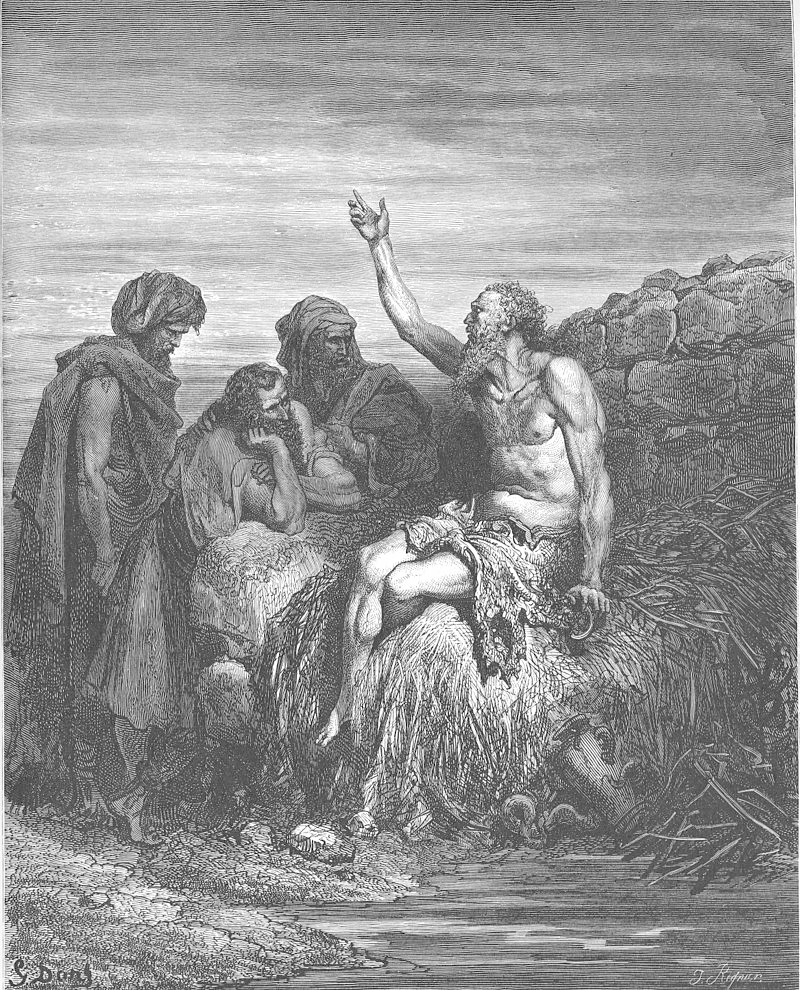
Job speaks with his friends, by Gustave Doré, 1866

Then Bildad the Shuhite replied:

“When will you end these speeches?
    Be sensible, and then we can talk.
Why are we regarded as cattle
    and considered stupid in your sight?
You who tear yourself to pieces in your anger,
    is the earth to be abandoned for your sake?
    Or must the rocks be moved from their place?

“The lamp of a wicked man is snuffed out;
    the flame of his fire stops burning.
The light in his tent becomes dark;
    the lamp beside him goes out.
The vigor of his step is weakened;
    his own schemes throw him down.
His feet thrust him into a net;
    he wanders into its mesh.
A trap seizes him by the heel;
    a snare holds him fast.
A noose is hidden for him on the ground;
    a trap lies in his path.
Terrors startle him on every side
    and dog his every step.
Calamity is hungry for him;
    disaster is ready for him when he falls.
It eats away parts of his skin;
    death’s firstborn devours his limbs.
He is torn from the security of his tent
    and marched off to the king of terrors.
Fire resides in his tent;
    burning sulfur is scattered over his dwelling.
His roots dry up below
    and his branches wither above.
The memory of him perishes from the earth;
    he has no name in the land.
He is driven from light into the realm of darkness
    and is banished from the world.
He has no offspring or descendants among his people,
    no survivor where once he lived.
People of the west are appalled at his fate;
    those of the east are seized with horror.
Surely such is the dwelling of an evil man;
    such is the place of one who does not know God.” (New International Version)

It only makes sense that Bildad was expecting a sensible discussion with Job.

But it was not going to happen.

Why?

Because grief doesn’t make sense; it’s nonsensical, whimsical, and fractal.

If you’ve ever been in a discussion with someone in which the person speaks illogically, it’s likely that you tried to talk sensibly and logically, pointing out the thought process.

And if you have ever done that, it’s also likely that the person did not change one iota of what they said.

Why?

Because people are not primarily thinking creatures who happen to have emotions. Instead, people are emotional creatures who happen to think.

Why do people ask, “Why?”

Because they’re angry. It’s not a cerebral question; it’s an emotional question.

Bildad, a “friend” of Job, was exasperated with his carrying on about being innocent, contending with God, and expressing anger – which is rather funny, because Bildad himself was angry.

Why?

Because supposedly logical and controlled people have illogical and emotional issues, too.

Welcome to the human race, all of you who pride yourselves on your flawless logic and neatly formed theology.

There is a chunk of people in this world who think that everything either works, or ought to work, according to Cartesian coordinates.

A Cartesian coordinate system describes the position of points in space using perpendicular axis lines that meet at a point called the origin. Any given point’s position can be described based on its distance from the origin along each axis. In other words, Cartesian coordinates allow one to specify the location of a point.

So, why am I talking about Cartesian coordinates?

Because that is what Bildad the Shuhite was trying to do with Job, to fix him on a plane that he could understand.

Because in Bildad’s theological world, the wicked are punished by God with bad circumstances and suffering. In the Cartesian world, as the wickedness increases, so does the pain and suffering.

Hence, one is being punished by God… But does the world really operate according to Bildad’s conception of it?

Hell no! (apparently wicked people say that sort of thing when not in the Cartesian world; they should probably get right with God; and, by the way, sarcastic people are wicked, too)

Bildad went so far as to suggest that perhaps Job doesn’t know God at all.

After all, that’s where one goes in a conversation with someone who doesn’t conform to clear and tidy Cartesian-style theology.

They can preach hellfire and damnation to others, yet when another even uses the word “hell” in a phrase, that is where they’re going to go.

It seems that Bildad isn’t really making sense.

Why?

Because he’s stuck. He cannot imagine life outside of his theological bubble.

The difference between Bildad and Job is that Job will admit that he is stuck, confused, messed-up, angry, and has no decent answer to what is going on in his life.

Whereas Bildad would never admit such a thing, even though he is so far stuck in the mud that it would take a divine miracle to get him out.

In fact, it appears we all need a divine miracle.

But God is silent.

Why?

I don’t know. But I do know that it won’t be for long.

Everyone might want to brace themselves for what’s coming.

Why?

Because we will receive precisely what we’re looking for: A word from God. But it’s probably not going to be what we expect.

After all, we aren’t living in a world of Cartesian coordinates.

O Lord God almighty, Creator of heaven and earth: I admit that these people you created drive me nuts! And I’m one of them! I can barely live with myself, let alone others.

In my wondering and confusion and pain, it’s hard to focus on anything. I don’t know why everything is upside-down and topsy-turvy. Yet, somehow I know, and am convinced, that you are present with me, and that you love me.

How in the world could I accept good from you, and not bad? If you love me, and are present with me, then I believe that whatever happens from this point forward, I shall not be forsaken by you.

Contend with those who contend against me. Help me with today, for tomorrow has enough worries of its own. Amen.

A Sad Family Situation (2 Samuel 14:25-33)

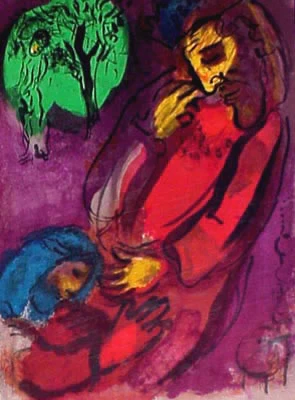
David and Absalom, by Marc Chagall, 1956

In all Israel there was not a man so highly praised for his handsome appearance as Absalom. From the top of his head to the sole of his foot there was no blemish in him. Whenever he cut the hair of his head—he used to cut his hair once a year because it became too heavy for him—he would weigh it, and its weight was two hundred shekels by the royal standard.

Three sons and a daughter were born to Absalom. His daughter’s name was Tamar, and she became a beautiful woman.

Absalom lived two years in Jerusalem without seeing the king’s face. Then Absalom sent for Joab in order to send him to the king, but Joab refused to come to him. So he sent a second time, but he refused to come. Then he said to his servants, “Look, Joab’s field is next to mine, and he has barley there. Go and set it on fire.” So Absalom’s servants set the field on fire.

Then Joab did go to Absalom’s house, and he said to him, “Why have your servants set my field on fire?”

Absalom said to Joab, “Look, I sent word to you and said, ‘Come here so I can send you to the king to ask, “Why have I come from Geshur? It would be better for me if I were still there!”’ Now then, I want to see the king’s face, and if I am guilty of anything, let him put me to death.”

So Joab went to the king and told him this. Then the king summoned Absalom, and he came in and bowed down with his face to the ground before the king. And the king kissed Absalom. (New International Version)

Parents are people, and so, they don’t always make sense. David was both a king and a parent. And those two roles often got mixed and complicated for him.

David’s son Abasalom had killed another son, Amnon, who had sexually assaulted a daughter, Tamar, Abasalom’s sister. Yes, it sounds a lot like a Bible soap opera.

Joab, David’s military general (and cousin) convinces the king to bring Absalom back to Jerusalem, having fled Jerusalem after killing Amnon. And David did so. Yet, he gave an order that Absalom was not to come into his presence, even though David longed for his son.

It was a case of the nonsensical – the parental approach of yearning for an adult child, while at the same time, shunning and shaming them. Indeed, these were incongruent actions on the part of David.

When Tamar was assaulted, David found out and was very angry; yet he neither dealt with Tamar by giving her support and compassion, nor dealt with Amnon in meting out justice.

As for Absalom, David’s feelings for him did not translate into action. It appears the story wants us to see the wide gap between King David’s emotions and actions.

Perhaps the emphasis on Absalom’s sheer beauty is designed to emphasize the incongruence of David – this handsome man is put at arm’s length by his father. Furthermore, this behavior would eventually put David’s royal position in jeopardy.

When guilt and shame are not confronted, it leads to a downward spiral into continued levels of degradation.

The assault of Tamar led to the murder of Amnon, which led to the inactions of David. Everyone ended up responding to someone else’s guilt by adding their own guilt to it. In this scenario, everyone loses something, and there is a lot of unnecessary grief.

Abasalom returned to his hometown of Jerusalem. But everything had changed. He was simply existing. Honestly, Absalom needed something, anything, instead of living day after day in a house without any love or acceptance. Absalom was in that awkward place of wanting either mercy or judgment, acceptance or punishment, because to live in limbo was shrinking him to nothing.

For those who know the story of David and Absalom, you understand where all of this family dysfunction is leading; and it will not end well.

It could be that Jesus had this story in the back of his head when he told the parable of the prodigal son (Luke 15). Perhaps Christ wanted us to see what could happen when a father chooses to respond with actions of grace, acceptance, and undeserved kindness. Even though the son had done something awful and was full of guilt, when he finally made his way home, the father ran to him, embraced him, and accepted him with a blowout party.

We can only wonder what would have happened had David stepped into the situations of his children’s lives when they were going awry. Methinks that had David done so, with his characteristic wisdom and mercy, there would have been a very different outcome in his family.

One way of viewing this story is that the incongruence of King David toward Absalom, with his combination of longing and rejection, was a stubborn passive-aggressive refusal to give his son the grace and love which God had given to him. In light of the story’s eventual end, this view makes a lot of sense.

Yet, this doesn’t have to be the same for you or me in our family relationships today. We can choose to love, instead of inflexibly holding on to a denial of love. One can do all the mental gymnastics of justifying that denial by believing you’re teaching the kid a lesson, or giving them what they deserve, but it’s really, at it’s core, choosing not to love with the love provided by God.

Réconciliation d’Absalom et de David, by Gabriel de Saint-Aubin, 1752

Absalom eventually entered David’s throne room and received a kiss. But it was simply too little, too late. And that’s why, at some point after this, Absalom decided to replace his emotionally and actively distant father as king.

If guilt, shame, evil, and sin go unchecked for too long, it makes for a terrible mess of people’s lives; and usually results in either verbal violence, physical violence, or both.

But it doesn’t have to be that way….

For being quick to see the sins of others, and slow to repent of our own, forgive us, Lord.

For clinging to remembered hurts, and brushing off gestures of kindness, forgive us, Lord.

For the divisions among us that damage our mission to the world, forgive us, Lord.

For the work we have not done because we refused to do it together, forgive us, Lord.

For these and all our sins, O God, we weep in sorrow and ask for your forgiveness, through Jesus Christ our Lord. Amen.

Effective Communication (Acts 17:16-31)

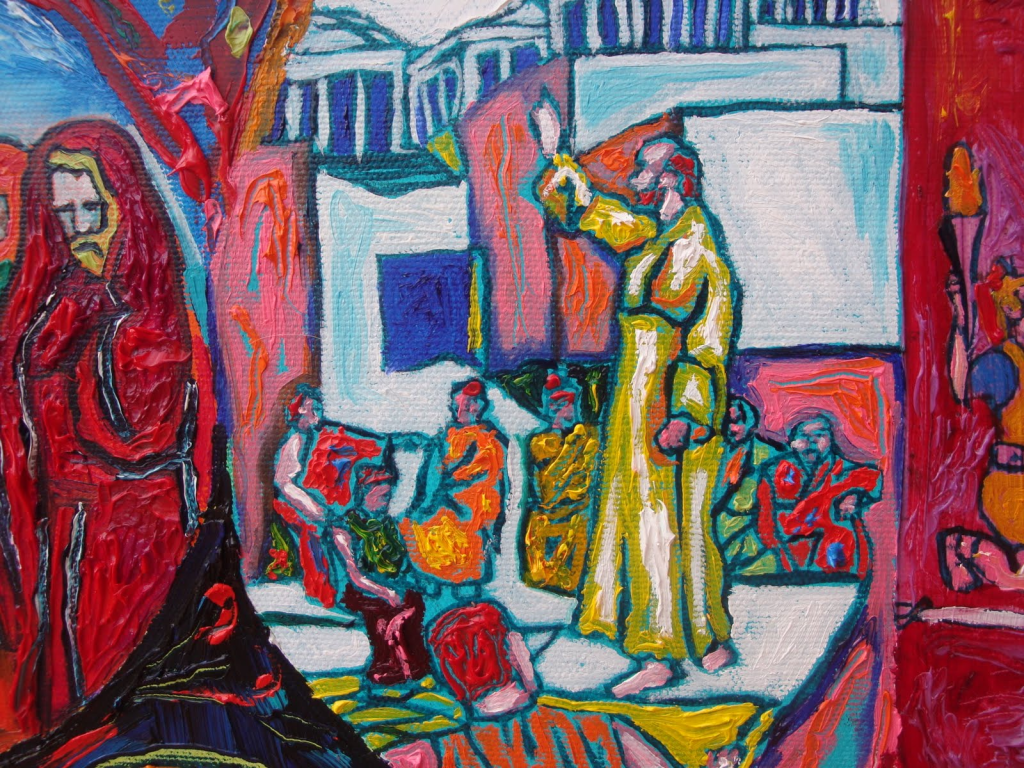
St. Paul preaching at the Areopagus in Athens, by Kennedy A. Paizs

While Paul was waiting for them in Athens, he was deeply troubled by all the idols he saw everywhere in the city. He went to the synagogue to reason with the Jews and the God-fearing Gentiles, and he spoke daily in the public square to all who happened to be there.

He also had a debate with some of the Epicurean and Stoic philosophers. When he told them about Jesus and his resurrection, they said, “What’s this babbler trying to say with these strange ideas he’s picked up?” Others said, “He seems to be preaching about some foreign gods.”

Then they took him to the high council of the city. “Come and tell us about this new teaching,” they said. “You are saying some rather strange things, and we want to know what it’s all about.” (It should be explained that all the Athenians as well as the foreigners in Athens seemed to spend all their time discussing the latest ideas.)

So Paul, standing before the council, addressed them as follows: “Men of Athens, I notice that you are very religious in every way, for as I was walking along I saw your many shrines. And one of your altars had this inscription on it: ‘To an Unknown God.’ This God, whom you worship without knowing, is the one I’m telling you about.

“He is the God who made the world and everything in it. Since he is Lord of heaven and earth, he doesn’t live in man-made temples, and human hands can’t serve his needs—for he has no needs. He himself gives life and breath to everything, and he satisfies every need. From one man he created all the nations throughout the whole earth. He decided beforehand when they should rise and fall, and he determined their boundaries.

“His purpose was for the nations to seek after God and perhaps feel their way toward him and find him—though he is not far from any one of us. For in him we live and move and exist. As some of your own poets have said, ‘We are his offspring.’ And since this is true, we shouldn’t think of God as an idol designed by craftsmen from gold or silver or stone.

“God overlooked people’s ignorance about these things in earlier times, but now he commands everyone everywhere to repent of their sins and turn to him. For he has set a day for judging the world with justice by the man he has appointed, and he proved to everyone who this is by raising him from the dead.” (New Living Translation)

Ancient ruins of Athens, Greece

The city of Athens was a major intellectual center in the ancient world. Ideas, philosophy, reason, rhetoric, and debate were standard fare amongst the citizens. At the time of the Apostle Paul’s arrival in the city, Greece knew next to nothing about Christianity.

Paul’s response to what he saw and felt in the city dictated what he did and said. And those words were wise and impactful for the people of Athens. The Apostle’s interaction with the philosophers was like a seminar in how to communicate with folks who believe and live very differently than ourselves.

Observation

Paul entered the city and made a simple observation: Athens is full of idols. Out of all the observations Paul could have made, this one would not likely be made by most people visiting the city. Athens was a glorious place with its unparalleled architecture. The Acropolis and the Agora were resplendent with the arts and democracy.

For all its physical beauty and brilliance, the one thing Paul homed-in on was the idols. This would have struck many folks as odd – something like focusing on the dog collar instead of the dog. Yet, Paul was using more than his physical eyes – his spiritual sight was making a big observation – that Athens was very much a religious place.

Feeling

The Apostle felt troubled and distressed. Paul was disturbed down deep in his gut with the spiritual state of this renowned city-state. The sheer volume of idols and the practice of idolatry did not sit well with him. He experienced feelings of pity mixed with anger.

Paul handled his emotions well. By freely acknowledging them, he was then able to choose his response. Had he not done so, it’s likely Paul might have gone on some frustrating tirade, thereby never truly connecting relationally with the people. There’s nothing wrong with being irritated or exasperated; it’s what we do with those feelings that’s important.

Need

Emotions, not thoughts, move us to act. Paul knew why he was feeling disturbed, and decided not to stuff those feelings. Instead, he stepped out and addressed the great need he was observing.

Paul decided to meet the Athenians on their turf and on their level by reasoning with them every day in the great buildings and open spaces of the city.

While in Athens, it seems that Paul, understandably, utilized the Socratic method of dialogue – involving questions and answers. It’s impressive that throughout the Acts of the Apostles, Paul demonstrated a deft ability to communicate and connect with a broad range of people.

Appeal

Paul wasn’t interacting and dialoging just for the fun of it; he wanted to make an appeal, a request for people to seriously consider the Christian good news of Jesus Christ’s resurrection as a viable philosophy of life. He made a widespread appeal to Jews, Greeks, and passers-by, as well as philosophers.

Since the massive intellect of Paul could handle any reasoned debate, he was invited to the Areopagus, which was the place where the best-of-the-best carried-on their discussions.

Paul’s address to them was incredibly cogent and well-reasoned – finding common ground from which to debate. While doing so, he maintained outward grace amidst his inward disturbance.

Conclusion

The late British exegete, John R.W. Stott, reflected on today’s New Testament lesson and gave us words which are still relevant for us in these contemporary times:

“Why is it that, in spite of the great needs and opportunities of our day, the church slumbers peacefully on, and that so many Christians are deaf to Christ’s commission, and dumb with tongues-tied in testimony? The major reason is this: We do not speak as Paul spoke because we do not feel as Paul felt. We have never had his indignation. Divine jealousy has not stirred within us. We constantly pray, ‘Hallowed be Thy Name,’ yet we do not seem to mean it… Paul saw people created in the image and likeness of God giving to idols the homage which was due to God alone… and he was deeply pained by it.”

May the good news of Jesus Christ be so pressed into our minds, hearts, and guts that what comes out of us is deep compassion, wise dialogue, and an effective ministry of communication with others. Amen.

Trust vs. Anxiety (Isaiah 30:15-18)

The holy Lord God of Israel
    had told all of you,
“I will keep you safe
if you turn back to me
    and calm down.
I will make you strong
    if you quietly trust me.”

Then you stubbornly said,
“No! We will safely escape
    on speedy horses.”

But those who chase you
    will be even faster.
As few as five of them,
or even one, will be enough
    to chase a thousand of you.
Finally, all that will be left
    will be a few survivors
as lonely as a flag pole
    on a barren hill.

The Lord God is waiting
to show how kind he is
    and to have pity on you.
The Lord always does right;
he blesses those who trust him. (Contemporary English Version)

God’s plan for our lives calls for times of retreat and renewal, of quiet patience and perseverance, for restraint and waiting.

Ancient Judah was experiencing one of their many periods of rebellion toward God’s commands. One of the things that happens – whether in ancient times or today – is that whenever we go off the road of God’s ways, our lives become characterized by a grand self-help program.

Those in the Judean royal court could not wait on God. They had to do something about Assyria. The Assyrian Empire was waning, and Judah wanted to take advantage of it, seeing an opportunity for some relative autonomy.

So, many of the activists in the royal court rushed to Egypt for help – not at all considering to turn toward God and wait on the Lord. God blesses those who trust and wait on divine promises and initiative. But, in their anxiety, the people of Judah would not exercise faith and patience.

As a result, the enemy would overtake them. The people’s refusal to take the quiet course would not end well for them.

On many days, as I attend to the hospitals for which I work, I visit many hurting people, including patients, their families, and teammates. In my time there, I deal with a vast array of emotional problems, spiritual struggles, and mental disorders. One of things I have discovered through this work is that people’s internal issues absolutely need to be expressed, out loud, to someone who cares and knows what to do with those expressions.

And this is not only a modern problem; the need to deal with our internal stuff has been there throughout all of human history. Every culture and society who does not attend well to personal and communal spiritual health is literally killing their bodies – because body and soul are inextricably connected in a union as one.

It continually amazes me that people who think nothing of going to a medical doctor, an emergency room, or having a surgery, would never think of getting help when their minds are mixed up, emotions are frayed, and spirits are downcast.

Stubbornly holding onto self-help to handle a spiritual crisis, refusing help from others, and ignoring God, is just as sure to kill you as believing that chest pains, shortness of breath, and inability to walk across the room will simply get better on its own.

Conversely, isolating oneself and calling it “waiting on God” and remaining passive – when the Lord has clearly told us to be active – will accomplish the same ends as the committed self-help person. Faith and action are not mutually exclusive terms. It takes some wisdom to know when to retreat, pray, and be patient; and when to take initiatives of faith, and trust God to work through action.

Rebellion gets us nowhere. It’s what puts us in the awkwardness of making bad decisions and discernments. The Lord had told the people of Judah to stay put and not rely on Egypt to help them. There were clear instructions through the prophets about what to do. But the people were too anxious, too impatient, wondering too much about whether God would show up or not.

The Spirit God gave us does not make us afraid. His Spirit is a source of power and love and self-control.

2 Timothy 1:7, ERV

No matter where we have been or what we have done, the Lord is continually waiting on us – and will consistently respond with grace and mercy to our petitions and overtures to live for God. It’s never too late to flee to God in quiet trust.

Running to God is not escaping our problems. Rather, the Lord enables us to face both our outward situations, as well as our inward thinking and feeling. It’s easy to engage in busywork and keep active when we are anxious; yet it is very difficult to sit still before God and be alone. Silence and solitude put us face to face with ourselves. And doing that is what many people would rather avoid.

“I’ll do it myself!” is the cry of many a person who is mentally, emotionally, and spiritually overwhelmed. That approach, however, is a highway to the grave. And, in fact, it is a stubborn rebellion that puts a stiff arm to God.

I’m not saying that opening-up is easy; I am stating that it is necessary to our spiritual and emotional health. It might be helpful to begin communicating with some vulnerability and authenticity to God. The following are some appropriate ways that might help:

  1. Be congruent between the outer self and inner self. Make sure your outside affect and behavior is congruent with your inside feelings and thoughts. If you are discouraged on the inside, but wear a smile and pretend to be spiritually with it, you’re not fooling God. You cannot receive grace apart from humble authenticity.
  2. Focus on feelings. You won’t get struck by lightning if you express your anger, or other emotions, to God. Be aware of how you are feeling. In fact, ask the Lord to help you understand your feelings. Share them openly as much as you can.
  3. Change questions into statements. Sometimes, when we have an attitude or a feeling, we’re afraid to say it and be open. So instead, we ask a question. Try changing questions such as “Do you love me?” into “I love you.” And, “Do you want me to do this?” to “I want to do your will.”
  4. Speak in the first person. Begin sentences with “I” instead of “you,” For example, ” I am happy that you are with me,” instead of asking, “Are you there?”
  5. Say out loud what you really want and need. It’s okay to do that. This is when it is appropriate to ask questions. The Lord’s ear is ready to listen.

Patient and confident trust in God is always a better option than anxious and nervous striving by yourself.

O God, the source of all health: So fill my heart with faith in your love, that with calm expectancy I may make room for your power to possess me, and gracefully accept your healing; through Jesus Christ our Lord. Amen.