From Adversaries to Allies (Isaiah 19:18-25)

In that day five cities in Egypt will speak the language of Canaan and swear allegiance to the Lord Almighty. One of them will be called the City of the Sun.

In that day there will be an altar to the Lord in the heart of Egypt, and a monument to the Lord at its border. It will be a sign and witness to the Lord Almighty in the land of Egypt. When they cry out to the Lord because of their oppressors, he will send them a savior and defender, and he will rescue them. 

So the Lord will make himself known to the Egyptians, and in that day they will acknowledge the Lord. They will worship with sacrifices and grain offerings; they will make vows to the Lord and keep them. The Lord will strike Egypt with a plague; he will strike them and heal them. They will turn to the Lord, and he will respond to their pleas and heal them.

In that day there will be a highway from Egypt to Assyria. The Assyrians will go to Egypt and the Egyptians to Assyria. The Egyptians and Assyrians will worship together. In that day Israel will be the third, along with Egypt and Assyria, a blessing on the earth. The Lord Almighty will bless them, saying, “Blessed be Egypt my people, Assyria my handiwork, and Israel my inheritance.” (New International Version)

Yahweh is so much more than an ancient local Israelite deity. This is the Lord God almighty, creator of heaven and earth. God is the Lord of the universe, and Israel is not just a sliver of land in the Middle East.

As such, all peoples belong to God. And God is concerned for all the nations. In the ancient world, the Lord was even concerned for places like Egypt and Assyria – two nations which historically treated Israel with contempt and oppression.

The Lord God, Yahweh, as the prophet Isaiah stated, will be revealed to the Egyptians, so that they, too, will worship the Lord with sacrifices and offerings. They will revere God with a monument to Yahweh’s saving power.

The Egyptians will make religious vows and fulfill them. And there will also be relations with Assyria. Israel will exist alongside – and literally geographically in the middle – the powers of Egypt and Assyria. And Israel will serve as a blessing between them.

In other words, God will choose to bless, bringing both religious and political balance and peace. It is rather extraordinary that the Lord speaks of Egypt as “my people” and Assyria as “my handiwork.” God’s vision is always much larger than our own puny human sight or imagination.

In a biblical book filled with sad visions of judgment and God’s wrath, today’s Old Testament lesson is a beautiful vision of hope and peace. This, my friends, is what can be! It doesn’t have to be a pipe dream that various peoples who are historical enemies of one another can walk together in the peace and wholeness of God’s blessing. This is no impossible, although it appears highly improbable.

It takes little effort to hold onto hate and enmity; but it takes a great deal of energy to work on peacemaking, and loving those who have harmed others so terribly.

The fact of the matter is that Yahweh responds to every people who cry out in their oppression – even those who were once oppressors themselves.

That is called “grace,” and it is why grace is so scandalous, because a lot of folks don’t want to see grace extended to those they dislike, hate, and even want dead.

God will do for other nations what God did for Israel, in delivering them from their harsh slavery. The Lord’s ears hear everyone on the earth, and not just some people.

All of the hard-hearted resistance of the past, personified so stubbornly in the Pharaoh who would not let go of Israel, is remarkably overcome and reversed.

This is how it always seems to operate throughout history, including today. People cry out and are delivered, then worship the God who granted them grace and freedom. We very often come to believe because we were in some sort of awful trouble, which caused us to cry out and acknowledge the God who saves.

God both strikes and heals, attacks and helps. God moves people from rancorous relationships to robust reconciliation.

People, however, are not passive in any of this process. Those who are already blessed and enjoy God must relinquish any sort of exclusive thoughts or practices and be willing to share their identity and privilege with others who were once enemies.

Unity, harmony, wholeness, and a true ecumenical spirit and vision will bring people together. The benefits are wonderful, yet let it also be acknowledged that reconciliation and relationships require giving up any sense of being better than the other, or holding on to primacy of positions and power.

Stated positively, it means that we embrace a diversity of people, including them in every way possible, because we discern them as being equals, and not so different from me.

God has other chosen people besides me and you. Can you accept that?

“Egypt comes home to its true self only as Israel opens its sense of privilege to its adversaries.”

Walter Brueggemann

The Lord opposes the arrogant and proud, but gives grace to the humble. God will gladly deliver and welcome all peoples.

If we have the spiritual eyes to see, we will notice and observe that the world is God’s chosen people.

O God, hear our humble prayer, so that we may serve you in holiness and faith, giving voice to your divine presence among us until the coming of your Son, Jesus Christ, who lives and reigns forever and ever. Amen.          

Telling a Story of Faith (Deuteronomy 26:5-10)

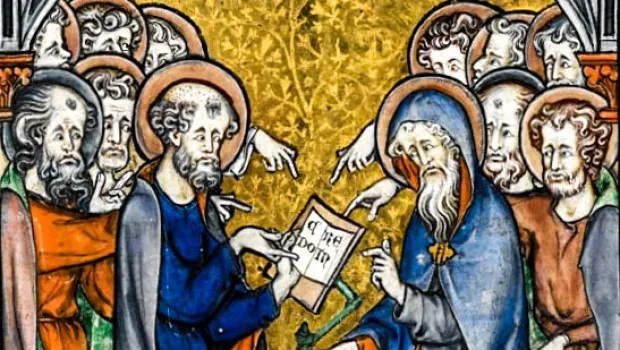
A 13th century artwork depicting the Apostles writing the Creed

Then, standing there in front of the place of worship, you must pray:

My ancestor was homeless,
an Aramean who went to live
    in Egypt.
There were only a few
    in his family then,
but they became great
and powerful,
    a nation of many people.

The Egyptians were cruel
    and had no pity on us.
They mistreated our people
    and forced us into slavery.
We called out for help
to you, the Lord God
    of our ancestors.
You heard our cries;
you knew we were in trouble
    and abused.
Then you terrified the Egyptians
with your mighty miracles
    and rescued us from Egypt.
You brought us here
and gave us this land
    rich with milk and honey.
Now, Lord, I bring to you
the best of the crops
    that you have given me.

After you say these things, place the basket in front of the Lord’s altar and bow down to worship him. (Contemporary English Version)

Forty years of wandering throughout the desert, in the backside of the wilderness. Having been delivered out of Egypt by the mighty hand of God, the Israelites were on a very circuitous journey to the Promised Land.

The Book of Deuteronomy is a restatement of the people’s history and God’s law for the generation about to enter the land of Canaan. Moses told the people that when they enter the land and have their first harvest of crops, they are to remember and give thanks for all their blessings.

People need to be reminded of important things. Sometimes, in the middle of success and good fortune, we can forget to savor the moment, neglect to appreciate what it took to get to this place, and fail to celebrate with others the God who has made good things happen.

Interestingly, in appreciation for the abundance of a harvest, Moses did not tell the people to give thanks for the weather or the crops themselves. Rather, they were exhorted to recall and retell the story of Israel and their ancestors.

Through historical narrative, the Israelites tethered themselves to their present reality. They located themselves in the past, as contemporary links in a holy chain that stretched generations, all the way back to the patriarch Jacob.

This sort of relational and generational gratitude is in stark contrast to what current cultural appreciation and thanksgiving is, for cars, homes, jobs, resources, and stuff. Although thankfulness is appropriate and necessary for those things, none of it is lasting and sustainable.

Beneath all of the purchased things and electronic devices is a longing for connection, a desire to know who we are, where we came from, and what our true roots are.

Greater emotional health comes from knowing where we came from. Our connections to family, friends, church, and community are a vital and essential piece of living a good life with satisfaction and contentment.

Healthy roots enable us to respond well to the challenges of life with strength and resilience.

One way to recall and remember is to recite a creed. Sadly, many churches today recoil at reciting creeds and confessions, as if this were a bad thing. But there is significance and power to a group of people who stand and recite an ancient creed together.

The Christian ecumenical church creeds, including the Apostles’ Creed, Nicene Creed, and Athanasian Creed, capture the settled convictions of early believers in Jesus as they struggled to express their faith in the church and the world.

Those creeds are a part of us, and of our collective spiritual history as the people of God. There are yet other kinds of creeds, as well. We have an even more ancient creed expressed in today’s Old Testament lesson – the sort of creed that tells a story.

Moses gave the Israelites some parting instructions to follow for their future worship in the Promised Land. When they enter the land a bring in their harvest, they were to bring the first-fruits of their crops to the priest, and then profess a creed, which is really a story, a historical narrative of God’s people.

Every Jewish farmer and worshiper who brought their crop to the priest would recite the creed about their ancestors suffering in Egypt and being redeemed by God through a great deliverance. God granted them the gift of land, a promised place to call their own.

We as the people of God must discern the importance of embracing the story of redemption, of crying out and being delivered from the shackles of sin, death, and hell. We receive this salvation with thanksgiving and joy.

Christians tell their story of deliverance not only through the ancient ecumenical creeds, but also through the sacramental means of communion. The Table proclaims the life and death of Christ, given for us, and for our salvation. It is a story with deep roots in the life of Israel.

Believers in Jesus are invited to participate is something bigger than themselves. The Christian’s story begins not at Pentecost in the New Testament, but in the promise to Abraham way back in the Old Testament.

The blessing given to Abraham was a blessing for all nations, not just Israel (Genesis 12:1-3). Knowing the roots of our spiritual life and Christian faith helps inform us how we are to live out that faith and life in this present time.

Within Christianity, our history and story is much bigger than Europe and Western civilization. The earliest church began in the Middle East. Ancient Christian traditions and churches still exist, and worship today in places like Egypt and Ethiopia. There are presently large numbers of Christians in every part of the world, especially in Latin America, Asia, and Africa.

Essentially, we are the lost, the last, the forgotten, the outsiders who cried out to God. And the Lord rescued us, blessed us with every spiritual blessing in Christ, and gave us the privilege of being ambassadors for Christ in the world.

We belong to God. Along with believers throughout the ages, and across the world, we declare:

I believe in God, the Father almighty,
creator of heaven and earth.

I believe in Jesus Christ, his only Son, our Lord.
He was conceived by the power of the Holy Spirit
and born of the Virgin Mary.
He suffered under Pontius Pilate,
was crucified, died, and was buried.
He descended to the dead.
On the third day he rose again.
He ascended into heaven,
and is seated at the right hand of the Father.
He will come again to judge the living and the dead.

I believe in the Holy Spirit,
the holy catholic Church,
the communion of saints,
the forgiveness of sins,
the resurrection of the body,
and the life everlasting. Amen.

1 John 2:18-28 – Who Is the Real Enemy?

Dear children, this is the last hour; and as you have heard that the antichrist is coming, even now many antichrists have come. This is how we know it is the last hour. They went out from us, but they did not really belong to us. For if they had belonged to us, they would have remained with us; but their going showed that none of them belonged to us.

But you have an anointing from the Holy One, and all of you know the truth.I do not write to you because you do not know the truth, but because you do know it and because no lie comes from the truth. Who is the liar? It is whoever denies that Jesus is the Christ. Such a person is the antichrist—denying the Father and the Son. No one who denies the Son has the Father; whoever acknowledges the Son has the Father also.

As for you, see that what you have heard from the beginning remains in you. If it does, you also will remain in the Son and in the Father. And this is what he promised us—eternal life.

I am writing these things to you about those who are trying to lead you astray. As for you, the anointing you received from him remains in you, and you do not need anyone to teach you. But as his anointing teaches you about all things and as that anointing is real, not counterfeit—just as it has taught you, remain in him. (New International Version)

Identifying the Antichrist is almost a spectator sport amongst some Christians. They seem to enjoy advancing particular persons as the archenemy of Christ and the Church.

Throughout Christian history, bloodthirsty kings and ruthless dictators have typically received the moniker of Antichrist. When the Protestant Reformation came along, five-hundred years ago, the Catholic Church often got labeled as the great enemy of Christianity.

The mudslinging that has gone on between different Christian traditions throughout the centuries can make any contemporary political war look like a powder puff football game.

Although some Christian groups tend to view the antichrist as a single enemy, setting-off a bomb of world-ending trauma, the earliest Church, following the teaching of the Apostle John, understood antichrist not as an individual, but as a class of people who deny Jesus is the Christ. 

It has become much too vogue in some circles of Christianity to identify and label enemies outside their small groups, leading to a xenophobic attitude of distrust and finger-pointing toward all kinds of people.


The fingers, however, must first be directed within our own house. It behooves us all to take up the instruction of John to let what we have heard from the beginning abide in us. If what you heard from the beginning abides in you, then you too will abide in the Son and in the Father. 

We are to embrace basic core cardinal truth given us. Then we will not be deceived by some supposed enlightened teacher who detracts from Trinitarian theology.

It is the last hour – but not because of some politician, tyrant, or religious figure. It is the end-times because Jesus has accomplished redemption for us, and the only event left is the return of Jesus to judge the living and the dead. 

Therefore, we must all live with the possibility and tension that it could be today. We are to be prepared. Proper preparation comes through proclaiming Jesus in all we say and do – not by obnoxiously ginning up fearmongering through pointing fingers at those we don’t like. Rather, we emulate our Lord in the way of loving God and neighbor.

When a person or group gets labeled by us as “enemy” or “antichrist” then our hate for them seems divinely justified and sanctioned. God, however, is the judge; not us. We are to follow the ethical instruction of Jesus to love our enemies, not curse them through declaring certain persons a “monster,” “devil,” “animal,” or some other non-human label.

Weaponizing words in a verbal war, which supposedly defends Christianity, only shifts the focus off Jesus and onto how horrible another is.

One of the great problems in our world, including many corners of Christianity, is that we assume we already know what another believes. So, we fail to listen. We cannot care as we ought because we’ve already formed our judgment.

“The moment someone attaches you to a philosophy or a movement, then they assign all the baggage and all the rest of the philosophy that goes with it to you. And when you want to have a conversation, they will assert that they already know everything important there is to know about you because of that association. And that’s not the way to have a conversation.”

Neil deGrasse Tyson

Within Christianity, there is more we have in common across the various traditions, than that which is different. Yes, spiritual charlatans exist. Let’s just make sure we have done our due diligence in listening to another and being curious before we form our opinions.

Despite the differences, the exchange of ideas and debate among various Christian groups in the early centuries of the church helped to clarify and form a sound Christology. While it may be difficult to avoid labeling individuals in an increasingly complex society, we must act in good faith and make the effort.

Perhaps we have already met the real enemy… us.

Gracious God, you are the Divine Gardener who cares for us with love. You call us to see the beauty of each branch united to the vine, the beauty of each person united to you in Christ through the Holy Spirit.

And yet, too often the differences in others make us afraid. We withdraw into ourselves. Our trust in you is forsaken. Enmity develops between us. Come and direct our hearts. Help us to live from your forgiveness so that we may be together and praise your name.

Lord Jesus, Prince of Peace, light the fire of your love in us so that suspicions, contempt and misunderstanding cease in the church. May the walls that separate us fall. Amen.

The Kingdom of God


          So, what is of first importance?  When it comes to ministry, what is to be of priority?  Jesus said in Matthew 6:33, in response to a lack of faith manifested through worry: “But seek first the kingdom of God and his righteousness….” I suppose Jesus could have said a lot of things to seek first. Seek salvation, seek family, seek love, seek justice, seek the church, seek me. Yet, the kingdom really encompasses all that and more. 


The kingdom has to do with the rule and reign of God in this world. It is distinguished from the church in that the church has to do with the people within God’s rule. The church, then, might be said to be the means to the end of establishing God’s kingdom rule, and is not a cul-de-sac where we just try to get people to attend church services.  The kingdom may be said to be a broader concept than the church because it aims at nothing less than the complete control of all manifestations of life. It represents the dominion of God in every sphere of humanity.

Here is how it works (ideally!):  The church proclaims the gospel and brings people into the church. New believers then begin to enjoy all the blessings of God’s kingdom rule in their lives: victory over sin and the availability of the power of the Holy Spirit. If we lose sight of the kingdom of God, we become insular and think that our particular church or Christian organization is the goal of ministry, and that issues outside our ministry have no real merit for our attention. Apart from the kingdom, the systemic problems surrounding justice, racial reconciliation, and poverty all take a backseat to personal expressions of faith in my limited sphere of doing my own thing, man.

When it comes to any particular church, denomination, or para-church ministry, if we have a kingdom mindset, we desire to see God’s reign expand across our community and we will work collaboratively to see this realized. Then it does not become “my” ministry and “your” ministry, but our ministry. It is no longer you and me, but we as kingdom minded people. This takes time and effort. But after all, our focus is to be in seeking first the kingdom as priority for ministry.

How do you think a kingdom mentality would change the face of your life and ministry?