
Be Brave, Not Afraid (Deuteronomy 31:1-13)

Then Moses went out and spoke these words to all Israel: “I am now a hundred and twenty years old and I am no longer able to lead you. The Lord has said to me, ‘You shall not cross the Jordan.’ The Lord your God himself will cross over ahead of you. He will destroy these nations before you, and you will take possession of their land. Joshua also will cross over ahead of you, as the Lord said. And the Lord will do to them what he did to Sihon and Og, the kings of the Amorites, whom he destroyed along with their land. The Lord will deliver them to you, and you must do to them all that I have commanded you. Be strong and courageous. Do not be afraid or terrified because of them, for the Lord your God goes with you; he will never leave you nor forsake you.”

Then Moses summoned Joshua and said to him in the presence of all Israel, “Be strong and courageous, for you must go with this people into the land that the Lord swore to their ancestors to give them, and you must divide it among them as their inheritance. The Lord himself goes before you and will be with you; he will never leave you nor forsake you. Do not be afraid; do not be discouraged.”

So Moses wrote down this law and gave it to the Levitical priests, who carried the ark of the covenant of the Lord, and to all the elders of Israel. Then Moses commanded them: “At the end of every seven years, in the year for canceling debts, during the Festival of Tabernacles, when all Israel comes to appear before the Lord your God at the place he will choose, you shall read this law before them in their hearing. Assemble the people—men, women and children, and the foreigners residing in your towns—so they can listen and learn to fear the Lord your God and follow carefully all the words of this law. Their children, who do not know this law, must hear it and learn to fear the Lord your God as long as you live in the land you are crossing the Jordan to possess.” (New International Version)

The Old Testament book of Deuteronomy is all about remembering and being reminded of what we already know. There’s really nothing new under the sun. So, our task as people is mostly to recall and bring to our minds and heart those things which we need to remember.

We humans have this tendency to remember the things we need to forget, and to forget the things we must remember. And what is to be continually remembered and recalled is that there is no basis to be afraid when God is with us and will fulfill divine promises.

For Christians, the resurrection of Christ from death has changed everything – especially when it comes to fear. In this Christian season of Eastertide, we discover and explore the vast implications of what it means to possess a new life. 

Because Christians serve a risen Savior, this newfound reality brings courage and confidence. Fear isn’t something we simply dismiss with willpower. Rather, fear begins to loosen and diminish whenever there is an awareness of God’s presence among us. Consider just a few of the many references to this in Holy Scripture, in addition to the statements in today’s Old Testament lesson:

Remember, I commanded you to be strong and brave. Don’t be afraid because the Lord your God will be with you wherever you go.” (Joshua 1:9, ERV)

 Don’t fear, because I am with you;
    don’t be afraid, for I am your God.
    I will strengthen you,
    I will surely help you;
    I will hold you
    with my righteous strong hand. (Isaiah 41:10, CEB)

Be happy with what you have because God has said, “I will never abandon you or leave you.” So we can confidently say,

“The Lord is my helper.
I will not be afraid.
What can mortals do to me?” (Hebrews 13:5-6, GW)

Believe it, or not, the Bible tells us 365 times to not be afraid. Maybe that’s not a coincidence that we can quote a verse every day of the year about our own fearfulness in the face of all life’s challenges.

When it comes to fear and bravery, God does not so much command us to be courageous, as he wants us to draw from the great reservoir of bravery within. That is, God has already created us strong, as creatures in the divine image. We just need to get in touch with what is already there. And, for the Christian, the reality of Easter awakens and calls forth that life.

We can act with boldness and overcome fear because Jesus is the pioneer of our salvation. Christ is the One who enables us to draw from the deep well of courage:

So then, since we have a great High Priest who has entered heaven, Jesus the Son of God, let us hold firmly to what we believe. This High Priest of ours understands our weaknesses, for he faced all the same testing we do, yet he did not sin. So, let us come boldly to the throne of our gracious God. There we will receive his mercy, and we will find grace to help us when we need it most. (Hebrews 4:14-16, NLT)

You and I can do this; we can do hard things. We really can face the fears in front of us. You can surmount the adversity you are in the middle of – not because of some words I say, but because Christ has risen from death. He’s alive, and his presence makes all the difference.

Ever-present God: Give me strength to live another day;
Let me not turn coward before its difficulties or prove recreant to its duties;
Let me not lose faith in other people;
Keep me sweet and sound of heart, in spite of ingratitude, treachery or meanness;
Help me to keep my heart clean and to live so honestly and fearlessly that no outward failure can dishearten me or take away the joy of conscious integrity;
Open wide the eyes of my soul that I may see good in all things;
Grant me this day some new vision of your truth;
Inspire me with the spirit of joy and gladness and make me the cup of strength to suffering souls; in the name of the strong Deliverer, our only Lord and Savior, Jesus Christ. Amen.

It’s About Love (1 Peter 1:17-23)

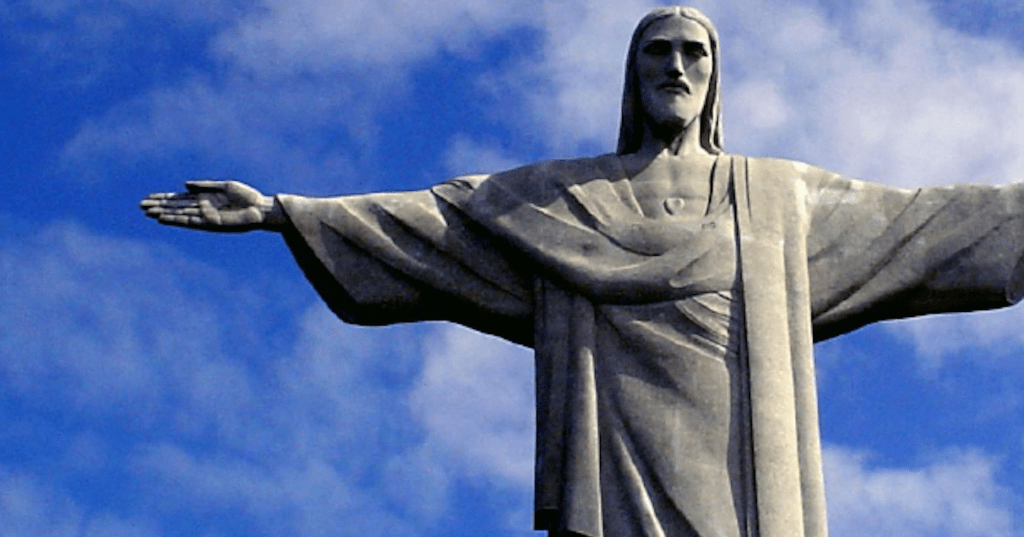
Statue of Christ the Redeemer, Rio de Janeiro, Brazil

Since you call on a Father who judges each person’s work impartially, live out your time as foreigners here in reverent fear. For you know that it was not with perishable things such as silver or gold that you were redeemed from the empty way of life handed down to you from your ancestors, but with the precious blood of Christ, a lamb without blemish or defect. He was chosen before the creation of the world, but was revealed in these last times for your sake. Through him you believe in God, who raised him from the dead and glorified him, and so your faith and hope are in God.

Now that you have purified yourselves by obeying the truth so that you have sincere love for each other, love one another deeply, from the heart. For you have been born again, not of perishable seed, but of imperishable, through the living and enduring word of God. (New International Version)

Love makes the world go round. The cycle of life brings an end to all things. Yet, the permanence of love has always existed, and will never cease to exist. (1 Corinthians 13:8-13)

Biblical godly love comes not because we first loved God, but because God first loved us and gave his Son, Jesus Christ, as an atoning sacrifice for our sins. (1 John 4:7-12)

So, the Christian’s faith and hope are completely grounded in the person and finished work of Jesus. People are so valuable to God that we were purchased from the slavery auction block with the costliest price ever: the precious blood of Jesus. 

To know this love of God in Christ, to be thoroughly captured and enraptured by it, results in a profound and deep love for others. And I’m not only referring to a nice touchy-feely love, but also a steadfast love which is committed to love regardless of what another person says or does.

Love is wonderful. But that doesn’t mean it’s easy. Being on the receiving end of love is a beautiful thing. Giving love, however, can sometimes get dicey.

Although we Christians really do believe that everything in life and ministry centers around the grace and love of God in Christ, our boots-on-the-ground loving sometimes seems compromised and conditional. That’s because it’s easy to love those who love us back. Yet, what if our love is not reciprocated or requited?

This situation brings us face-to-face with our own selves. The painful reality is that we all discover that our love is sometimes, maybe oftentimes, dependent on an assurance that we will be loved in return.

Mutual love is a beautiful thing, but what happens when only one of the persons is able to give love?

What do we do when grace is our only option, when we must choose to love, knowing that love won’t have a response?   

Christians are supposed to give the same kind of love that God shows to us in Christ – which means we need to decide that grace is going to be our lifestyle. It comes down to this: It simply doesn’t matter what condition the other person is in. It doesn’t matter what another is going to say, or not say. Nothing on the other party’s side matters. It…just… doesn’t… matter.

What really matters is our own loving another person deeply from the heart, regardless and in spite of everything else. That, my friends, is real Christian love.         

Since we are redeemed people; have acknowledged the truth of Christ’s redemptive events of crucifixion and resurrection; are recipients of God’s great love to us in Jesus; we must choose to live our lives full of grace and love, no matter what. 

As God’s redeemed people, purchased by the precious blood of Christ, our default response to others is to be this: We will love one another unconditionally.

Unfortunately, over time, many Christians slowly become disconnected from this fountain of grace and love. It is likely that, at some past point, they were deeply touched by a gracious encounter with Jesus Christ. They found peace, love, and joy. Minds were swept up in the awe and wonder of God. Hearts were deeply moved for a few hours, days, or weeks. 

But then, there was a return to the routine grind of daily existence. Gradually, the demands of life took over. Jesus began to be treated like an old friend from another town whom we dearly loved in years past, but have just lost track of. 

Of course, it was unintentional. We simply allowed circumstances to drift us apart. We became preoccupied with something else. Now, we find ourselves with a low level of irritation, frustrated with others and unable to love as we ought. We become what the late author Brennan Manning called “Christian agnostics,” that is, people who do not deny Jesus, but just ignore him.

If your days are trivial and/or hectic…

If the clock determines what you do…

If you are numb to the news and headlines around you…

If you are all jangled and jittered by life’s circumstances…

If phones and computers and gadgets rule your day…

If there is little room for responding to humanity humanely…

If you have settled into a comfortable piety and a well-fed virtue…

If you have grown complacent and lead a practical life…

Then you need to be touched again by the grace and love of God in Christ by treating Jesus as if he were your very best friend as well as the awesome Son of God. 

We are all still here walking on this earth because none of our failures and lack of faith have proved terminal; we are here today because of grace and love. 

The forgiveness of God is a liberation from guilt and regret. It is an extreme amnesty. Through looking in the mirror, and seeing personal sinfulness, we amazingly end up encountering the merciful love of the redeeming God. 

The grace of God says to us, “Hush, child, I don’t need to know where you’ve been or what you’ve been up to; just let me love you.” 

When we have experienced that kind of love, we are then finally able to love one another deeply from the heart. It’s a new life of love, the kind that comes from God – an unconditional love that’s permanent and will never go away.

Therefore, as Christians loved by Christ and belonging to God, we make the following affirmations of love:

  • We will love, no matter whether we are loved in return.
  • We will take the initiative to love, not just waiting for others to love first.
  • We will love, even when we are imperfect and feel unworthy to do so.
  • We will give love with the love we received from Jesus.
  • We will love with a gracious, sacrificial, vulnerable, and desperate kind of love. 

Many years ago, I spent some time with someone in a hospital waiting room after her brother had been severely burned in a farm accident. In that place, we were all strangers. Yet, there was a loving vulnerability to our being together. I sat watching and waiting with anguished people, listening to their urgent questions: Will my husband make it? Will my child walk again, even if she survives? How do you live without your companion of thirty years? 

Burn unit and intensive care unit waiting rooms are places. And the people who wait are different. They can’t do enough for each other. No one is rude. The distinctions of race and class melt away. Each person pulls for everyone else. Vanity and pretense vanish. No one is embarrassed about crying or asking tough questions. In that moment their whole world is focused on the doctor’s next report. If only it will show improvement.

Everyone intuitively knows that loving someone else is what life is all about. By God’s amazing grace we will all learn to live like that without having to learn it the hard way in a place of intense anxiety and suffering.

Christ’s resurrection is not some flash-in-a-pan – it has staying power – it is real and permanent. Christ is the Christian’s hope of living a new life of gracious unconditional love. 

Jesus actually expects more failure from you than you expect from yourself. And he gives grace. So, all of our failures to love as we ought can be laid before Jesus because there is grace that covers it all – a deep love that forgives, redeems, and makes new.

God of goodness and grace, we your people are aware of our human frailties and foibles, and yet are overwhelmed by your love for us. We give you praise that there is no human experience we might walk through where your love cannot reach us. If we climb the highest mountain you are there, and if we find ourselves in the darkest valley, you are there. Continually teach us to love you and others, through Jesus Christ our Lord. Amen.

A Mountain of Good News (Isaiah 25:6-9)

On this mountain the Lord of hosts will make for all peoples
    a feast of rich food, a feast of well-aged wines,
    of rich food filled with marrow, of well-aged wines strained clear.
And he will destroy on this mountain
    the shroud that is cast over all peoples,
    the covering that is spread over all nations;
    he will swallow up death forever.
Then the Lord God will wipe away the tears from all faces,
    and the disgrace of his people he will take away from all the earth,
    for the Lord has spoken.
It will be said on that day,
    “See, this is our God; we have waited for him, so that he might save us.
    This is the Lord for whom we have waited;
    let us be glad and rejoice in his salvation.” (New Revised Standard Version)

Mountains are a prominent and symbolic part of Holy Scripture.

Abraham sojourned to a mountain where he exhibited the pinnacle of faith in radical obedience to God’s command to sacrifice his son Isaac. (Genesis 22:1-19)

The Law was given to Moses on a mountain. (Exodus 19:1-20:17)

Elijah traveled 40 days and nights to meet God on a mountain. (1 Kings 19:11-18)

Jesus preached the most famous sermon ever on a mountain. (Matthew 5-7)

Because of such references, we routinely refer to extraordinary events as “mountaintop experiences.”

Your steadfast love, O Lord, extends to the heavens,
    your faithfulness to the clouds.
Your righteousness is like the mighty mountains;
    your judgments are like the great deep;
    you save humans and animals alike, O Lord. (Psalm 36:5-6, NRSV)

The mountain is a contrast and antithesis to the valley of death below. It signifies God’s power and reign over all earthly rulers. On the mountain we enjoy a great feast of the soul, not to mention an actual meal full of celebration. After all, food and celebration always go together in God’s kingdom.

Whenever healing and/or emancipation happen, it’s time for a celebration. To celebrate significant events, and ritualize them so we remember them, is wise and much needed.

For the Christian, Jesus is the fulfillment of all God’s good promises. In Christ, we have deliverance from guilt, shame, death, and hell. Because Jesus Christ is risen from death and has conquered the grave, our salvation is assured and made possible. And so, along with the prophet Isaiah, we proclaim the good news of peace through the crucifixion and resurrection of Christ.

How beautiful upon the mountains
    are the feet of the messenger who announces peace,
who brings good news,
    who announces salvation,
    who says to Zion, “Your God reigns.” (Isaiah 52:7, NRSV)

Celebration of the good news keeps any sort of spiritual amnesia at bay; and when future difficulties arise, because of our joy in salvation, we are able to recall the mighty acts of God and embrace hope for the future.

If we consistently practice celebration, the redemption experienced in the past is constantly fresh, like a sumptuous meal before us in an endless buffet of goodness. We can eat anytime we want.

Banquets are rightly associated with hospitality, generosity, and fellowship. Meals in the ancient Near East culture were much more than utilitarian; eating together was (and, frankly, still is in most parts of the world) a deeply spiritual event which communicates acceptance, encouragement, and love to one another.

God is the ultimate host. He throws the best parties. God ensures that there is plenty of food, fellowship, and fun. God’s joy knows no bounds. In the middle of a world beset with sadness, loss, and grief, God’s boundless generosity swallows up people’s disgrace and mourning.

At God’s Table, no one cries alone; everyone is comforted; nobody walks away hungry; and, every person is waited upon, no matter who they are or where they have come from. Indeed, there is always room at the Table.

Through Christ’s resurrection, death has been swallowed up in victory. (1 Corinthians 15:54)

Death no longer has any power to control, humiliate, or shame us into submission. Death’s threats are empty.

The Grim Reaper’s teeth have been pulled and his scythe has been broken. He is the party-pooper who is barred from entry.

There is life and abundance for all who ascend the mountain and feast with God at his Table. The invitation has gone out. The Table is spread. We need only to come.

In the joy of your Son, Jesus Christ, through his mighty resurrection and in expectation of his coming again, we offer ourselves to you, Almighty God, as holy and living sacrifices. Together with all your people everywhere and in every age, we proclaim the mystery of the faith:

Christ has died!

Christ is risen!

Christ will come again!

Send your Holy Spirit upon us, we pray, that the bread which we break and the cup which we bless may be to us a sacred communion, a holy celebration of Christ’s body, blood, and victory over death. We declare:

God has spoken!

God has acted!

God has provided!

May you gather all into your hospitable and abundant kingdom; through Jesus Christ, your Son, our Lord, who lives and reigns with you and the Holy Spirit, One benevolent God, now and forever. Amen.

Be Holy (1 Peter 1:13-16)

God chose us, in love, to be a holy people. (Ephesians 1:4)

Therefore prepare your minds for action; discipline yourselves; set all your hope on the grace that Jesus Christ will bring you when he is revealed. Like obedient children, do not be conformed to the desires that you formerly had in ignorance. Instead, as he who called you is holy, be holy yourselves in all your conduct, for it is written, “You shall be holy, for I am holy.” (New Revised Standard Version)

The Christian season of Eastertide is a time to focus on new life in Jesus Christ. God did more than save us for a future life; we are also delivered from sin, death, and hell to be a holy people.

Humanity, created in God’s image, is to reflect God’s character in all things. For example, unity, harmony, love, and peace always exists within the triune God. Therefore, we, too, are to be characterized with these same qualities. We are to be holy because God is holy.

Just as God is separated from evil, wickedness, impurity, and all that is wrong in the world – so, we are to live a holy life separate from everything that fosters division, hate, abuse, oppression, violence, pride, greed, theft, gluttony, avarice, adultery, and the host of human sins which bedevil the world.

God is not at all okay with racism, favoritism, gaslighting, bullying, selfishness, hubris, and all kinds of crimes against humanity which destroy both creature and creation. It goes against God’s holy Being.

Thus, a holy life involves both a separation from immoral and unethical thoughts, words, and practices; and a connection with integrity and right relationships. Holiness is to be thoroughly grafted into daily life.

The Israelites of the Old Testament had a clear understanding of holiness. In fact, an entire biblical book is devoted to holiness: Leviticus. The Apostle Peter drew from Levitical law when addressing the expectation of a holy life:

“I am the Lord your God; sanctify yourselves therefore, and be holy, for I am holy.” (Leviticus 11:44, NRSV)

“Speak to all the congregation of the people of Israel and say to them: You shall be holy, for I the Lord your God am holy.” (Leviticus 19:2, NRSV)

“Set yourselves apart for a holy life. Live a holy life, because I am God, your God. Do what I tell you; live the way I tell you. I am the God who makes you holy.” (Leviticus 20:7-8, MSG)

The ancient Israelites, through a series of regulations about what to wear and not wear, what to eat and not eat, how to relate to one another, etc. were continually reminded of God’s holiness. The importance of a pure life freed people from the drag of unholy living. Rather than following the crowd into mob action that damages people and property, holy living goes against the grain of popularity and seeks purity of life.

Jesus said, “Blessed are the pure in heart, for they will see God.” (Matthew 5:8, NIV)

Holiness means finding creative ways of connecting to one another, making a living, and promoting the common good of all persons. Holiness doesn’t involve impatience, tunnel vision, and allowing our shadow selves to call the shots. Holiness does involve expressions of love, peace, and unity – the very qualities that characterize God himself.

Confidence is born of trust in God’s kindness. Clarity of thought comes from immersing ourselves in God’s non-anxious presence. A holy life arises with the awareness and acknowledgment that God is with us.

Holiness can and must be an integral piece of meeting our basic human needs:

Safety

A significant part of holiness is being set apart from things which will harm us. To be holy means to avoid the stuff that separated us from God.

It is obvious what kind of life develops out of trying to get your own way all the time: repetitive, loveless, cheap sex; a stinking accumulation of mental and emotional garbage; frenzied and joyless grabs for happiness; trinket gods; magic-show religion; paranoid loneliness; cutthroat competition; all-consuming-yet-never-satisfied wants; a brutal temper; an impotence to love or be loved; divided homes and divided lives; small-minded and lopsided pursuits; the vicious habit of depersonalizing everyone into a rival; uncontrolled and uncontrollable addictions; ugly parodies of community. I could go on. (Galatians 5:19-21, MSG)

Satisfaction

Holiness really isn’t a downer. It helps bring contentment to our lives. Not only do we avoid the bad stuff, but we also prepare our minds for action and discipline ourselves to practice the good.

But what happens when we live God’s way? He brings gifts into our lives, much the same way that fruit appears in an orchard—things like affection for others, exuberance about life, serenity. We develop a willingness to stick with things, a sense of compassion in the heart, and a conviction that a basic holiness permeates things and people. We find ourselves involved in loyal commitments, not needing to force our way in life, able to marshal and direct our energies wisely. (Galatians 5:22-23, MSG)

Support

We need relationships, to give and receive love, to have connection with others and God. A holy life is the strong supporting foundation on which we can build solid relationships.

You’re no longer wandering exiles. This kingdom of faith is now your home country. You’re no longer strangers or outsiders. You belong here, with as much right to the name Christian as anyone. God is building a home. He’s using us all—irrespective of how we got here—in what he is building. He used the apostles and prophets for the foundation. Now he’s using you, fitting you in brick by brick, stone by stone, with Christ Jesus as the cornerstone that holds all the parts together. We see it taking shape day after day—a holy temple built by God, all of us built into it, a temple in which God is quite at home. (Ephesians 2:19-22, MSG)

Breathe in me, O Holy Spirit, that all my thoughts may be holy, as yours are holy.
Act in me, heavenly Father, that my actions, too, may be holy, as yours is holy.
Draw my heart to you, Lord Jesus, so that I love only what is holy, as you love what is holy.
Strengthen me, Mighty God, to defend all that is holy, as you are just and holy.
Guard me, triune God, that I may always be holy, as you are always holy.
Amen.