Psalm 23 – Trust and Rest

Rest

In this sacred season of Eastertide on the Church Calendar, Christians deliberately spotlight on what new life is and how it can bring transformation from fearing adversity to believing God through the adversity; from wondering where the heck my needs are going to be met to trusting in God’s willingness to provide; from worrying about the future to resting in the present.  Psalm 23 is just the right message for both the season and our world circumstances of pandemic and hardship.

Because of the psalm’s familiarity, some might only associate it with funerals and miss its relevance for the here-and-now. That would be quite unfortunate because this is a beautiful poem of trust which is prescient for us to face the vicissitudes of faith and life on this earth and be able to rest in the field of God’s benevolent kingdom.

Therefore, I am offering here my contemporary version of this most famous of psalms for the Church:

Jesus is my Pastor, and I lack absolutely nothing because of it.

My merciful overseer is watching me while I rest secure on a nice soft bed of grace;

             he leads me into an unhurried life; he is thawing out my cold anxious soul.

He leads me in all the right ways for the sake of his great name.

Even though I get lost and find myself in a dark alley,

             I really have no fear of evil;

for I know God is with me,

             his Word and Sacrament – they are more than sufficient to comfort me.

I have a big ol’ appetite and hunger for you, God,

             and you satisfy it,

             even though I have enemies within arm’s length;

you encourage my mind with joyous thoughts,

             so that my heart overflows with hope.

I am quite sure that goodness and mercy will follow me for a lifetime,

             and I will live in peace despite any adverse circumstances my whole life long. Amen.

Click The Lord’s My Shepherd by Stuart Townsend as we find rest for our souls.

Isaiah 25:6-9 – Celebrate!

village in front of the mountains
Photo by Quang Nguyen Vinh on Pexels.com

On this mountain the Lord Almighty will prepare
    a feast of rich food for all peoples,
a banquet of aged wine—
    the best of meats and the finest of wines.
On this mountain he will destroy
    the shroud that enfolds all peoples,
the sheet that covers all nations;
    he will swallow up death forever.
The Sovereign Lord will wipe away the tears
    from all faces;
he will remove his people’s disgrace
    from all the earth.
The Lord has spoken. 

In that day they will say, 

“Surely this is our God;
    we trusted in him, and he saved us.
This is the Lord, we trusted in him;
    let us rejoice and be glad in his salvation.” (NIV) 

Mountains are a prominent and symbolic part of Holy Scripture. Abraham sojourned to a mountain where the pinnacle of faith was exhibited. The Law was given on a mountain. Elijah met God on a mountain. Jesus preached the most famous sermon ever on a mountain. From such references, and more, we routinely refer to extraordinary events as “mountaintop experiences.”  

The mountain is a great contrast and antithesis to the valley of death below. It signifies God’s power and reign over all earthly rulersOn the mountain we enjoy a great feast of the soul, not to mention an actual meal full of celebration. After all, food and celebration always go together in God’s kingdom. 

85985-the2blast2bsupper

Whenever healing and/or emancipation happen, it is time for celebration. To celebrate significant events, and even to ritualize them so we remember them, is not only wise – it is much needed and vital to how we are wired as humans. The lack of celebration creates spiritual amnesia. When we need support in the future, we don’t recall the mighty acts of God. Yet, if we consistently practice celebration, the redemption experienced in the past is constantly fresh, like a sumptuous meal which is always before us. We can eat of it anytime we want. 

Banquets are rightly associated with hospitality, generosity, and fellowship. Meals in the ancient Near East culture were much more than utilitarian; eating together was (and, frankly, still is in most parts of the world) a deeply spiritual event which communicates acceptance, encouragement, and love to one another.  

God is the ultimate host. He throws the best parties. God ensures that there is plenty of food, fellowship, and fun. God’s joy knows no bounds. In the middle of a world beset with sadness, loss, and grief, God’s boundless generosity swallows up people’s disgrace and mourning. At God’s Table, no one cries alone; everyone is comforted; nobody walks away hungry; and, every person is waited upon, no matter who they are or where they have come from. Indeed, there is always room at the Table. 

Through Christ’s resurrection, “death has been swallowed up in victory” (1 Corinthians 15:54). Death no longer has any power to control, humiliate, or shame us into submission. Death’s threats are emptyThe Grim Reaper’s teeth have been pulled and his scythe has been broken. He is the party-pooper who is barred from entry. Conversely, there is life and abundance for all who ascend the mountain and feast with God at his Table. The invitation has gone out. The Table is spread. We need only to come. 

In the joy of your Son, Jesus Christ, through his mighty resurrection and in expectation of his coming again, we offer ourselves to you, Almighty God, as holy and living sacrifices. Together with all your people everywhere and in every age, we proclaim the mystery of the faith: 

Christ has died! 

Christ is risen! 

Christ will come again! 

Send your Holy Spirit upon us, we pray, that the bread which we break and the cup which we bless may be to us a sacred communion, a holy celebration of Christ’s body, blood, and victory over death. We declare: 

God has spoken! 

God has acted! 

God has provided! 

May you gather all into your hospitable and abundant kingdom; through Jesus Christ, your Son, our Lord, who lives and reigns with you and the Holy SpiritOne benevolent God, now and forever. Amen. 

Click Celebrate Jesus to keep the Easter songs coming in this season of celebrating new life.

1 Peter 1:13-16 – Be Holy

ChurchLight

Therefore, your minds must be clear and ready for action. Place your confidence completely in what God’s kindness will bring you when Jesus Christ appears again. Because you are children who obey God, don’t live the kind of lives you once lived. Once you lived to satisfy your desires because you didn’t know any better. But because the God who called you is holy, you must be holy in every aspect of your life. Scripture says, “Be holy, because I am holy.” (GW)

 This is the Christian season of Eastertide. It is a time with a focus on new life in Jesus Christ. God did not save us only for a future life; believers are delivered from sin, death, and hell to also be holy in all we say and do in the here-and-now. The life of the Christian is to be characterized by holiness.

Everything comes down to God. As God’s image bearers we are to reflect God’s character in all things. Unity, harmony, love, and peace always exists within the triune God. Therefore, we, too, are to be characterized with these same qualities. We are to be holy because God is holy. Just as God separates himself from evil, wickedness, impurity, and all that is wrong in the world – so, we are to live a holy life separate from everything that creates and fosters division, hate, abuse, oppression, violence, pride, greed, theft, gluttony, avarice, adultery, and the host of human sins which bedevil the world. God is not at all okay with racism, favoritism, gaslighting, bullying, selfishness, hubris, and all kinds of crimes against humanity which destroy both creature and creation.

Thus, holiness of life involves both a separation from immoral and unethical thoughts, words, and practices; and, a connection with integrity and righteousness which becomes thoroughly grafted into daily life.

The Israelites of the Old Testament had a clear understanding of holiness. In fact, an entire book is devoted to holiness of life: Leviticus. The Apostle Peter drew from Levitical law when addressing the expectation of a holy life:

“I am the Lord your God; sanctify yourselves therefore, and be holy, for I am holy.” (Leviticus 11:44, NRSV)

“Speak to all the congregation of the people of Israel and say to them: You shall be holy, for I the Lord your God am holy.” (Leviticus 19:2, NRSV)

“Set yourselves apart for a holy life. Live a holy life, because I am God, your God. Do what I tell you; live the way I tell you. I am the God who makes you holy.” (Leviticus 20:7-8, MSG)

The ancient Israelites, through a series of regulations about what to wear and not wear, what to eat and not eat, how to relate to one another, etc. were continually reminded of God’s holiness. The importance of a pure life free from the drag of unholy living is the Levitical aim. Rather than following the crowd into mob action that damages people and property, holy living goes against the grain of popularity to seek purity of life.

Jesus said, “Blessed are the pure in heart, for they will see God.” (Matthew 5:8, NIV)

We are not to slide away from our new life in Christ when the going gets hard. That means holiness involves Stay at Home orders, to be separate, even though it is a rough economic hit. It means maintaining social distancing, to have separation between each other, even though it goes against how we have always operated. Holiness means finding creative ways of connecting to one another, making a living, and promoting the common good of all persons. Holiness doesn’t involve impatience, tunnel vision, and allowing our shadow selves to call the shots. Holiness does involve expressions of love, peace, and unity – the very qualities that characterize God himself.

Confidence is born of trust in God’s kindness. Clarity of thought comes from immersing ourselves in God’s non-anxious presence. A holy life arises with the awareness and acknowledgment that God is with us.

Breathe in me, O Holy Spirit, that all my thoughts may be holy, as yours are holy.
Act in me, heavenly Father, that my actions, too, may be holy, as yours is holy.
Draw my heart to you, Lord Jesus, so that I love only what is holy, as you love what is holy.
Strengthen me, Mighty God, to defend all that is holy, as you are just and holy.
Guard me, triune God, that I may always be holy, as you are always holy.
Amen.

Click Take My Life by Scott Underwood as we express our desire to be holy.

Matthew 12:38-42 – A Changed Life

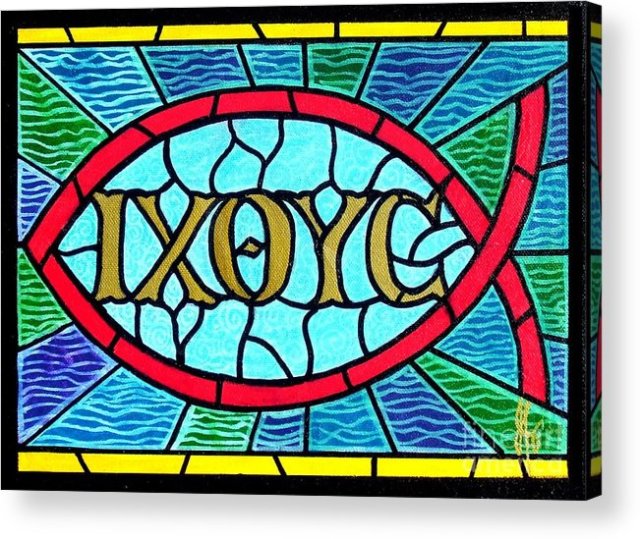
Ichthys
The ichthys (pronounced ick-thoos) is an early Christian symbol of new life in Jesus Christ.

Then some of the Pharisees and teachers of the law said to him, “Teacher, we want to see a sign from you.”

He answered, “A wicked and adulterous generation asks for a sign! But none will be given it except the sign of the prophet Jonah. For as Jonah was three days and three nights in the belly of a huge fish, so the Son of Man will be three days and three nights in the heart of the earth. The men of Nineveh will stand up at the judgment with this generation and condemn it; for they repented at the preaching of Jonah, and now something greater than Jonah is here. The Queen of the South will rise at the judgment with this generation and condemn it; for she came from the ends of the earth to listen to Solomon’s wisdom, and now something greater than Solomon is here. (NIV)

I say at the outset:

The greatest miracle, the best evidence of God’s work in the world, is a changed life.

Yes, both personal and corporate transformation – not a rearranging or a tweeking of habits – but a wholesale change of heart. New life is new life, and not a reconstituted life.

For many folks, when it comes to any discussion of change and transformation, it is a focus on others changing. Other people need to see things rightly; others who must bend their lives and organizations to how I believe things need to be. As you can tell, putting it in writing and laying it bear sounds an awful lot like pride and hubris. And, it is.

The need for repentance is for everyone, not just a select few or others for whom we believe need to change.

Jesus made waves with many people by hob-nobbing with the least, the lost, and the lowly. Christ actively sought such people out, and healed many of them from sickness, disease, and sin so that they would be united with God and no longer remain on the fringes of society.

Some within the religious establishment of the day did not take the healing ministry of Jesus into consideration because they were not in the transformation business. So, healing miracles which created new life did nothing for them. Jesus was not flexing any real Messiah muscle for them and improving their designs to see Gentiles get beat up and kicked out of Palestine. They even went so far as to ascribe Jesus’ healings as the work of the devil. They wanted a sign from heaven that would authenticate proper Messiah credentials.

Jesus responded by essentially saying there is already a sign that exists, the sign of Jonah. As Jonah was three days and three nights in the belly of a whale, so Jesus would be in the earth for three days and nights. The death and resurrection of Jesus is needed, and when faced with this information, the only appropriate response is repentance, a complete U-turn, to a changed life. Jesus brought up the Queen of the South to make the same point: When the ancient Ninevites, who were a sinful people, encountered the person of Jonah, they repented; when the Queen encountered the person of Solomon, she changed.

Therefore, how much more should we change when encountering the person of Christ?

Jesus himself is the sign. Jonah was in the belly of a whale. He was all but dead. But God caused the whale to belch up Jonah, and he went out as a changed man. The experience of having stomach fluids work on a person for three days and nights, some scholars point out that Jonah would have been both spiritually and physically different – bleached completely white and an incredible sight to see!

The whole point of bringing up this sign of Jonah was to communicate the great need for repentance when faced with Jesus, his life, his teaching, his ministry. The appropriate response to Jesus is a changed life.

Jesus was looking for status quo malcontents, and a desire for transformation and new life.

The process of change is hardwired into all creation – from seasons of the year to the seasons of people’s lives – all are designed for a sustained process of time to revolutionize us.

Jesus modeled this for us. He switched his address of heaven and moved into our neighborhood in order to bring us new life. As the Master of conversion, Jesus always extends the invitation to change. All he asks is to let God do the work of change within us, be patient with the construction of the soul he is doing and persist with daily routines of faith individually and with one another.

It pleases Jesus and it is the heart of God to realize new life. Change for change’s sake is not the point. Change that reflects the values of God is the point. And in order to know that, we must hear the Scriptures, and we must pray to seek the mind and heart of God.

God Almighty, we desire to be transformed by you and allow the life of Jesus to be expressed through us. We desire to walk in the light of your spirit. Reveal to us those things in our life that need to be made anew. Allow us to discern between flesh and spirit so that we can choose a healthy holy path. Continue to give us spiritual awareness. Transform us into something new altogether. May our old life and way disappear, and our new life emerge for the blessing of the world, through Jesus Christ our Lord in the power of the Holy Spirit. Amen.

Click I Will Rise by Chris Tomlin as we continue in this season of Eastertide with its focus on new life.