
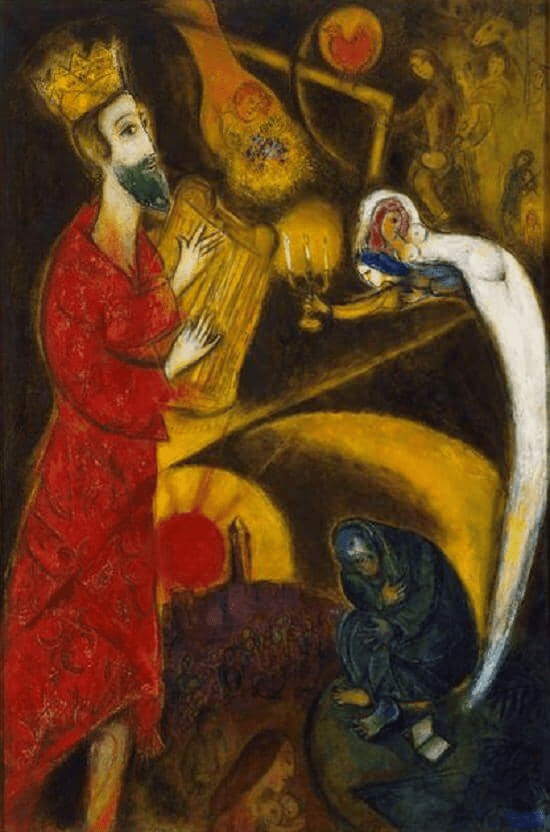
Pillow Thoughts (Psalm 132:1-12)

King David, by Marc Chagall, 1962

O Lord, remember in David’s favor
    all the hardships he endured;
how he swore to the Lord
    and vowed to the Mighty One of Jacob,
“I will not enter my house
    or get into my bed;
I will not give sleep to my eyes
    or slumber to my eyelids,
until I find a place for the Lord,
    a dwelling place for the Mighty One of Jacob.”

We heard of it in Ephrathah;
    we found it in the fields of Jaar.
“Let us go to his dwelling place;
    let us worship at his footstool.”

Rise up, O Lord, and go to your resting place,
    you and the ark of your might.
Let your priests be clothed with righteousness,
    and let your faithful shout for joy.
For your servant David’s sake
    do not turn away the face of your anointed one.

The Lord swore to David a sure oath
    from which he will not turn back:
“One of the sons of your body
    I will set on your throne.
If your sons keep my covenant
    and my decrees that I shall teach them,
their sons also, forevermore,
    shall sit on your throne.” (New Revised Standard Version)

King David took great pains in providing for the house of the Lord; and was very concerned about the worship of Yahweh. He went well out of his way to ensure that a temple would be built for his God.

David made as many preparations as he possibly could before his death, so that his son Solomon could follow through and build the temple. The editor of the Book of Chronicles commented on this:

David gave orders to gather together the aliens who were residing in the land of Israel, and he set stonecutters to prepare dressed stones for building the house of God. David also provided great stores of iron for nails for the doors of the gates and for clamps, as well as bronze in quantities beyond weighing, and cedar logs without number—for the Sidonians and Tyrians brought great quantities of cedar to David. 

For David said, “My son Solomon is young and inexperienced, and the house that is to be built for the Lord must be exceedingly magnificent, famous and glorified throughout all lands; I will therefore make preparation for it.” So David provided materials in great quantity before his death. (1 Chronicles 22:2-5, NRSV)

The king did all of this because God came to David and let him know that he would not be the one to build the temple; that job would fall to his son Solomon. (2 Samuel 7:4-13)

David’s final instruction to Solomon and the people had to do with the construction of a house for the Lord his God:

“Now set your mind and heart to seek the Lord your God. Go and build the sanctuary of the Lord God so that the ark of the covenant of the Lord and the holy vessels of God may be brought into the house built for the name of the Lord.” (1 Chronicles 22:19, NRSV)

The worship of God, for David, was to be the central feature of the Jewish people. All Israel and Judah were to encourage one another in worship at God’s house, the Lord’s Temple, in Jerusalem.

The priests of God wore special clothing, and handled the holy implements and the Ark of the Covenant of God. Yet, they were to be also clothed with righteousness, making sure that their outward ceremonial rituals reflected an inner moral purity and holiness before God.

David was bound and determined to not only worship the Lord himself, but to see that the entire nation of Israel had the opportunity to worship together in a central place.

Maybe a question arises for you about why David was so driven to construct a house for God. What is it that motivated King David to spend so much of his planning and energy on making sure that a temple would be constructed for the Lord?

Now when the king was settled in his house and the Lord had given him rest from all his enemies around him, the king said to the prophet Nathan, “See now, I am living in a house of cedar, but the ark of God stays in a tent.” Nathan said to the king, “Go, do all that you have in mind, for the Lord is with you.” (2 Samuel 7:1-3, NRSV)

A lot of events had transpired for David to be in the position of king, with peace all around him. The Lord had been with David, and brought him through the sort of adversities most of us will never know.

Once King David was at the pinnacle of peace and success, his thought were not about how to hold onto power, or to get more of it. He would lay his head on his pillow at night and wonder how he could give back to God for being so faithful.

And considering all that God had accomplished for him and for Israel, it seemed a travesty that he was luxuriating in a fine house, while the Ark of the Covenant – the objective presence of God among the people – was sitting in an old tent. So, David became determined to change that situation, because he could.

I wonder if when you and I are at a place in our lives where we feel safe and secure, prosperous and happy, our thoughts and dreams turn toward how we might give back to God in a worshipful way which will honor the Lord, as well as bless all the people of God.

I am curious what sort of things occupy your mind at night while your head is on your pillow, when you are feeling good about how your life is going.

Many, if not most, people will think about themselves, and what to do with what they have gained and/or accomplished. But what about you?

How will you respond to God’s grace, goodness, deliverance, and protection in your own life? What sort of ideas arise in your mind? What is in your heart to do for God and God’s people?

What are your pillow thoughts at night?

Presence itself is a great gift. The presence of God is incredibly gracious, good, and miraculous. And human presence, with each individual stamped with the image and likeness of God upon them, is also a wonderful gift from the Creator. And very much needed.

David enjoyed the presence of God, and longed for all the people to experience that divine presence. Although the Lord needed no temple to live in, David had in mind to provide one.

I imagine that King David understood that each person is a luminous icon of presence, reflecting God’s image, and needing the presence of God and others in order to have a nation who worships God as commanded in the Mosaic law.

Through communal worship at a designated site in Jerusalem, the Israelites could enjoy the beauty of God’s presence together, as well as the encouragement of one another.

Wherever there is presence and the acknowledgement of God and each other, there is freedom to offer affection, understanding, and respect.

It seems to me that these were the sort of thoughts that ran through King David’s mind, which made him determined to build a house for the Lord his God.

So, what will you do with your thoughts and your life?

Almighty God of all hope, of our thoughts and dreams: In humility, we give you thanks for all of creation; and for everything you give us. We praise you for forgiving us of our guilt and shame, even before we ask. You raise us from our broken state and make us whole. You give us the peace we yearn for.

Blessed God, fill us, your people, with your divine Spirit. Be our light in the darkness. Envelop us with your presence. Orient our hearts toward your justice; and help us always praise you. Let us ever be mindful of your power and grace in the world. Let us live as one with you in grace and in truth. Amen.

Forgotten, but Blessed (Genesis 40:1-23)

Joseph, the cupbearer, and the baker in prison, by Gerbrand van den Eeckhout, 1643

Sometime later, Pharaoh’s chief cupbearer and chief baker offended their royal master. Pharaoh became angry with these two officials, and he put them in the prison where Joseph was, in the palace of the captain of the guard. They remained in prison for quite some time, and the captain of the guard assigned them to Joseph, who looked after them.

While they were in prison, Pharaoh’s cupbearer and baker each had a dream one night, and each dream had its own meaning. When Joseph saw them the next morning, he noticed that they both looked upset. “Why do you look so worried today?” he asked them.

And they replied, “We both had dreams last night, but no one can tell us what they mean.”

“Interpreting dreams is God’s business,” Joseph replied. “Go ahead and tell me your dreams.”

So the chief cupbearer told Joseph his dream first. “In my dream,” he said, “I saw a grapevine in front of me. The vine had three branches that began to bud and blossom, and soon it produced clusters of ripe grapes. I was holding Pharaoh’s wine cup in my hand, so I took a cluster of grapes and squeezed the juice into the cup. Then I placed the cup in Pharaoh’s hand.”

“This is what the dream means,” Joseph said. “The three branches represent three days. Within three days Pharaoh will lift you up and restore you to your position as his chief cupbearer. And please remember me and do me a favor when things go well for you. Mention me to Pharaoh, so he might let me out of this place.For I was kidnapped from my homeland, the land of the Hebrews, and now I’m here in prison, but I did nothing to deserve it.”

When the chief baker saw that Joseph had given the first dream such a positive interpretation, he said to Joseph, “I had a dream, too. In my dream there were three baskets of white pastries stacked on my head. The top basket contained all kinds of pastries for Pharaoh, but the birds came and ate them from the basket on my head.”

“This is what the dream means,” Joseph told him. “The three baskets also represent three days. Three days from now Pharaoh will lift you up and impale your body on a pole. Then birds will come and peck away at your flesh.”

Pharaoh’s birthday came three days later, and he prepared a banquet for all his officials and staff. He summoned his chief cupbearer and chief baker to join the other officials. He then restored the chief cupbearer to his former position, so he could again hand Pharaoh his cup. But Pharaoh impaled the chief baker, just as Joseph had predicted when he interpreted his dream. Pharaoh’s chief cupbearer, however, forgot all about Joseph, never giving him another thought. (New Living Translation)

Joseph, the cupbearer, and the baker, by Alexander Ivanov (1806-1858)

It is a sinking (and stinking) feeling to be forgotten, as if no one cares. But we know God cares. And we also know Joseph did nothing wrong. How did he get to this point of being left in a prison? What’s up with that?

Joseph’s Story

The story of Joseph (Genesis 37, 39-50) is one of the longest narratives in the Old Testament. Joseph was next to the youngest of 12 sons born to their father Jacob. Rachel was Jacob’s favorite wife and Joseph’s mother – which also made Joseph one Jacob’s favorites. This didn’t go down well with the rest of the sons. Joseph’s brothers (unbeknownst by Jacob) sold him into slavery.

Joseph was taken to Egypt and became the servant of Pharaoh’s captain of the guard, Potiphar. Joseph distinguished himself as competent, skillful, and virtuous. It was actually his integrity which got him into prison. Refusing to sleep with Potiphar’s wife, she became an angry woman and accused Joseph of something he didn’t do. The captain promptly dispatched him to jail.

Human Hatred and Unfaithfulness

Joseph became a slave in Egypt because of jealousy, hatred, and lack of faithfulness on the part of Joseph’s brothers. They disowned him, sold him, and rid themselves of him. The brothers wanted to forget Joseph, and they did.

Furthermore, Joseph became a prisoner in Egypt because of anger, hate, and betrayal of faith. Potiphar’s wife didn’t get what she wanted from Joseph, so she lied and fumed, landing Joseph in a dank prison. He was left without another thought – forgotten and jailed for no fault of his own.

And just when we think the story might turn around, and Joseph will be freed from his unjust imprisonment, the chief cupbearer (wine steward) promptly forgot him and said nothing to Pharaoh after he was out of jail and restored to his position. Once again, Joseph is the undeserved recipient of unfaithfulness. He remains in prison for another two years. Oy.

As much as we might like to get past all these unjust and maddening situations, Holy Scripture does not let us off the hook so easily. We have to sit with Joseph for a while, and feel what he feels, experience what he experiences, so that we can learn our own lessons from him.

Whether we like it, or not, suffering is a reality. And yet, although sometimes forgotten by humanity, we are remembered by divinity….

Divine Presence in the Middle of Suffering

God is present with us through hardship and adversity. Joseph’s story sets up the contrast between fickle humans and a faithful God. A lot of people in Joseph’s life let him down. But God was there as the continual divine presence throughout every circumstance, both good and bad…

  • God gifted Joseph and had special plans for him. God was with Joseph in his dreams. (Genesis 37:5-11) 
  • God was with Joseph, so that he succeeded in everything he did; the Lord caused all that Joseph did to prosper. (Genesis 39:2-3)
  • God showed Joseph steadfast love, and gave him favor in the sight of the chief jailer. The jailer did not worry about anything, because the Lord was with Joseph and made him successful in all that he did. (Genesis 39:21, 23)
  • God was present with Joseph in helping him interpret dreams, even in difficult situations. (Genesis 40:8)

God’s presence makes a difference. The Lord met Joseph in his suffering – yet did not leave him there. God entered Joseph’s suffering, was present with him while in it, and eventually brought him out of it, to another and better place. And in the process, God blessed others through Joseph.

Not only did Joseph survive, but he also thrived in the middle of injustice. God quietly went about the business of using Joseph as an agent of blessing everywhere he was sent: To Potiphar and his household; to the chief jailer and all those in prison; and then to Pharaoh and all of Egypt.

In the end, even the conniving and caballing brothers receive blessing — through Joseph. In this way, the Lord was fulfilling the divine promise to Abraham — that he and Sarah and their descendants would be blessed; and that through them, all the nations of the earth would also be blessed.

God is present with those in suffering. Yet, the way God works almost never seems fast enough for those who are suffering. We, along with the psalm writers, cry out, “How long, O Lord!?”

In situations, such as Joseph’s, it won’t do to offer platitudes to “Let go, and let God,” “Everything works for good,” or “God never gives us more than we can handle.” Sheesh. I doubt anyone in life-or-death situations relies on nifty phrases. They want God, and they understandably want God now.

Whether quick or slow, hard or unbearable, the biblical promise nevertheless stills stands that God meets us in our suffering. And God does not leave us there. God also calls us and moves us to more pleasant places. And know this: In the process and in the journey, God will bless others through us.

O God:
Give me strength to live another day;
Let me not turn coward before its difficulties or prove passive to its duties;
Let me not lose faith in other people;
Keep me sweet and sound of heart, in spite of ingratitude, treachery, or meanness;
Preserve me from minding little stings or from giving them;
Help me to keep my heart clean, and to live so honestly and fearlessly that no outward failure can dishearten me or take away the joy of conscious integrity;
Open wide the eyes of my soul that I may see good in all things;
Grant me this day some new vision of truth;
Inspire me with a spirit of joy and gladness;
and make me the cup of strength to suffering souls;
in the name of the strong Deliverer, our Lord and Savior, Jesus Christ. Amen.

Jacob’s Dream (Genesis 28:10-22)

Jacob’s Ladder by Darius Gilmont

Jacob left the town of Beersheba and started out for Haran. At sunset he stopped for the night and went to sleep, resting his head on a large rock. In a dream he saw a ladder that reached from earth to heaven, and God’s angels were going up and down on it.

The Lord was standing beside the ladder and said:

I am the Lord God who was worshiped by Abraham and Isaac. I will give to you and your family the land on which you are now sleeping. Your descendants will spread over the earth in all directions and will become as numerous as the specks of dust. Your family will be a blessing to all people. Wherever you go, I will watch over you, then later I will bring you back to this land. I won’t leave you—I will do all I have promised.

Jacob woke up suddenly and thought, “The Lord is in this place, and I didn’t even know it.” Then Jacob became frightened and said, “What a frightening place! It must be the house of God and the gateway to heaven.”

When Jacob got up early the next morning, he took the rock that he had used for a pillow and stood it up as a place of worship. Then he poured olive oil on the rock to dedicate it to God, and he named the place Bethel. Before that it had been named Luz.

Jacob solemnly promised God, “If you go with me and watch over me as I travel, and if you give me food and clothesand bring me safely home again, you will be my God. This rock will be your house, and I will give back to you a tenth of everything you give me.” (Contemporary English Version)

“Dreams are impartial, spontaneous products of the unconscious psyche, outside the control of the will. They are pure nature; they show us the unvarnished, natural truth, and are therefore fitted, as nothing else is, to give us back an attitude that accords with our basic human nature when our consciousness has strayed too far from its foundations and run into an impasse.

Carl Jung, Collected Works, Vol. 10

Not all unconscious dreams are the same, any more than all conscious experiences are alike.

Some dreams are not much more than a thing which occurs while we’re sleeping; they’re akin to the tedious or pedantic things we do while awake. Yet, other dreams are loaded with symbolic significance and have complex patterns of organization and relating.

However, all dreams which we carry with us into conscious waking – no matter whether mundane or extraordinary – are telling us a similar message: “Hey! Pay attention to this!”

In other words, our unconscious brains are usually aware of what we need more than our conscious minds; and dreams become the vehicle by which our unconscious alerts our conscious selves of something we need to focus upon.

Jacob’s Ladder by Ben Avram

Jacob needed to pay attention to something that he was not consciously aware of. Before his dream, Jacob had left home at the behest of his aging father. Mom and Dad wanted Jacob to have a good wife, so they sent him off to a specific place to find one.

Now, mind you, Jacob was a mama’s boy; he stuck close to home and was attached to his mother. Off on his first outing away from familiar confines, Jacob would have been understandably anxious and fearful. Although he had the blessing of his parents, Jacob’s unconscious self knew he also needed the blessing of almighty God.

So, the Lord showed up in a dream. To Jacob’s credit, he paid attention by acknowledging the importance of the dream. Jacob also made the Lord a promise that he would give back a tenth of anything and everything he acquired because of God’s blessing.

I wonder: How many times do you and I fail to acknowledge that the Lord’s presence is in the very place we are? Maybe our dreams are trying to tell us something – that the God of all things, including dreams, is with us in our own particular place and situation.

It can be frightening to be in a new place or new situation that you’ve never been in before. Yet, there is no place any of us can go where God is not already there.

You have looked deep
into my heart, Lord,
    and you know all about me.
You know when I am resting
    or when I am working,
and from heaven
    you discover my thoughts.

You notice everything I do
    and everywhere I go.
Before I even speak a word,
    you know what I will say,
and with your powerful arm
you protect me
    from every side.
I can’t understand all of this!
Such wonderful knowledge
    is far above me.

Where could I go to escape
from your Spirit
    or from your sight?
If I were to climb up
to the highest heavens,
    you would be there.
If I were to dig down
to the world of the dead
    you would also be there.

Suppose I had wings
like the dawning day
    and flew across the ocean.
Even then your powerful arm
    would guide and protect me.
Or suppose I said, “I’ll hide
in the dark until night comes
    to cover me over.”
But you see in the dark
because daylight and dark
    are all the same to you. (Psalm 139:1-12, CEV)

The Lord is with you. Your dreams have already confirmed it.

O God, give me strength for this day, and not to turn coward in the face of difficulty or duty. Let me not lose faith in other people. Keep my heart pure and caring, free from all ingratitude or meanness. Open wide the eyes of my soul so that I may see the good in all things. Grant me today a new vision of your truth; and for tonight, may the Lord Jesus be in my dreams so that I might awake again and serve him in joy and gladness, in the power of the Holy Spirit. Amen.