God (Psalm 147:12-20)

Extol the Lord, O Jerusalem!
    Praise your God, O Zion!
For he strengthens the bars of your gates;
    he blesses your children within you.
He grants peace within your borders;
    he fills you with the finest of wheat.
He sends out his command to the earth;
    his word runs swiftly.
He gives snow like wool;
    he scatters frost like ashes.
He hurls down hail like crumbs—
    who can stand before his cold?
He sends out his word and melts them;
    he makes his wind blow, and the waters flow.
He declares his word to Jacob,
    his statutes and ordinances to Israel.
He has not dealt thus with any other nation;
    they do not know his ordinances.
Praise the Lord! (New Revised Standard Version)

The psalmist portrays a God who is clearly in control of all things. This is the Lord God almighty, who is the Creator, and is sovereign over the entire world.

God has no need for bluster, or to leverage knowledge in order to get things done. With only a word, the weather changes completely, and people are invited to participate in the divine will for this earth.

There is no creature, and no human on this earth, who has such power and authority, sovereignty and control, over everything and everyone as God.

Because of God’s great power, the Lord is able to extend gracious and providential care for those who put their hope in God’s steadfast love. Such grace and love of divine blessing is the means for Israel’s praise of Yahweh in the psalm.

The grandest blessing of them all is the gift of the “word.” God’s word of command is what sets in motion all of the natural processes of this earth. It is the divine word that gives and sustains life on this planet.

The same divine word which has been gifted in order for the waters to abundantly flow and the wind to continually blow, is the word given to Israel in the laws and commands for the people.

This gift of word is a wonderful privilege, given to the nation of Israel in the Old Testament. It is what makes them a peculiar people, recipients of the divine will. It is a word of guidance for the covenant people of God.

And that divine word is the primary reason for the human word to respond in praise by extoling the awesome might and mercy of God.

Please understand that today’s psalm is profoundly theological. In other words, it is all about God. We humans and the creation are mentioned and talked about within the psalm, yet all of it is in the context of God’s activity in the world, of God’s actions in history.

The things which God does among us and in this world is a theological reflection, in and of itself. Let me say it another way: God does what God is.

God didn’t simply do some wondrous act in the past. The Lord didn’t merely console and heal someone at some time. Rather, God is constantly binding up the brokenhearted; continually casting down the wicked; and consistently demonstrating steadfast love through right, good, and just actions, all the time.

There is a never a time when God is not God, being holy, loving, and good; and therefore, God’s eternal actions are a non-stop working of justice and righteousness in this old fallen world.

Evil, of course, is continually at work, as well. But we are not talking about opposing powers which are equal to each other. Justice and love will eventually swallow up wickedness and evil.

This is the hope that undergirds the psalmist, and it is the reason that the faithful keep persevering and offering their praise, adoration, and thanksgiving to the God who never slumbers nor sleeps, but is always watching over the righteous.

God’s wisdom and power is matchless. It is impossible for any one of us, or even all of us collectively, to count and number all the stars in the universe. But God can. And God even has them all named, because they all belong to God.

Neither you nor I could ever number the raindrops that fall on our roof in just a few minutes. Yet, God can. And the Lord can count the grains of sand on a beach and the hairs on every head (or in some cases, every hair on a guy’s back).

We humans number in the billions on this earth. Yet, God knows us all by name. And God’s perfection is near and intimate, not distant and remote.

I don’t know about you, my friend, but my encounters with God are nothing like a virtual Zoom meeting. My interactions with the God of the universe are close, intimate, and caring, just as a mother with her newborn baby.

Therefore, matters of renewal, restoration, and even resurrection are not problems for the God of the psalmist. Widows are comforted and rejoice. The poor are lifted up, and not ruined by their poverty.

The confused, the disordered and disoriented, the discouraged and discombobulated, are all held in the hands of the God who knows their confusion and will take care of them.

I might not understand; and, in fact, the older I become, I’ve discovered that the less I actually know. But I believe. I trust God. I do this, daily, because the Lord has demonstrated to me over and over again that God is trustworthy and has the ability to bend everything in this world for redemptive purposes.

That is the sort of God I serve – that the psalmist serves. And this faith, hope, and love is what I want for you, as well, my friend.

Life is too short and precious to squander it, and to flounder in disbelief. So, just listen; and take as much time as you need to hear the word, and experience the presence of life that is around you, and right in front of your face.

Dearest and most gracious Lord:

I thank you for the gift of life, the rising sun, and the promise of the seasons.

I give you thanks for my family and friends and the gifts they share; for my home and all its comforts within; for the abundance you give me and my willingness to share it with others.

I offer my gratitude to you for granting me wisdom, and the ability to listen; for acceptance of the challenges that I face every day; for strength and courage to act for justice and peace.

Most of all, I thank you for the knowledge that, without you, I have nothing; and with you, I possess all things, and have everything I need. Amen.

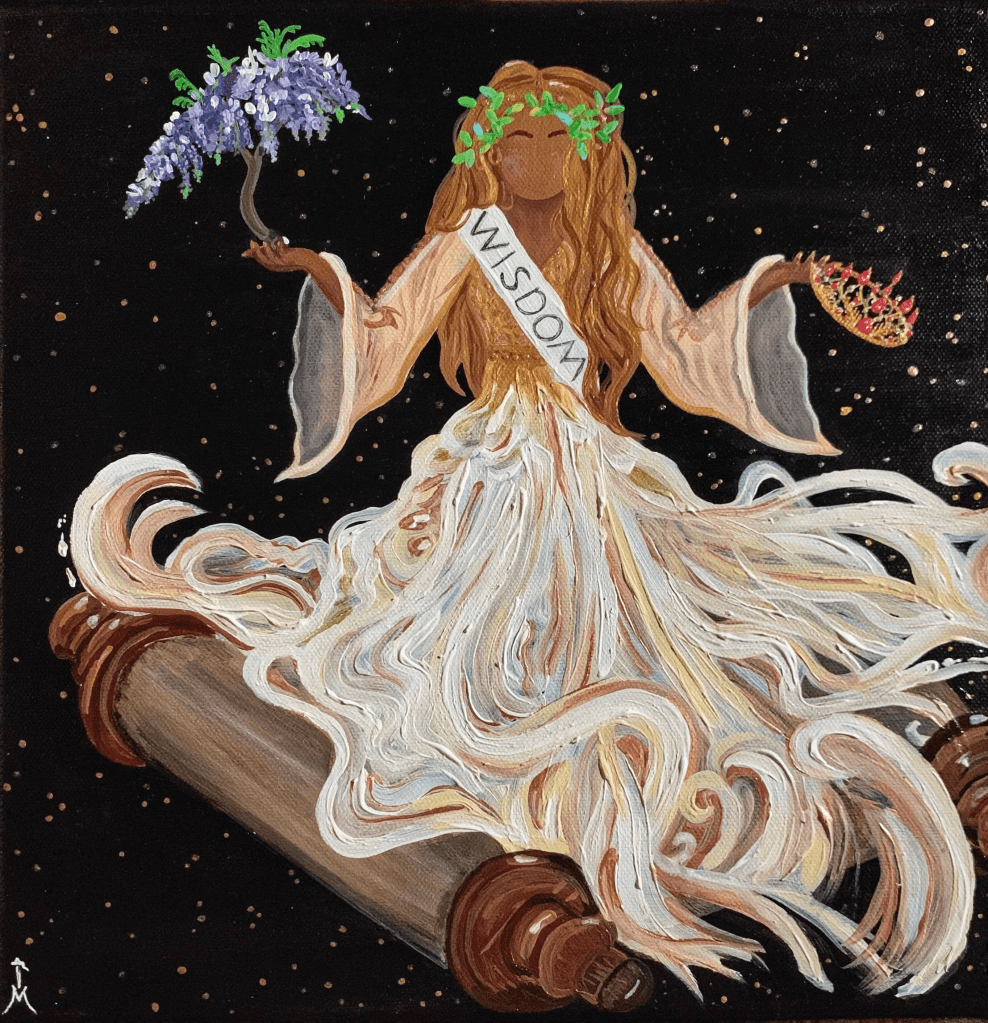
Lady Wisdom Is Speaking (Proverbs 8:1-31)

Lady Wisdom, by Mikayla Ragsdale

Doesn’t Wisdom cry out
    and Understanding shout?
Atop the heights along the path,
    at the crossroads she takes her stand.
By the gate before the city,
    at the entrances she shouts:

I cry out to you, people;
    my voice goes out to all of humanity.
Understand skill, you who are naive.
    Take this to heart, you fools.
Listen, for I speak things that are correct;
    from my lips comes what is right.
My mouth utters the truth;
    my lips despise wickedness.
All the words of my mouth are righteous;
    nothing in them is twisted or crooked.
All of them are straightforward to those who understand,
    and upright for the knowledgeable.
Take my instruction rather than silver,
    knowledge rather than choice gold.
Wisdom is better than pearls;
    nothing is more delightful than she.

I, Wisdom, dwell with prudence;
    I have found knowledge and discretion.
To fear the Lord is to hate evil.
    I hate pride and arrogance,
        the path of evil and corrupt speech.
I have advice and ability,
    as well as understanding and strength.
By me kings rule,
    and princes issue righteous decrees.
By me rulers govern,
    and officials judge righteously.
I love those who love me;
    those who seek me will find me.
Riches and honor are with me,
    as well as enduring wealth and righteousness.
My fruit is better than gold, even fine gold;
    my crops are better than choice silver.
I walk on the way of righteousness,
    on the paths of justice,
    to provide for those who love me
        and to fill up their treasuries.

The Lord created me at the beginning of his way,
    before his deeds long in the past.
I was formed in ancient times,
    at the beginning, before the earth was.
When there were no watery depths, I was brought forth,
    when there were no springs flowing with water.
Before the mountains were settled,
    before the hills, I was brought forth;
    before God made the earth and the fields
    or the first of the dry land.
I was there when he established the heavens,
    when he marked out the horizon on the deep sea,
    when he thickened the clouds above,
    when he secured the fountains of the deep,
    when he set a limit for the sea,
        so the water couldn’t go beyond his command,
    when he marked out the earth’s foundations.
I was beside him as a master of crafts.
    I was having fun,
    smiling before him all the time,
    frolicking with his inhabited earth
    and delighting in the human race. (Common English Bible)

Statue of Sophia (Wisdom), Sofia, Bulgaria

Wisdom is available. Wisdom is speaking to us. Wisdom lives with prudence. Wisdom enjoys God. And wisdom is personified as a woman (think about that before you have a round table discussion with all men).

To seek, cultivate, and teach wisdom is a worthy pursuit, in and of itself. The benefits of wisdom are great and profound, better than any earthly material thing, like silver or gold.

Actually, wisdom is quite an abstract ideal to pursue, which is likely why it helps to have it presented as a beautiful woman.

Proverbs are wise sayings; they are short pithy statements of experiential truth. This means that wisdom is less universal than it is situational. In other words, the Book of Proverbs is not a textbook or a manual on wisdom; it is rather something to be familiar with when we are facing difficult situations and thorny problems.

If there is a constant universal to all of the wisdom, it is to acknowledge and respect the presence of God in the world. All things change, except God. The Lord is the ever-present Being who is consistently right, just, and good all the time.

This may be why wisdom seems elusive. We can get to know God better and better for an eternity, and yet never exhaust getting to know God completely or fully.

Wisdom is like that. It’s too big, too variegated. There is no such thing as “Wisdom For Dummies,” that is distilled into a neatly bound book.

Truly, wisdom is rather slippery. It is not something to be mastered, but a grand sage presence to be mastered by. We must let Lady Wisdom have her way in our lives.

Lady Wisdom is in opposition to the temptress, the foolish one, who lures people into evil, and young men into the trap of misconduct that will alter their lives forever.

Just because Lady Wisdom has been around a long time – as old as the world – her beauty only increases over time; and her compelling message winsome.

The wise Lady still maintains a childlike wonder amongst God’s creative work. She revels in this world of delight and discovery. It’s fun to be alongside God and enjoy such a large and expansive playground of wonder.

Joy and levity are just as much at the heart of wisdom as brevity and seriousness. If Lady Wisdom can delight in the humans God has created, then we have much to learn from her in discovering how to frolic and play with our fellow creatures in good and wholesome ways.

The metaphorical image of wisdom as a beautiful woman who beckons us, is in competition with other voices that tempt us with quick and tidy happiness. Those other voices, however, never get around to mentioning the cost of their so-called solutions.

To court with foolishness is to make the devil’s bargain. It will only result in regret.

The best and straightest road to wisdom is by loving God and honoring God’s instructions. We get some help in this worthy endeavor through the wise sayings of Proverbs, and by means of Lady Wisdom’s sound advice.

We are called to keep up a pursuit of wisdom throughout the duration of our earthly lives – which means there is a lot of mystery to Lady Wisdom yet to discover; and there is much more to know about her.

Blessed God, help me to pay attention to your good friend, Lady Wisdom, so that in all my words and ways I may live into mercy, purity, and peace; and so, glorify You and enjoy this life you have given me. Amen.

Consider Wisdom (Proverbs 1:1-19)

By Peter Max, 2008

The proverbs of Solomon, son of David and king of Israel.

Here are proverbs that will help you recognize wisdom and good advice, and understand sayings with deep meaning. They can teach you how to live intelligently and how to be honest, just, and fair. They can make an inexperienced person clever and teach young people how to be resourceful. These proverbs can even add to the knowledge of the wise and give guidance to the educated, so that they can understand the hidden meanings of proverbs and the problems that the wise raise.

To have knowledge, you must first have reverence for the Lord. Stupid people have no respect for wisdom and refuse to learn.

My child, pay attention to what your father and mother tell you. Their teaching will improve your character as a handsome turban or a necklace improves your appearance.

My child, when sinners tempt you, don’t give in. Suppose they say, “Come on; let’s find someone to kill! Let’s attack some innocent people for the fun of it! They may be alive and well when we find them, but they’ll be dead when we’re through with them! We’ll find all kinds of riches and fill our houses with loot! Come and join us, and we’ll all share what we steal.”

My child, don’t go with people like that. Stay away from them. They can’t wait to do something bad. They’re always ready to kill. It does no good to spread a net when the bird you want to catch is watching, but people like that are setting a trap for themselves, a trap in which they will die. Robbery always claims the life of the robber—this is what happens to anyone who lives by violence. (Good News Translation)

“To educate a man in mind and not in morals is to educate a menace to society.”

Theodore Roosevelt

A proverb is a short pithy statement of experiential truth. Proverbs are meant to teach one how to live a good life. This sort of education requires a lifetime of learning. There is always wisdom to be gained.

In order to have true understanding and wisdom, there needs to be a balance of intellectual knowledge, affective feeling, and intuitive knowledge. Only possessing some of these elements makes one nothing more than a half-wit.

A commitment to virtue, morality, and ethics is a must in the acquisition of wisdom, and thus, a good life. Physical, mental, emotional, and spiritual maturity all take time. Marinading over a long period of time in the wisdom of biblical proverbs will prove to be a life saver. At the end of one’s life, they can look back with gratefulness and satisfaction, instead of sorrow and regret.

So, from the very outset of approaching the Book of Proverbs, the mindset and heart stance must not be one of popping a few proverbial pills in order to achieve a self-centered goal or gain an immediate solution.

Rather, proverbial wisdom demands daily immersion in its wise sayings. It requires implementation and experimentation every single day. There needs to be decisive action, coupled with contemplative reflection. Anything short of this truncates and stunts one’s growth.

There is yet one more necessary prerequisite toward the sagacious and good life. Without this, nothing is possible. But with this, all things are possible: Acknowledgment, awareness, and adoration of the Lord.

A fool is one who stubbornly refuses to take in the full range of epistemic knowledge. Being only book smart is to actually be stupid. To be only a walking heart of emotional intelligence is foolish. And to live only by gut instinct alone is to cut off yourself from wisdom’s teaching.

A wise life includes the head, the heart, and the gut – and to have them all aligned together as an integral whole. To live other than this is to live as a fool who believes they already have the answers and the key to knowledge and understanding.

Furthermore, this means that to take God and transcendent things off of the table, to begin with, is the most foolish decision a person can make. Conversely, to forsake the intellectual life and believe that all one needs is the spiritual, is to betray a woefully foolish approach to the good life.

There are also those who distance themselves from family, especially parents. On some level, this makes sense, if one had a childhood full of traumatic memories and difficult relationships.

However, learning to honor even these parents is to place oneself on the path of wisdom, and to learn what the good life truly entails. And this approach allows the person to see the good, and strain out the bad.

In other words, we discover that good and bad, wise and foolish, smart and stupid, exists within everyone and in every place. Wholesale jettisoning of persons and/or institutions gains us little to nothing.

This distancing from family and/or God is an attempt to assert some control, to effect one’s willpower upon life. But this will lead us away from the true path of wisdom.

That’s because wisdom is not something to be mastered. Wise sayings don’t exist to be collected, and their sagacity harnessed for one’s personal goals.

Yes, we are to avail ourselves of wisdom, yet perhaps not as we may believe or think. We do not capture wisdom, but are captured by it.

The importance of this mental, emotional, and spiritual stance must not be undervalued. We only learn wisdom by means of humility and reverence before powers greater than ourselves. Any vestige of pride in us shall cause wisdom to disappear and slip from our grasp.

Only until we both intellectually and experientially recognize that the essential operations of the universe are beyond us, shall anyone begin to trust and risk in a wisdom greater than our own.

“Without humility, all shall be lost.”

St. Teresa of Avila

Put another way, if we refuse to learn from God and from our parents, then we won’t.

Only by accepting this can anyone discern what to do and don’t do, say and don’t say, when faced with competing voices.

For there is continually a voice of foolishness, of wickedness, enticing us to get what we want quickly, selfishly, without any thought to the consequences or the effect upon others. A group of such voices becomes a gang who tries outdoing each other in competitive evil.

There is also a voice of wisdom, which admonishes us to avoid the fast, fun, and friendly gang of evil speech and behavior. The wise person discerns that what the wicked person does to another, comes back upon them.

The patient and powerful voice of wisdom communicates prudence in all things, that is, to do today what will lead to a better tomorrow.

So then, my friend, what is the thing – the decision, the action, the words – that you can and will do today which will help you accomplish a good, right, and just life for yourself (and others) for tomorrow?

Great God of all wisdom, help me to trust You and follow Your precepts in every twist and turn of my life. Grant me good understanding and guide my steps, so that Your will is done on earth, as it is always done in Your heaven. Amen.

What Can I Do in an Impossible Situation? (Daniel 2:1-23)

Daniel Interprets King Nebuchadnezzar’s Dream, by Mattia Preti (1613-1699)

In the second year of Nebuchadnezzar’s rule, he had many dreams. The dreams made him anxious, but he kept sleeping. The king summoned the dream interpreters, enchanters, diviners, and Chaldeans to explain his dreams to him. They came and stood before the king.

Then the king said to them: “I had a dream, and I’m anxious to know its meaning.”

The Chaldeans answered the king in Aramaic: “Long live the king! Tell your servants the dream, and we will explain its meaning.”

The king answered the Chaldeans: “My decision is final: If you can’t tell me the dream and its meaning, you will be torn limb from limb, and your houses will be turned into trash dumps. But if you do explain the dream and its meaning, you’ll receive generous gifts and glorious honor from me. So explain to me the dream as well as its meaning.”

They answered him again: “The king must tell his servants the dream. We will then explain the meaning.”

The king replied: “Now I definitely know you are stalling for time, because you see that my decision is final and that if you can’t tell me the dream, your fate is certain. You’ve conspired to make false and lying speeches before me until the situation changes. Tell me the dream now! Then I’ll know you can explain its meaning to me.”

The Chaldeans answered the king: “No one on earth can do what the king is asking! No king or ruler, no matter how great, has ever asked such a thing of any dream interpreter, enchanter, or Chaldean. What the king is asking is impossible! No one could declare the dream to the king but the gods, who don’t live among mere humans.”

At this, the king exploded in a furious rage and ordered that all Babylon’s sages be wiped out. So the command went out: The sages were to be killed. Daniel and his friends too were hunted down; they were to be killed as well.

Then Daniel, with wisdom and sound judgment, responded to Arioch the king’s chief executioner, who had gone out to kill Babylon’s sages. He said to Arioch the king’s royal officer, “Why is the king’s command so unreasonable?” After Arioch explained the situation to Daniel, Daniel went and asked the king to give him some time so he could explain the dream’s meaning to him. Then Daniel went to his house and explained the situation to his friends Hananiah, Mishael, and Azariah so that they would ask the God of heaven for help about this mystery, in hopes that Daniel and his friends wouldn’t die with the rest of Babylon’s sages. Then, in a vision by night, the mystery was revealed to Daniel! Daniel praised the God of heaven:

God’s name be praised
    from age to eternal age!
        Wisdom and might are his!
God is the one who changes times and eras,
    who dethrones one king, only to establish another,
        who grants wisdom to the wise and knowledge to those with insight.
God is the one who uncovers what lies deeply hidden;
    he knows what hides in darkness;
I acknowledge and praise you, my fathers’ God!
    You’ve given me wisdom and might,
        and now you’ve made known to me what we asked of you:
            you’ve made known to us the king’s demand. (Common English Bible)

Daniel Interprets Nebuchadnezzar’s Dream, 1917

The King’s Trouble

Nebuchadnezzar was quite the guy – a stereotypical ancient king, in many ways. In our story for today, he certainly comes across as a demanding sovereign, expecting his wishes and commands to be done, no matter how difficult or unreasonable they seem to others.

The king was bothered by a troubling dream. So, in expected kingly fashion, Nebuchadnezzar called for his court appointed sages to explain it to him. And in an over-the-top expectation, even for an arrogant king, Nebuchadnezzar had no intention of telling them what it is he had dreamt.

The sages, of course, had no idea what to do with this exaggerated command. The king’s wise men replied that no one – except the gods – can reveal such secrets as what was dreamt. But in King Nebuchadnezzar’s line of thinking, since the gods of the sages cannot reveal the dream – and thus an interpretation of the dream – then those gods must be weak, ineffective, and useless.

The King’s Anger

In reading and listening to the story, we can feel the response of Nebuchadnezzar coming, and know that it isn’t going to be good. Indeed, the king flew into a rage. The wise men’s failure to provide the contents of the dream, and so, a solid interpretation for the dream, led King Nebuchadnezzar to order them all killed. In issuing such a command, this meant that Daniel and his wise friends were to be killed, as well.

Daniel was a Jewish exile, brought to Babylon after Nebuchadnezzar’s conquest of Jerusalem. He was wise, godly, and even-keeled. Daniel calmly intervened and offered to do exactly what the king requested in the first place. All he asked was for some time. Then, Daniel immediately went to his godly and wise friends, and together they looked to the Lord in prayer.

Sure enough, just as God had come to Nebuchadnezzar in a dream, so God came to Daniel and revealed the mystery to him. Daniel’s prayer of thanksgiving makes it clear that the source of the wisdom is the God of heaven, and not Daniel himself. Thus, we are meant to make the connection that Daniel’s God is vastly superior than the gods of the court sages.

The King’s Limits

King Nebuchadnezzar’s sovereignty and control was not universal. It is God who grants wisdom. Yes, we do our part in gaining knowledge and understanding as best we can. We look into Holy Scripture for guidance and seek to obey biblical commands and live into divine promises. Yet, there is also an aspect of wisdom that is given by God.

Ultimate insight comes as a result of both human observation and learning, and divine revelation and response to prayer. Throughout the book of Daniel, a prominent theme is the importance of prayer as the prerequisite to receiving wisdom. Daniel and his three friends joined in prayer together, immediately after hearing of the king’s situation and command.

An even greater theme in the book of Daniel is that God can give wisdom because there is nothing hidden from the Lord; God understands everything. And it is this theological conviction which underlies prayer. Daniel and his companions were supported and emboldened by their knowledge of God.

Believers in every historical age have the privilege of beseeching God for wisdom when circumstances are rough and dire. As the Apostle James says in the New Testament:

My friends, be glad, even if you have a lot of trouble. You know you learn to endure by having your faith tested. But you must learn to endure everything, so you will be completely mature and not lacking in anything. If any of you need wisdom, you should ask God, and it will be given to you. God is generous and won’t correct you for asking. (James 1:2-5, CEV)

Whenever facing opposition and suffering, it is important to know that God is in control, and that divine enablement and insight is only a prayer away.

Blessed God, Light of the world, shine upon us and disperse the clouds of our selfishness and stubbornness, so that we may reflect the power of the resurrection in our life together. Amen.