God (Psalm 147:12-20)

Extol the Lord, O Jerusalem!
    Praise your God, O Zion!
For he strengthens the bars of your gates;
    he blesses your children within you.
He grants peace within your borders;
    he fills you with the finest of wheat.
He sends out his command to the earth;
    his word runs swiftly.
He gives snow like wool;
    he scatters frost like ashes.
He hurls down hail like crumbs—
    who can stand before his cold?
He sends out his word and melts them;
    he makes his wind blow, and the waters flow.
He declares his word to Jacob,
    his statutes and ordinances to Israel.
He has not dealt thus with any other nation;
    they do not know his ordinances.
Praise the Lord! (New Revised Standard Version)

The psalmist portrays a God who is clearly in control of all things. This is the Lord God almighty, who is the Creator, and is sovereign over the entire world.

God has no need for bluster, or to leverage knowledge in order to get things done. With only a word, the weather changes completely, and people are invited to participate in the divine will for this earth.

There is no creature, and no human on this earth, who has such power and authority, sovereignty and control, over everything and everyone as God.

Because of God’s great power, the Lord is able to extend gracious and providential care for those who put their hope in God’s steadfast love. Such grace and love of divine blessing is the means for Israel’s praise of Yahweh in the psalm.

The grandest blessing of them all is the gift of the “word.” God’s word of command is what sets in motion all of the natural processes of this earth. It is the divine word that gives and sustains life on this planet.

The same divine word which has been gifted in order for the waters to abundantly flow and the wind to continually blow, is the word given to Israel in the laws and commands for the people.

This gift of word is a wonderful privilege, given to the nation of Israel in the Old Testament. It is what makes them a peculiar people, recipients of the divine will. It is a word of guidance for the covenant people of God.

And that divine word is the primary reason for the human word to respond in praise by extoling the awesome might and mercy of God.

Please understand that today’s psalm is profoundly theological. In other words, it is all about God. We humans and the creation are mentioned and talked about within the psalm, yet all of it is in the context of God’s activity in the world, of God’s actions in history.

The things which God does among us and in this world is a theological reflection, in and of itself. Let me say it another way: God does what God is.

God didn’t simply do some wondrous act in the past. The Lord didn’t merely console and heal someone at some time. Rather, God is constantly binding up the brokenhearted; continually casting down the wicked; and consistently demonstrating steadfast love through right, good, and just actions, all the time.

There is a never a time when God is not God, being holy, loving, and good; and therefore, God’s eternal actions are a non-stop working of justice and righteousness in this old fallen world.

Evil, of course, is continually at work, as well. But we are not talking about opposing powers which are equal to each other. Justice and love will eventually swallow up wickedness and evil.

This is the hope that undergirds the psalmist, and it is the reason that the faithful keep persevering and offering their praise, adoration, and thanksgiving to the God who never slumbers nor sleeps, but is always watching over the righteous.

God’s wisdom and power is matchless. It is impossible for any one of us, or even all of us collectively, to count and number all the stars in the universe. But God can. And God even has them all named, because they all belong to God.

Neither you nor I could ever number the raindrops that fall on our roof in just a few minutes. Yet, God can. And the Lord can count the grains of sand on a beach and the hairs on every head (or in some cases, every hair on a guy’s back).

We humans number in the billions on this earth. Yet, God knows us all by name. And God’s perfection is near and intimate, not distant and remote.

I don’t know about you, my friend, but my encounters with God are nothing like a virtual Zoom meeting. My interactions with the God of the universe are close, intimate, and caring, just as a mother with her newborn baby.

Therefore, matters of renewal, restoration, and even resurrection are not problems for the God of the psalmist. Widows are comforted and rejoice. The poor are lifted up, and not ruined by their poverty.

The confused, the disordered and disoriented, the discouraged and discombobulated, are all held in the hands of the God who knows their confusion and will take care of them.

I might not understand; and, in fact, the older I become, I’ve discovered that the less I actually know. But I believe. I trust God. I do this, daily, because the Lord has demonstrated to me over and over again that God is trustworthy and has the ability to bend everything in this world for redemptive purposes.

That is the sort of God I serve – that the psalmist serves. And this faith, hope, and love is what I want for you, as well, my friend.

Life is too short and precious to squander it, and to flounder in disbelief. So, just listen; and take as much time as you need to hear the word, and experience the presence of life that is around you, and right in front of your face.

Dearest and most gracious Lord:

I thank you for the gift of life, the rising sun, and the promise of the seasons.

I give you thanks for my family and friends and the gifts they share; for my home and all its comforts within; for the abundance you give me and my willingness to share it with others.

I offer my gratitude to you for granting me wisdom, and the ability to listen; for acceptance of the challenges that I face every day; for strength and courage to act for justice and peace.

Most of all, I thank you for the knowledge that, without you, I have nothing; and with you, I possess all things, and have everything I need. Amen.

You Have Found Favor with God (Luke 1:26-38)

The Annunciation, by Liviu Dumitrescu

Six months after Elizabeth had become pregnant, God sent the angel Gabriel to Nazareth, a city in Galilee. The angel went to a virgin promised in marriage to a descendant of David named Joseph. The virgin’s name was Mary.

When the angel entered her home, he greeted her and said, “You are favored by the Lord! The Lord is with you.”

She was startled by what the angel said and tried to figure out what this greeting meant.

The angel told her,

“Don’t be afraid, Mary. You have found favor  with God.

You will become pregnant, give birth to a son,
and name him Jesus.

He will be a great man
and will be called the Son of the Most High.
The Lord God will give him
the throne of his ancestor David.
Your son will be king of Jacob’s people forever,
and his kingdom will never end.”

Mary asked the angel, “How can this be? I’m a virgin.”

The angel answered her, “The Holy Spirit will come to you, and the power of the Most High will overshadow you. Therefore, the holy child developing inside you will be called the Son of God.

“Elizabeth, your relative, is six months pregnant with a son in her old age. People said she couldn’t have a child. But nothing is impossible for God.”

Mary answered, “I am the Lord’s servant. Let everything you’ve said happen to me.”

Then the angel left her. (God’s Word Translation)

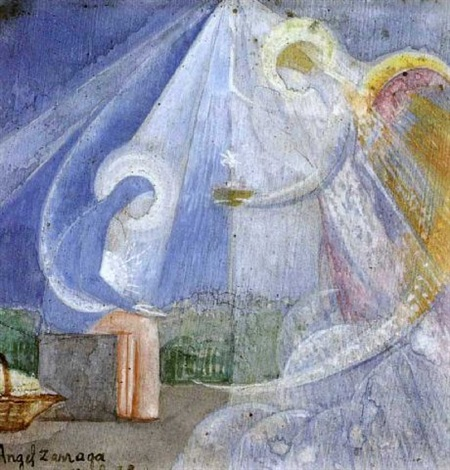
The Annunciation, by Angel Zárraga

Most of life is lived in the mundane. For the most part, we go about our business and deal with the daily grind.  That’s because we are common ordinary people.

So, we can especially relate to Mary. She is rather plain. Mary is of junior high age. If she were living in our day and age, Mary would likely be wearing clothes from the local Goodwill. She cannot read, because girls of her day rarely did.

Mary’s parents make all the decisions that affect her life, including the one that she should be married to an older man named Joseph. We don’t know if she even liked him. She lives in a small town that most people can’t even point to on a map. 

One night, this young girl is visited by the brightly beaming divine messenger Gabriel, whose name means, “God has shown himself mighty.” Mary stands there in her flannel nightgown; her life very quickly moving from the ordinary to extraordinary. The juxtaposition could not be more pronounced:

  • a mighty angel and a plain teen-ager
  • a messenger of the Most High God and a girl barely past puberty
  • holy angelic light in a simple candlelit bedroom
  • awesome power and complete vulnerability

Mary, compared to Gabriel, is defenseless, fragile, and overwhelmed. She’s in over her head. And that’s why we can relate to her. We can get our human arms around Mary. She’s like us. She has faced life with little power to make it turn out the way she planned. Forces beyond her control have rearranged her life and altered it forever. Mary is the Matron Saint of the Ordinary. We can totally understand why she responds the way she does.

Young Mary’s initial reaction was to be greatly troubled. She was disturbed, and was shaking in her ratty old slippers. The angel confidently told Mary that she had found favor with God. In other words Mary was quite literally “graced” by God. 

The situation was not that Mary had some extreme spirituality; but rather that God simply chose her to be the mother of Jesus. 

And Mary needed to come to grips with what was happening to her. This was not what she was looking for.  Becoming pregnant with the Savior of the world was not an answer to prayer for Mary. This was not on her agenda. 

Mary immediately sensed the crazy disconnect between what was being told to her and who she was. After all, she was a plain ordinary girl from the hick town of Nazareth, and she was being told that she would raise a king.  Maybe somebody in heaven screwed up. It could very well be that Gabriel got the wrong girl. Perhaps the angel’s Google map popped up the wrong town to visit. 

Relating to Mary, we can totally understand that she would question how in the world all this was going to happen. Not only is Mary ordinary, and far from royalty, but she is also very much a virgin. None of this made any sense whatsoever.

But the angel lets Mary know that God specializes in the impossible. I understand why many English translators chose to phrase the original rendering as “for nothing is impossible with God.” But I rather like a more literal translation which is “for there is nothing outside of God’s power.” 

There is nowhere we can go, no place on earth, no situation whatsoever that is beyond God’s ability, reach, and power to effect the divine will.

We do not always get straightforward answers to our questions about God. Yet, Mary asked a question and got a straight answer. She really can be pregnant with Jesus because the Holy Spirit will come upon her and overshadow her with power. 

If the story were to end here it would be a great story.  But to me the most astonishing part of this narrative is Mary’s response to what was happening to her.

Mary believed the message and took Gabriel’s words at face value. And so, having believed, she then submitted herself completely to God’s will for her life. 

I think we might totally understand if Mary simply said in her ordinary way that she was not prepared for this.  We would completely “get it” if Mary pushed back on what the angel said to her.

We could relate if Mary just dismissed it all, like Scrooge in the Christmas Carol, with the angel and his message being all humbug as if it were just “an undigested bit of beef, a blot of mustard, a crumb of cheese, a fragment of an underdone potato.  There’s more of gravy than of grave about you, whatever you are!”

And yet, Mary not only believed, but she also humbly submitted herself to what was happening. And, to me, this is what we need to relate to most about Mary – not her being just a plain ordinary person in a non-descript village, but stepping up to the calling she received. 

We, too, have received a calling in our lives. We, too, have been given the power of the Holy Spirit. And we, too, are ordinary people who have been given a very extraordinary task. 

It seems to me that our response today can and ought to be the same as Mary: “I am the Lord’s servant; may it be to me as you have said.” 

The Church is pregnant with possibilities because of the Holy Spirit. We know the end of Mary’s story. She gave birth to Jesus. She raised him in her plain ordinary way. She watched him grow up. She saw him embark on his ministry to proclaim that the kingdom of God has come near. 

Mary did not always understand what Jesus said or what he was doing. And she experienced every mother’s nightmare: seeing her beloved son killed in a terribly gruesome manner right in front of her eyes. 

Yet, just as the Holy Spirit was with the birth of Jesus, so the Spirit was with Jesus at his resurrection from the dead. Jesus, like his earthly mother, lived an ordinary life in a very extraordinary way. And today Jesus invites us to do the same. 

Because Jesus accomplished his mission of saving people from their sins and establishing a kingdom that will never end, he has given us the same Holy Spirit to follow him forever and call other people to follow him, too. 

The Christian life may often be difficult; but it is really not complicated. It’s rather simple, just like Mary. 

Mary responded to God’s revelation with faith, choosing to fully participate in what God was doing. “I am the Lord’s servant” is to be our confession, as well. “May it be to me as you have said” is to be our cry, along with Mary. 

The message Christians proclaim is that Jesus saves – he delivers from sin and Satan and will restore all things.

May you know the presence and the power of God today and always, through knowing Christ Jesus the Lord of all. Amen.