Morality Matters (2 Kings 9:14-26)

Then Jehu, Jehoshaphat’s son and Nimshi’s grandson, plotted against Joram. Now Joram along with all of Israel had been guarding Ramoth-Gilead against Aram’s King Hazael, but King Joram had gone back to Jezreel to recover from wounds that the Arameans had given him when he fought Hazael.

So Jehu said, “If this is the way you feel, then don’t let anyone escape from the city to talk about it in Jezreel.” Then Jehu got on a chariot and drove to Jezreel because Joram was resting there. Judah’s King Ahaziah had also come to visit Joram.

The guard standing on the tower at Jezreel saw a crowd of people coming with Jehu. He said, “I see a crowd of people.”

Joram said, “Take a chariot driver. Send him out to meet them to ask, ‘Do you come in peace?’”

So the driver went to meet him and said, “The king asks, ‘Do you come in peace?’”

Jehu replied, “What do you care about peace? Come around and follow me.”

Meanwhile, the tower guard reported, “The messenger met them, but he isn’t returning.”

The king sent a second driver. He came to them and said, “The king asks, ‘Do you come in peace?’”

Jehu said, “What do you care about peace? Come around and follow me.”

The tower guard reported, “The messenger met them, but he isn’t returning. And the style of chariot driving is like Jehu, Nimshi’s son. Jehu drives like a madman.”

Joram said, “Hitch up the chariot!” So they hitched up his chariot. Then Israel’s King Joram and Judah’s King Ahaziah—each in his own chariot—went out to meet Jehu. They happened to meet him at the plot of ground that belonged to Naboth the Jezreelite.

When Joram saw Jehu, he said, “Do you come in peace, Jehu?”

He said, “How can there be peace as long as the immoralities of your mother Jezebel and her many acts of sorcery continue?”

Then Joram turned his chariot around and fled. He shouted to Ahaziah, “It’s a trap, Ahaziah!”

Jehu took his bow and shot Joram in the back. The arrow went through his heart, and he fell down in his chariot. Jehu said to Bidkar his chariot officer, “Pick him up, and throw him on the plot of ground belonging to Naboth the Jezreelite. Remember how you and I were driving chariot teams behind his father Ahab when the Lord spoke this prophecy about him: Yesterday I saw Naboth’s blood and his sons’ blood, declares the Lord. I swear that I will pay you back on this very plot of ground, declares the Lord. Now pick him up, and throw him on that plot of ground, in agreement with the Lord’s word.” (Common English Bible)

Jehu shoots an arrow that strikes Joram in the back, by Jan Luyken, 1712

Ancient storytelling often had a moral to it. Historical writing was typically less concerned for objective details and much more interested to point out, in narrative form, how people morally lived and what happened to them. Rather than commenting on what the moral(s) are, the storyteller lets the story speak for itself.

Today’s Old Testament lesson brings several kings into the story (Jehu, Joram, Ahaziah, and Ahab). We are meant to contrast Jehu’s zeal for justice and living into God’s call with the others kings’ injustice and living for power and wealth. The final end of the kings is designed for us to see the ultimate consequence of injustice.

Elisha the prophet had given a non-descript Israelite military man, Jehu, instructions from the Lord about carrying out divine judgment against the unjust royal house of Omri – and more specifically, against King Ahab and Queen Jezebel.

After Jehu’s prophetic call and anointing, the soldiers under his command immediately acclaimed him as king. Jehu wasted no time in going after the people responsible for years of abusive power.

Rather than simply giving orders to his soldiers and remaining in back of his army, Jehu led his men into the thick of battle. We get the picture of a person with single-minded determination, aggressively going after unjust leaders; and seeking to upend a royal system of power which strayed far from their original mandate of upholding God’s system of law and covenant.

Jehu’s zeal is exemplified in his chariot driving: He was going to speedily get to where he needed to go, and do what he needed to do.

The story emphasizes the increasing drama of messengers sent to enquire of Jehu’s intentions: Are they peaceful? Clearly, no. There was betrayal afoot, as Jehu boldly drove against his own king of Israel, as well as the king of Judah.

The unjust kings had created a situation in their nations of peace for themselves, but not necessarily others. So, Jehu would take that peace from them.

The two kings of Israel and Judah personally went out to Jehu, not realizing what was about to happen. Ironically, it took place on land which Naboth had previously owned, and of which Ahab and Jezebel diabolically stole. It is a powerful depiction of what goes around comes around.

Jehu quickly got to the nub of the issue: There cannot be peace as long as Jezebel’s idolatry and witchcraft abound in the land. Her wicked ways had become thoroughly imbued throughout both Israel and Judah, and was supported by both of the kings.

From the perspective of Jehu, there was no peace that could exist between a follower of Yahweh and a practitioner of the Baal and Asherah cults. Jehu’s intent was to fulfill the prophecy that was announced by Elijah twelve years earlier. And he went about it with violent zeal.

Whenever the Lord begins to exact judgment and ensconce justice, there’s no way anyone is going to stop it. Joram went out to face an enemy that he could not stop. There was no escaping the inexorable force of God.

Divine providence brought the kings together on the very piece of land that was once Naboth’s vineyard – the place where Ahab took sinister control of it. (1 Kings 21). Murderous theft was the inevitable result of spiritual fornication; Ahab and Jezebel had prostituted themselves with the gods Baal and Asherah.

Spiritual adultery never ends well. Because God is a jealous Lover. Peace is not achieved by letting everyone do whatever they want. Instead, it is established through integrity, justice, truth, and ethical morality.

Eternal God, in whose perfect kingdom the sword of righteousness is drawn: Spread abroad your mighty Spirit, so that all peoples may be gathered under the banner of the Prince of Peace, as children of one Father; to whom be dominion and glory, now and forever. Amen.

Divine Providence (Esther 1:1-20)

The Refusal of Vashti, by Gustave Doré (1832-1883)

These events happened in the days of King Xerxes, who reigned over 127 provinces stretching from India to Ethiopia. At that time Xerxes ruled his empire from his royal throne at the fortress of Susa. In the third year of his reign, he gave a banquet for all his nobles and officials. He invited all the military officers of Persia and Media as well as the princes and nobles of the provinces. The celebration lasted 180 days—a tremendous display of the opulent wealth of his empire and the pomp and splendor of his majesty.

When it was all over, the king gave a banquet for all the people, from the greatest to the least, who were in the fortress of Susa. It lasted for seven days and was held in the courtyard of the palace garden. The courtyard was beautifully decorated with white cotton curtains and blue hangings, which were fastened with white linen cords and purple ribbons to silver rings embedded in marble pillars. Gold and silver couches stood on a mosaic pavement of porphyry, marble, mother-of-pearl, and other costly stones.

Drinks were served in gold goblets of many designs, and there was an abundance of royal wine, reflecting the king’s generosity. By edict of the king, no limits were placed on the drinking, for the king had instructed all his palace officials to serve each man as much as he wanted.

At the same time, Queen Vashti gave a banquet for the women in the royal palace of King Xerxes.

On the seventh day of the feast, when King Xerxes was in high spirits because of the wine, he told the seven eunuchs who attended him—Mehuman, Biztha, Harbona, Bigtha, Abagtha, Zethar, and Carcas—to bring Queen Vashti to him with the royal crown on her head. He wanted the nobles and all the other men to gaze on her beauty, for she was a very beautiful woman. But when they conveyed the king’s order to Queen Vashti, she refused to come. This made the king furious, and he burned with anger.

He immediately consulted with his wise advisers, who knew all the Persian laws and customs, for he always asked their advice. The names of these men were Carshena, Shethar, Admatha, Tarshish, Meres, Marsena, and Memucan—seven nobles of Persia and Media. They met with the king regularly and held the highest positions in the empire.

“What must be done to Queen Vashti?” the king demanded. “What penalty does the law provide for a queen who refuses to obey the king’s orders, properly sent through his eunuchs?”

Memucan answered the king and his nobles, “Queen Vashti has wronged not only the king but also every noble and citizen throughout your empire. Women everywhere will begin to despise their husbands when they learn that Queen Vashti has refused to appear before the king. Before this day is out, the wives of all the king’s nobles throughout Persia and Media will hear what the queen did and will start treating their husbands the same way. There will be no end to their contempt and anger.

“So if it please the king, we suggest that you issue a written decree, a law of the Persians and Medes that cannot be revoked. It should order that Queen Vashti be forever banished from the presence of King Xerxes, and that the king should choose another queen more worthy than she. When this decree is published throughout the king’s vast empire, husbands everywhere, whatever their rank, will receive proper respect from their wives!”

The king and his nobles thought this made good sense, so he followed Memucan’s counsel. (New Living Translation)

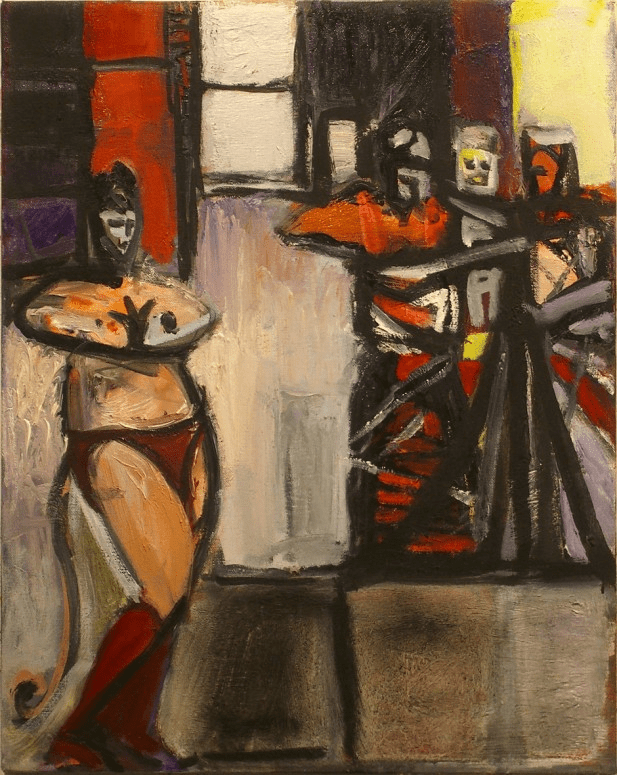
Vashti Refuses, by Richard McBee

The Jews were living in exile. The Babylonian Empire had taken Jerusalem, destroyed the temple, and exiled many of the people to Babylon. Later, the Medes and Persians conquered Babylon and ruled over a vast area of many different peoples.

The story of Esther begins with the story of King Xerxes and Queen Vashti. They were the most powerful people in the world, at that time. This meant that Vashti had more power and authority than any woman on earth, at that time.

Although most women had few rights, Vashti was not one of them. However, when it came to the king, the queen was most definitely second fiddle.

Today, we can understand Vashti’s response to Xerxes. But back then, it was unthinkable. It wasn’t only Xerxes who ruled the land; misogyny did, as well.

Queen Vashti appears in the story as a strong-willed independent woman of power. While the king and queen were each having their respective parties, things started to go sideways.

No limits on the bar meant unlimited drinking. A drunk King Xerxes had one of those moments that seemed logical to the inebriated mind, but was actually nonsensical. He insisted that his queen stop her celebration, leave her guests, get all gussied up in her royal accoutrements, and parade around for a bunch of drunk guys to gawk at.

As readers of the story, we can tell this is not going to have a good ending for Vashti. She was in an impossible situation. She could submit and face humiliation, or worse. So, the queen chose not to abide by the king’s order.

Little did Vashti know that she was paving the way for a new queen to ascend to the side of King Xerxes. The extreme action of Xerxes attempting to use his queen then turned into another action of consulting his advisors and deposing the queen. Vashti was banned from the court, and the kingdom.

Hence, events were set in motion to find a new queen. As the story unfolds, Esther is a young Jewish woman living in this forced diaspora of the Persian Empire. Little did she know that Vashti’s fall was the beginning of her own rise.

“So the last will be first, and the first will be last.”

Jesus (Matthew 20:16)

Although the story of Esther never mentions the word “God,” we see an incredible Providence guiding events through the biblical book of Esther. Young Esther found favor with the king, became queen, and risked her life to save the Jewish people from destruction.

Esther’s story is the Jewish story – a tale of others pronouncing pogroms upon them and attempting to rid themselves of these others who live strangely and differently. But a champion arises; one who bring deliverance.

The Jewish story is one of resilience as a people throughout the millennia. Rather than ignoring, or worse, persecuting Jews, we can observe how they have had to deal with the enduring issues of perseverance through suffering; preserving their identity; and ensuring their survival in the middle of social and cultural pressures.

We also see that just because one is in the courts of power and is not one of the peoples who is persecuted, does not necessarily mean that there is an exemption from harm. Vashti was a powerful woman, but her power didn’t last.

In the end, Vashti was treated more like an oppressed Jew than a privileged Gentile; and Esther would move from powerless to powerful.

And from a Christian perspective, we can see Jesus as the Savior who puts himself at risk to save the world from sin, death, and hell.

And let us run with perseverance the race marked out for us, fixing our eyes on Jesus, the pioneer and perfecter of faith. (Hebrews 12:1b-2a, NIV)

We can, as well, observe that God is not fazed by any big earthly political power. The Lord sees all, knows all, and has the authority to do something about injustice and accomplishing just purposes on this earth.

O God, your never-failing providence sets in order all things both in heaven and earth: Put away from us, we entreat you, all hurtful things, and give us those things which are profitable for us; through Jesus Christ our Lord, who lives and reigns with you and the Holy Spirit, one God, for ever and ever. Amen.

Rebuilding (Ezra 6:1-16)

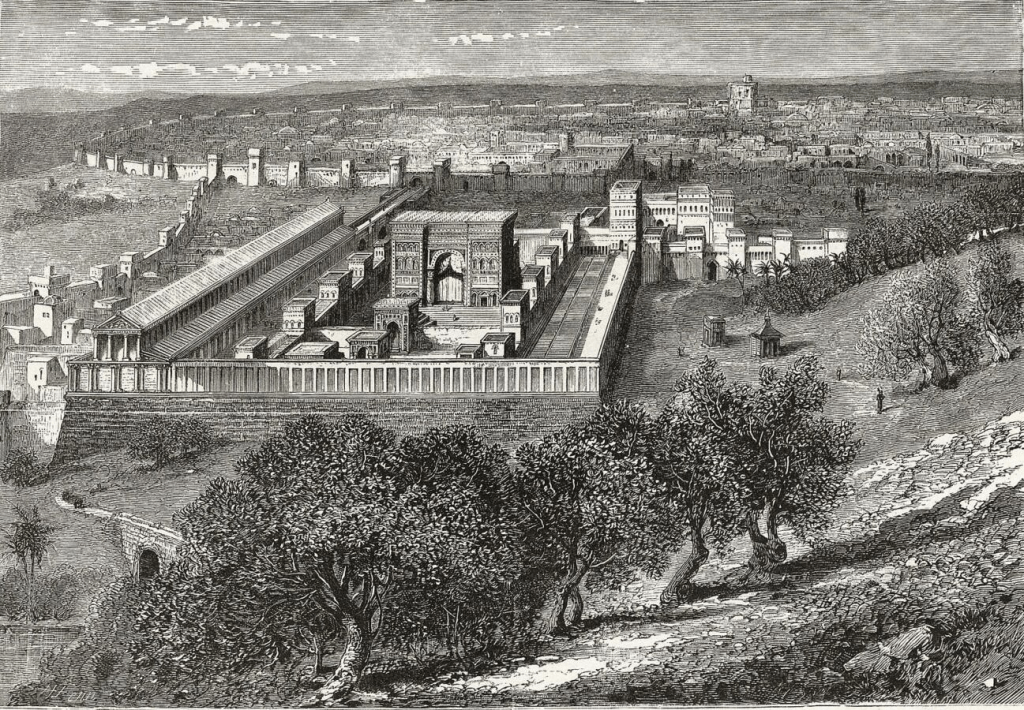
Rebuilding of the Temple, by Gustave Doré, 1866

Then King Darius made a decree, and they searched the archives where the documents were stored in Babylon. But a scroll was found in Ecbatana, the capital of the province of Media, on which was written the following:

A memorandum— In the first year of his rule, King Cyrus made a decree: Concerning God’s house in Jerusalem: Let the house at the place where they offered sacrifices be rebuilt and let its foundations be retained. Its height will be ninety feet and its width ninety feet, with three layers of dressed stones and one layer of timber. The cost will be paid from the royal treasury. In addition, the gold and silver equipment from God’s house, which Nebuchadnezzar took out of the temple in Jerusalem and brought to Babylon, is to be restored, that is, brought back to Jerusalem and put in their proper place in God’s house.

Now you, Tattenai, governor of the province Beyond the River, Shethar-bozenai, and you, their colleagues, the officials in the province Beyond the River, keep away! Leave the work on this house of God alone. Let the governor of the Jews and the elders of the Jews rebuild this house of God on its original site.

I also issue a decree about what you should do to help these elders of the Jews as they rebuild this house of God: The total cost is to be paid to these people, and without delay, from the royal revenue that is made up of the tribute of the province Beyond the River. And whatever is needed—young bulls, rams, or sheep for entirely burned offerings to the God of heaven, wheat, salt, wine, or oil, as requested by the priests in Jerusalem—let that be given to them day by day without fail so that they may offer pleasing sacrifices to the God of heaven and pray for the lives of the king and his sons.

I also decree that if anyone disobeys this edict, a beam is to be pulled out of the house of the guilty party, and the guilty party will then be impaled upon it. The house will be turned into a trash heap.

May the God who has established his name there overthrow any king or people who try to change this order or to destroy God’s house in Jerusalem. I, Darius, have decreed it; let it be done with all diligence.

Then Tattenai, the governor of the province Beyond the River, Shethar-bozenai, and their colleagues carried out the order of King Darius with all diligence. So the elders of the Jews built and prospered because of the prophesying of the prophet Haggai and Zechariah, Iddo’s son. They finished building by the command of Israel’s God and of Cyrus, Darius, and King Artaxerxes of Persia. This house was completed on the third day of the month of Adar, in the sixth year of the rule of King Darius.

Then the Israelites, the priests and the Levites, and the rest of the returned exiles joyfully celebrated the dedication of this house of God. (Common English Bible)

Throughout the time period of the Babylonian exile, the Jews waited impatiently for the day that Babylonian or Persian kings would allow them to return to their land and rebuild the Temple. When Cyrus was appointed king, their efforts were finally rewarded. Cyrus ordered that they be allowed to return to Israel and rebuild the Temple. He even promised to provide supplies for the project.

Under Persian rule, each subject people was allowed to live by its ancestral laws, which were enforced by the imperial government. Violations of the laws of the group to which one belonged constituted an offense against the state precisely because they led to instability. The maintenance of order in Judea, for example, would ensure the security of traveling to and from Egypt, and therefore the king required, in his own interest, that Jewish law be observed.

But down the road, when rebuilding efforts were questioned by the Persian governor of Judea, Tattenai, he and his associates wrote to King Darius about the legitimacy of the work. A search of the Persian records verified the Jewish claim and authority to rebuild the Temple.

What’s more, King Darius strongly affirmed support of restoration, including the use of tax revenues to help with funding the work. It was important enough for Darius to communicate that severe punishment would happen if anyone hindered rebuilding of the Temple.

The Temple was thus completed (in 516 B.C.E.) and it happened over a long period of time, under consistently adverse circumstances. The success of such a huge endeavor came through a combination of two different Persian kings who authorized the work and supported it fully; the prophets Haggai and Zechariah who encouraged it and provided spiritual support; and the Jewish leaders and workers who did the actual reconstruction and supported the effort with their blood, sweat, and tears.

In other words, a lot of stars in the universe needed to align for the Temple to actually be rebuilt. And it happened. Celebration of God’s sovereignty and divine help was then in order.

Awe and wonder are the basis of any good spirituality. Experiences that defy our imagination stick with us and bolster our faith for future mysteries and conundrums. I’m sure the Jews involved in rebuilding the Temple seriously wondered if it ever would materialize. Yet, it did.

While moments of awe come upon us, and cannot really be planned, there are yet some ways in which we can attune ourselves to experience awe in the everyday, such as:

  • Reading Holy Scripture, or inspiring biographies and novels
  • Attending church worship services and special events
  • Walking out in creation and spending time outside
  • Listening to music and going to live music performances
  • Visiting museums and community events
  • Engaging in spiritual disciplines and practicing them with others

We all go through times of rebuilding and needing to restore something which has been damaged or devastated. In your efforts, may you see the wonder of God’s movements in your life today, as you work and labor for a better tomorrow. Amen.