
The Second Woe Upon the Earth (Revelation 9:13-21)

The sixth angel sounded his trumpet, and I heard a voice coming from the four horns of the golden altar that is before God. It said to the sixth angel who had the trumpet, “Release the four angels who are bound at the great river Euphrates.” And the four angels who had been kept ready for this very hour and day and month and year were released to kill a third of mankind. The number of the mounted troops was twice ten thousand times ten thousand. I heard their number.

The horses and riders I saw in my vision looked like this: Their breastplates were fiery red, dark blue, and yellow as sulfur. The heads of the horses resembled the heads of lions, and out of their mouths came fire, smoke and sulfur. A third of mankind was killed by the three plagues of fire, smoke and sulfur that came out of their mouths. The power of the horses was in their mouths and in their tails; for their tails were like snakes, having heads with which they inflict injury.

The rest of mankind who were not killed by these plagues still did not repent of the work of their hands; they did not stop worshiping demons, and idols of gold, silver, bronze, stone and wood—idols that cannot see or hear or walk. Nor did they repent of their murders, their magic arts, their sexual immorality or their thefts. (New International Version)

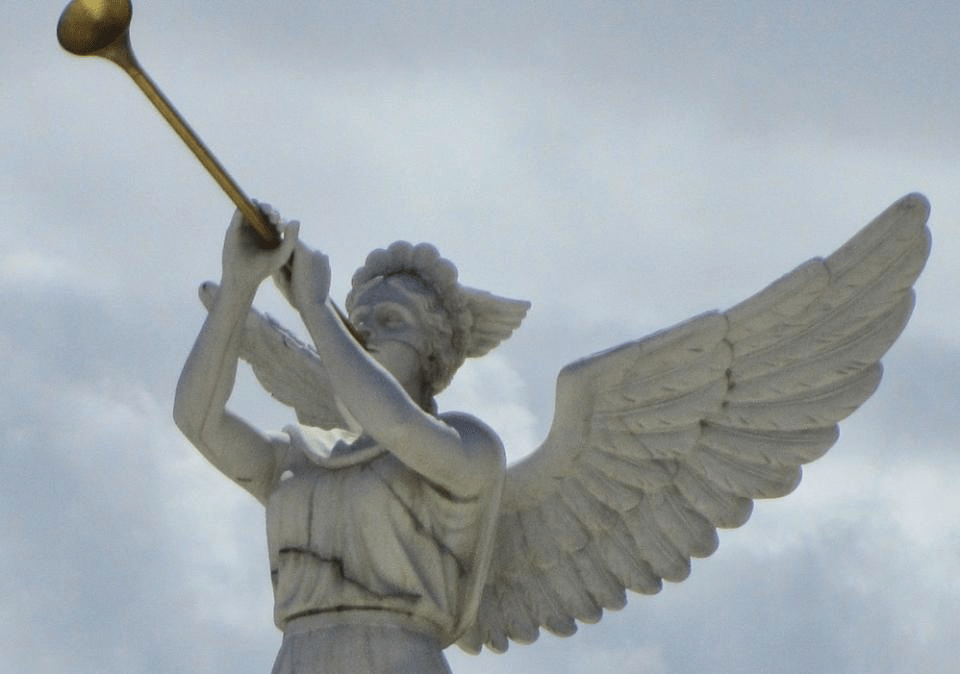
In an apocalyptic vision of God’s judgment at the end of time, the Apostle John saw seven angels with seven trumpets. Each blast of the horn brought ever increasing levels of destruction upon the earth. The final three trumpets are also described as the three woes. (Revelation 8:2-6, 13)

The Sixth Trumpet (Second Woe)

The sixth angel sounded the sixth trumpet, which was also the second woe pronounced on the world. Four angels are released from their place of restraint. Whereas the invasion of locusts in the fifth trumpet (first woe) came from the pit of hell, the next invasion comes from the east, from the outskirts, that is, outside the Roman Empire.

The terrible angels go out to kill a third of all humanity. They lead a massive destructive force that overwhelms the earth. The incredible army looks something like centaurs, being horse and rider in one. And out of their mouths come fire, smoke, and sulfur. These are three plagues which brings death to a third of humanity.

The Response to the Second Woe’s Invasion

John records the human response to the divine judgment unleashed upon humanity with the four angels and their three plagues. In reality, it’s actually a lack of response; there is no change of heart and no repentant attitude from anyone. The awful devastation does nothing to elicit any sort of self-reflection, public awareness of sin, or reconsideration of ways by those left alive.

The Apostle records that the rest of the people, after going through such a traumatic time, keep up their worship of demons and their idolatry. They continue to murder, carouse, and steal, as if nothing had happened.

What’s more, John’s graphic and disturbing vision – from it’s very beginning – does not record a single person turning away from their evil ways. The surviving inhabitants of the earth act like old Pharaoh in Egypt during the days of Moses and the exodus; their hearts are hard, and they are not about to change.

What It Means For Us

A big question for us as contemporary people, two-thousand years removed from John’s apocalyptic vision is this: Do the judgments contained in the book of Revelation have any relevance for us today?

Some might dismiss all of this as weird historical story that nobody can really understand, so we might just as well put it aside as belonging in the past. Others grew up hearing “fire and brimstone” sermons from Revelation that did nothing for them other than help them decided that they never want to be in a church again and listen to a sinner about how sinful everybody is.

Although I do not condone hellfire preaching that does little more than make people feel bad, I do believe these difficult judgment chapters in the book of Revelation have something to say to us which we would do well to hear.

  • If we dig in and want what we want, without considering anyone else or even God, then we really cannot expect blessing either in this life or the life to come.
  • If and when disaster or destruction happens – and afterwards go on our merry way as if nothing even occurred – then we have come under divine judgment.
  • If we purposely stick our heads in the sand, and intentionally avoid what is happening around us in this world, then it will not go well for us in the end.
  • If we become angry, and nurse the grudge to the point of becoming hateful and unloving, then the hardness of heart will not recognize God’s visitation when it comes.
  • If we hurt and harm others without any remorse, or make excuses for bad behavior when called out on it, then we are no better than the unrepentant mass of humanity in the book of Revelation.

There is coming a time when it will be too late. The Day of the Lord will come. There will be a final judgment. But if you are reading this, there is obviously still time. Spiritual procrastination only leads to destruction. Spiritual attention to the here-and-now leads to life. What will you do “Today?”

Our Father who is in heaven,

uphold the holiness of your name.

Bring in your kingdom

so that your will is done on earth as it’s done in heaven.

Give us the bread we need for today.

Forgive us for the ways we have wronged you,

just as we also forgive those who have wronged us.

And don’t lead us into temptation,

but rescue us from the evil one. Amen.

Consider Your Reputation (Revelation 18:1-10, 19-20)

After this I saw another angel coming down from heaven. He had great authority, and the earth was illuminated by his splendor. With a mighty voice he shouted:

“‘Fallen! Fallen is Babylon the Great!’
    She has become a dwelling for demons
and a haunt for every impure spirit,
    a haunt for every unclean bird,
    a haunt for every unclean and detestable animal.
For all the nations have drunk
    the maddening wine of her adulteries.
The kings of the earth committed adultery with her,
    and the merchants of the earth grew rich from her excessive luxuries.”

Then I heard another voice from heaven say:

“‘Come out of her, my people,’
    so that you will not share in her sins,
    so that you will not receive any of her plagues;
for her sins are piled up to heaven,
    and God has remembered her crimes.
Give back to her as she has given;
    pay her back double for what she has done.
    Pour her a double portion from her own cup.
Give her as much torment and grief
    as the glory and luxury she gave herself.
In her heart she boasts,
    ‘I sit enthroned as queen.
I am not a widow;
    I will never mourn.’
Therefore in one day her plagues will overtake her:
    death, mourning and famine.
She will be consumed by fire,
    for mighty is the Lord God who judges her.

“When the kings of the earth who committed adultery with her and shared her luxury see the smoke of her burning, they will weep and mourn over her. Terrified at her torment, they will stand far off and cry:

“‘Woe! Woe to you, great city,
    you mighty city of Babylon!
In one hour your doom has come!…’

They will throw dust on their heads, and with weeping and mourning cry out:

“‘Woe! Woe to you, great city,
    where all who had ships on the sea
    became rich through her wealth!
In one hour she has been brought to ruin!’

“Rejoice over her, you heavens!
    Rejoice, you people of God!
    Rejoice, apostles and prophets!
For God has judged her
    with the judgment she imposed on you.” (New International Version)

Much of the book of Revelation, also known as The Apocalypse of John, is related in symbolic language. The Apostle John had a vision – much like a dream – and saw things that were to come. Like the prophet Ezekiel, experiencing a vision from the Lord is hard to put into words once you’ve experienced it.

John sees and hears the fall of Babylon, that is, the city of Rome. He heard the angel proclaim the empire’s utter desolation and saw what the city would lose. It’s bad news for Rome but good news for the rest of the earth. Drunkenness and sexual immorality are metaphors for the Roman Empire’s crime of acquiring wealth and luxury on the backs of others through imperialism.

What’s more, Rome deceived the nations by causing them to think and believe this economic and religious imperialism was right, good, and needed. So, other city states and nations went to bed with them in this impure and unholy cause. Therefore, divine judgment was coming.

The Fall of Babylon, 15th century artwork

The Apostle John wanted his readers to make a clean break with the Roman Empire and everything it represents. Rome had a “good” reputation with many of the conquered and colonized peoples in the Empire. But, in reality, they had spread evil and encouraged others in their immorality. There was an awfully dark underbelly to Rome’s power and authority that the people of God were invited to see and repudiate.

The issue of reputation is an important one, because how we come across to others might be different than who we actually are.

One day at a parent-teacher conference, many years ago when my middle daughter was in second grade, the teacher told my wife and I about the class reading some Winnie the Pooh books. The kids were to talk about which Pooh character they liked the most and why. Since my sweet daughter is an outgoing and bouncy person, I was certain that she had said that Tigger was her favorite. But instead, she told the teacher her favorite was Eeyore, “because Eeyore reminds me of my Daddy.”

Ouch. I wasn’t ready for that one. Yet, as I thought about my daughter’s answer, I began to see that since I was working as a factory supervisor, going to graduate school at night, and being a part-time church pastor, I was continually drained and tired. So, my daughter experienced me as if I was Eeyore loping about the house with a pinned-on tail.  

Before that parent-teacher conference encounter, I never would have described myself as my daughter did. Obviously, my reputation did not match my self-perception – which leads me to ask a question for you to struggle with: What is your reputation with others? 

The question is not: What do you think your reputation is? That’s because the only way to know your reputation is to interact with other people. And their answers may be very different than what you think they might be.

If there is a clear disconnect between what someone or some group says about you, and what you think is true about you, then please do not dismiss their thoughts or opinions. You may not like what they say, but we need to weigh the words and glean as much wisdom as we can from them.  

Also, if it is a negative perception, or truly off the mark, use the information to help inspire you toward change. And if there are things that you know need changing, think about what kind of reputation you want to have and begin setting some goals for achieving what you want. Begin with the results you want, and then focus on the small steps you can do to gain what you are after.

There is yet one more critical question to ask, and the way you answer it requires the utmost honesty and vulnerability: What is your reputation with God?

As with others, your approach is to be the same, that is, ask God what God thinks about you. Read Holy Scripture and spend time with the Lord. No individual believer or faith community can ever hope to glorify God and have effective ministry unless they are genuine and urgent about where they stand before God and what their reputation is with people outside of church.

Let’s not assume that others do or should think highly of us, of Christians, or of the Church. Ask the questions of reputation. Use them to spawn the kind of interaction that is needed to help address what God wants for your life. 

I did not want to be Eeyore, so I reassessed my use of time so that I could be more fully present to my family. What will it mean for you?

Blessed Holy Spirit, in the name of Jesus, help me to cultivate godly character, thereby building a good reputation. Deliver me from whatever will destroy my reputation. Save the leaders of your church everywhere from the enemy that seeks to damage their reputation. Protect and preserve them, O Lord. Amen.