Spiritual Support (Ezekiel 29:3-7)

Speak and say, The Lord God proclaims:

I’m against you, Pharaoh, Egypt’s king,
    great crocodile lurking
    in the Nile’s canals,
        who says, “The Nile is all mine;
        I made it for myself!”
I will set hooks in your jaws;
    I will make the fish from the Nile’s canals cling to your scales.
I will drag you out of the Nile’s canals,
    and also all the fish from the Nile’s canals
    clinging to your scales.
        I will fling you out into the desert,
        and also all the fish from the Nile’s canals.
You will fall on the open ground,
    and won’t be gathered or retrieved.

I’ve given you to the beasts of the earth
        and the birds in the sky for food.
Everyone living in Egypt will know that I am the Lord.

Because they were a flimsy crutch for the house of Israel—when they took you in hand, you would splinter and make their shoulders sore; when they leaned on you, you would break, bringing them to their knees. (Common English Bible)

“Relying on God has to begin all over again every day as if nothing yet had been done.”

C.S. Lewis

From where, and to whom, do we look to for support?

The Pharaoh of Egypt could open his mouth as wide as a crocodile, but he had no real strength – only talk and no bite – and talk is cheap, especially in the face of a sovereign God.

The Lord had little tolerance for Pharaoh’s bombast, so God decided to don the divine crocodile hunter hat and pull the old creature out of the Nile River.

The reeds that grow along the Nile in Egypt look something like bamboo. They appear as if they might make a decent staff or crutch, but the reeds are not good for that, and if used so, would shatter and put some significant splinters into your hand.

God was warning the Israelites against sizing up Egypt as a significant means of support, and then putting weight on them for help. The leadership of Jerusalem was trusting in Pharaoh and his Egyptian troops to rescue them from the Babylonian army.

But, as we know from history, the Babylonians soundly defeated the Egyptian soldiers. Pharaoh was no support, at all, and became a shattered crutch to Judah, just as God had warned.

We need to be careful about choosing our sources of support. There are a lot of unreliable means of help out there, that people turn to in life.

When going through tough times, we may believe that popularity and power, or alcohol and drugs, or wealth and position will help support us and get us through the hard situation. Yet, they all prove too weak and inadequate in the end.

God is able to carry a person through a crisis, so that we do not just survive it, but grow and thrive through it. We must continually be vigilant and wise to resist the temptation toward the shiny things in life which may draw us to depend upon unreliable things and people. We need God working through God’s people to help support us in a time of need.

Our help is in the name of the Lord,
    who made heaven and earth. (Psalm 124:8, NRSV)

One of the great Christian theologians of the twentieth century, the Protestant Swiss professor Karl Barth, believed that we are not fully human and fully supporting one another apart from:

  • mutual seeing and being seen
  • reciprocal speaking and listening
  • granting one another mutual assistance
  • doing everything with gratitude and gratefulness

Barth used the German term Mitmenschlichkeit (co-humanity) to communicate that we are human and supported with a trusted other person alongside us. In other words, human flourishing requires mutual giving and receiving. Only in relation to each other, including those in need, do we thrive as people.

Christianity is a dependence upon God and an inter-dependence on one another; it’s not an isolated independent venture. Adversity, hardship, and difficulty can become a symbiotic relationship between the care-seeker and the caregiver, within the foundation of Trinitarian love, expressed with grace and hope given by Jesus in the power of the Holy Spirit.

So, when we talk about spiritual support of another, it includes the following alliterated points:

  • Struggle. Enter another’s spiritual and emotional wrestling along with them, without succumbing to the impetus to change or fix, but to empathize, affirm, and validate emotions and experiences.
  • Share. Seek to be emotionally available and aware – to be present in another’s pain and wonderment, understanding that a person cannot go any deeper with me than I have gone with myself.
  • Story. Listen to the story that a person weaves about their own situation, background, family, support, religious milieu, as well as their personal spiritual and emotional world.
  • Salvation. Allow and give permission to the person to name and resolve their own struggle; because I am neither the Savior nor in the saving business, as if deliverance and freedom depended upon me.

“Do not let your hearts be troubled. Believe in God; believe also in me.”

Jesus to his disciples (John 14:1, NRSV)

Trust of another must be given carefully and wisely, not flippantly or thoughtlessly. And becoming a trusting person involves not only a willingness to do so, but also the presence to listen, the place to care, and the passion and commitment to do what is helpful, not hurtful.

Blessed God of support and strength, you have given me the shield of your salvation, and your right hand has supported me. Your divine help has gotten me through, and given me a wide place for my steps under me, so that my fee do not slip.

Gracious God, you have given me an example through the Lord Jesus that we must support the weak, remembering his words, “It is more blessed to give than to receive.” May it be so, in the strength given by the Holy Spirit, to your glory and honor. Amen.

Assurance for the Next Step in Life (Judges 6:36-40)

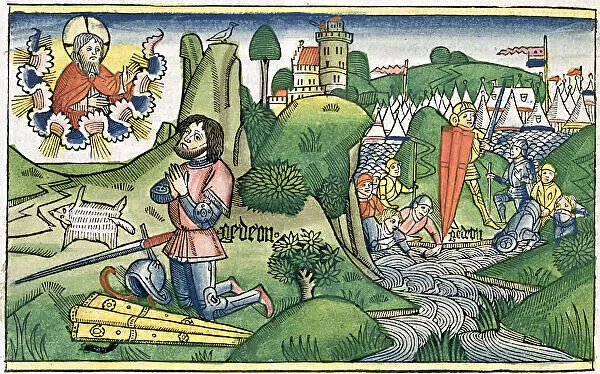
15th century German artist depiction of Gideon putting out the fleece

Gideon prayed to God, “I know that you promised to help me rescue Israel, but I need proof. Tonight I’ll spread a sheep skin on the stone floor of that threshing place over there. If you really will help me rescue Israel, then tomorrow morning let there be dew on the skin, but let the stone floor be dry.”

And that’s just what happened. Early the next morning, Gideon got up and checked the sheep skin. He squeezed out enough water to fill a bowl. But Gideon prayed to God again. “Don’t be angry with me,” Gideon said. “Let me try this just one more time, so I’ll really be sure you’ll help me. Only this time, let the skin be dry and the stone floor be wet.”

That night, God made the stone floor wet with dew, but he kept the sheep skin dry. (Contemporary English Version)

It’s only human to want assurances. And since humanity requires some sort of affirmation that they’re hearing things right, or are on the right track, God graciously accommodates to our need. Much like the disciple of Jesus, Thomas, who desired an assurance that Christ is alive and was victorious over the grave, so Gideon needed clarification that victory was truly at hand.

In both cases of doubting Thomas and anxious Gideon, the Lord does not chide them for needing such assurances. Rather, God immediately responds to their requests. You and I might feel ourselves weak or confused in needing such support, yet God doesn’t feel this way about us.

Sometimes, in our disorientation and our dismay, we try and put feelings aside and stoically attempt to do whatever must be done with complete dispassion and lack of emotion. But that’s to try and be somebody we are not; humans simply aren’t wired that way. There’s no need to try and stir up the courage and confidence on our own.

To navigate this life with any success, we’ll need to pay attention to the inner person, to what’s going on inside us, whenever we are in stressful or confusing times. Then we can connect with the God who mercifully awaits hearing our request. It’s good to be equipped and ready for what’s ahead by having a few convictions….

It’s not the destination that’s important; it’s the journey

Gideon needed to come around to seeing that getting from Point A to Point B as quickly and as efficiently as possible was not the goal. The process of getting from one place to another is the very opportunity needed to connect with the Lord and with others around us. God’s instructions may seem, at times, nonsensical – which is why we often look for assurances that we’ve heard them correctly!

Gideon and the fleece, in the Frauenkirche, Esslingen, Germany

For us modern folk, the Lord doesn’t want us getting lost in the race to become ever more streamlined and productive, only looking at the end goal. If relationships, human connection, justice, love and respect of others is our highest value, then we really need to pay a lot more attention to the process of what we’re doing, and not just the product and outcomes.

Focusing solely on a final outcome turns factory workers into extensions of the machines they are using to churn out a quality product; it turns families at church into giving units with potential to support all the programs and ministries; it turns adversity into an unwanted obstacle to achieving victory; and turns needy people into problems we can fix.

Life is a pilgrimage to walk; it’s not a race to run

At the end of life, folks don’t reminisce about how much they produced, how many places they’ve been, or how much money they made. Instead, they talk about people, both the relationships that were rich and full, as well as the broken or lapsed relationships which cause them regret.

This is why, daily, I purpose to saunter, walk slowly, and observe the people and places around me. This practice allows me to take the time to greet others, connect with some, and even have a sit down conversation with another person – all on the way to doing something else.

Frankly, from a goal-oriented perspective of achievement and accomplishment, this practice does nothing to help whittle down my massive checklist for the day. But I do it, anyway, because human connection our real purpose in life.

Humanity is our business

It doesn’t matter what we do for a living, or where we live. Relationships are the only reality we take with us in the end – both with God and other people.

Dead with ball and chain, the ghost of Jacob Marley responded to Ebenezer Scrooge’s accolade that he was such a good man of business:

“Mankind was my business. The common welfare was my business; charity, mercy, forbearance, benevolence, were all my business. The dealings of my trade were but a drop of water in the comprehensive ocean of my business!” 

Jacob Marley, in Charles Dickens, A Christmas Carol

Marley had discovered this insight too late. 

All of life is a gift given by God, meant for us to be stewards toward the benefit and welfare of humanity. All our abilities, skills, intellectual acumen, possessions, and even the lack thereof – literally everything – is meant to be used in the betterment of our fellow human beings.

We all share the common human condition of needing our stories told and heard by one another, so that we can have some assurance and comfort through what we’re facing.

Will I be there to hear another? Will another be there to hear me? Will I listen to God? Will God listen to me?

Be fully present to others; avoid thinking about the past or focusing on the future

If you think about it, Jesus was perhaps the most productive person to ever walk this earth. In just three short years his ministry completely changed the world and continues to do so. Perhaps our Lord’s “secret” was no secret at all. 

Christ was fully present to the Father, and to the people right in front of him. He was never hurried, and didn’t capitulate to the anxiety of others who wanted him to pick up the pace of being a kickass Messiah.

So, my friends, may you slow down enough to observe, see, hear, smell, and witness the incredible and deep humanity that is present next door to you, down the hall from you, and sitting across the table with you. 

May you experience the wide mercy of God and graciously extend the same love to others. 

May you embrace the process of whatever you are doing to include the space of others and their unique humanity.

For this is how we gain our assurance that God is with us and that we are on the right track for that next step in life.

Trust the Promises (Joshua 3:1-17)

Crossing the Jordan River, by Yoram Raanan

Early in the morning Joshua and all the Israelites set out from Shittim and went to the Jordan, where they camped before crossing over. After three days the officers went throughout the camp, giving orders to the people: “When you see the ark of the covenant of the Lord your God, and the Levitical priests carrying it, you are to move out from your positions and follow it. Then you will know which way to go, since you have never been this way before. But keep a distance of about two thousand cubits between you and the ark; do not go near it.”

Joshua told the people, “Consecrate yourselves, for tomorrow the Lord will do amazing things among you.”

Joshua said to the priests, “Take up the ark of the covenant and pass on ahead of the people.” So they took it up and went ahead of them.

And the Lord said to Joshua, “Today I will begin to exalt you in the eyes of all Israel, so they may know that I am with you as I was with Moses. Tell the priests who carry the ark of the covenant: ‘When you reach the edge of the Jordan’s waters, go and stand in the river.’”

Joshua said to the Israelites, “Come here and listen to the words of the Lord your God. This is how you will know that the living God is among you and that he will certainly drive out before you the Canaanites, Hittites, Hivites, Perizzites, Girgashites, Amorites and Jebusites. See, the ark of the covenant of the Lord of all the earth will go into the Jordan ahead of you. Now then, choose twelve men from the tribes of Israel, one from each tribe. And as soon as the priests who carry the ark of the Lord—the Lord of all the earth—set foot in the Jordan, its waters flowing downstream will be cut off and stand up in a heap.”

So when the people broke camp to cross the Jordan, the priests carrying the ark of the covenant went ahead of them. Now the Jordan is at flood stage all during harvest. Yet as soon as the priests who carried the ark reached the Jordan and their feet touched the water’s edge, the water from upstream stopped flowing. It piled up in a heap a great distance away, at a town called Adam in the vicinity of Zarethan, while the water flowing down to the Sea of the Arabah (that is, the Dead Sea) was completely cut off. So the people crossed over opposite Jericho. The priests who carried the ark of the covenant of the Lord stopped in the middle of the Jordan and stood on dry ground, while all Israel passed by until the whole nation had completed the crossing on dry ground. (New International Version)

400 years of Egyptian slavery. Then deliverance from bondage. Another 40 years of wandering around the desert. It might have seemed to the ancient Israelites that getting to the Promised Land would never happen.

How can we know God is with us? Will divine promises really hold up? Can I keep trusting in the Lord, even though it is taking so darned long to get where I need to be?

Through yet another miracle of the parting of the waters and walking on dry land to get to the other side, Joshua and people of Israel (and us) are given a visual, tactile, experiential way of trusting God. By this indelible encounter, the people will know that the living God is among them, and without fail, the Lord will drive out all obstacles and opposition to entering and taking the land.

All the dramatic events that occurred were for the sake of the people, so that they would know that God is with them and will give them victory. To heighten the experience, the Jordan River was at flood stage at the time of the crossing. If you have ever been on the bank of a raging river, you know how significant a miracle this really was to behold. 

Today, we may not have the experience of seeing a rushing river stop and crossing over on dry ground; yet we have these stories that bear witness to the truth that God is among us, that God will do what was promised, and that God will give us victory.

Know that the victory came after a long liminal period of moving from one reality to another. A “liminal space” (an intermediate position characterized by transition, a place where things are either coming or going) is where the Israelites had to hang out for a very long time. Now, the promises were about to be realized.

Miracles and wonders and victories are neither easy nor cheap. They come as a result of significantly hard movements from the past into the future. In other words, our present experiences can be quite adverse and difficult. If we lose where we’ve come from, and where we’re going, we may too easily lose heart or become afraid and simply give up all hope.

That’s why God gives divine promises, so that we will be sustained with God’s words until the promised time is realized. It’s our job to encourage one another and remind each other of those promises; they are meant to buoy up our flagging spirits when things get rough.

So, keep looking and praying for that miracle. Just understand that you may need to persevere in faith, patience, and holiness for a while before it happens.

Blessed and holy God, continue the good work begun in me, so that I may increase daily in wholeness, integrity, and strength. I rejoice in your goodness and think and do that which pleases you, through Jesus Christ our Redeemer. Amen.

Wednesday of Holy Week (Psalm 70)

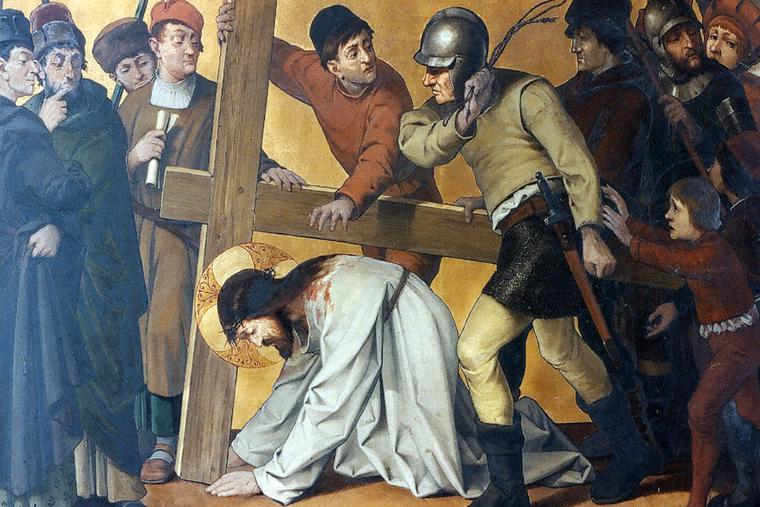
Ninth Station of the Cross, Jesus falls the third time, by Théophile Marie François Lybaert, c.1886

Be pleased, O God, to deliver me.
    O Lord, make haste to help me!
Let those be put to shame and confusion
    who seek my life.
Let those be turned back and brought to dishonor
    who desire to hurt me.
Let those who say, “Aha, Aha!”
    turn back because of their shame.

Let all who seek you
    rejoice and be glad in you.
Let those who love your salvation
    say evermore, “God is great!”
But I am poor and needy;
    hasten to me, O God!
You are my help and my deliverer;
    O Lord, do not delay! (New Revised Standard Version)

We all need help. Even Jesus.

As we journey with Jesus, and walk with him along the Via Dolorosa, we learn to set aside our illusions and delusions of radical independence, and to adopt his sense of dependence upon the heavenly Father. We come around to saying that we need divine help.

Continuing with a deliberate Christological view of the psalms, we are reminded that there was a time that Jesus felt desperation, just like we do. We go with him to the Garden of Gethsemane. And even though, in our own stressed out souls, we end up falling asleep and failing to pray as we ought, nevertheless we remember that the Lord Jesus sweat great drops of blood and agonized over what he was about to face.

There are times when the help we need isn’t for next week or tomorrow, but immediately, now!

I don’t know if you have ever been in such a stressful and dangerous situation in which all you could say is “Help, help me!” The abject feeling is helplessness is palpable and just plain awful. The sense there is nothing you can do to improve your circumstance other than some sort of merciful divine intervention is more than unnerving. It’s downright hard to breathe, let alone cry-out to be rescued.

In today’s psalm, it seems there were people getting a twisted sense of joy over the misfortune of others. It’s as if they were delighting in the confusion and vulnerability of those unable to stop what is happening.

In the throes of such stress and danger, the help we need is to have the evil turned back on the wicked. The psalmist wants such persons off his back – to have God hunt them like they are hunting the poor and needy who have no ability to resist.

It makes sense this psalm is short, just a few verses. Long prayers aren’t necessarily better than short ones, especially when it’s a frantic cry for God’s help. There is nothing in Holy Scripture that dictates how long or short prayer ought to be.

“Help!” just might be one of the best prayers we can pray. One little word. That’s all it takes.

It makes sense to me that this is an honest prayer. When in the throes of some horrible situation, all pretension goes out the window. Honest heartfelt prayers are the best kind of prayer.

If we are hurting badly enough, boldness comes quickly to the tip of our tongues. I once had a kidney stone and walked, doubled over in pain, into the Emergency Department of a hospital. I yelled at the first staff person I encountered, saying, “I need help, NOW!

To confess our great need to a God who listens might just be the best kind of theology we could ever express.

In such a terrible place of agony – of either body, soul, or both – there’s no thought to keeping up appearances, but only an unfiltered expression of need. Our prayers can, and need to be, earnest and urgent.

Prayer can be short, honest, and urgent because emergent situations require it. So, what do you do when you feel desperate? How do you handle your emotions? Where do you go for help?

In this Holy Week we are reminded that Jesus looked to the Father for help. In the worst of circumstances – facing ridicule, torture, and a horrible death – the Lord Jesus let the psalms shape his own prayers of desperation while under severe stress and duress:

“The one who ate my bread has lifted his heel against me.” (John 13:18; Psalm 41:9)

“They hated me without a cause.” (John 15:24; Psalm 69:4)

“I am deeply grieved, even to death; remain here, and stay awake with me.” (Matthew 26:38; Psalm 42:5-6)

“My God, my God, why have you forsaken me?”

Jesus (Matthew 27:46; Psalm 22:1)

Then Jesus, crying with a loud voice, said, “Father, into your hands I commend my spirit.” Having said this, he breathed his last. (Luke 23:46; Psalm 31:16)

There is a God who understands our plight. Jesus, the pioneer of our salvation, has gone before us in the way of suffering. He knows what it’s like to experience the agony and anguish of evil’s weight. He is our great high priest, the one who can intercede effectively and compassionately for us in our great times of need:

Now that we know what we have—Jesus, this great High Priest with ready access to God—let’s not let it slip through our fingers. We don’t have a priest who is out of touch with our reality. He’s been through weakness and testing, experienced it all—all but the sin. So, let’s walk right up to him and get what he is so ready to give. Take the mercy, accept the help. (Hebrews 4:14-16, MSG)

May you find in Jesus the help you so desperately need. Amen.