
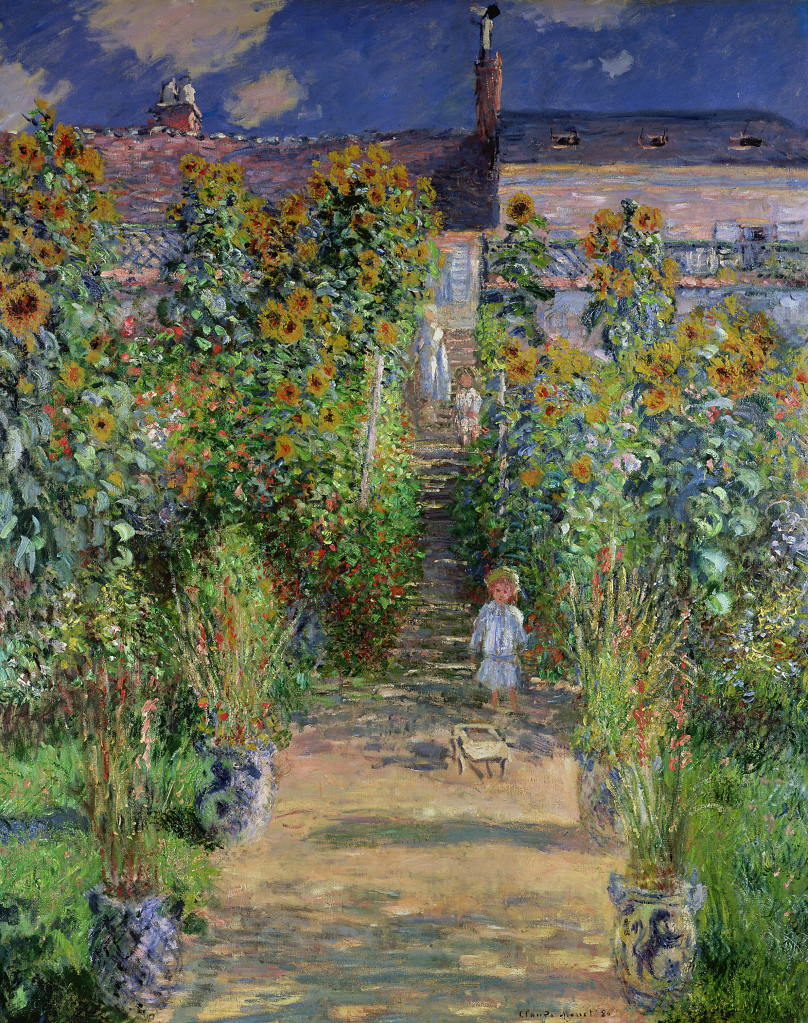
The Divine Gardener

The Artist’s Garden at Vétheuil, by Claude Monet, 1881

The fruit of the Spirit is love, joy, peace, patience, kindness, goodness, faithfulness, gentleness, and self-control. (Galatians 5:22-23, Common English Bible)

Soon it will be Spring. Many people are already planning for the soil in fields and gardens to be turned over for planting and cultivating.

Healthy plants grow and feed many. They don’t simply occur by happenstance. And neither does things like morality, ethics, and living an altruistic life; they don’t just happen.

Virtue and a good life are the result of solid and robust inner work within the soul.

The daily overall trajectory of personal and institutional life demonstrates whether they are driven by egoistic desires, or influenced from an inner garden of delectable fruit which has been wisely plucked for others to enjoy.

 “A good tree doesn’t produce bad fruit, nor does a bad tree produce good fruit. Each tree is known by its own fruit. People don’t gather figs from thorny plants, nor do they pick grapes from prickly bushes. A good person produces good from the good treasury of the inner self, while an evil person produces evil from the evil treasury of the inner self. The inner self overflows with words that are spoken.”

Jesus (Luke 6:43-45, Common English Bible)

The Apostle James learned well from his Teacher when he said:

My brothers and sisters, can a fig tree produce olives? Can a grapevine produce figs? (James 3:12, Common English Bible)

The soul is a garden which must have a faithful gardener to continually attend to it. There is a constant need for paying attention to the plants through consistent weeding, watering, and nurturing the seeds placed in good rich soil.

If we will but only allow it, the Holy Spirit of God can be our Divine Gardener, being the elements we need for growth, maturity, and a good life which produces good succulent fruit for many to enjoy.

Apart from the Spirit’s warming, watering, and protecting, people can easily degenerate into all kinds of illicit thinking and behavior such as immorality, moral corruption, doing whatever feels good, idolatry, substance abuse, casting evil spells, hate, fighting, obsessive behaviors, violent anger, competitive opposition, conflict, selfishness, group rivalry,jealousy, and lying.

The Christian virtues which flower and produce the fruit of love, joy, peace, patience, kindness, goodness, faithfulness, gentleness, and self-control occur through a close intimate connection with the Divine Gardener. 

Our Divine spiritual Gardener knows that all things are connected – that below the surface the roots of every plant become connected with one another. There is really no such thing as a person who is disconnected from the rest of humanity.
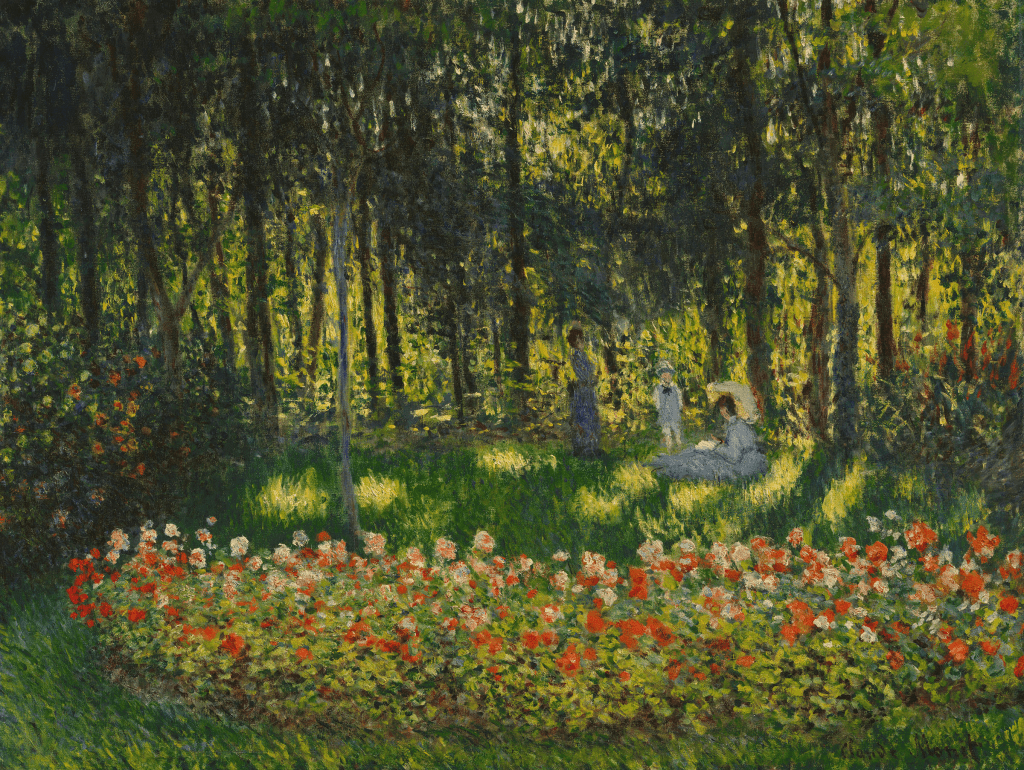
The Artist’s Family In the Garden, by Claude Monet, 1875

Thus, the Apostle Paul, having also learned well, understood that there are not spiritual “fruits,” but only spiritual “fruit.” That is, the nine virtues Paul mentioned are the “fruit of the Spirit,” not “fruits.”

In other words, all virtuous words and behavior are connected with each other. When a person or an organization has the Divine Gardener attending to them, all nine of the Christian values are a collective basket of fruit which cannot be separated from one another.

So then, if we look at the list of spiritual fruit in the New Testament book of Galatians and say something like, “Well, I’m pretty good at kindness and goodness, but I don’t have much peace or patience,” then what this really means is that we are likely doing kindness and goodness from a different place than by means of the Holy Spirit.

Because when the Spirit is manifested in us, we exhibit spiritual fruit. We cannot separate the nine spiritual virtues any more than we can separate the Trinity. They’re all one spiritual fruit, cultivated and produced within the inner person by the agency of God’s Spirit, our Divine Gardener.

Perhaps we need to consider what is happening in the ground, underneath the surface, which is the shadow side of our lives that no one sees.

For example, it could be that we are driven far more by our ego and our anxiety about most things than about genuine altruism and love. The results of our actions and words may look the same or similar, but the motivation might be far from truly altruistic.

Any sort of “fruit” will simply not last if our actions spring from a place of ego control and worry – because it is not of the Spirit.

Both persons and institutions must mortify (put to death) the deeds and the weeds of the sinful nature.

I have been crucified with Christ and I no longer live, but Christ lives in me. And the life that I now live in my body, I live by faith, indeed, by the faithfulness of God’s Son, who loved me and gave himself for me.

The Apostle Paul (Galatians 2:20, Common English Bible)

The Spirit will always have us in the good rich soil of Christ, so that when we are planted and receive the proper amounts of spiritual sun and living water, we will most certainly produce a hundredfold crop.

Then, we learn to make proper and right judgments about what is happening in our world. We are able to see the thief in the garden who cares only to pick fruit he has neither planted nor cared for, having no intention of sharing anything, but instead seeks to amass a gluttonous basket for his own self.

There is a great need for virtuous living, ethical sensibilities, and wise discernment among everyone in this world.

We are now observing what happens when a people are ignorant of how true righteousness, justice, goodness, and peace are grown and developed in any culture, society, and government. Fools are allowed to roam the garden, and they make a complete mess of things.

Let us all do our part in ensuring that genuine spiritual fruit is produced, coming from the true self. Disconnection, destruction, and chaos are the fruit of a bad tree. Then, it is only fit to cut down and thrown into the fire.

Jesus said:

“Every good tree produces good fruit, and every rotten tree produces bad fruit. A good tree can’t produce bad fruit. And a rotten tree can’t produce good fruit. Every tree that doesn’t produce good fruit is chopped down and thrown into the fire. Therefore, you will know them by their fruit.” (Matthew 7:17-20, Common English Bible)

Therefore, beware, watch out, and be wise in the way your own soul is cultivated, and how you discern the souls of others.

For the Christian, the season of Lent is the best and most appropriate time to focus upon spiritual disciplines which help connect us with Christ and with one another.

Daily attention to the garden of our soul prepares us for Holy Week by participating with Jesus in both his crucifixion and resurrection. All that is wrong and sinful in this old fallen world is put to death, and a new life of virtuous and altruistic living is enjoyed.

And the beauty of it all is that it will organically spring from the depths of a well-cultivated soul garden. The Divine Gardener stands ready with both hose and hoe to bring about the fruit of the Spirit.

Soli Deo Gloria

Insiders and Outsiders (Romans 11:13-29)

But I don’t want to go on about them [the Jews]. It’s you, the outsiders, that I’m concerned with now. Because my personal assignment is focused on the so-called outsiders, I make as much of this as I can when I’m among my Israelite kin, the so-called insiders, hoping they’ll realize what they’re missing and want to get in on what God is doing. If their falling out initiated this worldwide coming together, their recovery is going to set off something even better: mass homecoming! If the first thing the Jews did, even though it was wrong for them, turned out for your good, just think what’s going to happen when they get it right!

Behind and underneath all this there is a holy, God-planted, God-tended root. If the primary root of the tree is holy, there’s bound to be some holy fruit. Some of the tree’s branches were pruned and you wild olive shoots were grafted in. Yet the fact that you are now fed by that rich and holy root gives you no cause to gloat over the pruned branches. Remember, you aren’t feeding the root; the root is feeding you.

It’s certainly possible to say, “Other branches were pruned so that I could be grafted in!” Well and good. But they were pruned because they were deadwood, no longer connected by belief and commitment to the root. The only reason you’re on the tree is because your graft “took” when you believed, and because you’re connected to that belief-nurturing root. So don’t get cocky and strut your branch. Be humbly mindful of the root that keeps you lithe and green.

If God didn’t think twice about taking pruning shears to the natural branches, why would he hesitate over you? He wouldn’t give it a second thought. Make sure you stay alert to these qualities of gentle kindness and ruthless severity that exist side by side in God—ruthless with the deadwood, gentle with the grafted shoot. But don’t presume on this gentleness. The moment you become deadwood, it’s game over.

And don’t get to feeling superior to those pruned branches down on the ground. If they don’t persist in remaining deadwood, they could very well get grafted back in. God can do that. He can perform miracle grafts. Why, if he could graft you—branches cut from a tree out in the wild—into an orchard tree, he certainly isn’t going to have any trouble grafting branches back into the tree they grew from in the first place. Just be glad you’re in the tree, and hope for the best for the others.

I want to lay all this out on the table as clearly as I can, friends. This is complicated. It would be easy to misinterpret what’s going on and arrogantly assume that you’re royalty and they’re just rabble, out on their ears for good. But that’s not it at all. This hardness on the part of insider Israel toward God is temporary. Its effect is to open things up to all the outsiders so that we end up with a full house. Before it’s all over, there will be a complete Israel. As it is written,

A champion will stride down from the mountain of Zion;
    he’ll clean house in Jacob.
And this is my commitment to my people:
    removal of their sins.

From your point of view as you hear and embrace the good news of the Message, it looks like the Jews are God’s enemies. But looked at from the long-range perspective of God’s overall purpose, they remain God’s oldest friends. God’s gifts and God’s call are under full warranty—never canceled, never rescinded. (The Message)

A big reason a lot of people don’t go to church anymore, is that they can’t stand the bickering, backbiting, and belligerence amongst the people. It’s sad that so many have had a bad experience of Christians squabbling with each other. It’s not supposed to be this way.

Paul disputing with both Gentiles and Jews, c.1175 C.E., (Victoria and Albert Museum, London)

The letter to the Romans reminds me of two siblings going at it, always at odds with each other. Gentile and Jew both together in one church, constantly arguing, and never stopping to listen to the other. The Apostle Paul, their spiritual parent, had enough of it. So, he wrote a lengthy tome, often alternating between speaking directly to Brother Gentile and then to Brother Jew.

Wisely, Paul never took sides and avoided favoritism even though he himself was Jewish. In today’s New Testament lesson, Paul speaks pointedly and forthrightly to the Gentiles in the church. He gets to the issue of Brother Gentile’s attitude and view toward Brother Jew. Father Paul’s instruction to Brother Gentile is also instructive for us, as we navigate a pluralistic world and a diverse church.

Brother Gentile tended to look down on Brother Jew as stuck in the past, too concerned for tradition, and unwilling to change. Brother Gentile thought it was high time Brother Jew understood that all that Jewish stuff is no longer needed; Gentiles were the future of the church.

For Brother Gentile, God has accepted him, and Brother Jew has been rejected as an unwanted anachronism. But Father Paul would have none of it; he was not going to allow Brother Gentile to eviscerate Brother Jew of his identity.

Notice Father Paul’s reasoning to his son, Brother Gentile, utilizing the lesser to the greater argument:

  • Brother Jew’s stumbling and bumbling has already caused Brother Gentile to come to faith in Christ.
  • Brother Gentile’s deliverance and acceptance will cause Brother Jew’s jealousy to kick in.
  • Brother Jew’s response will bring even greater spiritual blessing to the world.

Paul insisted that Brother Jew still has a prominent place in the family, and that a time is coming when the entire human family will have their socks blessed off because of him. Just as an olive tree is pruned and has branches grafted in, Brother Gentile needs to understand he’s a graft, and not part of the original tree.

Therefore, there is no place for arrogant pride. Grafted branches get broken off and pruned, too! And pruned branches can also be grafted back on the tree.

So, Father Paul wanted his sons to understand and appreciate one another as the one tree in God’s family. There is room for neither Brother Gentile’s complacency nor Brother Jew’s despair. Both brothers share together in one equitable tree of life, enjoying the blessings of renewal and restoration.

Let us take these lessons to heart in our interactions with folks who are different from ourselves! There is no room in God’s benevolent kingdom for simpletons who fail to see beyond the end of their noses. Instead, we are to appreciate our brother who looks, thinks, and lives differently than us.

God is only intolerant about intolerance. The Lord desires mercy and justice toward those distinctly offbeat from our own path. Just because Jesus is the way, the truth, and the life does not give any follower of Christ a license to misinterpret, misrepresent, and mistreat another group of people who subscribe to various jots and tittles other than me.

Neither you nor I are the Gardener. We do not get to do the pruning and grafting. That is God’s job, not ours. Love is our business, while the Lord will show both his kindness and sternness when and to whom he will.

Simply assuming we are always on the right side of things only produces a lack of listening, a lack of like-mindedness, and a lack of love. It creates a worldly system of demagoguery, inattention to suffering, and narrow policies, procedures, and laws which benefit only one brother, and not all the siblings.

Father Paul said earlier in his letter, “God doesn’t have any favorites!” (Romans 2:11, CEV)

Father James said in his letter, “Don’t treat some people better than others.” (James 2:1, ERV)

Father Peter said, “I really am learning that God doesn’t show partiality to one group of people over another. Rather, in every nation, whoever worships him and does what is right is acceptable to him.” (Acts 10:34-35, CEB)

And the witness of the Old Testament says, “Cut away the thick calluses from your heart and stop being so willfully hardheaded. God, your God, is the God of all gods, he is the Master of all masters, a God immense and powerful and awesome. He doesn’t play favorites, takes no bribes, makes sure orphans and widows are treated fairly, takes loving care of foreigners by seeing that they get food and clothing.” (Deuteronomy 10:17-18, MSG)

For our failure to realize that the whole world is a family, that Christ is all and in all: O Lord, forgive.

For our prejudice and self-consciousness of race, color, or language: O Lord, forgive.

For our indifference and lack of concern for our neighbors living in poverty and unemployment and for children who are ill-clothed, illiterate, and ill: O Lord, forgive.

For our unwillingness to understand the needs and problems of other people, the bitterness of those without power, and the groans of the oppressed: O Lord, forgive.

For our readiness to acquiesce in the ways of the majority, to seek the path of least resistance, and to prefer popularity to fairness: O Lord, forgive. Christ have mercy on us all. Amen.