Exodus 15:22-27 – On Grumbling

Then Moses led Israel from the Red Sea and they went into the Desert of Shur. For three days they traveled in the desert without finding water. When they came to Marah, they could not drink its water because it was bitter. (That is why the place is called Marah.) So, the people grumbled against Moses, saying, “What are we to drink?”

Then Moses cried out to the Lord, and the Lord showed him a piece of wood. He threw it into the water, and the water became fit to drink.

There the Lord issued a ruling and instruction for them and put them to the test. He said, “If you listen carefully to the Lord your God and do what is right in his eyes, if you pay attention to his commands and keep all his decrees, I will not bring on you any of the diseases I brought on the Egyptians, for I am the Lord, who heals you.”

Then they came to Elim, where there were twelve springs and seventy palm trees, and they camped there near the water. (NIV)

I like children’s books. I suppose its because I’m still a kid at heart. It’s fun to read to my grandchildren. One of the books I read to them is “Alexander and the Terrible, Horrible, No Good, Very Bad Day.” The book begins with Alexander recounting when he awoke one morning:

“I went to sleep with gum in my mouth and now there’s gum in my hair and when I got out of bed this morning, I tripped on the skateboard and by mistake I dropped my sweater in the sink while the water was running and I could tell it was going to be a terrible, horrible, no good, very bad day…. I think I’ll move to Australia.”

For the remainder of the story, Alexander’s day was a mishap of messes. Nothing seemed to go his way, and no one appeared to notice or even to care.

One of the reasons the book has been read so many times by so many children (and obviously adults, like me) is because we can all relate to the feelings of having a day where nothing seems to go right. In the middle of it we just feel like being somewhere else, like Australia.

In such times, when life is topsy-turvy and upside-down, it is so amazingly easy to grumble and complain. The ancient Israelites were having an Alexander-like day. Unlike having gum in your hair, not having water to drink is a big deal, a vital problem. So, we might understand why there was so much grumbling going on among the people. I am sure they were anxious, nervous, and scared.

Yet, complaining, unlike our emotions, is a volitional response. We choose to grumble. The problem with gripes and complaints is that it sets a person down a dark path. Oh, the criticisms and grievances begin easily and are seemingly harmless, at first. They are, however, anything but innocuous.
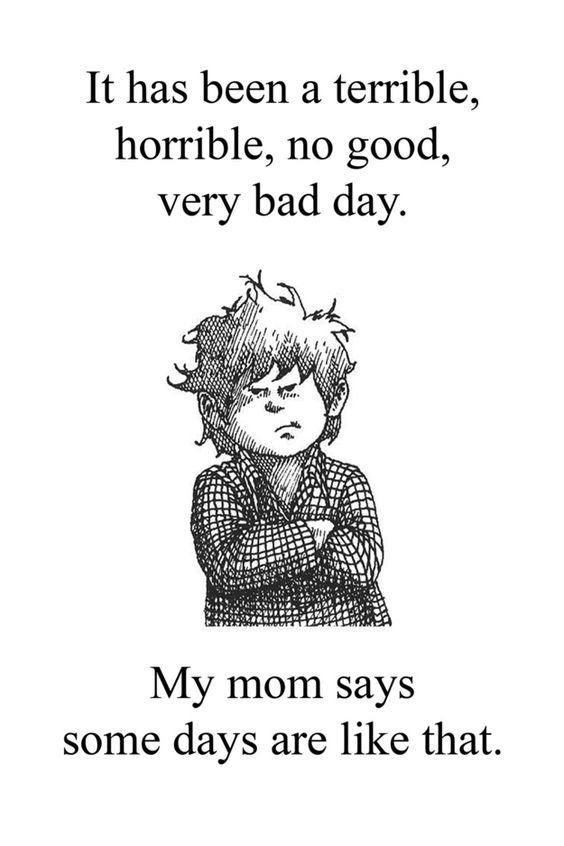
A mere grumble under the breath did not stop with finally getting water to drink. If we look ahead in the story of God’s people in the exodus event, the moaning and complaining quickly returned the minute something did not go their way. Then, the people became so disillusioned with their circumstances that they began longing for the “good old days” back in Egypt when they had plenty to eat and drink, forgetting about their cruel bondage in slavery. (Exodus 16:1-3)

The psychological progression continued with beginning to blame their situation on God, as if he were some mean malevolent deity. From that point, it was inevitable that the people would disobey God and eventually succumb to the idolatry of the golden calf. (Exodus 32:1-8)

Despite the grand celebration of leaving Egypt and experiencing a miraculous deliverance through the Red Sea, the people quickly forgot because of their present circumstance of lacking water. It is only logical and makes sense that the mighty God who saved them with incredible acts of power would care for the people in a desert. Yet, for many, there was no faith to be found in a new situation they had not faced before.

Failure of faith begins neither with ignorance nor an egregious sin. It begins with grumbling and complaining. And if allowed to run amok, complaints will bear the fruit of discouragement, disobedience, and eventually a disavowal of God.

The author of the New Testament letter to the Hebrews reflected on the grumbling of their forebears and had this to say in response:

See to it, brothers and sisters, that none of you has a sinful, unbelieving heart that turns away from the living God. But encourage one another daily, as long as it is called “Today,” so that none of you may be hardened by sin’s deceitfulness. We have come to share in Christ, if indeed we hold our original conviction firmly to the very end. As has just been said:

“Today, if you hear his voice,
    do not harden your hearts
    as you did in the rebellion.” (Hebrews 3:12-15, NIV)

Encouragement is the insecticide which eliminates the worm of complaints. If left alone, we stew in our own bitterness over missed expectations. Grumbling bores its way into our soul and eats away at our faith. We need the continual encouragement of one another to remember our collective deliverance and express gratitude for our salvation.

May it be so to the glory of God.

We give you thanks, Lord God, because you give food and drink to all, heal all, create wonders in this world, forge wisdom within us, and give refuge beneath the shadow of your wings. From your wisdom grant us wisdom, from your love grant us love, from your understanding grant us understanding. Feed us when we are hungry, give us strength when we are weak, raise us up when we are bent over, set us free when we are enslaved. Just as our spiritual ancestors were blessed – may you grant us the blessing of peace, strength, and gratitude. Amen.

Romans 13:1-7 – Good Citizenship

1960 Elementary Classroom

Be a good citizen. All governments are under God. Insofar as there is peace and order, it’s God’s order. So live responsibly as a citizen. If you’re irresponsible to the state, then you’re irresponsible with God, and God will hold you responsible. Duly constituted authorities are only a threat if you’re trying to get by with something. Decent citizens should have nothing to fear.

Do you want to be on good terms with the government? Be a responsible citizen and you’ll get on just fine, the government working to your advantage. But if you’re breaking the rules right and left, watch out. The police aren’t there just to be admired in their uniforms. God also has an interest in keeping order, and he uses them to do it. That’s why you must live responsibly—not just to avoid punishment but also because it’s the right way to live.

That’s also why you pay taxes—so that an orderly way of life can be maintained. Fulfill your obligations as a citizen. Pay your taxes, pay your bills, respect your leaders. (MSG)

Back in the day (way back!) when I was in elementary school every student received a grade on their report card for “citizenship.”  Even further back, my Dad’s report cards had grades for “deportment.” Both citizenship and deportment were words used by the public-school system to gauge how well individual students conducted themselves with the teacher’s authority, behaved with fellow students, and handled the responsibilities of their studies. It was a grade given for the overall obedience and submission of students with their duties and obligations, or the lack thereof.

Today’s New Testament lesson is one of those Scripture texts which has been used and abused throughout history. Since we no longer give grades on citizenship and deportment, a careful consideration of both what this biblical passage is, and is not, must be observed.

What Citizenship is Not: Irresponsible and Disobedient Injustice

Advocating a favored political philosophy or party to the point of avoiding a rival party or power and resisting their government through lack of submission, being uncivil and disrespectful, and stubbornly disobedient is poor deportment and will earn an “F” from God on the report card of life.

Picking-and-choosing which laws I will obey and which ones I will not is extremely far from the biblical teaching given. Rebellion against laws I do not like will only result in getting punished from the principal for being shortsighted and stupid.

On the other hand, blind and unthinking adherence to a government is irresponsible and can be unethical. Unjust leaders and immoral laws which merely champion certain people and not the common good of all need to be dislodged and dismantled. When one simply says, “I’m just doing my job,” or “I don’t want to get in trouble,” in the face of unjust laws and leadership, then we are complicit in the perpetuating of the evil person or system. Blind obedience keeps abusive people in the classroom.

Vigilante-ism is a form of “recess justice.” It is a refusal to accept what is taking place and takes matters into one’s own hands. Just before explaining citizenship, the Apostle Paul said, “Do not take revenge but leave room for God’s wrath,” and, “Do not be overcome by evil but overcome evil with good” (Romans 12:19, 21). There is no place for vigilante justice in the kingdom of God. At its basest form, vigilantes are resisting God’s justice and being extremely impatient with the divine plan.

Good Citizenship

What Citizenship is: Responsible and Submissive Justice

Submission is a choice. The word “submit” in the New Testament means “to place oneself under authority.” In other words, to submit to another person, group, system, or government is a human volitional choice. Obedience through coercion, as in totalitarian regimes, is not submission – it is oppression.

Good citizenship begins with humble submission to governing authorities who are trying to do their best and have everyone’s best interests at mind with responsible laws which benefit the common good of all. Most parents and school boards would do well to remember that.

Justice is primarily about provision, and not about being punitive. I realize that many, if not most, people use the term justice in the penal sense – wanting convictions and incarcerations when someone has committed a crime against the state and/or humanity. And, although this is a very important work of government, the biblical sense of justice is about provision – giving people their rights to life and liberty and ensuring that we all exist in an equitable form of union together as one people.

When people fall through the cracks of bureaucracy and do not have what they need to survive, let alone thrive, then this is an injustice which needs remedy sooner than later – without putting it off to another election cycle. So, put the spanking paddles of shame away (yes, kids at school got the paddle in my day) and instead find ways to uplift and support one another.

Responsible citizenship involves a proper deportment of volitional submission, careful obedience, proper payment of taxes for the benefit of all, and providing due respect to public servants. Keep in mind that the Apostle Paul originally wrote about how to conduct ourselves with government smack in the middle of a Roman Empire which was often fickle and careless about the rights of Christians, Jews, and others.

We submit not because we must, but because it is the right thing to do. To do otherwise is to not only violate the law but our consciences, as well.

Our consciences also need to be clear and clean about the need for justice in this old fallen world of ours. Christians have a continuing and outstanding debt to love one another. Having justice for some and injustice for others is not going to cut it with a Just God. Our Creator and Sustainer desires that every single individual on planet earth – regardless of race, gender, ethnicity, sexual orientation, class, or any other human contrived social construct – have their needs met without prejudice, favoritism, or cronyism.

God’s original plan for the world includes an egalitarian society, so we must be careful to remember and work toward the ideal, while at the same time dealing graciously and resolutely with the realities of injustice all around us. I wonder what grade Jesus would give us so far this year for our deportment.

Lord Jesus Christ, Son of God, just as you welcome us into your kingdom, help us to love each other deeply,
offer hospitality to one another without grumbling, encourage each to use the gifts we have received to serve others, and submit to the governing authorities with the good citizenship you have provided us so that every one of us will be a faithful steward of God’s grace in its various forms. Amen.