The Feeding of the Four Thousand (Mark 8:1-8)

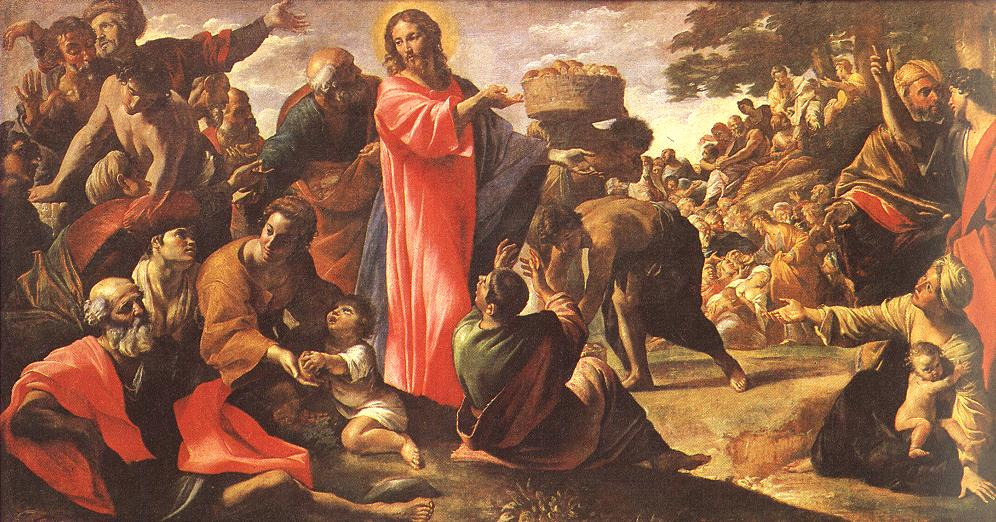
Miracle of the Loaves and Fishes, by Giovanni Lanfranco, c.1620

In those days when there was again a great crowd without anything to eat, he called his disciples and said to them, “I have compassion for the crowd because they have been with me now for three days and have nothing to eat. If I send them away hungry to their homes, they will faint on the way—and some of them have come from a great distance.” 

His disciples replied, “How can one feed these people with bread here in the desert?” He asked them, “How many loaves do you have?” They said, “Seven.” 

Then he ordered the crowd to sit down on the ground, and he took the seven loaves, and after giving thanks he broke them and gave them to his disciples to distribute, and they distributed them to the crowd. They had also a few small fish, and after blessing them he ordered that these, too, should be distributed. 

They ate and were filled, and they took up the broken pieces left over, seven baskets full. Now there were about four thousand people. And he sent them away. And immediately he got into the boat with his disciples and went to the district of Dalmanutha. (New Revised Standard Version)

This was an incredible miracle by Jesus. And it was also an incredible lack of faith on the part of his disciples. Christ had already taught them an important faith lesson by feeding 5,000 people earlier. You’d think they would have gotten it right this time.

It appears that the disciples were anxious about the situation. After all, whenever we are given to anxiety within a stressful circumstance, we typically are not thinking wisely about what to do.

There simply was no evidence that the disciples were tapping into their wise minds – even though they could have. And there’s where the rub is: Do we have the wherewithal to pause, in order to connect with what and who we know?

Let’s notice in the story that Jesus did not seem at all perturbed by the disciples’ small faith. And he certainly was not hindered in any way by the meager supply of food which was on hand. So, a remedial lesson was provided.

All the food the disciples pulled together was given to Jesus. It wasn’t much for thousands of people. Seven loaves of bread and a few fish. Yet, Christ transformed it into enough to feed the entire crowd of mostly Gentiles, without depriving the disciples of their share. They collected enough to fill seven baskets large enough to hold a man.

So there’s the lesson redone and restated, but with a different twist. Whereas the earlier miracle of food was provided for mostly Jews, the feeding of the four thousand consisted of nearly all Gentiles.

Perhaps the disciples did not really want a miracle to begin with. Maybe they believed their ministry ought to be with Israel, and not the heathen nations around them. It could be that Christ’s disciples simply did not want to be in Gentile territory at all, let alone have to engage in ministry to them, up close and personal.

So, we may be dealing with something more than an issue of faith; we might be looking at plain old fashioned prejudice against another group of people. Discriminatory behavior shrinks one’s faith and makes it small – whereas including others, and seeing their inherent worth as God’s image-bearing creatures, increases our faith and helps it grow large.

Jesus had a heart big enough, a mind open enough, and more than enough ability to make the miracle of food happen. In other words, Christ wanted to do it. He had compassion on the people, regardless of the fact that they were not like him.

It could be that a lesson in prejudice was the teaching he wanted them to get a hold of.

We see in today’s story a trajectory of inclusion, that the kingdom of God is meant to be full of diverse people from every nation, race, and background. Jesus purposely went to the Decapolis, a geographical region with a lot of different people – mostly non-Jews.

The Decapolis (which means “Ten Cities”) was a group of ten Hellenistic cities. It was a center of Greek and Roman culture, in a region mostly populated by Jews and Arameans. Each city functioned as a sort of city-state which was dependent upon Rome. There was enough diversity within the Decapolis itself which seemed to prevent them from working together as an organized region.

When it comes to Christian ministry, there are often two issues going on, namely because ministry is all about working with people. One is that we may have a problem, like the disciples of old, in going to a place we’ve never been before – and really don’t ever want to go. We have particular ideas about the people who live there and what they’re like – and we’d rather not have to deal with them.

The second issue is that we may have a problem with ourselves. Unlike the first issue in which we wonder why Jesus would care about those people, the second is wondering if Jesus really cares about me.

In this, you have no problem believing that Jesus would go to the Decapolis and have compassion on the Gentiles. But you struggle with God caring for you, and that Jesus could ever use you in ministry to people like those in the Decapolis. You can think of all sorts of other people who could do the job much better than yourself.

Since you know yourself pretty well, you understand your own doubts, weaknesses, and sins; and have a hard time trusting that the Lord could or would want to involve you in any ministry.

We, of course, could read today’s Gospel lesson from either of the two issues. Yet, we probably need not make it an either/or issue; it may be more of a both/and issue.

That is, Christ’s disciples – including those past and present – likely struggle with both: We continually keep finding that we have personal prejudices which prevent us from reaching out to particular people; and we also have personal insecurities and inhibitions about God truly loving us enough to use us in effective ministry.

Within the story of Jesus feeding the four thousand, both issues can find their resolution. The fact of the matter is that Jesus cared about the people in the region of the Decapolis, and created a miracle in order to take care of them; and, Jesus used a group of men who probably were likely prejudiced, and also insecure about being used for such a ministry.

May you know that you are infinitely loved by God – and loved alongside all sorts of other people, as well, from everywhere in every place. And may you understand that God has you on this earth to be a blessing to all kinds of persons.

May it be so, to the glory of God. Amen.

God Has No Favorites (Acts 10:1-34)

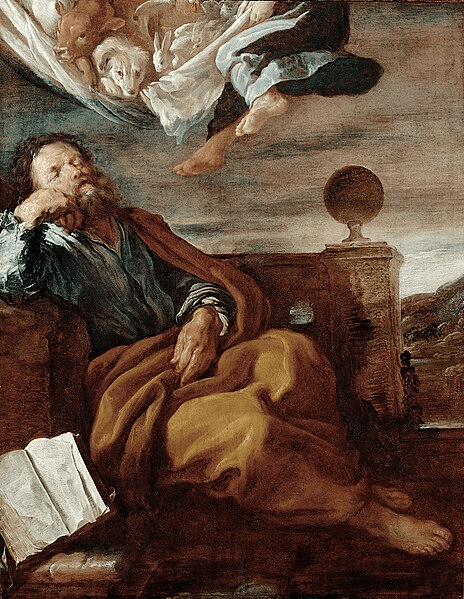
Peter’s Vision, by Domenico Fetti, c.1619

At Caesarea there was a man named Cornelius, a centurion in what was known as the Italian Regiment. He and all his family were devout and God-fearing; he gave generously to those in need and prayed to God regularly. One day at about three in the afternoon he had a vision. He distinctly saw an angel of God, who came to him and said, “Cornelius!”

Cornelius stared at him in fear. “What is it, Lord?” he asked.

The angel answered, “Your prayers and gifts to the poor have come up as a memorial offering before God. Now send men to Joppa to bring back a man named Simon who is called Peter. He is staying with Simon the tanner, whose house is by the sea.”

When the angel who spoke to him had gone, Cornelius called two of his servants and a devout soldier who was one of his attendants. He told them everything that had happened and sent them to Joppa.

About noon the following day as they were on their journey and approaching the city, Peter went up on the roof to pray. He became hungry and wanted something to eat, and while the meal was being prepared, he fell into a trance. He saw heaven opened and something like a large sheet being let down to earth by its four corners. It contained all kinds of four-footed animals, as well as reptiles and birds. Then a voice told him, “Get up, Peter. Kill and eat.”

“Surely not, Lord!” Peter replied. “I have never eaten anything impure or unclean.”

The voice spoke to him a second time, “Do not call anything impure that God has made clean.”

This happened three times, and immediately the sheet was taken back to heaven.

While Peter was wondering about the meaning of the vision, the men sent by Cornelius found out where Simon’s house was and stopped at the gate. They called out, asking if Simon, who was known as Peter, was staying there.

While Peter was still thinking about the vision, the Spirit said to him, “Simon, three men are looking for you. So get up and go downstairs. Do not hesitate to go with them, for I have sent them.”

Peter went down and said to the men, “I’m the one you’re looking for. Why have you come?”

The men replied, “We have come from Cornelius the centurion. He is a righteous and God-fearing man, who is respected by all the Jewish people. A holy angel told him to ask you to come to his house so that he could hear what you have to say.” Then Peter invited the men into the house to be his guests.

The next day Peter started out with them, and some of the believers from Joppa went along. The following day he arrived in Caesarea. Cornelius was expecting them and had called together his relatives and close friends. As Peter entered the house, Cornelius met him and fell at his feet in reverence. But Peter made him get up. “Stand up,” he said, “I am only a man myself.”

While talking with him, Peter went inside and found a large gathering of people. He said to them: “You are well aware that it is against our law for a Jew to associate with or visit a Gentile. But God has shown me that I should not call anyone impure or unclean. So when I was sent for, I came without raising any objection. May I ask why you sent for me?”

Cornelius answered: “Three days ago I was in my house praying at this hour, at three in the afternoon. Suddenly a man in shining clothes stood before me and said, ‘Cornelius, God has heard your prayer and remembered your gifts to the poor. Send to Joppa for Simon who is called Peter. He is a guest in the home of Simon the tanner, who lives by the sea.’ So I sent for you immediately, and it was good of you to come. Now we are all here in the presence of God to listen to everything the Lord has commanded you to tell us.”

Then Peter began to speak: “I now realize how true it is that God does not show favoritism…”

Peter’s Vision, by Doug Jaques

In this binary world of either/or, there are either good guys or bad guys, protagonists or antagonists, nice folk or jerks, Christians or non-Christians, etc.

Because this story is tied to its own cultural context, its punchline may not have the intended effect. Perhaps the story needs to be heard in a contemporary setting…

There was a man named “Dem.” He lived in New York, and was head of a labor union there. Dem did right by the people he represented. He always found ways to help those in need; led his family to worship God; and prayed faithfully every day.

One day, at about 3:00pm, during his time of prayer, he had a vision. An angelic messenger of God, as real as his next-door neighbor, came in and said, “Dem.”

Dem stared hard, wondering if he was seeing things. Then he said, “What do you want?” The angelic messenger said, “Your prayers and good works at your workplace and in your neighborhood have gotten God’s attention. So, here’s what you are to do: Send some people to Washington to get the one everyone calls ‘Pastor Pub.’ He’s staying with Perry the Politician whose house is down by the ocean.”

As soon as the angelic messenger was gone, Dem called two employees and one devout worker from the union. He went over with them in great detail everything he just experienced, and sent them off to Washington.

The next day, as the three travelers were approaching the city, Pastor Pub went out on the patio to pray. It was about noon. He got hungry and started thinking about lunch. While his food was being prepared, Pastor Pub fell into a trance.

He saw the skies open up. Something that looked like a huge blanket lowered by ropes at its four corners settled on the ground. Every kind of person – ethnicity, race, and gender – was on it. Then a voice came: “Go, Pastor Pub – baptize, marry, and bury.”

Pastor Pub exclaimed, “Oh, no, Lord. I’ve never so much as gotten close to non-Christians, let alone baptize, marry, or bury just anyone! It’s not holy!”

The voice came a second time: “If God says it’s okay, it’s okay.”

This happened three times, and then the blanket was pulled back up into the skies.

Peter’s Vision, by Edward Knippers

As Pastor Pub sat there puzzled, trying to figure out what it all meant, the people sent by Dem showed up at Perry’s front door. When the butler answered the door bell, they asked if there was a person known as Pastor Pub there.

Pastor Pub, on the back patio, didn’t hear them. So, the Spirit whispered to him, “Three people are at the door looking for you. Get up and go with them. Don’t ask any questions. I sent them to get you.”

Pastor Pub went to the front door and said, “I think I’m the guy you’re looking for. What in the world is going on?”

They said, “Dem is a God-fearing person, well-known for his just and right ways. Ask any politician in this city! He was commanded by an angelic messenger to get you and bring you to his house, so he could hear what you have to say.” Pastor Pub invited them in and was hospitable.

The next morning he got up and went with them. Some of his friends from Washington went along. Arriving in New York, Dem was expecting them; his close friends and relatives, and some workers, were waiting with him.

The minute Pastor Pub came through the door, Dem was up on his feet greeting him – and then down on his knees thanking him profusely. But Pastor Pub pulled him up saying, “There’s no need for that. I’m just a person no different than you.”

Talking things over, they went into the house, where Dem introduced Pastor Pub to everyone. Pastor Pub addressed them, “I’m sure that this is a highly irregular meeting. After all, Republicans, straight people, and anti-abortionists don’t do this sort of thing – visit and relax with Democrats, LGBTQ+ folk, and abortionists.

But God has shown me that no political party, gender, or issue is better than any other. So, the minute I was sent for, I came, no questions asked. But now I’d like to know why you sent for me.”

Dem said, “A few days ago at about this time, midafternoon, I was home praying. Suddenly there was a man right in front of me, flooding the room with light. He said, ‘Dem, your daily prayers and benevolent work have brought you to God’s attention. I want you to send to Washington to get the one they call Pastor Pub. He’s staying with Perry the Politician down by the ocean.’ So, I did it – I sent for you. And you have been good enough to come. Now we are all here in God’s presence, ready to listen to whatever the Lord put in your heart to tell us.”

At that point, the good news came exploding out of Pastor Pub: “It’s God’s own truth, and nothing could be plainer than this: God has no favorites!”

My friends, it is high time we set aside our sinful prejudice toward others. Far too many of us believe and claim that our positions on issues and ideas about how things ought to go are gospel truth – not to mention our ungodly discrimination against another race, ethnicity, and gender.

If it is judgment you want, then that judgment must begin with your own house, and specifically with you yourself…

James 2:1-7 – Favoritism is Foolish

My dear friends, don’t let public opinion influence how you live out our glorious, Christ-originated faith. If a man enters your church wearing an expensive suit, and a street person wearing rags comes in right after him, and you say to the man in the suit, “Sit here, sir; this is the best seat in the house!” and either ignore the street person or say, “Better sit here in the back row,” haven’t you segregated God’s children and proved that you are judges who can’t be trusted?
 
Listen, dear friends. Isn’t it clear by now that God operates quite differently? He chose the world’s down-and-out as the kingdom’s first citizens, with full rights and privileges. This kingdom is promised to anyone who loves God. And here you are abusing these same citizens! Isn’t it the high and mighty who exploit you, who use the courts to rob you blind? Aren’t they the ones who scorn the new name—“Christian”—used in your baptisms? (The Message)
 
Have you ever felt like an outsider?  It is an awkward feeling, isn’t it? 
           
Imagine being a visitor to a church worship service. Picture that you are a just a normal person trying to make ends meet, without much money or resources, and only a few clothes with none of them being very dressy. You have never been to this church before. You pull up in a fifteen year old car that has a few rattles to it and park. 
 
What is going through your mind?… What are you observing?… “Wow, that is a big building! I don’t know anybody here.” You work-up the courage to get out of the car and walk into the building. Your inner dialogue may be, “Where do I go? Will anybody notice me? How am I supposed to act? Are my kids going to be okay?  Where do I sit?” All the things the regular attenders never think about and take for granted are at the forefront your mind. 
 
Not everyone thinks the same and has the same experiences – and that is the point the Apostle James was communicating to the insiders about the marginalized outsiders. 
 
If we are only attentive and aware and care about people who look just like us, think just like us, and act just like us, then we are playing favorites and have become judgmental persons who cannot be trusted with the things of God.
 
That’s a big reason why so many persons in the West today have no desire to be a regular church attender.
           
Showing favoritism is not a good thing. It’s foolish. The word “favoritism” comes from an idiom, “lifting up the face,” that is, taking something merely at face value. To make a biased judgment based only on surface impressions is contra God’s will.
 
Jesus freely associated with people of dubious morality. He went out of his way to hob-nob with hated tax collectors and came into close contact with ostracized lepers.
           
Discrimination of people based on our limited understanding of them is soundly condemned throughout Holy Scripture. 
 
You must neither show partiality to the poor nor honor the rich. You must judge your fellow citizen fairly. (Leviticus 19:15, NET)
 
Prejudice is wrong. (Proverbs 28:21, GNT)
 
I caused everyone to hate and despise you, because you disobeyed me and failed to treat all people alike. (Malachi 2:9, CEV)
 
Times change; God’s heart for the poor never changes. God cares for all kinds of people, not just “insiders.” 
 
The Apostle Peter had to get prejudice of Gentiles out of his heart. He had always assumed they were inferior and needed to be outsiders. It took a series of visions from God for Peter to become woke.
 
“I really am learning that God doesn’t show partiality to one group of people over another. Rather, in every nation, whoever worships him and does what is right is acceptable to him.” (Acts 10:34-35, CEB)
 
All people, without exception, are to be treated well and respected. 
 
Be fair with everyone, and don’t have any favorites. (1 Timothy 5:21, CEV)
 
God soundly condemns favoritism. Whenever we discriminate between people, we render opinions based on outward appearance. Then, there are only insidious motives toward outsiders to be used for one’s own advantage – which is at the heart of all discrimination and segregation.
           
The church James addressed had the mistaken notion that certain persons were better than others because of their ability to contribute to world missions and wield a big influence. 
 
The temptation was to suck-up to the rich. The church needed some stable donors, and not some poor people who were going to drain their already short resources. Showing preferential treatment to the wealthy only made sense to them.
           
But James would have none of it. For him, showing favoritism was sin and reflected a terrible malady of the heart: a divided loyalty between God and the world. 
 
When things got rocky they turned to the rich, instead of coming to the Lord who has unlimited resources. 
 
Wherever you find favoritism, there you will find a divided loyalty between the kingdom of God and the kingdom of Satan.
 
Inattention to the poor and needy might make good fiscal and business sense, but it will result in spiritual death when Jesus comes back to judge the living and the dead. 
 
Blaming poor people for being poor merely takes the attention off one’s own heart and need for repentance.
           
Showing favoritism ought to bring to the surface that we need to re-establish a true, genuine, authentic, and real relationship with Jesus who does not look at us for what we can do for him but loves us just because he wants to. 
 
People who show favoritism and give preferential treatment to certain persons only demonstrate that they are not gracious, merciful, and kind, like God is.
           
In the third century, Brother Lawrence was a deacon in the Church of Rome. According to tradition, Lawrence was in charge of the church’s treasury and its mercy (benevolence) fund. One day the Prefect of the city asked Lawrence to gather up and give him “the wealth of the church.”
 
Lawrence sent back a message: “I do not deny that our Church is rich … and that no one in the world is richer, not even the emperor …. I will bring forth all the precious things that belong to Christ, if only you will give me a little time to gather everything together.” The Prefect agreed, as he dreamed of what he could do with the money, gold, and silver.
 
For three days, Lawrence ran about the city of Rome, collecting the Church’s treasures. But they were not the sort of treasures the greedy Prefect was dreaming of. Instead, Lawrence walked through all the alleys and squares of the city and gathered the church’s real treasure—the poor, the disabled, the blind, the homeless, and the lepers.
 
The people Brother Lawrence gathered into the church included a man with two eyeless sockets, a disabled man with a broken knee, a one-legged man, a person with one leg shorter than the other, and others with grave infirmities. He wrote down their names and lined them up at the entrance to the church. Only then did he seek out the Prefect to bring him to the church.
 
“These are the treasures of the Church of Christ!” Lawrence declared as he presented the ragged crowd to the astonished Prefect. “Their bodies may not be beautiful, but within these vessels of clay they bear all the treasures of divine grace.”
 
The ground is level at the foot of the cross. Jesus was not an upwardly mobile and tech-savvy Jew; he was a king who chose to serve and get into the lives of the poor, the pitiful, the wretched and the marginal folks of society just as he did with the rich and influential. 
 
Getting rid of favoritism only happens whenever we adopt a ministry of mercy toward the poor.
 
Learn. Get to know a family in poverty. Listen to their story. Find out the roots of their situation. See how incredibly resourceful and resilient they are at getting by and how they are helping others.
 
Act. Volunteer at the local food pantry. Deliver meals at Christmas. Do some research on poverty in your area.  Find out what poverty level is and calculate if you could live on that amount. Take a helping vacation or mission trip. Send a needy student to college. Find out what organizations need to help those in poverty. Show respect to everyone who is need.
 
Connect. Do you have any ways of helping people out of poverty? Feel free to share what you have done.
 
Come, Holy Spirit, and open our hearts, minds, and souls to your presence. Grace us with the strength to follow the example of Jesus. May you provide us with a voice to cry out for justice for the poor. Remind us that what we do to the least of those among us, we do to you. Amen.

Micah 4:6-8 – Belonging

“In that day,” declares the Lord,

“I will gather the lame;
    I will assemble the exiles
    and those I have brought to grief.
I will make the lame my remnant,
    those driven away a strong nation.
The Lord will rule over them in Mount Zion
    from that day and forever.
As for you, watchtower of the flock,
    stronghold of Daughter Zion,
the former dominion will be restored to you;
    kingship will come to Daughter Jerusalem.” (New International Version)

One of the great tragedies of our world, as well as one of the worst feelings of humanity, is the sense that one does not belong.

Since people are hard-wired by God for community, belonging is essential, not optional. The image of the rugged individualist who gets things done on their own terms and marches to the beat of a different drum might be an appealing picture to many Westerners – but it falls woefully short of real lived human experience.

Since the fall of humanity, people have tended to group themselves into insiders and outsiders. In other words, discrimination is the enemy of true belonging. And, what’s more, there always seems to be people who are ready to create such division for their own purpose and profit. Indeed, it’s an age old tale, perhaps best told by Dr. Seuss in his classis book, Sneetches and Other Stories (1961).

In the story, Sneetches with stars on their bellies discriminate against and shun those without. A slick entrepreneur, Sylvester McMonkey McBean, offers the Sneetches without stars on their bellies the chance to get them with his Star-On machine, for three dollars, of course.

The application of stars upon thars is instantly and wildly popular. However, this abjectly upsets the original star-bellied Sneetches. They are in danger of losing their special status! So, McBean then tells them about his Star-Off machine, costing ten dollars, of course, and the Sneetches who originally had stars happily pay the money to have them removed.

Since McBean only cares about profit, he allows the recently starred Sneetches through this machine, as well. Ultimately, the entire affair escalates, with all the Sneetches running from one machine to the next…

“…until neither the Plain nor the Star-Bellies knew

whether this one was that one… or that one was this one…

or which one was what one… or what one was who.”

The Sneetches end up penniless. McBean leaves a rich man. The Sneetches learn from the experience that neither plain-belly nor star-belly Sneetches are superior. They finally become friends. Dr. Suess intended his story to be a satire of discrimination between races and cultures.

The kingdom of God is an egalitarian realm. There are no walls and barriers dividing people into opposing groups. And there isn’t such a thing as marginal, excluded, insignificant, forbidden, or discounted people.

Micah’s prophecy tells not of the privileged and powerful coming together for renewal but the lame. God’s care in maintaining a remnant and gathering them for restoration will be made up of the wounded, the ones who have no ability to bring themselves to the center.

The upside-down kingdom of God makes the last first, and the first, last. The Lord’s rule and reign champions the disabled and the misfits – those without an ability to come. They may be forgotten by others but never by God.

Like Santa coming to the island of misfit toys, rescuing and airlifting forgotten toys so that they can become treasured gifts for boys and girls – so God creates belonging where there seems none to be had. And leading the effort is a tossed aside reindeer named Rudolph, using his unique “deformity” to cut through the tough winter storm.

Perhaps you feel a bit, or maybe a lot, like the square peg trying to fit into a round hole. It could be that you wonder whether there is a place for you. You have experienced life as something of an oddity, as if the normal world around you is not aware of your very personhood.

The good news is that a prominent place is given to the humble, for those attempting to make a difference in the world that gives them no place to belong. God sees. God hears. God knows. God cares.

The Lord sends a Savior, a Deliverer, who will himself be a peculiar individual on this earth. It will seem as if he is from another place… which he is. But, then again, aren’t we all? Each of us was crafted with divine care and attention.

You are the one who created my innermost parts;
    you knit me together while I was still in my mother’s womb.
I give thanks to you that I was marvelously set apart.
    Your works are wonderful—I know that very well.
My bones weren’t hidden from you
    when I was being put together in a secret place,
    when I was being woven together in the deep parts of the earth.
Your eyes saw my embryo,
    and on your scroll every day was written that was being formed for me,
    before any one of them had yet happened. (Psalm 139:13-16, CEB)

The Lord has good plans for you and me. It might seem as if there are times God is placing a heavy hand upon us, even punishing. Yet, restoration is in the future. In this season of the year, we celebrate that Jesus is our Immanuel, God with us.

May Christ, who by his incarnation gathered into one, things earthly and heavenly, fill you with joy and peace. Amen.