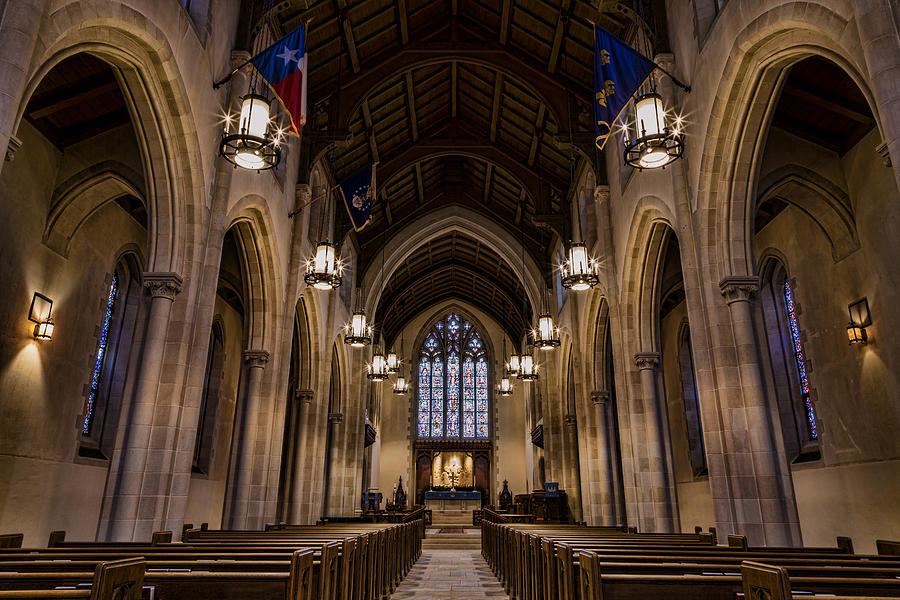
The Episcopal Church of the Heavenly Rest in Abilene, Texas
Then the twenty-four elders who sit on their thrones before God fell on their faces and worshiped God, singing,
“We give you thanks, Lord God Almighty, who are and who were, for you have taken your great power and begun to reign. The nations raged, but your wrath has come, and the time for judging the dead, for rewarding your servants, the prophets and saints and all who fear your name, both small and great, and for destroying those who destroy the earth.”
Then God’s temple in heaven was opened, and the ark of his covenant was seen within his temple; and there were flashes of lightning, rumblings, peals of thunder, an earthquake, and heavy hail. (New Revised Standard Version)
Late in his life, as the old Apostle John lived in exile, he experienced a grand vision. It is what we today refer to as The Book of Revelation, or The Apocalypse of John.
At the turn of the first century, Christ’s Church was facing a great deal of difficulty and hardship. Christians were the minority. Believers in Jesus were looked at with suspicion. Followers of Christ were often misunderstood and persecuted because of false information.
In short, all of the myriad sufferings and persecutions that Jewish people currently face and have faced for millennia were true of the early believers in Jesus.
Therefore, the purpose of John’s vision was not to give slick preachers a reason to craft elaborate prophecy charts about what’s going to happen in the future. Instead, God was concerned for the current welfare of his people. The vision was meant to bring encouragement.
The message to John, passed onto the suffering church, was that this present hard situation will not always be this way. Danger, adversity, and hardship will not last forever. There is a day coming when God’s judgment and benevolent reign will truly rule in all of its glorious fullness.
Our prayers will be answered, the ones we have lifted to God for centuries: “Your kingdom come, your will be done, on earth as it is in heaven.”
Gergeti Trinity Church, Georgia
The Lord did not want his beloved children to succumb to discouragement and lose heart. So, the vision from John assured them that all will be made right. Jesus is Lord, and his good rule will have the day.
Yes, we currently live in a world profoundly touched by the presence and power of sin. And because of that sad reality, we feel all kinds of various pain. We have no choice but to endure the hardships of national wars, bodily diseases, lack of resources, economic woes, mental disorders, emotional distress, and spiritual warfare.
It is possible to observe, as well as experience, all the crud of this sinful world and fall into despair. If or when that happens, we give-in to unhealthy ways of coping with the adverse circumstances around us.
Graciously, we have been given a glimpse into how all of history will shake-out in the end. That brief pulling back of the curtain is meant to bring us needed encouragement, steadfast hope, and patient endurance.
There is coming a day when expressions of grief and lament will give way to praise and gratitude to God. And that incredible praise will explode with all believers, past and present, along with all creation, proclaiming together that the Lord God is all-powerful.
The kingdom of this world belongs to our Lord and to his Chosen One. And he will rule forever and ever.
Some might protest that Christians have been harping on this return of Jesus for two millennia and he still isn’t here. We must not misinterpret God’s inaction as uncaring or that God is non-existent. Because it is really patient grace.
But do not forget this one thing, dear friends: With the Lord a day is like a thousand years, and a thousand years are like a day. The Lord is not slow in keeping his promise, as some understand slowness. Instead, he is patient with you, not wanting anyone to perish, but everyone to come to repentance. (2 Peter 3:8-9, NIV)
Our present sufferings must also not be misinterpreted, as if God hates us or is just plain mean. For the Christian, suffering is transformed into solidarity with Jesus Christ.
My dear friends, do not be surprised at the painful test you are suffering, as though something unusual were happening to you. Rather be glad that you are sharing Christ’s sufferings, so that you may be full of joy when his glory is revealed. (1 Peter 4:12-13, GNT)
All of our collective experiences are meant not for harm, but for good so that we might realize spiritual growth and maturity.
Grow in the grace and knowledge of our Lord and Savior Jesus Christ. To him be glory both now and forever! Amen. (2 Peter 3:18, NIV)
Lord Jesus Christ, by your patience in suffering you caused our earthly pain to be sacred and have meaning. Through your example of humble obedience, you opened the way for us to walk through our own hard circumstances with grace and submission.
Be near me in my time of weakness and pain. Sustain me by your grace, so that my strength and courage may not fail. Heal me according to you will. Help me always to believe that what happens to me in this present life is of little account if you hold me in eternal life, my Lord and my God.
As Jesus cried out on the cross, I cry out to you in pain, O God my Creator. Do not forsake me. Grant me relief from this suffering and preserve me in peace; through Jesus Christ my Savior, in the power of the Holy Spirit. Amen.
Give ear, O Shepherd of Israel, you who lead Joseph like a flock! You who are enthroned upon the cherubim, shine forth before Ephraim and Benjamin and Manasseh. Stir up your might, and come to save us!
Restore us, O God; let your face shine, that we may be saved.
O Lord God of hosts, how long will you be angry with your people’s prayers? You have fed them with the bread of tears, and given them tears to drink in full measure. You make us the scorn of our neighbors; our enemies laugh among themselves.
Restore us, O God of hosts; let your face shine, that we may be saved. (New Revised Standard Version)
Restoration is a beautiful thing. I don’t often watch makeover shows on television. But if I’m channel surfing and see an old house, appearing ready for the wrecking ball, getting restored to its original charm and beauty, I’m hooked. We resonate deeply with things being repaired and rejuvenated, as if it is brand new.
For that to occur, someone needs to have a vision to see the old become new. If not, then the drab discouragement of a gray and dreary environment can easily take over. We then forget the original shine of how things once were to the point where we cannot even imagine that it’s worth salvaging.
In the context of today’s psalm, God’s people once enjoyed the covenant and the promises of God. But over time, the relationship was not maintained and cared for. So, the people gradually slid into disrepair. Centuries of sheer neglect brought a situation where it seemed the only recourse was to raze everything and begin again.
The psalms have been the prayer book of God’s people for over three millennia. Suffering and hard circumstances provide the backdrop for many of them. Sometimes the difficulty is external – another nation oppressing the people. Yet other times, like in today’s psalm, the problem is internal – sheer neglect of God’s commands over time. It went on to the point that God’s longsuffering ran out.
I would much rather enjoy God’s favor than God’s disappointing anger. To begin addressing any sort of spiritual neglect, the work of prayer becomes the tool we need. Restoring broken lives and broken communities to their original beauty starts with prayer and praise, offered daily and often.
Seven times a day I praise you for your righteous laws. (Psalm 119:164, NIV)
What’s more, our tears, which seem, at times, to be our daily bread, are a kind of baptismal offering to God – prayers coming through groans which words cannot express. Even with our prayers, the Lord is gracious to help us with the requests themselves and not just the answers.
And the Holy Spirit helps us in our weakness. For example, we don’t know what God wants us to pray for. But the Holy Spirit prays for us with groanings that cannot be expressed in words. (Romans 8:26, NLT)
God is waiting for us to approach the throne of grace with confidence. And we must keep coming to the Lord, again and again.
Jesus understands every weakness of ours because he was tempted in every way that we are. But he did not sin! So whenever we are in need, we should come bravely before the throne of our merciful God. There we will be treated with undeserved kindness, and we will find help. (Hebrews 4:15-16, CEV)
Like the continual routine of using the hammer, pounding nail after nail, so we must offer our prayers morning, noon, and night, day after day, crying out to God with the great cry of the church: Restore us, O God; let your face shine, that we may be saved!
May the hope of Advent, the love of God in Christ, and the encouragement of the Holy Spirit restore your soul and enliven your spirit, now and forever. Amen.
O loving and gracious God, bring restoration to my life, to my church, to my family, to my workplace, and to my community. Things are not as they once were. Send your Holy Spirit so that we might enjoy seasons of blessing again. Restore, renew, revive and rejuvenate our disordered churches. May your face shine upon us once again through the mighty name of Jesus. Amen.
Day after day every priest stands and performs his religious duties; again, and again he offers the same sacrifices, which can never take away sins. But when this priest had offered for all time one sacrifice for sins, he sat down at the right hand of God, and since that time he waits for his enemies to be made his footstool. For by one sacrifice, he has made perfect forever those who are being made holy.
The Holy Spirit also testifies to us about this. First he says:
“This is the covenant I will make with them after that time, says the Lord. I will put my laws in their hearts, and I will write them on their minds.”
Then he adds:
“Their sins and lawless acts I will remember no more.”
And where these have been forgiven, sacrifice for sin is no longer necessary.
Therefore, brothers and sisters, since we have confidence to enter the Most Holy Place by the blood of Jesus, by a new and living way opened for us through the curtain, that is, his body, and since we have a great priest over the house of God, let us draw near to God with a sincere heart and with the full assurance that faith brings, having our hearts sprinkled to cleanse us from a guilty conscience and having our bodies washed with pure water. Let us hold unswervingly to the hope we profess, for he who promised is faithful. And let us consider how we may spur one another on toward love and good deeds, not giving up meeting together, as some are in the habit of doing, but encouraging one another—and all the more as you see the Day approaching. (New International Version)
The book of Hebrews was originally a sermon preached to a group of struggling Jewish Christians who were discouraged. They were a congregation in decline. The preacher’s approach throughout is to demonstrate that Jesus is better and superior to anything or anyone ever.
With this high view of the person and work of Christ, the preacher comes to the punch line of his sermon. He insists that what the believers need is perseverance to keep going – no matter what adversity they face. For without the ability to endure hardship, the sagging congregation would continue to decline and eventually give up.
Yet, giving up is not an option when it comes to the Christian life. The Christians may not have been going through a Job-like experience, but they needed to get some spiritual spine to them so that they could stand up for Jesus.
Sometimes, because most of life is lived in the mundane, we can slowly drift from our spiritual moorings and just go through the motions of Christianity without really living for Jesus. Boring and repetitive work; the monotony of caregiving; the tedium of busywork; and the continual grind of it all can be an effective tool in the devil’s workshop.
When we begin sleepwalking through life, we are in danger of wandering from faith. We then need some stout spiritual stamina. “I didn’t sign up for this!” can be the cry of both the person who is downtrodden with hard circumstances, as well as the person who is simply living a dull life.
We all have our quitting point – that point where we say, “enough is enough” and we give up and cry uncle. Those times usually come when the pain or inconvenience of what is happening overcomes the resolve to persevere. The devil keeps detailed notes on everyone’s quitting points, and he tries to get us to that point of being ineffective and giving up on the Christian life.
It easily begins with some minor irritation or complaint against from another. Then moves further along by the loss of someone close. Frustration mounts if financial hardship happens. After a while, if things do not markedly improve, living day in and day out with missed expectations and disappointing situations may lead to bailing out, blowing up, or binging on a sinful desire.
At the quitting point, we throw up our hands, wrongheadedly believing others don’t care and that God is indifferent to our situation.
The preacher of Hebrews knows that the one real measure of a person is the learned ability to push through the quitting points of life. We need endurance and perseverance. But how will we get it? How can we endure, living for Jesus for the rest of our lives?
There are three indispensable elements of the Christian life, necessary to persevering. Perseverance is a privilege, and not some drudging duty to slog through. Following Jesus for a lifetime comes as we embrace our spiritual privileges.
Faith is the privilege of continually approaching the Lord with confidence
We possess the incredible privilege of approaching the throne of grace with confidence because Jesus has opened the way to God. No longer do we need the elaborate Old Testament sacrificial system in order to approach God. So, let us draw near to God with a sincere heart in full assurance of faith.
We need faith to keep going in the Christian life. Faith is more than doctrinal confession; it is something we experientially live by every day. By faith, we come to God through Jesus – not only soaking in more information but also drawing near to Christ.
Jesus, when on this earth, drew near to the Father. We are to follow Christ in his example. Jesus practiced solitude, silence, and extended times of prayer. Our Lord oriented his teaching and healing ministry around his relationship with the Father by engaging in basic spiritual disciplines that put him in a position to hear and listen so that he could then do the will of God.
“We can all see God in exceptional things, but it requires the culture of spiritual discipline to see God in every detail.”
Oswald Chambers
A successful student orients her life around certain study disciplines in order to learn and reach graduation day. A winning athlete orients his life around certain daily practices in order to develop the skills needed to face the upcoming competition. Likewise, if we want to follow Christ and draw near to God, we need to reorient our time and commitment in order to take advantage of the privilege of growing and maturing in Jesus.
The perspective of Hebrews is that we must orient our lives around basic disciplines of faith and put our hands out in order to receive the gift of faith God wants to give us. Faith is a muscle that must be exercised, or it will atrophy and become useless. And with puny weak faith muscles, it is easy to give up because we have no “umpff” for the Christian life.
Hope is the privilege of living for Jesus with a confident expectation that God keeps divine promises
Perseverance requires hope. Hopelessness happens without the continuing practice of faith expressed in drawing near to God. Hope in Scripture is not wishful thinking; it is a confident expectation that God is good for his promises.
Hope enables us to bank on the words and ways of Jesus. In those times when we feel hopeless; when there is negativity in the air that brings us to the quitting point; when we sense a season of blessing is not going to come; it is in those very times the preacher of Hebrews says to hold unswervingly to your profession.
We will not always squint our spiritual eyes, looking for the least little hope. Just as young mothers must remember that constant lack of sleep and caring for a needy infant is not always going to be the status quo; just as kids must remember that they will not be in school for the rest of their lives; in the same way, we must remember that God will accomplish everything he sets out to do; that there is an end and a goal to Christianity; and we will be richly rewarded if we keep going and do not give up.
Love is the privilege of encouraging fellow believers
We are to pay thoughtful attention to one another. Believers are to take an interest in each other’s welfare, and put some significant thought into how to spur, incite, cajole, and provoke others into keeping up with Jesus.
A major opportunity for encouragement is corporate gatherings. Attendance is not an end in itself. Worship services, small group Bible studies, and other ministries of the Church are important because they are moments for us to encourage other people.
Let’s play good response/bad response to this. Bad response: “I feel guilty about what you just said, so I will try harder to love and encourage others.” That’s a prescription for frustration and failure. It ends in reaching the quitting point because we are focusing too much on the strength of our own will, or lack thereof.
Good response: “Wow! God wants to use me to love other people! I’ll seek to know Jesus better so that I can learn to live and love, just like him. I can’t wait to encourage someone and build them up in the faith.”
Church is not optional equipment for the Christian life. We need each other. We need the Church.
“Love cannot exist in isolation: away from others, love bloats into pride. Grace cannot be received privately: cut off from others, it is perverted into greed. Hope cannot develop in solitude: separated from the community, it goes to seed in the form of fantasies. No gift, no virtue can develop and remain healthy apart from the community of faith. ‘Outside the church there is no salvation’ is not ecclesiastical arrogance but spiritual common sense, confirmed in everyday experience.”
Eugene Peterson
“No one can have God as his Father who does not have the Church as his Mother.”
Cyprian (210-258 C.E.) Bishop of Carthage
“May Christians be guided by the Church’s maternal care until they grow up to maturity and attain the perfection of faith…. To those whom God is a Father, the Church must also be a Mother.”
John Calvin
The Church:
Creates a unique presence with God. (Matthew 18:20)
Provides the nurture, guidance, and encouragement necessary for spiritual development. (Romans 12:4-5)
Helps form our identity as Christians. (Ephesians 2:19-20)
Enables endurance through suffering and brings comfort and encouragement in difficult times. (James 5:14-15)
Nourishes with the Word in preaching and sacrament. (Acts 2:46-47)
Lifts up godly examples to imitate. (1 Corinthians 4:16)
Intervenes when sheep go astray. (Colossians 3:16)
Brings maternal care and help. (1 Thessalonians 2:7)
Conclusion
Let’s be encouragers – loving others with the grace of Jesus. The following are six types of encouragers displayed in the book of Hebrews for us to emulate:
The Promoter. Cheering others on to endurance. We are surrounded by a great cloud of witnesses cheering us on and promoting us to push through the quitting points. They did it, and so can we (12:1).
The Professor. Affirming others’ work as valuable and important. God will not forget your work and the love you have shown God’s people and how you continue to help them (6:9-10).
The Preacher. Rebuking and admonishing in love (Proverbs 27:5). We must pay more careful attention to what we have heard, so that we do not drift away. How shall we escape punishment if we ignore such a great salvation? (2:1-3).
The Prayer Warrior. Approaching the throne of grace with confidence, so that we may receive mercy and find grace to help us in our time of need (4:16).
The Partner. Coming alongside one another daily so that no one may be hardened by sin’s deceitfulness” (3:13).
The Pastor. Shepherding others through the confusing situations of life. Jesus suffered outside the city gate to make the people holy through his own blood. Together, let’s go to him outside the camp, bearing the disgrace he bore, as we look forward to the heavenly city to come (13:12-14).
It’s our privilege to persevere through the spiritual gifts of faith, hope, and love. Use them for building up one another so that together we can endure for a lifetime.
Therefore, let us move beyond the elementary teachings about Christ and be taken forward to maturity, not laying again the foundation of repentance from acts that lead to death, and of faith in God, instruction about cleansing rites, the laying on of hands, the resurrection of the dead, and eternal judgment. And God permitting, we will do so.
It is impossible for those who have once been enlightened, who have tasted the heavenly gift, who have shared in the Holy Spirit, who have tasted the goodness of the word of God and the powers of the coming age and who have fallen away, to be brought back to repentance. To their loss they are crucifying the Son of God all over again and subjecting him to public disgrace. Land that drinks in the rain often falling on it and that produces a crop useful to those for whom it is farmed receives the blessing of God. But land that produces thorns and thistles is worthless and is in danger of being cursed. In the end it will be burned.
Even though we speak like this, dear friends, we are convinced of better things in your case—the things that have to do with salvation. God is not unjust; he will not forget your work and the love you have shown him as you have helped his people and continue to help them. We want each of you to show this same diligence to the very end, so that what you hope for may be fully realized. We do not want you to become lazy, but to imitate those who through faith and patience inherit what has been promised. (New International Version)
Whenever things get tough and really hard, it is inevitable that there will be people who drop out. It happens in every arena of life, including the Christian life. Sometimes life becomes so overwhelming that we feel like we’re just not making a dent in any of our issues or responsibilities. It is tempting to simply give up and leave it all behind.
Today’s New Testament lesson addresses a group of people who were considering leaving the Christian faith. Some folks had already left, causing confusion with the people still around about how to think about this and what to do going forward.
Who is the author talking about?
He’s talking about those who made a profession of Christ. Are they actual Christians? This gets at the heart of what makes a Christian a Christian. And the answer is that a Christian exhibits both faith and obedience, both trust and perseverance. Real Christians profess the name of Christ with their mouths and demonstrate faith with their actions by obeying the words and ways of Jesus.
What are they in danger of?
Apostasy is a deliberate and intentional renouncing of faith with no intention of ever going back to Christ. An apostate is a person who once professed faith, then rescinded it. This is the author’s point for crafting his message to the struggling Christians. In their hardship, they were seriously toying with the notion of leaving Christianity altogether.
Why would they ever renounce their faith?
Because of hard circumstances, spiritual overwhelm, and grinding tiredness. Adverse situations never leave us the same. They either make us bitter or better, depending upon our response to them. If Christians believe that the Christian life should be an unending journey of victory and glory in this life, disappointment will settle in rather quickly. Missed expectations are typically the manure which fertilizes the field of apostasy.
How can they be restored?
The author of Hebrews makes it clear that they cannot – not because God never gives second chances to people but because the hardness of heart in the apostate is such that they have no intention or desire to live for Jesus. In fact, they now have a hatred of Christ and show contempt for him. We are not talking about flaky or fickle people. We are talking about folks who, with their full faculties intact, put as much energy into resisting, rejecting, and renouncing Christ as they can. This isn’t a momentary lapse in judgment. Rather, it is a calculated decision to hate all that is Christian, after having once loved it.
Where does this happen?
It happens in the heart. When Jesus told his parable of the soils, he was not talking about four different kinds of Christians. The point of Christ’s parable is that there is only one kind of Christian – the other three simply demonstrated they were not the genuine article to begin with. All four professed faith but only one proved it through growth, maturity, and harvest. (Matthew 13:1–23; Mark 4:1–20; Luke 8:4–15)
According to Jesus, there is either no response, a superficial response, a temporary response, or a genuine response. The person who does God’s will is the real deal.
Some people make a dichotomy between faith and obedience, as if they are separate things. Yet, in truth, they are a package deal and cannot be separated. The following all belong together and are not to have any division between them. It is a matter of “and,” not “or.”
Faith and works.
Past and future.
Grace and merit.
Event and process.
People fall away from their faith commitments when they are unable or unwilling to hold the “and’s” together. Whenever the rocks and thorns of life hit them and stick them in ways they don’t like, it is crucial to respond in a way which doesn’t compromise staying on a path of spiritual maturity.
So, where are you on the journey of faith? How do you handle missed expectations and grave disappointments? Are you okay? What do you need? Are there ways others can help?
There are other options besides giving up. Go ahead and explore them.
Grant, O God, that I may never lose the way through self-will, and so end up in the far countries of the soul; that I may never abandon the struggle, but endure to the end; that I may never drop out of the race, but ever press forward to the goal of my calling; that I may never choose cheap and passing things, and embrace the eternal; that I may never take the easy way, and so leave the right way; that I may never forget that sweat is the price of all things, and that without the cross, there cannot be the crown.
So, keep your people and strengthen us by your grace that no disobedience and no weakness and no failure may stop us from entering into the blessedness which awaits those who are faithful in all the changes and chances of life down even to the gates of death, through Jesus Christ our Lord. Amen










 Rev. Tim Ehrhardt