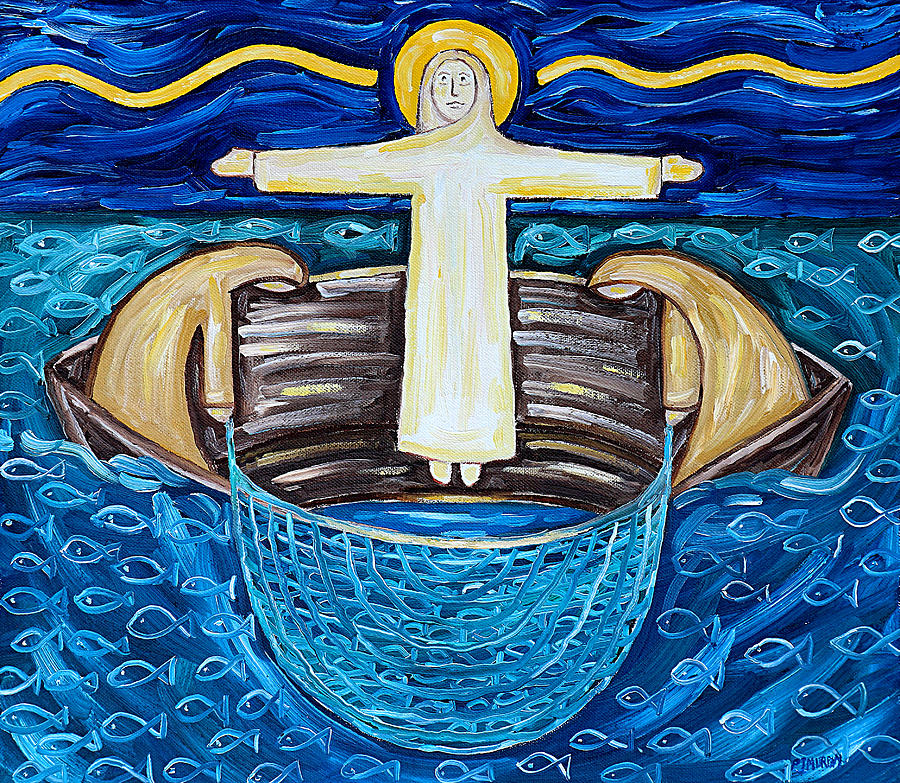
Luke 5:1-11 – Surprised by Generosity

The Miraculous Catch of Fish by Patrick J. Murphy

One day Jesus was standing beside Lake Gennesaret when the crowd pressed in around him to hear God’s word. Jesus saw two boats sitting by the lake. The fishermen had gone ashore and were washing their nets. Jesus boarded one of the boats, the one that belonged to Simon, then asked him to row out a little distance from the shore. Jesus sat down and taught the crowds from the boat. When he finished speaking to the crowds, he said to Simon, “Row out farther, into the deep water, and drop your nets for a catch.”

Simon replied, “Master, we’ve worked hard all night and caught nothing. But because you say so, I’ll drop the nets.”

So, they dropped the nets, and their catch was so huge that their nets were splitting. They signaled for their partners in the other boat to come and help them. They filled both boats so full that they were about to sink. When Simon Peter saw the catch, he fell at Jesus’ knees and said, “Leave me, Lord, for I’m a sinner!” Peter and those with him were overcome with amazement because of the number of fish they caught. James and John, Zebedee’s sons, were Simon’s partners and they were amazed too.

Jesus said to Simon, “Don’t be afraid. From now on, you will be fishing for people.” As soon as they brought the boats to the shore, they left everything and followed Jesus. (Common English Bible)

One of the most fundamental characteristics of God is generosity. God’s benevolent nature defines the divine stance toward humanity. This may not seem overly remarkable. Yet, when the infinite holiness of God intersects with the prideful arrogance of sinful people, gracious generosity is the unpredictable and amazing result.

Many people on planet earth have been raised with a god who is aloof and something of an old cranky curmudgeon. Such a god gets easily angry and zaps people with lightning or some natural disaster. It is no wonder so many persons have fled from belief in God.

Can we, however, entertain the notion that the Creator God of the universe is quite the opposite of the perpetually upset deity?

In Jesus, we have displayed for us what the basic disposition of the Divine truly is.

On one occasion, Peter (a guy who could raise the ire of most gods) was going about his business, fishing in the Sea of Galilee. Having not yet encountered Jesus, yet stopping to listen to his words, Peter ended up having this uninvited stranger literally get in the boat with him.

There was something remarkably different and compelling about Jesus since Peter did not immediately toss him out. Such a calm, confident, and gracious nature – nothing like Peter had expected. So, here is this ordinary fisherman face-to-face with the Christ of God. 

Jesus told Peter to put the boat out and cast the nets. Peter, an experienced fisherman and knowledgeable about the water, knew for certain that he would not catch anything. But, out of deference to Jesus, he did so, anyway. The result was such a large catch of fish that the nets nearly broke from the weight.

The Great Catch by John August Swanson (1938-2021)

Peter’s response is instructive. He fell at the feet of Jesus in a profound sense of his own smallness and sinfulness. Next to Jesus. Peter saw how little faith he really had. He rightly discerned that he did not deserve such generosity from Jesus, an overflowing abundance given to him despite his unbelief. 

In the face of such grace, in the vortex of an incredible mercy, having seen the generosity of God directed squarely at him, Peter left it all behind to follow Jesus.

So, here we have the nature and character of God before us. No perturbed deity. No exasperated god ready to raise a storm and toss the boat over with Peter in it. No, Jesus, the Son of God, does not operate that way. There is no strong-arming people into faith. God’s tactics steer clear of base manipulation through guilt, or mind-twisting others through shaming them. 

Instead, God is beautifully and simply present with people – showing grace and generosity in places where one would least expect to find it. 

If confronted with such love, what would you do?

Early in my life, I viewed God as some eternally bored deity who would occasionally get out his divine BB gun and shoot people in the rear, just for something to do. God, in my understanding, cared nothing for the real lived experiences of people on earth.

But much like Peter of old, Jesus showed up unannounced in my life. And what I found was like Peter – a kind, benevolent Being who showered such generous love on me that my heart was immediately captured. I have never looked back since.

We intuitively know, down deep in our gut, in the very marrow of our bones, when genuine Love is among us. Generously true Love immediately connects with the deepest needs of our lives. No evangelist must convince us with offering free gold crosses or promised blessings. None of that matters when Love incarnate is present, when the great God of all is among us.

Peace, hope, and faith are the results of the divine loving presence. They cannot be conjured or ginned up through excessive asceticism or extreme discipline. Love is a gift. Love is a person. And it is given generously and graciously from the One whose very nature is charitable and hospitable.

Praise be to God!

Gracious God, you sent your Son to me even though I was neither looking for him nor expecting anything from him. Thank you for breaking-in to my life so that I could break-out for you with glory, honor, and praise.  Amen

Breakfast In the Liminal Space

Welcome, friends! John 21:1-19 is a story of Jesus and the disciples in the six weeks between Christ’s resurrection and ascension. It’s an awkward time for the disciples, as they try and come to grips with a new reality in which all the old rules have changed. Click the videos below and let’s help each other move into a new reality….

Pastor Tim Ehrhardt, John 21:1-19

Before us it is blessed, behind us it is blessed,
below us it is blessed, above us it is blessed,
around us it is blessed as we set out with Christ.
Our speech is blessed as we set out for God.
With beauty before us, with beauty behind us,
with beauty below us, with beauty above us,
with beauty around us, we set out for a holy place indeed. Amen. –A traditional Navajo blessing

John 21:1-19 – Breakfast in the Liminal Space

Miraculous Draught of Fishes by John Reilly, 1978

Afterward Jesus appeared again to his disciples, by the Sea of Galilee. It happened this way: Simon Peter, Thomas (also known as Didymus), Nathanael from Cana in Galilee, the sons of Zebedee, and two other disciples were together. “I’m going out to fish,” Simon Peter told them, and they said, “We’ll go with you.” So, they went out and got into the boat, but that night they caught nothing.

Early in the morning, Jesus stood on the shore, but the disciples did not realize that it was Jesus.

He called out to them, “Friends, haven’t you any fish?”

“No,” they answered.

He said, “Throw your net on the right side of the boat and you will find some.” When they did, they were unable to haul the net in because of the large number of fish.

Then the disciple whom Jesus loved said to Peter, “It is the Lord!” As soon as Simon Peter heard him say, “It is the Lord,” he wrapped his outer garment around him (for he had taken it off) and jumped into the water. The other disciples followed in the boat, towing the net full of fish, for they were not far from shore, about a hundred yards. When they landed, they saw a fire of burning coals there with fish on it, and some bread.

Jesus said to them, “Bring some of the fish you have just caught.” So, Simon Peter climbed back into the boat and dragged the net ashore. It was full of large fish, 153, but even with so many the net was not torn. Jesus said to them, “Come and have breakfast.” None of the disciples dared ask him, “Who are you?” They knew it was the Lord. Jesus came, took the bread and gave it to them, and did the same with the fish. This was now the third time Jesus appeared to his disciples after he was raised from the dead.

When they had finished eating, Jesus said to Simon Peter, “Simon son of John, do you love me more than these?”

“Yes, Lord,” he said, “you know that I love you.”

Jesus said, “Feed my lambs.”

Again, Jesus said, “Simon son of John, do you love me?”

He answered, “Yes, Lord, you know that I love you.”

Jesus said, “Take care of my sheep.”

The third time he said to him, “Simon son of John, do you love me?”

Peter was hurt because Jesus asked him the third time, “Do you love me?” He said, “Lord, you know all things; you know that I love you.”

Jesus said, “Feed my sheep. Very truly I tell you, when you were younger you dressed yourself and went where you wanted; but when you are old you will stretch out your hands, and someone else will dress you and lead you where you do not want to go.” Jesus said this to indicate the kind of death by which Peter would glorify God. Then he said to him, “Follow me!” (New International Version)

The Miraculous Catch of Fish by Belgian artist Erik Tanghe

Sometimes, maybe oftentimes, it takes a bit of time to wrap both our heads and our hearts around a new reality. After all, if you’ve been used to operating a particular way for a long time, it can be hard to come around to embracing something different – even if that change is really good.

Good ol’ Peter, bless his heart, you’ve got to love him. The Lord Jesus is risen from death and he, along with some of the other disciple fishermen, are not quite up to speed on resurrection. Christ is alive, the disciples have already seen him on two separate occasions, yet they seem like a dog who has chased a rabbit and now don’t know what to do with it once they’ve surprisingly gotten it cornered.

So, Peter goes fishing. Yep, when all else seems upside-down and topsy-turvy, just go fishing. The problem is: Peter and the boys are going back to a life that doesn’t exist anymore. And that’s pretty much what we all tend to do when we are stuck in a liminal space (to be at the threshold of something new, but not quite there yet) caught in a situation of uncertainty without much of a clue what to do. We simply go back to what we’ve always done and hope we catch some fish.

But we can’t catch fish. It isn’t the same anymore. There’s a new reality. The resurrection of Jesus has completely upended the world. There is no going back to any sort of pre-resurrection days. All has changed. I’m not sure if the disciples believed they were going to catch any fish, or not. Seems they just had to go do something familiar.

Unbeknown to them, the rules changed. The old way of fishing won’t work, anymore. While they’re off trying to live from the familiar confines of the old life, Jesus shows up on shore. The disciples don’t realize its him. So, they don’t anticipate that when Jesus calls out and encourages them that they’ll end up with a nice haul of fish.

While the old life yields nothing, the new life with Christ brings abundance, blessing, and fellowship. After the big catch of fish, here are the disciples now eating breakfast with the King of Kings, yet they’re still scratching their heads. What’s going on? Who is it? Well, of course, it’s Jesus, but is it? What’s the plan? I’m so confused.

In the passage and through the journey from one reality to another – the place of familiarity to a place of a future we’ve never seen – there is both the shadow of doubt which makes everything feel so uncertain and the confidence of faith which keeps us going forward.

In this middle passage, this liminal space, there is a continual vacillating between doubt and faith. Rarely is there ever a black-and-white existence. Instead, it’s wise to become friends with the gray because most lessons we learn come while inhabiting this weird in-between space.

When the disciples encountered Christ in today’s Gospel story, it was an experience of Jesus in the middle – a six-week time between resurrection and ascension. It was also an experience of the disciples in the middle. There was no going back to a pre-resurrection time of walking and talking with Jesus as they had done before. And there is also no future where they can live in the past or pick up the fishing business just like before.

Although we have the advantage of knowing how the story shakes-out with Christ’s ascension, the giving of the Spirit, and a robustly bold group of disciples going out to change the world – the disciples cannot picture that future in their present liminal space on the beach.

This is why Jesus helps and coaxes Peter along with three consecutive questions – enabling this Rock of a disciple to move through his own liminal space to a new place of the bold and confident apostle that we find in the book of Acts.

We, too, inhabit a middle space. We are in-between the two advents of Christ. This truly is an awkward time in which we, along with disciples, experience a mix of belief and doubt because we are not yet at the end of the story.

So, a strange combination of worship and wondering exists in the here-and-now. Jesus did not chide the disciples for sometimes believing and sometimes not. And, what’s more, our Lord isn’t exasperated with us. That’s because one of the certainties for the Christian is that grace overcomes and overwhelms literally everything. Sitting down with Word and Meal creates a new space where we can begin to make sense of our sometimes very nonsensical lives.

Great God of Resurrection, help me to embrace both the meaning and the mystery of faith as I negotiate and interpret every situation in my life through the light of Jesus Christ, your Son, my Lord, who lives and reigns with you and the Holy Spirit, one God, now and forever. Amen.

Luke 24:1-12 – The Wonder of Christ’s Resurrection

Women at the empty tomb of Jesus encountering an angel

On the first day of the week, very early in the morning, the women took the spices they had prepared and went to the tomb. They found the stone rolled away from the tomb, but when they entered, they did not find the body of the Lord Jesus. 

While they were wondering about this, suddenly two men in clothes that gleamed like lightning stood beside them. In their fright the women bowed down with their faces to the ground, but the men said to them, “Why do you look for the living among the dead? He is not here; he has risen! Remember how he told you, while he was still with you in Galilee: ‘The Son of Man must be delivered into the hands of sinners, be crucified and on the third day be raised again.’” Then they remembered his words.

When they came back from the tomb, they told all these things to the Eleven and to all the others. It was Mary Magdalene, Joanna, Mary the mother of James, and the others with them who told this to the apostles. But they did not believe the women, because their words seemed to them like nonsense. Peter, however, got up and ran to the tomb. Bending over, he saw the strips of linen lying by themselves, and he went away, wondering to himself what had happened. (New International Version)

“The message of Easter is that God’s new world has been unveiled in Jesus Christ and you’re now invited to belong to it.”

N.T. Wright

The disciples were stuck in the yesterday of Holy Saturday and the grief of Good Friday. Christ’s death was nothing but bad news, leaving them with an awful wondering about what could have been.

And now, an empty tomb. What does it mean? The disciples did not yet discern the reality and impact of what had happened. Their perplexity and curiosity eventually turned to a different kind of wondering: The amazement that Christ is alive! That Jesus has taken care of the sin issue once for all. That a new order is now in force that forever changes everything!

We, too, have the chance to be amazed and in wondrous awe over the resurrection of Jesus. Because the resurrection of Jesus is not just a doctrine to be believed; it is a powerful reality to be lived, and a source of eternal wonder and praise.

Women Arriving at the Tomb by He Qi

The Wonder of the Female Disciples

Do you wonder why women were the first disciples to encounter the empty tomb and the risen Lord?

Women are central to Luke’s resurrection account because women are central to the gospel. They play a significant role, along with men, in the ministry of the good news of Jesus. Within an ancient culture, and religious milieu, in which men were prominent and women were not regarded as reliable witnesses to anything, God used the female disciples as the very first witnesses of the empty tomb. 

Women now play an important part alongside men in ministry. 

This fact was not lost on the early church, who commissioned both men and women as apostles, serving in the highest ranks of the ministry. For example, Junia was a female apostle – an eyewitness of Christ’s life, ministry, and death, as well as a leader who helped build the Church. (Romans 16:7) 

If you ever “wonder” what role women ought to play in the church, the answer is: They ought to serve in the highest offices of leadership because the female disciples were prominent witnesses to the resurrection, on purpose.

The female disciples were curious about the empty tomb. While they were wondering about it, a couple of angels show up and ask them a question designed to lead them to a proper interpretation of Christ’s missing body:

“Why do look for the living among the dead?”

He Is Risen by He Qi

Many people today seek Jesus among the dead. They look for him in empty places.

Some look for Jesus in good ideas, as if knowledge or education save us. We may reason: If we have all the right information, express right belief, and sign-off on right doctrine, then we are okay. However, we are not saved by thoughts, even understanding, as if our brains are what deliver us from sin, death, and evil. We are saved by the person and work of Jesus Christ (Romans 6:1-23).

Many look for Jesus through their efforts, as if I can work my way into the good graces of God. We believe that action is the key. So, whenever we mess up, we seek penance by beating ourselves up, in some way, to somehow atone for the mistakes. However, Jesus finished the work! We participate with Christ in his death and resurrection through faith, not by works. We cannot do for ourselves what Christ has already done for us. Our “work” is to believe, and to be in wonder. (John 6:28-29)

Folks might search for Jesus in the heart – feeling that if our belief is sincere, if I’m basically a good person, if my heart is in the right place, that’s what matters. Yet, we are not saved through sincerity, or by warm-fuzzy feelings about God, as if our hearts save us.

Our hearts can be desperately wicked and are in need of redemption. Through repentance and faith, people find Jesus. Since Jesus is in the heart transplant business, you will find him wherever there are people with critically low heart function.

To find Jesus, in the ancient world, one needed to find the tax collectors, the lepers, the blind, the poor, or even a Roman Centurion. Today, if you want to find Jesus, he will still be found among the poor, the diseased, the refugee, the immigrant, the prisoner, and those who are despised by others.

The last place you would look, in Christ’s day, is with the religious leaders. And today, whenever we look for God to show up with all the answers and all the heart transformation in church, we then wonder why we cannot see Jesus. That’s because Jesus is not in the grave but, as the risen Christ, is out bestowing new life to the people with sick and hard hearts.

Why do you look for Jesus in church? Rather than asking Jesus to come to us, let’s go to where he is.

Since Christ is alive, we are alive.

We need not be perplexed about the empty tomb because Jesus is alive!  He is risen!  This reality is to impact our lives forever:

Since then, you have been raised with Christ, set your hearts on things above, where Christ is, seated at the right hand of God. Set your minds on things above, not on earthly things. For you died, and your life is now hidden with Christ in God. When Christ, who is your life, appears, then you also will appear with him in glory. (Colossians 3:1-4, NIV)

This is the gospel, the good news of Christ. It’s no secret. Jesus made this plainly known. The gospel is not insider news. It’s freely available to everyone. Early in his ministry Jesus said to his disciples:

“The Son of Man must suffer many things and be rejected by the elders, the chief priests and the teachers of the law, and he must be killed and on the third day be raised to life.” (Luke 9:22, NIV)

A few years later, before heading for Jerusalem, Jesus laid it out again for them:

“We are going up to Jerusalem, and everything that is written by the prophets about the Son of Man will be fulfilled. He will be delivered over to the Gentiles. They will mock him, insult him and spit on him; they will flog him and kill him. On the third day he will rise again.” (Luke 18:31-33, NIV)

The Wonder of Peter

The women hurried to tell the disciples. But the men were clueless; they didn’t believe the women. Peter, always the impetuous one, hurried to see the tomb for himself. He left wondering (thinking hard about) what all this empty tomb stuff means.

So, why (since the disciples were told what was going to happen) were they left wondering what in the world the empty tomb was all about? 

Its meaning was hidden from them. They did not know what Jesus was really talking about. But this would all change. After appearing to them…

Jesus opened their minds so they could understand the Scriptures. He told them, “This is what is written: The Messiah will suffer and rise from the dead on the third day, and repentance for the forgiveness of sins will be preached in his name to all nations, beginning at Jerusalem. You are witnesses of these things. I am going to send you what my Father has promised; but stay in the city until you have been clothed with power from on high.” (Luke 24:45-49, NIV)

Conclusion

Present-day Christians know of Christ’s redemptive events of cross, resurrection, ascension, and the giving of the Spirit at Pentecost. We do not need to wonder (be perplexed). We are clothed with power from on high to accomplish the mission of Christ on this earth.

We can now revel and rejoice in wonder and awe over the person and work of Jesus.  We possess forgiveness of sins, the Holy Spirit, and one another because of Christ’s mighty resurrection from death. 

Perhaps we need a newfound sense of wonder (awe) about Christ and his rising from death so that the resurrection of Jesus is not only a doctrine to believe, but a source of joy and wonder that impacts our daily lives.

Here are some ways we might cultivate a sense of wonder that will help us better connect with the risen Christ:

  • Watch kids play, learn, or do anything. Kids approach life with a sense of wonder. Everything is new, bright, and exciting – from being excited with a new toy to smiling at the simplest things – and even responding to Holy Scripture.
  • Read Scripture as if it were your first time. A great way to do this is to get together with someone or a group of people who aren’t familiar with the Bible. Spend some regular time reading through a book of God’s Word together, observing the wonder of the biblical characters.
  • Pay attention to God’s creation. All that we see is a window to the unseen. Whether taking a walk in nature, or traveling to other places, observe the changes of seasons and geography that elicits awe, reminding us of Christ’s resurrection.
  • Learn something new. Learn or rediscover a musical instrument. Research a topic you have always wanted to know something about. Take up a new hobby. Learn a new language. Doing anything new helps us to know new life in Christ better.

“Our Lord has written the promise of resurrection, not in books alone, but in every leaf in springtime.”

Martin Luther

All new life is wondrous and points to Easter, Resurrection Day. Whenever we lose our awe, we get stuck. Then, it’s hard to be excited about unseen spiritual realities. So, let us work at cultivating a sense of wonder so that the resurrection of Christ remains existentially fresh and alive.

Christ is risen!  Christ is risen, indeed!