For today’s Old Testament story set to song, click Wrestle with God from the Church in Ireland; and, Jacob’s Song sung by Gabrielle Ariana.
May the Lord bless you and protect you. May the Lord smile on you and be gracious to you. May the Lord show you his favor and give you his peace. Amen.
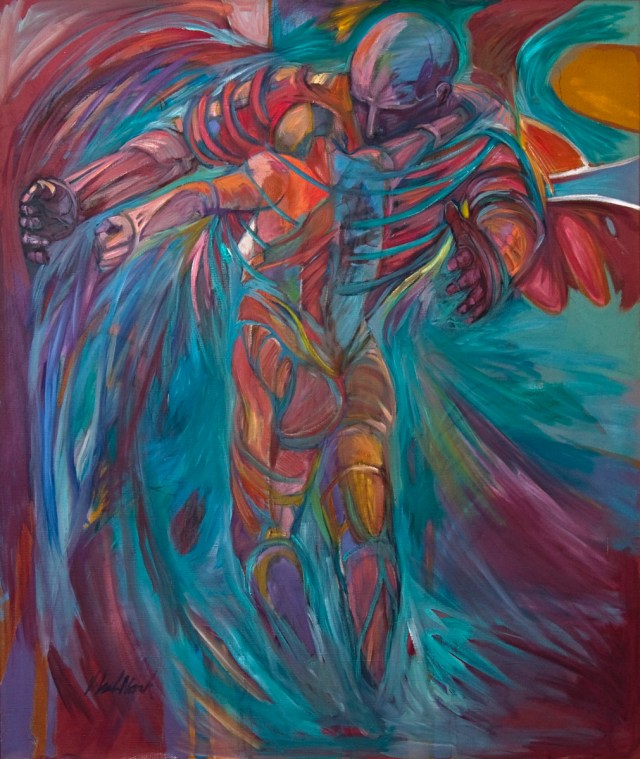
Jacob Wrestling the Angel by Karen Laub-Novak (1937-2009)
Confrontation and struggle were a way of life for me in my first solo pastorate. In the first six weeks of being in the church I faced every kind of sin imaginable, to the point that my mentor in the faith recommended I take some time off. I had not even been there for two months! Although that was a difficult time, the greatest struggle was with God himself and feeling like my prayers were doing nothing but bouncing off the ceiling. In fact, I spent several years of my life in an extended wrestling match with God. He touched me and crippled me by his grace, reminding me how much he is in control. Since that time, I walk with a limp that is not visible – an invisible limp which reminds me I am a different person – one who knows Jesus better and is much more at peace with life.
If we do not wrestle with God in the stressful times of our lives, we will have difficulty discovering what genuine humility is, how much we need the Holy Spirit, and the grace that can be ours to face the rest of our lives. Five hundred years ago Thomas à Kempis wrote to new priests entering ministry with this advice:
“We should so firmly establish ourselves in God that we have no need to seek much human encouragement. It is when a man of good will is distressed or tempted, or afflicted with evil thoughts, that he best understands the overwhelming need he has for God, without whom he can do nothing. While enduring these afflictions he takes himself to prayer with sighs and groans; he grows tired of this life and wishes to die so that he could be undone to live with Christ. It is in such times of trial that he realizes that perfect security and full peace are not to be found in this world.”
The Old Testament patriarch, Jacob, was worried and stressed. He knew he had deceived his brother Esau many years earlier to gain their father’s blessing. Now Jacob is about to meet Esau after all these years, and he is downright afraid for himself and his large family. So, he divided them up into two groups, thinking that if Esau were to attack, the other group could escape. The night before the big stressful meeting, Jacob sent his wives and family across a tributary of the Jordan River, the Jabbok, and spent the night alone wrestling with God. (Genesis 32:22-31)
God will put us in life-compromising positions to create divine encounters so that we will walk away changed. Those events usually come in the form of engaging God with all the questions and difficulties of an incredibly stressful situation. The inner change that occurs comes in the form of a new identity, a new limp, and a renewed understanding of God’s grace. A new confidence arises, convinced that through disability and weakness we are strong and able.
Jacob Wrestling with the Angel by Israel Isaac Lipshitz (1903-1980)
There is a good deal of symbolism happening in the story of Jacob wrestling with the angel of God. First, take note that this Scripture story raises more questions than it answers, such as: Who was the man Jacob wrestled? Was he God, an angel, or someone else? Why have a wrestling match? What in the world is going on here? The unanswered questions are symbolic of the reality that we do not and probably will not get the clarity we are looking for in our struggles with God. Sometimes we might not even know it is God whom we are wrestling with. It is quite possible where we see God estranged from us, he really has us in the grip of grace and will not let go.
Second, Jacob got up during the night, representing his dark night of the soul and struggle with the circumstance he must face. Jacob was left alone with no one to deceive (his typical modus operandi) which is symbolic of his great need – he had no “tricks up his sleeve” and had nowhere to turn but to God. Jacob was asked by his wrestling opponent what his name is. Jacob’s answer is a humble one, confessing who he really is (Jacob means “schemer” or “deceiver”). Jacob asked for a blessing, which in itself is an act of humility because it is an honest profession that he lacks something necessary for life that he cannot provide on his own through any kind of ingenuity on his part.
Third, Jacob asked for God’s name – and got no answer to his question, no clarity, and no satisfaction. This is deeply symbolic of the fact that God is mysterious, and we will not always get the answers to our questions we want. God will not kowtow to our puny attempts at controlling him. Jacob would not let the wrestling match end and held on, just like he grasped the heel of his brother Esau at their birth. This is a symbolic reference to Jacob’s stubbornness which was redeemed and transformed into tenacity, rather than a manipulation of people to get what he wanted.
Fourth, God renamed Jacob, “Israel.” Jacob is now distinguished from the old deceiver with a new identity. Israel literally means “God fights” which is a reference of hope for Jacob’s descendants. That Jacob struggled with God and was able to walk away from it is not really a statement of physical victory so much as a reference to Jacob’s having overcome his constant fear and need for control which prompted his continual trickery.
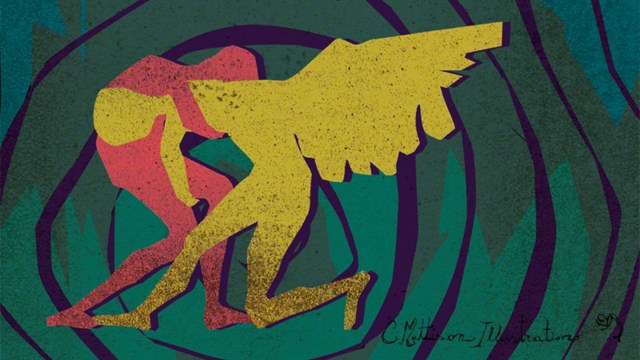
Jacob Wrestles the Angel by Christina Mattison Ebert
Fifth, Jacob’s limp is a permanent sign of God’s grace to Jacob. God is with him and his descendants. Jacob is a different person having encountered God, and the limp is a continual reminder God changed his life forever – Jacob will never be the same after this. Ironically, the limp made Jacob stronger, not weaker. From this point forward in Jacob’s life, he is mindful of his limitations and that God is the One who will arise to fight, protect, and carry on the covenant promises. There is no longer any need or even desire to scheme to accomplish anything.
It will be difficult to find grace apart from wrestling with God in the painful situations of life. It is in such times we must be crippled by grace. We need to be willing to fight with God. It is necessary to get in the match and struggle with God rather than worry within ourselves or just pretend everything is okay so that we will avoid the hard contest in front of us.
Has God left a permanent mark on you? Do you carry a limp from him? What is your name? How does God identify you? Our great need is not in being clever, smart, or working harder; it is God’s grace that we all need. As a kid, when my parents left the house, my brother and I would rearrange the furniture so that we could have a good-solid-knock-down-drag-out wrestling match. Since my brother was older, it usually ended badly for me with a pile-driver that left me incapacitated. It is seriously a miracle that I am still alive after being dropped on my head so many times.
Whenever Christians approach the Lord’s Table, we are reminded of the Son who wrestled with the Father in prayer in the garden of Gethsemane and came away confident of facing a cruel cross so that we might have life. The Lord Jesus carries with him even now the reminders of his suffering – the marks on his hands and his feet from a crucifixion that accomplished deliverance from sin on our behalf. The elements of bread and cup are deeply symbolic reminders of what Jesus did as the cost for our salvation. And they are further reminders that just as we eat this bread and drink this cup we will drink again with Jesus at the end of the age. It is faith in Jesus alone that creates and secures for us a transformed life so that we can share in a crippling grace from him forever.
“And to the angel of the church in Smyrna write: These are the words of the first and the last, who was dead and came to life:
“I know your affliction and your poverty, even though you are rich. I know the slander on the part of those who say that they are Jews and are not but are a synagogue of Satan. Do not fear what you are about to suffer. Beware, the devil is about to throw some of you into prison so that you may be tested, and for ten days you will have affliction. Be faithful until death, and I will give you the crown of life. Let anyone who has an ear listen to what the Spirit is saying to the churches. Whoever conquers will not be harmed by the second death. (NRSV)
What is unique about chapters two and three of Revelation is that Jesus himself is the speaker to seven different churches. Today’s New Testament lesson is addressed to the church at Smyrna, which was a large and beautiful port city in the ancient world. Jesus was letting the believers in Smyrna know they were about to experience severe persecution. However, they need not be fearful and can remain faithful because their Lord knows all about suffering. The church’s perseverance under such trouble would result in the crown of life, given to them by Jesus himself. This was surely an encouragement to the believers as they underwent difficulty.
The congregation at Smyrna was facing imprisonment and, for some, even death for their faith. The heart of the message by Jesus is to remain faithful. There will always be cowards and those with weak faith who will fold when the going gets tough. Yet, persecution and hardship have a way of purging the soul as well as the church of its dross.
Suffering is inevitable; how we handle adversity when it comes is completely under our own control.
Few of us reading this will ever likely face a hardship that could result in martyrdom. Knowing there are brothers and sisters in the faith throughout the world who do face daily hardship for their devotion and beliefs puts our own troubles in a different light. The daily irritations and trials God puts in our way to refine us and shape our faith certainly seem small compared to imprisonment and martyrdom. Yet, no matter who we are and where we are located on this earth, whether facing uncommon hardship or banal difficulty, the afflictions of both body and soul come to us as opportunities to lean into faith and love Jesus to the end.
Our Lord is not looking for perfect people, just faithful followers willing to endure suffering with the truth that our Lord stands with us.
Whatever our current circumstances may be, Jesus offers us his perspective on it. He knows precisely what is going on and understands the spiritual resources you and I possess for each adverse situation we encounter. In fact, few of us really discern the largess of internal resources are within us because of Christ’s redemptive work and the Spirit’s abiding presence – not to mention the very personality God graciously gave us in the womb before we were even born. Even though it seems, at times, we lack strength, wisdom, and courage for what is ahead – Jesus has supreme confidence in us to maintain faith and endure through our afflictions.
Life is not a sprint. Life is a marathon.
To finish the race we need to be in good spiritual health. The perseverance of the saints will happen as we run step after step with boldness despite fear of the unknown future around the bend. This requires the equipment of risk, vulnerability, accountability, and steadfast love which is both received and given. Perhaps most of all it requires keeping our heads up and running toward the promise of reward at the finish. The crown of life is an image of both congratulation and celebration of a race well-run and the enjoyment of unending fellowship with our Lord for whom we have endured so much.
When all is said and done, and the end of the age has occurred, we will be able to look back in hindsight and see that it was really Jesus who all along was fortifying us to keep standing and keep going. Christ is so vested in us that he continually ensures our ultimate victory through a constant presence of help and encouragement. The heritage of both Reformation and Holy Scripture testify to this truth:
“All our progress and perseverance are from God.” –John Calvin
“I’m sure about this: the one who started a good work in you will stay with you to complete the job by the day of Christ Jesus.” (Philippians 1:6, CEB)
May the grace of Jesus sustain you; the love of God surround you; and, the encouragement of the Spirit surprise you, today and every day. Amen.
Grant, O God, That we may never lose the way through our self-will, and so end up in the far countries of the soul; that we may never abandon the struggle, but that we may endure to the end, and so be saved; that we may never drop out of the race, but that we may ever press forward to the goal of our high calling; that we may never choose the cheap and passing things, and let go the precious things that last forever; that we may never take the easy way, and so leave the right way; that we may never forget that sweat is the price of all things, and that without the cross, there cannot be the crown.
So keep us and strengthen us by your grace that no disobedience and no weakness and no failure may stop us from entering into the blessedness which awaits those who are faithful in all the changes and chances of life down even to the gates of death; through Jesus Christ our Lord. Amen
“Have you commanded the morning since your days began, and caused the dawn to know its place, so that it might take hold of the skirts of the earth, and the wicked be shaken out of it? It is changed like clay under the seal, and it is dyed like a garment. Light is withheld from the wicked, and their uplifted arm is broken.
“Have you entered into the springs of the sea, or walked in the recesses of the deep? Have the gates of death been revealed to you, or have you seen the gates of deep darkness? Have you comprehended the expanse of the earth? Declare, if you know all this.
“Where is the way to the dwelling of light, and where is the place of darkness, that you may take it to its territory and that you may discern the paths to its home? Surely you know, for you were born then, and the number of your days is great! (NRSV)
The older I get, and the more understanding I gain, the more I realize how little knowledge I truly possess. When I was eighteen years old, I thought I had the world pretty much figured out. Since then, it has all been downhill. With each passing year, my ignorance seems to grow exponentially. I suppose this all really makes some sense when talking about God’s upside-down kingdom. So much more of life is a mystery to us than we realize.
The more discernment I get, the less, I discover, I know.
Seems like the biblical character of Job found this out the hard way. If there is any person in Holy Scripture that would be wise and understanding, its him. God speaks highly of Job in the Bible.Regarding the upcoming destruction of Jerusalem, God said, “even if these three men—Noah, Daniel and Job—were in it, they could save only themselves by their righteousness, declares the Sovereign Lord” (Ezekiel 14:14).Job is held up as the model of patience under suffering: “As you know, we count as blessed those who have persevered. You have heard of Job’s perseverance and have seen what the Lord finally brought about. The Lord is full of compassion and mercy” (James 5:11).
Yet, with all of Job’s integrity, patience, and righteousness his understanding can barely get a movement on the Richter Scale of God’s expansive knowledge. We likely are somewhat familiar with the story of Job. Being a conscientious follower of God, Job is careful to live uprightly. He acknowledges God in all things and worships him alone. Yet, suffering befell him – for no other reason than that God allowed it. Job knew fully well that there was no personal sin behind his awful ordeal of grief and grinding pain.
So, Job contended with God. For an agonizing thirty-five chapters (Job 3:1-37:24) Job questions God and respectfully takes him to task – as Job’s supposed friends questioned him and assume his guilt. Through it all God is there silent… saying nothing. Then, just when we think God is paying no attention, he suddenly speaks. What is so remarkable about God’s speech is that for the next four chapters (Job 38:1-41:34) he gives no answers. It is all questions. God said,
“Brace yourself like a man; I will question you and you shall answer me” (Job 38:3).
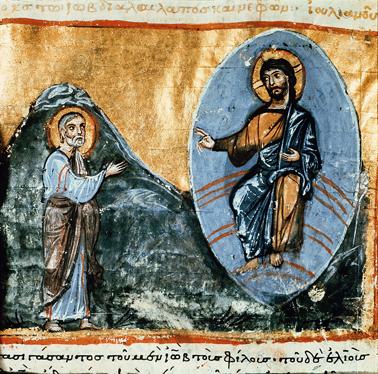
God questions Job. From a 12th century Byzantine text.
It becomes abundantly clear after just a few questions that it would be impossible for any human being to even come close to having the understanding to answer anything God asks. And that was the whole point. God is God, and we are not. Our questions, however legitimate, real, and raw they are, come from a very puny perspective. In other words, we just don’t know as much as we think we do.
To Job’s great credit, he keeps his mouth shut and listens. At the end of the questioning, Job responds in the only wise way one could after such an encounter:
“Surely I spoke of things I did not understand, things too wonderful for me to know” (Job 42:3).
None of this means that, for us, we need to face our hardships and our sufferings with a stoic keep-a-stiff-upper-lip approach. Trapped grief will inevitably come out sideways and only cause more hurt. I believe God allowed Job to express his terrible physical, emotional, and spiritual pain for chapter after chapter because he needed to. Only when God sensed it was the proper timing did he jump in and bring the perspective Job then needed. And even after being challenged by God about his vantage point, Job still did not receive answers as to why he had to endure the awfulness of loss beyond what most of us could comprehend.
Maybe we lack being able to understand even if God directly answered all our questions. Most likely, God protects us from knowing things that might bring irreparable damage to our human psyches. Again, this is all pure conjecture. Which leaves us with perhaps one of our greatest challenges as human beings: We must eventually come to the place of being comfortable with mystery – and even embracing it.
We simply will not have all things revealed to us that we want to know. And that’s okay.
There is yet one more comment to observe about God’s questioning of Job. God is sarcastic. Sarcasm often gets a bad rap, much like anger does, because it is so often associated with unacknowledged emotions and/or expressing our feelings in an unhelpful way. Yet, there the sarcasm is, with the God of the universe. I must admit, I take some odd comfort in knowing that God can be snarky at times – in a good way. Anytime we try to pin God down to nice neat understandable categories, he typically colors outside our human contrived lines and demonstrates to us that he cannot be contained in our ramshackle box. I like it that God is playful, wild, and free to be himself – even if there are times it may bug me.
God is unbound by any human knowledge, understanding, ideas, or plans. God will do what God will do. God will be who he will be. “I AM who I AM,” he once said. Now that’s a God I can put my trust in.
O Lamb of God that takes away the sins of the world, have mercy upon me.
O Lamb of God that takes away the sins of the world, have mercy upon me.
O Lamb of God that takes away the sins of the world, grant me your peace. Amen.









 Rev. Tim Ehrhardt