Psalm 107:1-16 – The Necessity of Telling Our Secrets

Photo by Brett Sayles on Pexels.com

O give thanks to the Lord, for he is good;
    for his steadfast love endures forever.
Let the redeemed of the Lord say so,
    those he redeemed from trouble
and gathered in from the lands,
    from the east and from the west,
    from the north and from the south.

Some wandered in desert wastes,
    finding no way to an inhabited town;
hungry and thirsty,
    their soul fainted within them.
Then they cried to the Lord in their trouble,
    and he delivered them from their distress;
he led them by a straight way,
    until they reached an inhabited town.
Let them thank the Lord for his steadfast love,
    for his wonderful works to humankind.
For he satisfies the thirsty,
    and the hungry he fills with good things.

Some sat in darkness and in gloom,
    prisoners in misery and in irons,
for they had rebelled against the words of God,
    and spurned the counsel of the Most High.
Their hearts were bowed down with hard labor;
    they fell down, with no one to help.
Then they cried to the Lord in their trouble,
    and he saved them from their distress;
he brought them out of darkness and gloom,
    and broke their bonds asunder.
Let them thank the Lord for his steadfast love,
    for his wonderful works to humankind.
For he shatters the doors of bronze,
    and cuts in two the bars of iron. (NRSV)

The psalmist calls upon others to give thanks to the good Lord who shows enduring love to people. The psalmist furthermore exhorts those who have been redeemed to say so, to declare God’s praises for delivering them from trouble. 

Whatever the circumstances and however difficult the experiences may have been, the believer is not to remain in silence but is to publicly thank God.

Speaking our spiritual stories to others is important for those who share them, and for those who listen, so that the community of the redeemed will be strengthened in their faith and emboldened to share with others. Far too many Christians are reticent to talk about what God has done or is doing in their lives. Shame, embarrassment, or a host of other reasons might prevent us from being vulnerable enough to let others in on God’s deep work within us. But the psalmist does not let us off the hook, even if we feel we are not articulate or are too afraid to speak.

We all likely have had the privilege of hearing another person share their heart and experience of hardship and God’s deliverance. It was uplifting, encouraging, and helpful. So, let’s not keep our stories to ourselves. Stories are meant to be told, not hidden. 

Bringing to light our faith journey is healing for all, as well as declaring the light of Jesus to the world.

Author Frederick Buechner wrote a book several years ago entitled, “Telling Secrets.” Buechner tells of his own experience of keeping some stories inside and never letting them see the light of day. One of those stories was growing up with an alcoholic father and all the other stories that went along with that singular story. It was only in finally telling the family secret of alcoholism that he discovered a better path forward to healing and blessing. He writes:

“What we hunger for perhaps more than anything else is to be known in our full humanness, and yet that is often just what we also fear more than anything else. It is important to tell at least from time to time the secret of who we truly and fully are because otherwise we run the risk of losing track of who we truly and fully are and little by little come to accept instead the highly edited version which we put forth in hope that the world will find it more acceptable than the real thing. It is important to tell our secrets, too, because it makes it easier for other people to tell us a secret or two of their own.”

“My story is important not because it is mine, God knows, but because if I tell it, the chances are you will recognize that, in many ways, it is also your story. It is precisely through these stories in all their particularity, as I have long believed and often said, that God makes himself known to each of us more powerfully and personally. If this is true, it means that to lose track of our stories is to be profoundly impoverished not only humanly but also spiritually.”

Shame is like a vampire. It lives in the shadows, thirsting for and feeding upon secrets.

But when our stories are told and see the light of day, the vampire of shame is destroyed by the bright rays of truth and vulnerability. We then become open to genuine relationships without propping up a false self to pose for others. We place ourselves in a position to receive and give love. In short, we can meaningfully connect with both God and others because we found our voice and told our story.

Great God of deliverance, I praise you that I have a story to tell of your grace and faithfulness. Help me to tell of your mercy in my life so that the name of Jesus will be exalted, and that your people might be built up in the faith.  Amen.

Psalm 22:23-31 – Full of Suffering

Psalm 22 by Mike Moyers, 2016

All of you who revere the Lord—praise him!
    All of you who are Jacob’s descendants—honor him!
    All of you who are all Israel’s offspring—
        stand in awe of him!
Because he didn’t despise or detest
    the suffering of the one who suffered—
    he didn’t hide his face from me.
    No, he listened when I cried out to him for help.

I offer praise in the great congregation
    because of you;
    I will fulfill my promises
    in the presence of those who honor God.
Let all those who are suffering eat and be full!
    Let all who seek the Lord praise him!
        I pray your hearts live forever!
Every part of the earth
    will remember and come back to the Lord;
    every family among all the nations will worship you.
Because the right to rule belongs to the Lord,
    he rules all nations.
Indeed, all the earth’s powerful
    will worship him;
    all who are descending to the dust
    will kneel before him;
    my being also lives for him.
Future descendants will serve him;
    generations to come will be told about my Lord.
They will proclaim God’s righteousness
        to those not yet born,
        telling them what God has done. (CEB)

“Faith must be tested, because it can only become your intimate possession through conflict.”

oswald chambers

“Suffering” is a word we would like to avoid. Simply saying or reading the word might make us cringe. Suffering? No thanks. I think I’ll pass on that. Yet, something inside of us instinctively knows we cannot get around it. Everyone suffers in some way. It is endemic to the human condition that at times we will suffer physically, financially, mentally, emotionally, and spiritually. 

That’s why I believe there is so much talk within some Christian circles about miracles. It’s more than understandable. A chronic pain sufferer wants relief; she prays for a miracle of health. A small business owner is bleeding financially; he looks to God for an immediate miracle of wealthy clients. A beloved senior saint knows she is afflicted with Alzheimer’s; she prays for the miracle of deliverance, even to be taken home to be with the Lord. A young adult finds himself in the throes of depression and has tried everything to cope and get out of it; he petitions God for a miracle out of the deep black hole. The believer in Jesus keeps experiencing a besetting sin and cannot get over it; she looks to God for the miracle of not struggling any more with it.

These scenarios and a thousand other maladies afflict people everywhere. There are a multitude of stories out there. Folks who have experienced a miracle tell of their wonderful deliverance. But what about the rest? Those without the miracle? Do they have a lack of faith? Has God forgotten them?

Oh, my, no! God sees, and God knows. God is acquainted with suffering. Jesus knows it first-hand. Remember, it was Jesus who said, “My God, my God, why have you forsaken me?”  Even Jesus cried out in his suffering.  But there was no deliverance coming for him.  There was, instead, deliverance coming for us.

Sometimes the greatest miracle and deliverance of all is to be freed from the need for a miracle. The reason God doesn’t just offer immediate relief from everyone’s suffering and bring a miracle is that he is doing something else: Walking with us through our suffering. God oftentimes has plans and purposes for us well beyond our understanding.  We simply are not privy to everything in God’s mind.

We may not get the miracle we desire. However, what we will get without fail is God’s provision and steadfast love all the way through the suffering. Where is God in your suffering? Jesus is suffering with you. You are not crying alone; Christ weeps with you.

Let, then, those who suffer, eat and be full. Let them be satisfied with the portion God has given them. What’s more, let them offer praise to the God who is squarely beside them in every affliction and each trouble.

God Almighty, you are the One who knows suffering and affliction better than anyone. I admit I don’t often understand what in the world you are doing or not doing in my life and in the lives of those I love. Yet, I admit that I have found in you the comfort, encouragement, and strength to live another day in my trouble. For this, I praise you, in the Name of Jesus Christ, in the power of the Holy Spirit. Amen.

Psalm 130 – Waiting in Hope

waiting

Out of the depths I cry to you, Lord;
Lord, hear my voice.
Let your ears be attentive
to my cry for mercy.

If you, Lord, kept a record of sins,
Lord, who could stand?
But with you there is forgiveness,
so that we can, with reverence, serve you.

I wait for the Lord, my whole being waits,
and in his word I put my hope.
I wait for the Lord
more than watchmen wait for the morning,
more than watchmen wait for the morning.

Israel, put your hope in the Lord,
for with the Lord is unfailing love
and with him is full redemption.
He himself will redeem Israel
from all their sins. (NIV)

This psalm is the miserable cry of a nobody from nowhere. Yet, because the Lord is attentive to the righteous, the cry penetrates heaven and is received. The psalmist only wants to serve God with a new beginning and fresh obedience – and he will wait and hope for liberation from his misery.

We typically use the term “hope” in a wishful thinking sort of way. That is because we are not quite sure if things will shake-out like we want.  But biblical hope is not wishful thinking.  Rather, it is a confident expectation of what is to come. Hope is like anticipating the seasons.  In the dead of winter when it is bitter cold with little sunshine, we hope, and not wish, for Spring because we know it is coming.  It might come in early March, maybe in late April. The trees will bud, the grass will turn green, and the temperature will warm – you can bet your britches on it.

This old world might be messed up and broken right now, but it will not always be this way.  Because of the person and work of Jesus Christ, there is hope, the confident expectation that deliverance from sin, death, and hell will be fully realized. We are saved from the bondage of sin through the cross and resurrection of Christ.  We are delivered into an inheritance which can never perish, spoil, or fade – kept in heaven for us until the time is right. Meanwhile, we hope with the confident expectation of Christ’s coming again.

Praise be to the God and Father of our Lord Jesus Christ! In his great mercy he has given us new birth into a living hope through the resurrection of Jesus Christ from the dead, and into an inheritance that can never perish, spoil, or fade. This inheritance is kept in heaven for you, who through faith are shielded by God’s power until the coming of the salvation that is ready to be revealed in the last time. In all this you greatly rejoice, though now for a little while you may have had to suffer grief in all kinds of trials. (1 Peter 1:3-6, NIV)

Until our hope is fully realized, we cry out to God and watch for his deliverance. Regarding our salvation, it is accurate to say that we have been saved (from the realm of sin); we are currently being saved (through being made holy in this life); and, we will be saved (when Jesus returns). Liberation from both our personal struggles and the evil machinations of this world is an ongoing process that will only reach its complete fulfillment at the end of the age.

That is why we experience such a weird existence on this earth, a strange amalgam of good and bad.  We not only get mixed messages from the world, but also internally, within our souls, we experience the struggle between right and wrong.  Outwardly, we suffer in all kinds of earthly grief from others who do not understand us.  Inwardly, we have the silent pain and terrible wrestling of wanting to forgive but desiring revenge; of seeking to be gracious but seething with anger; of looking to express kind words but having hate speech blurt out instead.

It will not always be this way. We have a living hope.  Jesus has risen from death. He is alive. He is coming back to judge the living and the dead.  He will take us to be with him forever.  It is the confident expectation of unhindered relationship, with no obstacles of difficult people, and without any systemic evil from organizational structures giving us a hard time.

MLK hope quote

Hope is real. It is just as real as anything we will ever know this side of heaven. We might not always find what we are looking for in this life, yet, in the next life, we shall find the life that is truly life in Jesus Christ, who is our hope. Until then, we are to wait neither idly nor passively. Instead, it is sage for us to do the following:

Occupy the time. One of the best ways to avoid becoming anxious while waiting is to do what we are on this earth to do: be a blessing to others.

Bless those who persecute you; bless and do not curse. Rejoice with those who rejoice; mourn with those who mourn. Live in harmony with one another. Do not be proud but be willing to associate with people of low position. Do not be conceited…. Do not be overcome by evil but overcome evil with good. (Romans 12:14-16, 21, NIV)

Don’t try too hard. Trying to use willpower to squelch anxiety will only prompt even greater anxiety. Accept that we will have to wait and that we are not privy to God’s timetable.

Give all your worries and cares to God, for he cares about you. (1 Peter 3:7, NLT)

Wait with other people. Waiting with others through talking about our shared hope helps redeem our time in the here and now.

Be still in the presence of the Lord and wait patiently for him to act. Don’t worry about evil people who prosper or fret about their wicked schemes. (Psalm 37:7, NLT)

Think of patience as compassion. Becoming impatient about something in life is entirely normal and happens to all of us. Our impatience is a stress response to a situation. Learning to be more patient is a way of being more compassionate to ourselves and others.

Therefore, as God’s chosen people, holy and dearly loved, clothe yourselves with compassion, kindness, humility, gentleness, and patience. (Colossians 3:12, NIV)

Lord God Almighty, your hope arises with each dawn, pushing back the rubble of our lives. Each new day reminds us of your grace as you paint hope across the sky. Into the deafening cry of hopelessness, you whisper love that catches and holds us. There is no end, just new beginnings. No finish, just new starts. Into your resurrection we follow you into hope. You are alive in the world and in us. So, we carry your hope within our spirits always. Help us to lift our eyes and experience Christ’s resurrection hope arise in our lives through Jesus our Lord. Amen.

The Big Reveal

Joseph feasting with his brothers by Yoram Raanan
Joseph Feasting with His Brothers by Yoram Raanan

The biblical character, Joseph, went through a lot. While growing up, his brothers misunderstood and ridiculed him as “that dreamer.” Their jealousy and hatred of Joseph led them to throw him into a well and leave him for dead. Then, they turned around and pulled him out only to sell him into slavery. Joseph served as a household slave, until he was again misunderstood and wrongly accused by his master’s wife.

So, Joseph languished in a prison for years, suffering injustice. Yet, the awkward liminal space in between his family of origin and becoming the administrator over all Egypt was not a waste of time. Rather, it gave Joseph a divine perspective on his life and shaped him for his rise to power.

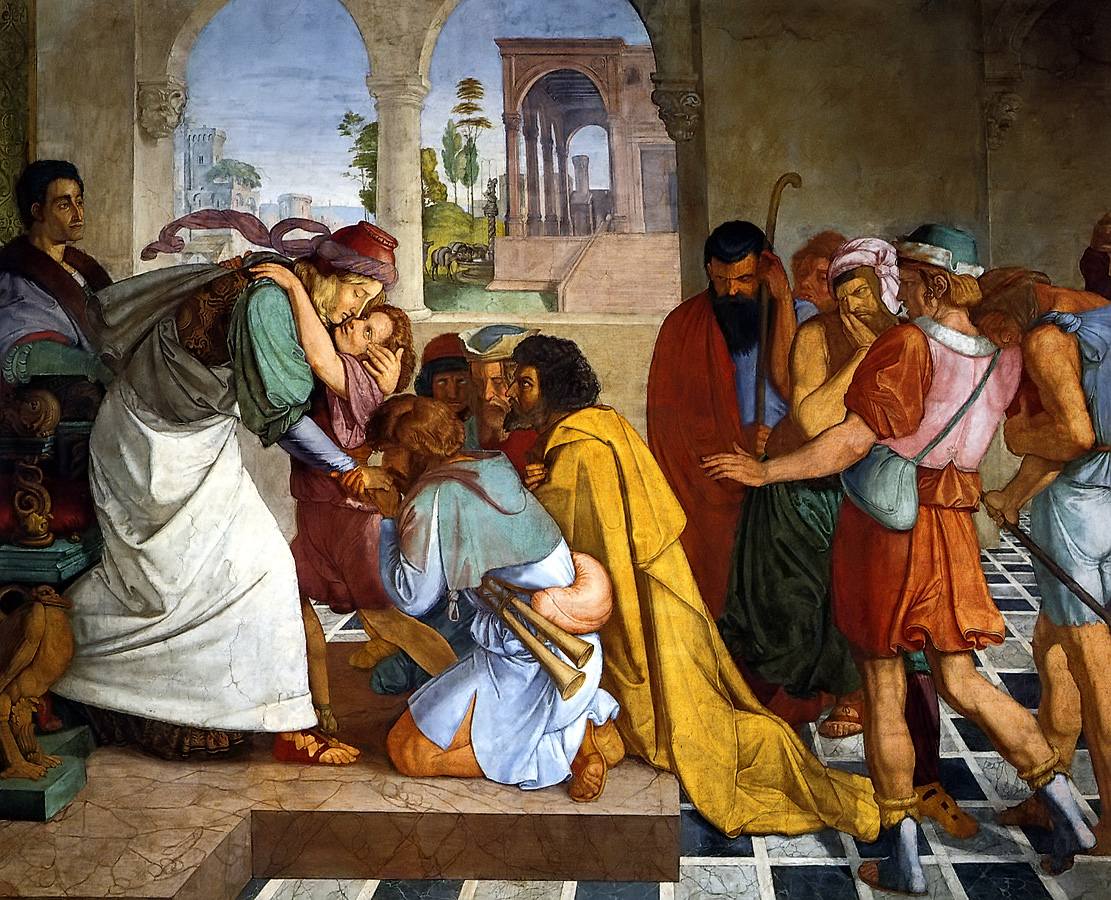
Likely believing he would never see his brothers and father again Joseph went about the immense work of overseeing Egypt. One day, during a severe famine, lo and behold, his brothers show up in his court looking to purchase some food for their large families! Joseph immediately recognized them. The brothers, however, did not have a clue that this was their long-lost brother.

Joseph, understandably guarded, kept his identity to himself and toyed with his brothers to discover how Jacob his father was doing. Eventually, through a labyrinthine experience of a few journeys of the brothers back and forth from Palestine to Egypt, Joseph could take it no longer; he just had to reveal his identity to his brothers. (Genesis 45:1-15)

Yet, the ultimate unveiling is much more a glimpse of what God was up to. Joseph provided a commentary on his life, why he endured hardship, and how he came to be the administrator over all Egypt. Joseph wisely discerned that God sent him to Egypt to save many lives.

It is mostly in retrospect we see what God has been doing all along.  A good chunk of our lives is a mystery that is concealed, only revealed with time and patience on our part. While we exist in the strange space of the great unknowing and may struggle to understand our hardships, God is working behind the scenes, bending all our life events to his purposes. And that is the key to understanding the entire narrative of Joseph (Genesis 37-50).

Joseph’s brothers, despite being stinkers, were the means God used to send Joseph to Egypt.  Furthermore, all of Joseph’s experiences in Potiphar’s house, and in the prison where he was unjustly sent were the training ground for him to lead all Egypt, second only to Pharaoh himself.

The Reconciliation of Joseph and his Brothers, Peter Cornelius 1
The Reconciliation of Joseph and His Brothers by Peter Cornelius, 1817

Therefore, trust and faith are imperative for God’s people. Faith is placed where the object is trustworthy. In other words, we trust God if we believe God is good and has our best interests at mind. Conversely, if we view God as sometimes fickle or inattentive, then placing faith in him becomes a gamble and we might be hesitant, hedging our bets and relying more on ourselves and our own ingenuity to get through a hard circumstance.

Don’t be deceived, my dear brothers.  Every good and perfect gift is from above, coming down from the father of the heavenly lights, who does not change like shifting shadows.  He chose to give us birth through the word of truth, that we might be a kind of first fruits of all he created. (James 1:16-18, NIV)

We all face times and seasons in our lives where we wonder if the Lord is sitting in his Lazy-God recliner sleeping while we wither in some miserable situation, believing that God has better things to do, or has simply lost interest in my puny life. Yet, it could be that the Lord is providentially shaping our circumstances in preparation for us to accomplish a significant godly purpose.

Although hindsight can help us see the superintendence of God, the relationship between divine sovereignty and human responsibility is still largely a mystery.  Many times, we can only affirm paradoxical truths. For example:

  • It was ordained before the foundation of the world that Jesus would be our Savior.
  • Jesus chose to willingly face the cross for our sake.

Both statements are equally true at the same time, all the time.

  • Christ’s betrayal by Judas was foreordained and foretold in the Old Testament centuries before Judas Iscariot was born.
  • Judas deliberately chose to betray Jesus with a kiss for thirty pieces of silver.

Both are equally true.

  • Joseph was meant by God to go through all kinds of hardship for a purpose.
  • Joseph willingly submitted to his hardship, choosing not to become angry, bitter, or vindictive.

Both of those realities are equally true.

It is not so much what happens to us that is the issue or problem. Rather, it is how we interpret what happens to us that is the critical issue. The way Joseph interpreted his difficult circumstances and his brothers’ calloused behavior toward him was to see the big picture of what God was doing in the world, instead of merely viewing events from a narrow perspective of painful personal adversity and becoming hateful.

Just as Joseph saw his suffering, hardship, and persecution as the means to saving lives, so Jesus viewed his suffering on the cross as the means to save our lives and bring us reconciliation. And, in the same way, we too, will undergo suffering and hardship for the purpose of saving lives through peacemaking efforts.

My dear wife and I have endured our share of hardship in our lives. I choose to interpret the reason we have gone through it all just as the Apostle Paul discerned his own adversity by saying to the Corinthian Church:

Praise be to the God and Father of our Lord Jesus Christ, the Father of compassion and the God of all comfort, who comforts us in all our troubles, so that we can comfort those in any trouble with the comfort we ourselves have received from God.  For just as the sufferings of Christ flow over into our lives, so also through Christ our comfort overflows.  If we are distressed, it is for your comfort and salvation; if we are comforted, it is for your comfort, which produces within you a patient endurance of the same sufferings we suffer.  And our hope for you is firm because we know that just as you share in our sufferings, so also you share in our comfort. (2 Corinthians 1:3-7, NIV)

Whatever you are going through, or have gone through, even if it has been many years ago, God wants to use your difficulties and troubles for both your personal strengthening of faith, and for empathic and compassionate ministry for the sake of others.

We all need to practice patience and perseverance through hard times, if we are going to realize better days and gain a better interpretation of our difficult circumstances. Here are a few ways to do just that:

Write It Out

When suffering an upsetting event, writing about it can make us feel better as well as helping us make some sense of it. The act of writing organizes our thoughts, which then makes the experience feel less chaotic. Writing also provides an emotional release, along with insight and awareness into yourself. And with awareness, we have conscious choices.

Guard your heart more than anything else because the source of your life flows from it. (Proverbs 4:23, GW)

Some thoughts to get started writing:

  • Set aside 10-15 minutes a day for several days to write about the event and how it made you feel.
  • Don’t worry about grammar or creativity. This is just for you.
  • Stick with it. At first writing about an upsetting experience might be painful. However, over time it can help you get past the upset. Keep in mind, though, that if it is an especially disturbing event, you might want to do this work along with a trained professional.

Tackle Your Problem(s)

When distressed, it is unhelpful to stew in self-pity or to waste energy in blame shifting. Instead, be assertive.

Make every effort to present yourself to God as a tried-and-true worker, who does not need to be ashamed but is one who interprets the message of truth correctly. (2 Timothy 2:15, CEB)

Take charge of your trouble:

  • Write down the problem. On paper it seems more manageable than when it is swirling inside your head.
  • List as many solutions as possible. You can reject options later.
  • Assess the list. Ask yourself how you would like this situation to end. Which of the written options likely will get you there? Weigh the pros and the cons.
  • Accept a reasonable solution, without searching for the perfect one. Focusing on perfection only breeds disappointment.
  • Form a concrete workable plan. Set some realistic and specific deadlines.
  • Avoid discouragement if the first solution does not pan out – just try another one on your list.

Get Support

We as people are hard-wired by God for community and needing one another.

Help each other with your troubles. When you do this, you are obeying the law of Christ. (Galatians 6:2, ERV)

  • Ask someone to give you a hand if you are overwhelmed.
  • Do not be afraid to ask for advice. Consulting and collaborating with others are always the way of wisdom.
  • Get emotional support. Crying, sharing our frustrations, or otherwise venting helps release tension, relieve stress, and helps us move on.

So, may we choose to have the eyes of faith and trust, discerning that God is good and  sovereignly works out his will through our troubles.