Acts 28:23-31 – Focused on Mission

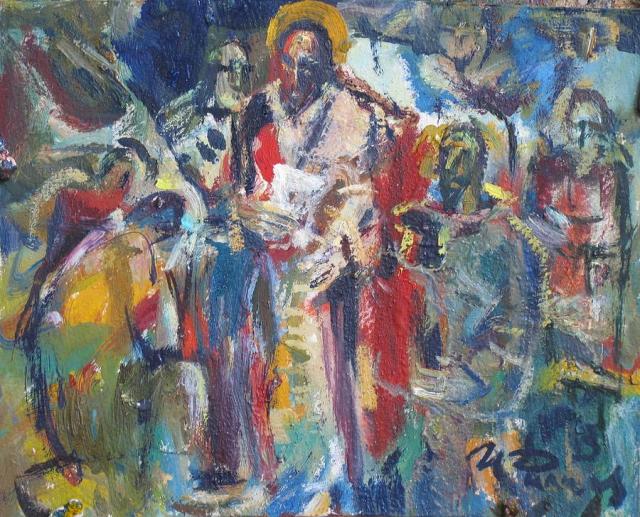
Apostle Paul by Ivan Filichev

They arranged to meet Paul on a certain day and came in even larger numbers to the place where he was staying. He witnessed to them from morning till evening, explaining about the kingdom of God, and from the Law of Moses and from the Prophets he tried to persuade them about Jesus. Some were convinced by what he said, but others would not believe. They disagreed among themselves and began to leave after Paul had made this final statement: “The Holy Spirit spoke the truth to your ancestors when he said through Isaiah the prophet:

“‘Go to this people and say,
“You will be ever hearing but never understanding;
    you will be ever seeing but never perceiving.”
For this people’s heart has become calloused;
    they hardly hear with their ears,
    and they have closed their eyes.
Otherwise they might see with their eyes,
    hear with their ears,
    understand with their hearts
and turn, and I would heal them.’

“Therefore, I want you to know that God’s salvation has been sent to the Gentiles, and they will listen!”

For two whole years Paul stayed there in his own rented house and welcomed all who came to see him. He proclaimed the kingdom of God and taught about the Lord Jesus Christ—with all boldness and without hindrance! (New International Version)

The Apostle Paul took quite a licking throughout his Christian life. Incredibly, Paul not only physically survived whippings, beatings, stoning, arrests, shipwreck, and imprisonment – he also came through it all with a robust spirit and a dogged determination to live his life with purpose and mission.

Acts 28 is the final chapter in the book. Paul is in Rome under house arrest. Even in this situation, he kept finding ways to engage others. Since he couldn’t go to them, he had others come to him – lots of them.

Paul described to the visitors his own experience of encountering the risen Christ. He reasoned with his fellow Jews and vigorously debated with them from the Scriptures. It was always the deep desire and hope of Paul that his own people come to faith in Christ, just as he had. Although some did, most didn’t.

Many decades ago, my grandfather was approached by one of his friends about investing in a new insurance company startup. For a lot of reasons, grandpa ended up not participating in his friend’s venture. So, the friend asked others. Eventually, the startup happened and steadily grew. Today, Nationwide Insurance has over 250 billion dollars of assets. Good old gramps just didn’t know what he was rejecting.

The good news of Jesus Christ, I believe, is worth infinitely more than an insurance company. Christian mission, I believe, is worth investing my life into. I’m glad the gospel was proclaimed to Gentiles because I am a recipient of such grace. And I’m grateful that Paul tenaciously kept interacting with people for the last two years of his life under arrest.

Despite, and even because of, Paul’s sufferings and his house arrest, the message of faith and forgiveness in Christ was confidently and consistently presented to a steady flow of people, including the highest heads of state. Difficulties are no problem for God. The Lord bends all circumstances to divine and good purposes, creating new avenues of faith, hope, and love that wouldn’t be possible under “normal” times.

“He is no fool who gives what he cannot keep to gain that which he cannot lose.”

Jim Eliot

In fact, Paul endured five years of imprisonment: two in a Caesarea jail; two under house arrest in Rome; and nearly a year in transport between the two cities. For a personality like Paul, we might imagine this would drive him nuts. Yet, several letters to the churches, now contained in the New Testament, were written during that time.

Whether we like it, or not, nothing proves, affirms, and grows our faith quite like our willingness to endure suffering for the gospel. Witness, suffering, and martyrdom are inextricably bundled together in God’s economy. When suffering is viewed as a necessary means to an altruistic and noble end, then, although the pain is no less real, there is the opportunity for both willing endurance and genuine joy.

Paul was willing to labor on behalf of people who were very different from himself. His concern was for all people everywhere – both his own people, the Jews, as well as Gentiles. Paul never gave in and never gave up. He had a magnanimous spirit and even greater spiritual gifts. He willingly and gladly used that spirit and gifts for the benefit of humanity.

In 64 C.E. Paul was condemned and executed. Before his death, he wrote that he had fought the good fight, finished the race, and kept the faith. Now, the next generations of new believers must follow in his footsteps and continue the work

This is precisely why the book of Acts ends so abruptly, with no resolution, no tidy conclusion – because the work is still being done and will carry on until Christ returns.

Gracious and loving God, you work everywhere reconciling, loving, and healing your people and your creation. In your Son Jesus, and through the power of your Holy Spirit, you invite each of us to join you in your work. We ask you to form us more and more in your image and likeness, through our prayer and worship of you and through the study of Holy Scripture so that our eyes will be fully opened to your mission in the world. Then, God, into our communities, our nation, and the world, send us to serve with Christ, taking risks to give life and hope to all people and all of your creation, through Jesus Christ our Lord.. Amen.


Isaiah 40:1-11 – The Lord’s Glory Will Appear

Comfort, comfort my people!
    says your God.
Speak compassionately to Jerusalem,
        and proclaim to her that her compulsory service has ended,
    that her penalty has been paid,
    that she has received from the Lord’s hand double for all her sins!

A voice is crying out:
“Clear the Lord’s way in the desert!
    Make a level highway in the wilderness for our God!
Every valley will be raised up,
    and every mountain and hill will be flattened.
    Uneven ground will become level,
    and rough terrain a valley plain.
The Lord’s glory will appear,
    and all humanity will see it together;
    the Lord’s mouth has commanded it.”

A voice was saying:
    “Call out!”
And another said,
    “What should I call out?”
All flesh is grass;
    all its loyalty is like the flowers of the field.
The grass dries up
    and the flower withers
    when the Lord’s breath blows on it.
    Surely the people are grass.
The grass dries up;
    the flower withers,
    but our God’s word will exist forever.

Go up on a high mountain,
    messenger Zion!
Raise your voice and shout,
    messenger Jerusalem!
Raise it; don’t be afraid;
    say to the cities of Judah,
    “Here is your God!”
Here is the Lord God,
    coming with strength,
    with a triumphant arm,
    bringing his reward with him
    and his payment before him.
Like a shepherd, God will tend the flock;
    he will gather lambs in his arms
    and lift them onto his lap.
    He will gently guide the nursing ewes. (Common English Bible)

Advent is a time of longing, hoping, and anticipating fulfilled promises. Meanwhile, in this awkward liminal space, it’s a hard slog.

Most of the Christian’s life is lived in the mundane, yet necessary work of mission. The daily pilgrimage of faith is barely noticed by most people. Our small and seemingly obscure acts of kindness; the discreet gestures of love; and the graciously chosen words of encouragement can be undetected by so many – except for God.

I am sure the ancient Jewish people felt that, for an awfully long time, they were plodding along as faithfully as they could with often little to show for it. However, they knew it would not always be this way. God’s people anticipated that a time was coming when their pedantic service would see the light of day.

I am sure we, too, have times when it feels as if our prayers are only bouncing off the ceiling. In such times, words of comfort and assurance come as a breath of fresh air. When we least expect it, God speaks to us tenderly and with compassion. The Lord steps into our weariness and exhausting work and says, “Enough!”

Whereas our walk with God may often feel like trudging up and down hills, sloshing through muddy valleys, and traversing hard terrain, the proclamation of comfort assures us that it will not always be this way. The way to God will be made level so that we can connect with the Lord post haste.

No matter how much our worldly circumstances break us down, even shattering our expectations and dreams, we carry with us an unflagging vision of wholeness, integrity, and hope. God is our true home, our polestar, our ultimate destiny. Feeling displaced, out of sorts, or like we just do not belong are signs that we long for our place with God.

And when we find our home with God, all might be going to hell around us, yet we are buttressed and sustained by living divine words. For those with eyes to see, ears to hear, and hearts attuned to grace, there is John the Baptist, smoothing the highway to our Lord – preparing the way to Jesus. (Mark 1:1-4)

God, as the warrior who powerfully fights our battles – and the shepherd who lovingly tends to our needs – firmly takes the initiative to bring us home, going out of the way to gently pick us up and carry us back to the place we belong.

The good news is that the world is changed by God. The world around us is no longer the way we thought it was or was supposed to be. Despair gives way to confident expectation, and discouragement is slowly replaced by consolation. The long exile is coming to an end. Jesus is coming soon. All will be made right. Justice and peace will have the day.

Let your hearts be true and humble, as befits God’s holy reign. For the glory of the Lord is on the earth and will be from everlasting to everlasting.

Glory to God in the highest, and on earth, peace to people of goodwill. We praise you; we bless you; we adore you; we give thanks to you for your great glory. Amen.

Hebrews 10:32-39 – Believe, Be Patient, and Remember

Remember those earlier days after you had received the light, when you endured in a great conflict full of suffering. Sometimes you were publicly exposed to insult and persecution; at other times you stood side by side with those who were so treated. You suffered along with those in prison and joyfully accepted the confiscation of your property, because you knew that you yourselves had better and lasting possessions. So do not throw away your confidence; it will be richly rewarded.

You need to persevere so that when you have done the will of God, you will receive what he has promised. For,

“In just a little while,
    he who is coming will come
    and will not delay.”

And,

“But my righteous one will live by faith.
    And I take no pleasure
    in the one who shrinks back.”

But we do not belong to those who shrink back and are destroyed, but to those who have faith and are saved. (New International Version)

Sometimes we get stuck in our troubles. We might get lost in adversity and cannot see either how we got here or a way out. This is hopelessness. Without a confident expectation of better days ahead, while in the throes of difficulty, a failure of faith can too easily happen.

To realize better days, it’s important to remember the earlier days. I’m not talking about living in the past and wishing it were the 1950s again with Beaver Cleaver across the street. This is not about believing that the past was the good old days, and the present is no good. Rather, I’m referring to remembering the ways we endured and persevered with joy in past experiences.

The original Christian recipients of the message of Hebrews needed to recall the various ways they stood firm and tall in their faith, despite the adversity. They were insulted and persecuted, showing solidarity to others in similar situations. They were attentive to prisoners and sought to meet their needs. And they actually responded to the confiscation of their property with joy because they knew there was more than this present life.

God blesses those who patiently endure testing and temptation. Afterward they will receive the crown of life that God has promised to those who love him.

James 1:12, NLT

The believers needed to reconnect with their purpose, with their why. The reason they had such incredible attitudes while enduring hard things is because they were pursuing heavenly treasure. Their earthly possessions were merely temporary things, not of eternal value. It is people who have eternal value, and the believers willingly focused efforts in helping others.

However, the Christians eventually, over time, lost their focus and could only see the pain and the difficulty. They became disconnected with their purpose. And so, they were in danger of losing their faith and becoming utterly hopeless.

Remember what God has done for you. Affirm what is right, just, and true. Embrace faith and patience. That’s what the prophet Habakkuk did. And his resilience helped to bring proper perspective to present troubles.

“Nothing that is worth doing can be achieved in a lifetime; therefore, we must be saved by hope.”

Reinhold Niebuhr

Habakkuk was distressed over the corruption of his fellow Israelites. So, he complained to God about it. God responded by informing Habakkuk that judgment was coming to Israel through the Babylonians. This was neither what Habakkuk expected nor wanted. The prophet grumbled even more because the Babylonians were more corrupt than the Israelites. “The Babylonians need judgment, too!” believed Habakkuk. 

Habakkuk struggled to come to terms with what God was doing, and not doing. Finally, he concluded the matter by reconnecting with his faith: 

Even though the fig trees have no blossoms,
    and there are no grapes on the vines;
even though the olive crop fails,
    and the fields lie empty and barren;
even though the flocks die in the fields,
    and the cattle barns are empty,
yet I will rejoice in the Lord!
    I will be joyful in the God of my salvation!
The Sovereign Lord is my strength!
    He makes me as surefooted as a deer,
    able to tread upon the heights. (Habakkuk 3:17-19, NLT)

One of the most significant faith experiences we can ever have, is to come to the point of complete trust in God so that our happiness is not dependent upon good circumstances. The truth is that the Christian’s joy and spiritual security is independent of what is going on around us. Even though situations might be difficult and even evil, believers can still rejoice because we do not need everything to go our way in order to experience happiness.

Faith, patience, and joy are neither cheap, nor easy. It requires daily affirmations of faith and patience. It requires remembering. There is a reward ahead if we persevere to the end.

We can remain patient, express faith, kindle hope, and remember necessary things whenever we stop doing unimportant things which do not add value to our ultimate goals; be mindful of those things which are most important to us; and move through life at a pace of hope, not anxiety.

God, give us grace to accept with serenity
the things that cannot be changed,
Courage to change the things
which should be changed,
and the Wisdom to distinguish
the one from the other.

Living one day at a time,
Enjoying one moment at a time,
Accepting hardship as a pathway to peace,
Taking, as Jesus did,
This sinful world as it is,
Not as I would have it,
Trusting that You will make all things right,
If I surrender to Your will,
So that I may be reasonably happy in this life,
And supremely happy with You forever in the next.

Amen.

James 5:13-20 – Pray In Times of Trouble

Is anyone among you in trouble? Let them pray. Is anyone happy? Let them sing songs of praise. Is anyone among you sick? Let them call the elders of the church to pray over them and anoint them with oil in the name of the Lord. And the prayer offered in faith will make the sick person well; the Lord will raise them up. If they have sinned, they will be forgiven. Therefore, confess your sins to each other and pray for each other so that you may be healed. The prayer of a righteous person is powerful and effective.

Elijah was a human being, even as we are. He prayed earnestly that it would not rain, and it did not rain on the land for three and a half years. Again, he prayed, and the heavens gave rain, and the earth produced its crops.

My brothers and sisters, if one of you should wander from the truth and someone should bring that person back, remember this: Whoever turns a sinner from the error of their way will save them from death and cover over a multitude of sins. (New International Version)

This entire letter of the Apostle James to a suffering church is grounded in two important theological truths:  God is good; and God acts powerfully in the world for good. 

The foundation of Christian prayer is the conviction that God cares – that the Lord hears us and responds. Prayers can be lifted at any time. Yet, the God-focused and God-honoring prayer has a price. It will cost us time, effort, vulnerability, and follow-through with appropriate action. Biblical prayer is more than private requests; it requires something of us as a community of believers in Jesus.

When To Pray?

We are to pray whenever there is trouble in our lives which causes us to suffer. Whether physical trouble, emotional suffering, or relational difficulty, we are to pray about it all. We are to pray even when we do not feel like it. In short, we are to be pray continually because there is always a need for prayer.

The Apostle James practiced what he taught. The Roman historian, Eusebius, wrote concerning James that “his knees grew hard like a camel’s because of his constant worship of God, kneeling and asking forgiveness for the people.” James was in constant intercession to God for people. 

“His knees grew hard like a camel’s because of his constant worship of God, kneeling and asking forgiveness for the people.”

The fourth-century historian Eusebius, describing the Apostle James

Like James, we all need prayer is to be our default response in trouble and suffering. When in trying circumstances, a temptation is to lash out at the person who enabled the adversity. We may even become mad at God for allowing trouble in our lives.

Yet, when afflicted, suffering, or in trouble, we need to pray. Sometimes God will always take away our afflictions, suffering, or troubles. Sometimes not. However, by bringing our circumstances before the Lord and acknowledging our need for divine help, we can see God intervene in the situation we are presently facing. What’s more, prayer can give us the grace we need to endure and come closer to God.

So, when the bottom drops out; when you feel you are hanging by a thread; when circumstances are overwhelming or grow worse by the minute, we should pray. We should pray, whether afflicted, sick, or overcome by guilt and shame.

The cost of prayer is time. For many people, time is as precious as money. So, we try to fit prayer into our lives without ever altering our schedules. That will not do. Prayer takes time because it is a conversation with God, and it requires extended focused attention.

Who Should Pray?

Everyone is to pray – including everyone in the church who are happy, suffering, healthy, or ill. Specifically, James tells us the elders of the church are to pray for those who are sick – including physical suffering, mental illness, emotional hurt, and spiritual sickness. Prayer is for all those who are weak, weary, and worn down by life circumstances.

Notice the chain of responsibility here in today’s New Testament lesson. The onus is on the sick person to contact the elders of the church. Scripture clearly puts the need for communicating an adverse situation on the person who is undergoing the trouble. For many people, this is humbling and difficult, so they simply don’t do it. Prayer has a price: openness and vulnerability.

When the needy person communicates the trouble, then the elders are to anoint the person in the name of the Lord and offer a prayer of faith for the afflicted person. It is the leadership’s job to pray. In the ancient biblical world, anointing with oil was a deeply symbolic act of encouragement. It was a tangible way of lifting the person out of trouble.

And all kinds of sickness are in view: physical ailments of bodily sickness; heart problems of anger or bitterness; spiritual struggles of doubt; emotional challenges of depression or anxiety; along with anything and everything that causes ill health. It all should be prayed over, with people being anointed and encouraged.

Prayer is not a strictly private affair; it is a communal activity. Consider the thought that if you are not experiencing healing, wholeness, and health – whether physical, relational, or spiritual – then perhaps God is calling you and I to more than private prayer but to corporate prayer offered by the elders of the church. 

It is not just the prayer offered by one solitary individual that makes the sick person well – it is the collective faith prayer of the church’s leadership on the troubled person.

How To Pray?

Pray in faith. Pray earnestly. Trust God for healing and wholeness with prayers that are persistent, passionate, and prolonged. Again, this will cost the troubled person a profound willingness to be vulnerable, real, and honest. No vulnerability, no healing. No gut-level honesty with the true condition, no power to raise the person up. No willingness to stop fighting and let go of the pride and perceived ability to handle it ourselves, no end to the trouble.

Today, many people throughout the world are trying to independently get out of their trouble and do not want others to help them through the ministry of prayer. The cost of letting others see their terrible situation is too high for them. So, they suffer in silence, failing to confess and receive healing prayer.

Why Pray?

The goal of prayer is total and complete healing from physical, mental, emotional, relational, and spiritual ills. In addition, it is through prayer that prodigals return from their wandering in the muck of the world.

The prayer of a righteous person is powerful and effective. The Old Testament prophet Elijah simply believed God’s Word and prayed accordingly. Elijah knew from reading the book of Deuteronomy that God said whenever God’s people wander from the truth, there will be drought, no rain. 

So, Elijah prayed the words of God. He prayed that it would not rain, and it didn’t. Then, when there was a great revival of the people back to God, Elijah prayed it would rain with passionate, sincere, believing, and persevering prayer. And it rained a gulley-washer.

So, let’s pray…

Good and gracious God, we believe you are compassionate, willing, and able to heal people in the name of Christ. Today we pray for those requiring surgery; needing confidence and courage; trying to understand their suffering; having a sense of guilt or failure; experiencing great anxiety; lacking patience; feeling disappointed; tiring of limitations; wearying of old age; lacking sleep; and wandering from the truth. For all these people and their situations of trouble, we pray to you, Lord, for healing, health, and wholeness. 

Eternal God, send your Holy Spirit upon each person we are praying for right now. Drive away all sickness of body and spirit. Make whole that which is broken. Give deliverance from the power of evil. Provide strengthening of faith in Jesus Christ, our Lord, who suffered on our behalf, yet also rose from death so that we, too, could live a new life.

Most gracious God, you are the source of healing. We give you thanks for all your gifts to us, but most of all, for the gift of your Son, the Lord Jesus, through whom you gave and still give strength and deliverance to all who believe. As we wait in eager expectation for the coming of that day when suffering and pain shall be no more, help us by your Holy Spirit to be assured of your power in our lives and to trust in your eternal love, through Jesus Christ our Lord.  Amen.