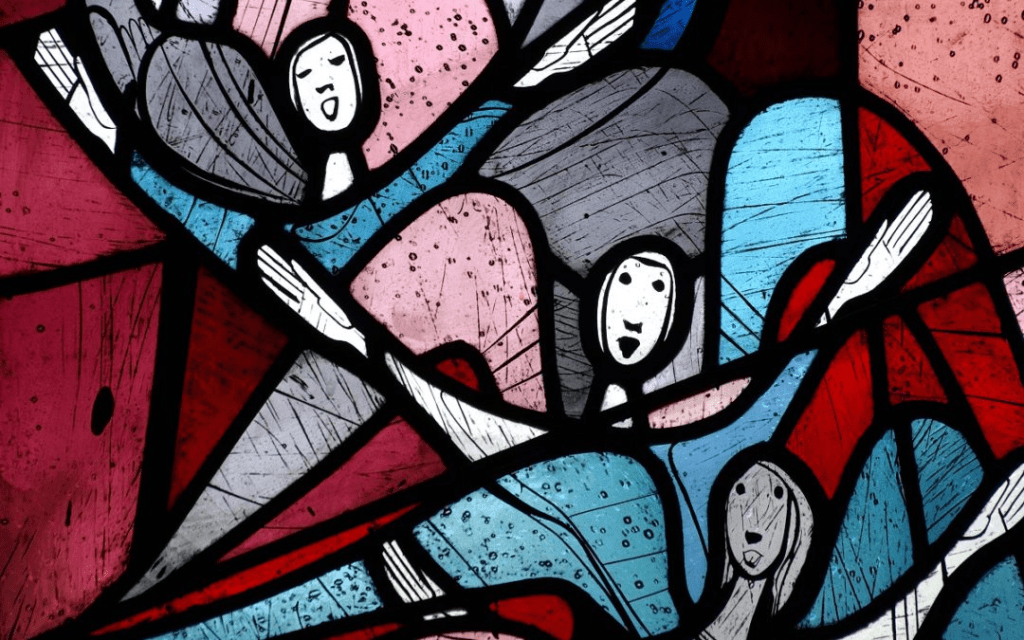
A Living Hope (1 Peter 1:3-9)

Let us give thanks to the God and Father of our Lord Jesus Christ! Because of his great mercy he gave us new life by raising Jesus Christ from death. This fills us with a living hope, and so we look forward to possessing the rich blessings that God keeps for his people. He keeps them for you in heaven, where they cannot decay or spoil or fade away. They are for you, who through faith are kept safe by God’s power for the salvation which is ready to be revealed at the end of time.

Be glad about this, even though it may now be necessary for you to be sad for a while because of the many kinds of trials you suffer. Their purpose is to prove that your faith is genuine. Even gold, which can be destroyed, is tested by fire; and so your faith, which is much more precious than gold, must also be tested, so that it may endure. Then you will receive praise and glory and honor on the Day when Jesus Christ is revealed. 

You love him, although you have not seen him, and you believe in him, although you do not now see him. So you rejoice with a great and glorious joy which words cannot express, because you are receiving the salvation of your souls, which is the purpose of your faith in him. (Good News Translation)

There’s no need for hope if everything’s going just the way you like it. I remember when I was a college undergraduate, I hoped for Christ’s return toward the end of every semester. The prospect of all those final exams and the pressure of grades had me longing for heaven.

But that’s life. Maturity, resilience, perseverance, and just about every virtue you can think of comes as a result of life’s trials and sufferings. The Christian has hope, precisely because things aren’t the way they’re supposed to be.

Faith has to be tried and tested. And hard circumstances are the way of purifying it. Like gold being purged of any dross by being exposed to extreme heat, so our faith becomes strong, robust, and genuine by the purgative fires of life’s many large and small sufferings.

The whole point of it all is to make us people worthy of our spiritual calling. Resurrection only happens because there’s been a death. Glory is only realized through suffering.

New life, the Christian life, isn’t a matter of making a new set of resolutions, as if it were nothing more than aspirations at the beginning of a calendar year. Rather, Christian faith is a response to the mercy of God in Jesus Christ.

One of my all-time favorite stories is Victor Hugo’s Les Miserables. It’s a story of grace and new life, of a hopeless man given the chance at hope.

The main character is Jean Valjean, who spends nineteen years in jail for stealing a loaf of bread for his starving family. The experience in prison caused him to become a bitter and cynical man. After his release, Jean Valjean has nowhere to go. 

In desperation, he seeks lodging one night at the home of a Catholic bishop, who treats him with genuine kindness, which Valjean sees only as an opportunity to exploit. In the middle of the night, he steals the bishop’s silver and skedaddles. 

The next day, however, Valjean is caught by the police. When they bring him back to the bishop’s house for identification, the police are surprised when the bishop hands two silver candlesticks to Jean, implying that he had given the stolen silver to him, saying, “You forgot these.” 

After dismissing the police, the bishop turns to Jean Valjean and says, “I have bought your soul for God.” In that moment, by the bishop’s act of mercy, Valjean’s bitterness is broken. Hope springs to life.

Jean Valjean’s forgiveness is the beginning of a new life. The bulk of Victor Hugo’s novel demonstrates the utter power of a redeemed life. Jean chooses the way of mercy, as the bishop had done. Valjean raises an orphan, spares the life of a parole officer who spent fifteen years hunting him, and saves his future son-in-law from death, even though it nearly cost him his own life. 

“Jean Valjean, my brother, you no longer belong to what is evil but to what is good. I have bought your soul to save it from black thoughts and the spirit of perdition, and I give it to God.” ― Victor Hugo, Les Misérables

Throughout Jean Valjean’s new life, there are trials and temptations all along the way. Yet, mercy keeps his faith strong, and hope kindled. Whereas before, Valjean responded to mercy with a brooding melancholy and inner anger, now – after being shown grace – he responds to each case of unjust suffering with gratitude, deeply thankful for the chance to live a new life full of grace.

Hope is kept alive because of suffering. Faith is strengthened by means of adversity. And both originate because of mercy and grace.

Christianity is a worldview perspective that enables one to rejoice in difficulty. For the Christian, there is no empty meaningless grief; there is the hope that our suffering means something. Like the athlete who endures all the painful practice in order to realize a future hope, so the believer in Jesus goes into strict training for the development of faith – all in the confident expectation of a fulfilled salvation.

It’s a hard lesson to learn, this seemingly weird alchemy of faith, suffering, hope, joy, and new life. And every generation of Christians needs to experientially discover it. Each believer eventually learns, in the crucible of hard circumstances, that the promises of God are the ballast to persevere in faith and patience throughout life.

Christian hope is a confident expectation that the promises of God will be completely realized.

A Christian’s salvation encompasses past, present, and future.

We were saved back there in the past when Christ died on the cross for us. We were crucified with him.

We are presently being saved from the world, the sinful nature, and the devil, through the sanctifying work of the Spirit in making us holy.

And we will be saved in the future when Christ returns to judge the living and the dead. Then, our salvation will be fully realized. Since that hasn’t happened yet, we have hope to sustain us.

It was hope that sustained me in college. I endured all the hours of study, all the exams, all the various courses taken, with the confident expectation that I would someday walk across that stage, receive my diploma, and graduate with my intended degree.

We ourselves, who have the first fruits of the Spirit, groan inwardly as we wait eagerly for our adoption to sonship, the redemption of our bodies. For in this hope we were saved. But hope that is seen is no hope at all. Who hopes for what they already have? But if we hope for what we do not yet have, we wait for it patiently. (Romans 8:23-25, NIV)

The Christian’s hope for ultimate deliverance is imperishable, undefiled, and unfading. This means we can live through a difficult day or week or month or a year, or even decades, with spiritual endurance. Our goal shall come in all its fullness. 

Then I saw a new heaven and a new earth, for the first heaven and the first earth had passed away, and the sea was no more. And I saw the holy city, the new Jerusalem, coming down out of heaven from God, prepared as a bride adorned for her husband. And I heard a loud voice from the throne saying,

“See, the home of God is among mortals.
He will dwell with them;
they will be his peoples,
and God himself will be with them and be their God;
he will wipe every tear from their eyes.
Death will be no more;
mourning and crying and pain will be no more,
for the first things have passed away.” (Revelation 21:1-4, NRSV)

Eventually, suffering will have done its work and we will be with Christ forever. Until that day, let us explore all that God has for us, embracing both the meaning and the mystery of faith. 

Since our salvation is assured, let us live with confidence and run the race marked out for us.

Heavenly Father, you created us and lovingly care for us. We accept all our sufferings willingly, and as truly obedient children we submit ourselves to your holy will. Give us the strength to accept your loving visitation to us through adversity, and never let us grieve your heart by giving-in to impatience. We offer you our pains to be used for your honor and glory, through Jesus Christ our Lord, in the strength of the Holy Spirit. Amen.

Get Me Out of This Scary Dungeon Cave! (Psalm 142)

I pray to you, Lord.
    I beg for mercy.
I tell you all my worries
    and my troubles,
and whenever I feel low,
    you are there to guide me.

A trap has been hidden
    along my pathway.
Even if you look,
    you won’t see anyone
who cares enough
    to walk beside me.
There is no place to hide,
    and no one who really cares.

I pray to you, Lord!
    You are my place of safety,
and you are my choice
    in the land of the living.
Please answer my prayer.
    I am completely helpless.

Help! They are chasing me,
    and they are too strong.
Rescue me from this prison,
    so I can praise your name.
And when your people notice
your wonderful kindness to me,
    they will rush to my side. (Contemporary English Version)

The modern holiday of Halloween is kitschy with a funny sort of scary. But there’s nothing funny about being truly frightened and feeling helpless. Its anything but a holiday.

The psalmist, David, was in both a literal and a metaphorical cave. Before he ever became king of Israel and Judah, David was on the run from King Saul. He hid in a cave. He had more suspense and was on the edge of his seat much more than any horror slasher film could portray.

David was hiding and just trying to stay alive. There was nothing in his life which deserved such maltreatment. It was sheer jealousy on Saul’s end of things that caused him to give his soul over to oppressive pride. And David was the brunt of that oppression.

As biblical readers, we know the end of the story. Saul is eventually killed in battle and David is exalted as the new king. Yet, here, in today’s psalm, we have the genuine cry of a desperate man who longed for the justice of God – not knowing what the end of it all would be.

One of the reasons David was a person after God’s own heart is that he was humble and remained connected to God without succumbing to the bitterness of his situation. I strongly suggest that David was able to keep his life free from pride because he regularly liberated his spirit through real and raw expressions of his emotions and experiences to God.

Spiritual confidence cannot be ginned-up through pretending that all is well, and everything is okay. Rather, spiritual courage is forged in the most awful of circumstances through loud cries of emotional pain to the God who truly hears it all.

Anyone who tells you different is flimsily trying to maintain their puny sense of delusional power. God sees you in the dark place and he hears your cry for mercy. He knows your dark cave better than you know it yourself.

One of the reasons I love the psalms so dearly is that they know the human condition. There is no pretense with the psalmist, David. He opens his mind and heart. He lets the genuine feelings of his life pour out in an offering to the God who pays attention to the humble and contrite.

The proud and arrogant will forever be flummoxed by the psalms, not understanding why they are even in the canon of Holy Scripture.

Yet, here they are, for all to examine and experience. Whereas the piously insincere are continually putting up a false front of godliness and keeping up appearances of superior spirituality, here we have authentic religion smack in front of our faces.

For me, the psalms liberate us from the shackles of trying to be someone I am not and enable us to connect with a God who encourages us in our strange wonderings, our emotional pain, and our sometimes horrific situations.

The Lord is perfectly at home with hearing loud cries, agonizing shouts, and desperate prayers directed to heaven.

Those who oppress others, I believe, are easy to spot because they:

  • Ask rhetorical questions to make a point.
  • Assume their thoughts and ways are always best.
  • Accuse without evidence based on their faulty assumptions.
  • Seek to harm and destroy.
  • Enjoy chaos and thrive on taking advantage of others’ misfortune.
  • Refuse to listen and learn from others.
  • Suppress all competing voices contrary to their own.

Autocrats are too smug and too far into their delusions of power, authority, and self-righteousness to be able to hear any voice other than their own.

A self-absorbed despot in power feels like being in a dingy dank prison cave with no ability to leverage a release.

A self-abnegated deliverer in authority feels like being in a wide open field with freedom to help others in bondage.

God hears when others don’t. The Lord advocates on behalf of those caught in the crosshairs of tyrannical injustice and maltreatment. Divine benevolence is always on the lookout for those being oppressed.

The Almighty uses power to listen and respond when distressed persons are scared silly with maltreatment. Voices raised to heaven shall never go unheard.

Since God listens to those in need of mercy, this is precisely the disposition we are to adopt, as well.

The proud, convinced of their superiority, either cannot or will not see those languishing underneath unjust power structures. There is no space within arrogant hearts to accommodate the cries for justice from people beneath them.

Therefore, recourse for the oppressed comes from God – because God acts with equity, integrity, and justice.

It is not the oppressed who need our pity; it is the ungodly, because they don’t know anything about pity, or empathy, or mercy. Oppressors have no stomach for any of that. So, they keep people locked in systems of oppression. They maintain relational distance and turn a blind eye to the genuine frightened screams of those under their boot.

The weak, the distressed, and the spiritually tired in this corrupt world, however, have the chance for appeal. They can call out to the God who knows them and their situations.

Although cries for deliverance may not happen immediately, we can be assured that divine help is forthcoming. And that is scary good stuff.

Lord Jesus Christ, by your patience in suffering you made my earthly pain sacred and gave me the example of humility. Be near to me in my time of weakness and pain; sustain me by your grace so that my strength and courage may not fail. Heal me according to your will. Loving Jesus, as you cried out on the cross, I cry out to you in my desperation. Do not forsake me. Grant me relief and preserve me in your perfect peace. Amen.

Comfort For Those with Troubles (2 Corinthians 1:1-11)

St. Paul, by Rembrandt Harmenszoon van Rijn, 1657

Paul, an apostle of Christ Jesus by the will of God, and Timothy our brother,

To the church of God in Corinth, together with all his holy people throughout Achaia:

Grace and peace to you from God our Father and the Lord Jesus Christ.

Praise be to the God and Father of our Lord Jesus Christ, the Father of compassion and the God of all comfort, who comforts us in all our troubles, so that we can comfort those in any trouble with the comfort we ourselves receive from God. 

For just as we share abundantly in the sufferings of Christ, so also our comfort abounds through Christ. If we are distressed, it is for your comfort and salvation; if we are comforted, it is for your comfort, which produces in you patient endurance of the same sufferings we suffer. And our hope for you is firm because we know that just as you share in our sufferings, so also you share in our comfort.

We do not want you to be uninformed, brothers and sisters, about the troubles we experienced in the province of Asia. We were under great pressure, far beyond our ability to endure, so that we despaired of life itself. Indeed, we felt we had received the sentence of death.

But this happened that we might not rely on ourselves but on God, who raises the dead. He has delivered us from such a deadly peril, and he will deliver us again. On him we have set our hope that he will continue to deliver us, as you help us by your prayers. Then many will give thanks on our behalf for the gracious favor granted us in answer to the prayers of many. (New International Version)

You probably didn’t sign-up for trouble.

Although varying from person to person and from group to group, all of us experience trouble in this world.

The Apostle Paul experienced a lot of trouble throughout his Christian life:

Five times I received from the Jews the forty lashes minus one. 

Three times I was beaten with rods, once I was pelted with stones, three times I was shipwrecked, I spent a night and a day in the open sea, I have been constantly on the move.

I have been in danger from rivers, in danger from bandits, in danger from my fellow Jews, in danger from Gentiles; in danger in the city, in danger in the country, in danger at sea; and in danger from false believers. 

I have labored and toiled and have often gone without sleep; I have known hunger and thirst and have often gone without food; I have been cold and naked. Besides everything else, I face daily the pressure of my concern for all the churches. (2 Corinthians 11:24-28, NIV)

Why didn’t Paul get cynical or jaded by his awful troubles?

What was the secret to Paul’s incredible resilience in the face of such trouble?

How did Paul get through all of that nasty trouble?

Paul, in my opinion, was the consummate Christian. He is the model missionary, mentor, pastor, and caregiver. Yet, it wasn’t his superior giftedness or dogged personality which got him through the tough times.

The Apostle persevered through trouble without succumbing to despondency by receiving help.

Let’s be honest: Most people would rather give than receive – and that is a good thing. Yet, what isn’t a good thing is continual caregiving without yourself receiving care.

We cannot expect to help others without accepting it ourselves. 

The caregiving Christian needs to be vigilant about practicing selfcare and understanding their limitations. One must not pretend to be super-spiritual, with unlimited super-strength and super-compassion, extended to others 24/7 with super-skill. It’s neither realistic, nor smart. 

Caregivers, and not only care recipients, need to accept comfort from both God and others.

“We must accept our vulnerability and limitations in regard to others.  We cannot expect to help others without accepting it ourselves.”

Mother Teresa

The word dominating today’s New Testament lesson is “comfort.” It’s used by Paul ten times in these verses. Comfort involves both speech and action, words and deeds. For comfort to happen, someone comes alongside another and helps them with both loving actions and encouraging words.

We can only give what we have – which means that if we want to continue helping and caring for others, there will need to be continual healthy rhythms of receiving comfort yourself. We provide for others from the largess of grace given to us by the God of abundance.

Sometimes people get stuck in their grief. The troubles have caused such a change and loss that they need help getting out. And the way people get unstuck and resolve their troubles, is through telling their story – which requires someone else to listen. 

St. Paul, by Rembrandt, 1630

Through my own experience of trouble, as well as helping others through their trouble (and sometimes being a troublemaker!) I have developed a checklist of things to do, to allow, and to keep in mind as a caregiver:

  • Live a balanced life. Live in the tension between caring for others and caring for self – without assigning any judgment, shame, or guilt to any of it.
  • Learn to trust other people. You aren’t the only person on earth who can care for the people you care for. Let them contribute so that you can take have a respite.
  • Make a list of needs and concerns. Do this both for yourself and those you care for. Delete those needs that you personally cannot meet. Of the remaining needs, determine the ones for which you are primarily responsible, then, decide which ones are the most important.
  • Contact your Pastor. That’s what he/she is there for. Reach out. You aren’t in a John Wayne movie or an episode of the Lone Ranger. By the way, you know they’re fictional characters, right?
  • Carry your own backpack. Other people have their own backpacks to carry filled with troubles and responsibilities. Although you can help shoulder their load, taking the weight completely off is Christ’s job, not yours. What’s more, don’t fill your own backpack with rocks that leave you with a crushing weight. Be realistic and confident in what you can and ought to do, as well as what you cannot and should not do.
  • Listen to others. Trusted family members and friends usually see the signs of stress in your life before you do. When they speak up, give them your attention. They know what they’re talking about.
  • Accept help. The fast track to bitterness and burnout is refusing the assistance of others who can give you a break in your constant caregiving.
  • Involve others. There are individuals willing and ready to participate if you would just inform them as to what would be helpful.
  • Talk to a therapist. We all get overwhelmed in particular seasons of life. If caregiving has become a compulsion, then take one hour per week to meet with a good therapist or counselor to talk through things in your life.
  • Delegate. Delegate. Delegate. Then, delegate some more.
  • Recharge your soul. Find personal time for yourself daily. Engage in things that feed your spirit and energize your inner person.
  • Don’t waste your time and energy. Some people aren’t going to understand what you’re doing and why you’re doing it; and they don’t really want to understand. And it is not our job to make them understand.
  • Don’t manipulate others. A common temptation is to try and force family, friends, and faith communities to do what we want them to do, whenever we are heavy into ministry. Instead, focus on your own responsibilities and don’t worry about everybody else’s.

God always has a listening ear. The Lord knows grief better than all of us. Jesus understands trouble. In Christ, hope is kindled, care is received, and comfort abounds.

May you, by faith, enter into abundant life – despite the circumstances – so that your overwhelming trouble is transformed into overflowing comfort. Amen.

Don’t Let Suffering Surprise You (1 Peter 4:12-19)

Dear friends, do not be surprised at the fiery ordeal that has come on you to test you, as though something strange were happening to you. But rejoice inasmuch as you participate in the sufferings of Christ, so that you may be overjoyed when his glory is revealed. 

If you are insulted because of the name of Christ, you are blessed, for the Spirit of glory and of God rests on you. If you suffer, it should not be as a murderer or thief or any other kind of criminal, or even as a meddler. 

However, if you suffer as a Christian, do not be ashamed, but praise God that you bear that name. For it is time for judgment to begin with God’s household; and if it begins with us, what will the outcome be for those who do not obey the gospel of God? And,

“If it is hard for the righteous to be saved,
    what will become of the ungodly and the sinner?”

So then, those who suffer according to God’s will, should commit themselves to their faithful Creator and continue to do good. (New International Version)

In a culture of toxic positivity, we can never quite bring ourselves around to the reality of suffering. Being uncomfortable with the unwanted emotions associated with suffering seems to be the modus operandi of the Western world.

Like it, or not, none of us gets off this fallen planet without experiencing a host of circumstances we neither asked for nor wanted. And no amount of plastic smiles, fake-it-till-you-make-it approaches, and spin doctoring of attitudes will ever take the pain completely away – or even fully understand it’s mystery. In the long run, whitewashing pain only exacerbates the suffering.

Yet, despite all hardship and hurt, joy and the ability to rejoice still remains a necessary part of life, even in the worst of situations. The problem is: We tend to believe that we cannot hold seemingly opposing feelings at the same time – even though we actually do it all the time.

When the youngest child leaves home and the parents are empty nesters, they feel the simultaneous emotions of proud joy and deep sadness.

And when an aging parent or grandparent dies, the family experiences the bittersweet feelings of knowing that suffering is ended, yet also this dear loved one is gone from us.

Or when you are treated unfairly and spoken of unkindly, there is a mix of emotions from anger about what is happening to some sense of peace that this person or group of people have shown their real colors to the world.

I am going to make one of the simplest observations about God’s people in the Bible: they suffered; they were seen.

Whether Abel dying by the hand of his own brother, Noah enduring the ridicule of his neighbors, Abraham facing an uncertain future, Jeremiah weeping over Jerusalem’s calloused destruction, or Paul enduring persecution, everyone who wants to live a godly life will face suffering.

Every New Testament Epistle has a message about how to handle the inevitability of human suffering.

Fifth Station of the Cross, by Candido Portinari, 1953

The Apostle Peter, in his epistle, made it clear that every Christian should neither be surprised nor shocked when they suffer. If our Lord suffered (which he did, even to the extreme) then we, too, will also suffer, as those who follow him. 

Yet, Peter balances the harsh reality of suffering with the need for followers of Jesus to properly interpret that suffering. The Apostle learned the hard way that our means of accepting, coping with, and transcending hardship is by interpreting our personal suffering in light of Christ’s own suffering.

He insisted that the Christian’s suffering is a privilege, even a blessing. It is a mark of belonging – a sign that God’s Spirit is within us. 

If we do stupid things, we face the consequences for our foolishness. But when we do the good, right, and altruistic thing – then suffer some adverse effect – it puts us in solidarity with Christ. We can be glad for the chance to suffer as Christ suffered. It prepares the believer for even greater happiness when Jesus returns to judge the living and the dead.

I’m under no illusions or delusions here. Interpreting our suffering through specifically Christian lenses is no easy task. Sometimes it’s rough and downright hard. And it gets complicated when the suffering doesn’t let up and is compounded daily for weeks, months, even years at a time.

So, what shall we do in such times? Peter says that if your suffering originates in obedience to God, then keep the faith, keep on doing the right, the just, and the good thing.

A bad attitude, giving up, and revenge are not options on the table for the Christian. I believe most followers of Jesus understand that. The greater temptation, however, is a more subtle and insidious approach toward suffering: going with “meh.”

“Meh” is a spiritual, emotional, and mental stance of simply going with the flow, getting along on the surface of things, and hoping all the unpleasantness goes away soon. In facing the adversity with all it’s painful suffering, the “meh” person just shrugs their shoulders and says, “Meh, whatever; what’s a guy to do, anyway?”

Thanks for asking. We persevere. Don’t let suffering surprise you when it shows up at your door like an unwanted guest. Here’s some practical ways of getting through it:

  1. Tell your story to others and don’t go it alone and be the martyr. We already have a Martyr, and his name is Jesus.
  2. Do something that isn’t nothing. Avoid piddly busywork. Instead, when renewal and rest are needed, read a good book or have a stimulating conversation.
  3. Have a support system in place before suffering comes upon you. Trials to faith will happen. It will be overly difficult to face them without a community of persons around you.
  4. Ask for help, for God’s sake! People are hard-wired by their Creator for community. Rugged individualism is a myth; it doesn’t exist and isn’t even possible.
  5. Be comfortable with being uncomfortable. Comfort is not the summum bonum of life. Hedonism only masks pain and does not take it away. Expand your ability to handle diverse situations.
  6. Realize that Christianity is a process of becoming more and more like Jesus Christ. Christianity is not a one-and-done uttering a sinner’s prayer and waiting to cash-in a divine life insurance policy in order to stay out of hellfire. If you actually believe this, I suggest reading the Bible.
  7. Keep living your life. The earth is still spinning on its axis. The sun will still come up in the morning. God’s steadfast and faithful love will still be waiting for you when you wake up.

God sees and will vindicate the godly attitude, the ongoing work, and all the blood, sweat, and tears that go with our commitment to Christ and perseverance in the faith.

You’re already signed-up for suffering just by being a person. Welcome to the human condition. What will you do with your pain?

Saving and sustaining God, it is a small thing for me to suffer in light of your great suffering on my behalf through the cross. Empower me, and all your people everywhere, to do right every day so that praise, glory, and honor for Jesus Christ will always be on my lips through the enablement of the Holy Spirit. Amen.