Remember Passover (Deuteronomy 16:1-8)

Exodus, by Yoram Raanan

Observe the month of Aviv and celebrate the Passover of the Lord your God, because in the month of Aviv he brought you out of Egypt by night. Sacrifice as the Passover to the Lord your God an animal from your flock or herd at the place the Lord will choose as a dwelling for his Name. Do not eat it with bread made with yeast, but for seven days eat unleavened bread, the bread of affliction, because you left Egypt in haste—so that all the days of your life you may remember the time of your departure from Egypt. Let no yeast be found in your possession in all your land for seven days. Do not let any of the meat you sacrifice on the evening of the first day remain until morning.

You must not sacrifice the Passover in any town the Lord your God gives you except in the place he will choose as a dwelling for his Name. There you must sacrifice the Passover in the evening, when the sun goes down, on the anniversary of your departure from Egypt. Roast it and eat it at the place the Lord your God will choose. Then in the morning return to your tents. For six days eat unleavened bread and on the seventh day hold an assembly to the Lord your God and do no work. (New International Version)

The first five books of the Old Testament are known by Christians as the Pentateuch. These same books are the Torah in Judaism. Deuteronomy is the fifth and final book; it is a restatement of God’s Law for the Israelites about to enter the Promised Land.

Several prominent theological themes are highlighted in the book of Deuteronomy. It vigorously advocates for exclusive loyalty to the monotheistic God, Yahweh. Yahweh is characterized as a transcendent Being, full of steadfast love and transformative justice.

Deuteronomy places significant emphasis upon the covenant relationship between God and Israel. The covenant was established with the patriarchs – Abraham, Isaac, and Jacob – and affirmed at Mount Sinai after the exodus from Egypt, at the giving of the Law. This Law was graciously provided by God for the people; it is encapsulated in the Ten Commandments, and is to be reaffirmed as soon as Israel enters the land.
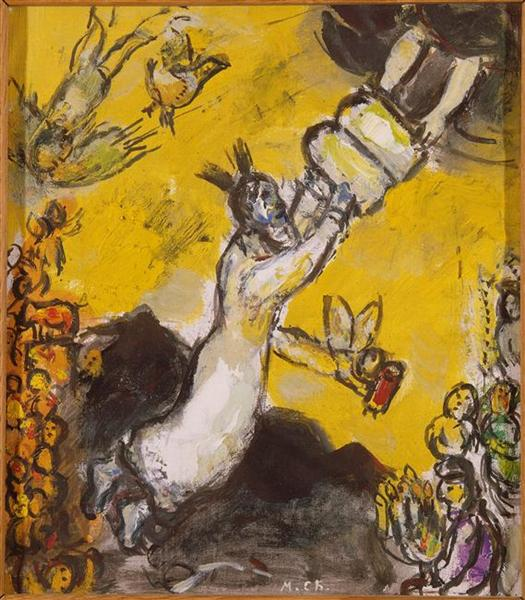
Moses receiving the Tablets of Law, by Marc Chagall, 1963

Therefore, the entire book of Deuteronomy looks forward toward a new existence in the Promised Land. This new society is to pursue justice and be devoted to righteousness. All Israel is to live in harmony with God and one another, enjoying the land and the covenant relationship.

The welfare of Israel depends upon upholding and maintaining the social and religious laws given by Yahweh. God’s commands are a divine gift, and if closely followed, will be the best humanitarian way of caring for the poor and disadvantaged, as well as bringing the people close to Yahweh.

The sacrificial system will revolve around a singular sanctuary in the religious capital. By locating sacrifices in a particular place, this has the effect of Jewish faith not becoming dependent on offerings, but instead on mercy, love, learning the law, and rituals that uphold reverence for God.

Perhaps the greatest of all the rituals is Passover. Israel’s experience of deliverance at the Red Sea and the centralization of worship in Jerusalem is remembered and celebrated at the festival of Passover every year.

In the original Passover, at the time of the exodus, the blood of a sacrificed lamb was smeared on the doorposts of each Jewish home. In doing this, it let the angel of death know to “pass over” that house, thereby only entering Egyptian homes that did not revere nor recognize God. This act was also the final miraculous act of ten plagues leveled on Egypt.

And There Was a Great Cry in Egypt, by Arthur Hacker, 1897

As the households of Egypt were grieving their dead, Israel was urged by the Egyptians to get out. Egypt feared what would happen if the Israelites remained. Therefore, Israel left post haste. They didn’t have any time for their bread to rise. The people ate unleavened bread so they could immediately leave Egypt.

So, from then on, every year in early Spring, Israel commemorates and remembers God’s deliverance of the people from slavery. God, through Moses, instructed the Israelites to mark Aviv as the first month; it is then that the Passover festival is to occur.

I believe that what we can takeaway from this Scripture, is that perhaps, we ought to stop trying to always have takeaways for everything – as if the Bible can be boiled down to some neat personal application for my life.

Aside from admitting I’ve had a bit of a cynical streak lately, we really must contend with seasons like Passover and Lent, and matters such as social justice and religious worship. These religious seasons are important enough to warrant what the late Eugene Peterson called “a long obedience in the same direction.”

By that phrase, Peterson meant that there are some spiritual practices that we must commit ourselves to year after year, even day after day, for the rest of our lives. Generations before did, and generations after us will need to, as well.

Spiritual growth and maturity take time; and we must patiently and consistently cultivate a sense of justice and a practice of righteousness over and over again.

Passover Seder, by Melita Kraus

One must fight for what they believe, each and every day. Spiritual growth takes a lot of time, grit, tenacity, and resilience. It requires patience and grace, perseverance and a good nature. And it is very much a skill which demands daily practice.

Contemporary society is obsessed with quick fixes and easy solutions. But the time-tested practices of Lent, rooted in the remembrances of Passover, are a Christian discipleship that is long on obedience in the same well-worn ancient directions.

We need to keep moving in the directions of deepening a life of prayer, learning the joy of service, growing in the worship of God, and discovering the virtues of humility and a concern for the welfare of everyone in the community.

In other words, to truly observe something, we need to do it, over and over, year after year. In observing the significant events and dates and seasons of the Christian Year, we can find the sort of spiritual support that will fortify our soul, and bless others.

Almighty and everlasting God, you hate nothing you have made and forgive the sins of all who are penitent: Create and make within us new and contrite hearts, so that we may acknowledge our guilt and lament our shame. Let us obtain from you, O merciful God, reconciliation through the Cross, and empowerment through the Spirit, to do justice, love mercy, and walk humbly with you. Amen.

Have Some Spiritual Discernment (Deuteronomy 13:1-5)

Prophet, by Théophile Alexandre Steinlen, 1902

Prophets or interpreters of dreams may promise a miracle or a wonder, in order to lead you to worship and serve gods that you have not worshiped before. Even if what they promise comes true, do not pay any attention to them. The Lord your God is using them to test you, to see if you love the Lord with all your heart. Follow the Lord and honor him; obey him and keep his commands; worship him and be faithful to him. 

But put to death any interpreters of dreams or prophets that tell you to rebel against the Lord, who rescued you from Egypt, where you were slaves. Such people are evil and are trying to lead you away from the life that the Lord has commanded you to live. They must be put to death, in order to rid yourselves of this evil. (Good News Translation)

It’s a foolish notion that a servant of God can have a moonlighting gig with another god. A shortsighted philosophy believes that worshiping God on the Sabbath allows one to then do whatever they want on the other six days. And a downright deadly act is to become enamored with a miracle and then follow the miracle worker who did it, even though they want nothing to do with devotion to the Lord.

It only takes one bad apple to spoil the whole bushel basket of them. Just one rotten egg in a six egg omelet will ruin the entire thing. And one bad prophet amongst the people will end up destroying the congregation. Evil isn’t something to dabble with; instead, wickedness is something to rid yourself of altogether.

“If your right eye causes you to stumble, gouge it out and throw it away. It is better for you to lose one part of your body than for your whole body to be thrown into hell. And if your right hand causes you to stumble, cut it off and throw it away. It is better for you to lose one part of your body than for your whole body to go into hell.” Jesus (Matthew 5:29-30, NIV)

Jesus declared that believers must take decisive, drastic, and radical action against idolatry. Serving other gods, along with the one true God, requires an amputation. The biblical text of both Testaments leaves us no room to believe that it’s okay to dabble in things that the Lord condemns. And if we think we are not hurting anybody to hold onto such a thought, we very much need to think again.

True prophets and preachers don’t lead people into idolatry, no matter how spectacular their omens, wonders, or miraculous signs. False prophets and preachers exist only to test the sincerity of a believer’s love for the Lord. Israel was to take decisive and radical measures to rid themselves of false gods. Failing to do so would certainly lead to idolatry.

These are the regulations and the case laws that you must carefully keep in the fertile land the Lord, your ancestors’ God, has given to you to possess for as long as you live on that land:

You must completely destroy every place where the nations that you are displacing worshipped their gods—whether on high mountains or hills or under leafy green trees. Rip down their altars and shatter their sacred stones. Burn their sacred poles with fire. Hack their gods’ idols into pieces. Wipe out their names from that place.

Don’t act like they did toward the Lord your God! (Deuteronomy 12:1-4, CEB)

Believers of every era need to learn that the occurrence of supernatural manifestations, and/or wild success in ministry, does not automatically authenticate the prophet or preacher.

Theology always takes precedence over miraculous signs and wonders. A growing church doesn’t necessarily mean that God’s favor rests upon it, anymore than a declining church signals God’s displeasure. This is why we are to never add to or take away from God’s Word to people. (Deuteronomy 12:32)

“It is the nature of false prophets to create a conscience where there is none, and to cause conscience to disappear where it does exist.”

Martin Luther

If Christians are ever invited to disobey and rebel against the words and ways of Jesus, they are to refuse the offer. This, of course, requires actually knowing God’s Word and handling the worship of God and the interpretation of God’s Word with great care, humility, and wisdom.

There are many times that false preachers are quite sincere, believing that they are proclaimers of truth, when they are really leading others astray. We are always to be students of Holy Scripture, consistently discerning the difference between truth and error, right and wrong. Let us be careful to avoid the situation of the believers in the New Testament book of Hebrews:

In fact, though by this time you ought to be teachers, you need someone to teach you the elementary truths of God’s word all over again. You need milk, not solid food! Anyone who lives on milk, being still an infant, is not acquainted with the teaching about righteousness. But solid food is for the mature, who by constant use have trained themselves to distinguish good from evil. (Hebrews 5:12-14, NIV)

Let’s be people who take the time and effort to grow in the grace and knowledge of the Lord Jesus; and be patient and humble enough to learn over time what truly pleases the Lord.

Blessed God, give your servant a discerning heart to govern, lead, and teach your people, so that we may all be able to distinguish between right and wrong, doing your divine will and obeying your divine commands, to the glory of Jesus Christ, in the power of the Holy Spirit. Amen.

Take Responsibility (Deuteronomy 3:23-29)

It was also at that same time that I begged the Lord: Please, Lord God! You have only begun to show your servant your greatness and your mighty hand. What god in heaven or on earth can act as you do or can perform your deeds and powerful acts? Please let me cross over the Jordan River so I can see the wonderful land that lies beyond it: those beautiful highlands, even the Lebanon region.

But the Lord was angry with me because of you! He wouldn’t listen to me. He said to me: That’s enough from you! Don’t ever ask me about this again! Go up to the top of Mount Pisgah. Look west, north, south, and east. Have a good look, but you will not cross the Jordan River. Instead, command Joshua, strengthen him, and encourage him because he’s the one who will cross the river before this people. He’s the one who will make sure they inherit the land you will see.

After that, we stayed in the valley across from Beth-peor. (Common English Bible)

I wonder if God ever feels like the parents of elementary aged children. “Please, please, puh-leeeze let me have it!” It’s a good thing God is spirit, because there may be some divine eye rolling happening with certain people’s requests.

When Moses pleaded God to allow him to cross the Jordan River into the Promised Land, the Lord forbade him to do so. The reason God gave is that Moses had to bear the brunt of the Lord’s anger on behalf of the community.

But you [Israel] had no faith in the Lord your God about this matter, even though he went ahead of you, scouting places where you should camp, in fire by night, so you could see the road you were taking, and in cloud during the daytime.

The Lord heard what you said. He was angry and he swore: Not even one of these people—this wicked generation!—will see the wonderful land that I promised to give to your ancestors… (The Lord was even angry with me [Moses] because of what you did. “You won’t enter the land either,” God said. “But Nun’s son Joshua, your assistant, will enter it. Strengthen him because he’s the one who will help Israel inherit the land.”) (Deuteronomy 1:32-38, CEB)

Not allowing Moses to enter the land may seem strange to us whose culture prizes individualism and self-reliance. But that was not the culture of ancient Israel. There was a common core belief in corporate responsibility. The leader acted as the representative of the people, and so, Moses was answerable for the community’s sins.

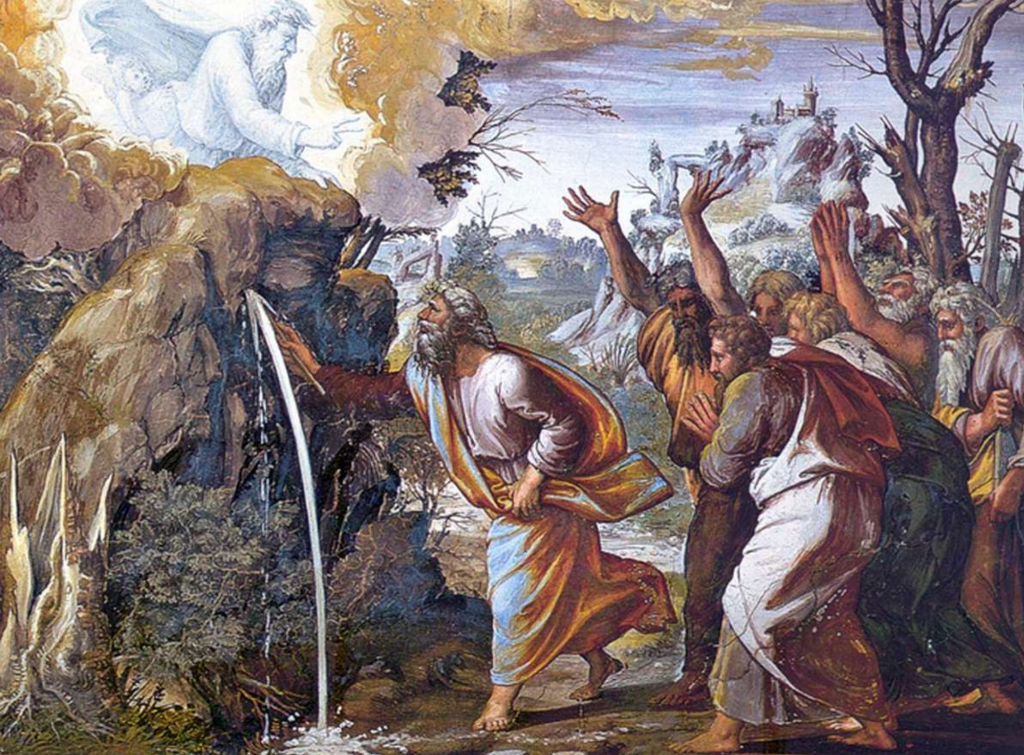
Fresco of Moses and water from the rock, by Raffaello Sanzio da Urbino (Raphael), 1519

Lest we still don’t like what’s going on here, elsewhere in scripture we get a perspective that it was also the lack of faith by Moses that caused him to lose privilege in entering the land:

Moses and Aaron gathered the assembly before the rock. He said to them, “Listen, you rebels! Should we produce water from the rock for you?” Then Moses raised his hand and struck the rock with his staff twice. Out flooded water so that the community and their animals could drink.

The Lord said to Moses and Aaron, “Because you didn’t trust me to show my holiness before the Israelites, you will not bring this assembly into the land that I am giving them.” These were the waters of Meribah, where the Israelites confronted the Lord with controversy and he showed his holiness to them. (Numbers 20:10-13, CEB)

The fact of the matter is that we are responsible for both our personal selves and the entire community of people we are a part of. Indeed, we truly are our brother’s and sister’s keeper.

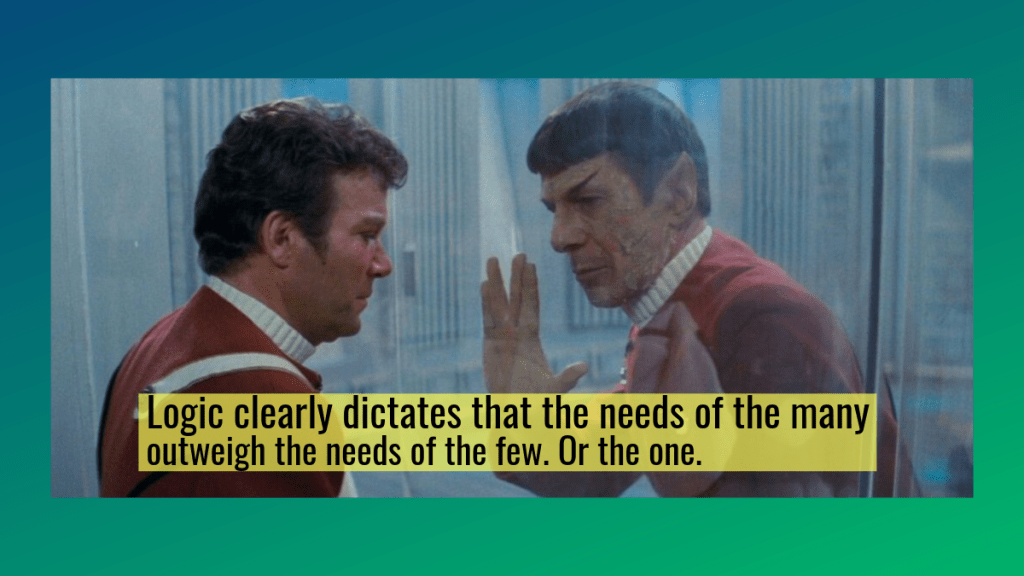
It’s important that everyone considers what the Lord’s will is – not only personally – but for the common good of all the people. Perhaps this idea is captured best in the fictitious Star Trek adage of the alien Vulcans who would logically examine a decision and say, “The needs of the many outweigh the needs of the few (or the one).”

What’s more, believers in God are meant to consider what is pleasing to the Lord, and not only to one’s personal or communal pleasure. The Lord is God and we are not. Sovereignty belongs to God. Servanthood belongs to us; and our ultimate service is to the Lord.

The bottom line for me is believing that the Lord God is good, all the time, and truly has our best interests at mind and at heart. Since God did not allow Moses into the land, I reason that it was for a greater good that transcended the individual request of Moses to enter.

Maybe that’s a difficult perspective to find whenever we are in the middle of strong desires for something, but it is one that we must struggle to find. Since the Lord is high and holy above everyone and everything, God is able to see the big picture and every angle of a situation.

We, however, only see a very small slice of the total view. So, it only makes sound spiritual sense that we learn to entrust ourselves to the One who sees all and acts according to what is right, just, and good.

Gracious and generous God, Creator and Giver of all that is good, we thank you for our many blessings. We acknowledge that all that we have is from you. We offer you thanks and praise for the beauty of the earth, our work, our family, our loved ones, and all the gifts we have been given.

You are with us always. In each dark hour, you are here. In each bright hour, you are here. Blessed by your grace, may we show gratitude by sharing what we have been given. For by serving our brothers and sisters, we serve you.

We remain ever grateful for your constant love, the gift of your Son Jesus, and the presence of your Holy Spirit with us. Protect and guide us on our personal and collective journeys, as we seek to be your faithful stewards. Amen.

Take the Long View (Deuteronomy 34:1-12)

Moses looking from the mountain, from the movie “Prince of Egypt” (1998)

Then Moses climbed Mount Nebo from the plains of Moab to the top of Pisgah, across from Jericho. There the Lord showed him the whole land—from Gilead to Dan, all of Naphtali, the territory of Ephraim and Manasseh, all the land of Judah as far as the Mediterranean Sea, the Negev and the whole region from the Valley of Jericho, the City of Palms, as far as Zoar. Then the Lord said to him, “This is the land I promised on oath to Abraham, Isaac and Jacob when I said, ‘I will give it to your descendants.’ I have let you see it with your eyes, but you will not cross over into it.”

And Moses the servant of the Lord died there in Moab, as the Lord had said. He buried him in Moab, in the valley opposite Beth Peor, but to this day no one knows where his grave is. Moses was a hundred and twenty years old when he died, yet his eyes were not weak nor his strength gone. The Israelites grieved for Moses in the plains of Moab thirty days, until the time of weeping and mourning was over.

Now Joshua son of Nun was filled with the spirit of wisdom because Moses had laid his hands on him. So the Israelites listened to him and did what the Lord had commanded Moses.

Since then, no prophet has risen in Israel like Moses, whom the Lord knew face to face, who did all those signs and wonders the Lord sent him to do in Egypt—to Pharaoh and to all his officials and to his whole land. For no one has ever shown the mighty power or performed the awesome deeds that Moses did in the sight of all Israel. (New International Version)

A signpost stands at a fork in the road.

Pointing in one direction, the sign says “Victory.”

Pointing in another direction, the sign says, “Fulfillment.”

We must pick a direction.

Which one will we choose?

If we choose the path to Victory,

the goal is to win!

We will experience the thrill of competition,

as we rush toward the finish line.

Crowds gather to cheer for us!

And then it’s over.

And everyone goes home.

If we choose the path to Fulfillment,

The journey will be long.

There will be times in which we must watch our step.

There will be times when we can stop to enjoy the view.

We keep going.

We keep going.

Crowds gather to join us on the journey.

And when our lives are over,

those who joined us on the path to Fulfillment,

will keep going without us and

inspire others to join them, too. – Simon Sinek

It wasn’t all about Moses. The dream and vision of entering the Promised Land did not die with Moses. He was just one character, albeit an especially important character, along generations of Israelites who anticipated the fulfillment of God’s promises to the people.

In Christianity, the victory has already been won. In Christ, every good promise of God is and will be fulfilled. Therefore, we can choose fulfillment. We can live into Christ’s victory over sin, death, and hell by choosing to be fulfilled in our Christian lives and our Christian service.

Fulfillment of our godly dreams, good vision, and compassionate ministry requires looking beyond the short term. Long term sustainable thriving in Christian mission and flourishing as a Christian community requires an eternal perspective.

To have the end in mind, a future far ahead of us, demands systemic change. This alternative system will be inspirational, not fear-based. Rather than afraid of what might happen, a long term view is for the next generation – not the next budget crisis due to the next building need.

Maybe because I have been a pastor for so long and know my tenure in each place is only temporary, I know that my vision needs to look further down the road than my own time with a group of people. And a vision of any faith community needs to outlast our own mortal existence. If such a perspective and vision appear as if it will take the energy and will you do not have, then there is no shame in saying so and planning for a good death.

The church is resilient. It has lasted two millennia. She has weathered a lot of challenge and adversity.

Metaphors matter. The word pictures we use are important. I choose not to view the church as the first bite of the apple, which I believe is the best bite. Instead, I see the church as a fine cigar. It’s the last puff of a cigar which to me is the best of all. Christ’s Church is far from its last puff. Rather, I’m saying that the best is yet to come.

Your best years are not in the past; they are in the future. And that is exactly what the author of the New Testament book of Hebrews wanted his readers to see. Yes, it is difficult in the present. You might be tired and weary, feeling as if you cannot keep going with this whole church thing. Maybe you’ve even dropped out altogether. So, according to Hebrews, this is what we do:

You must encourage one another each day. And you must keep on while there is still a time that can be called “today.” If you don’t, then sin may fool some of you and make you stubborn. (Hebrews 3:13, CEV)

Since we have a great high priest who has ascended into heaven, Jesus the Son of God, let us hold firmly to the faith we profess. For we do not have a high priest who is unable to empathize with our weaknesses, but we have one who has been tempted in every way, just as we are—yet he did not sin. Let us then approach God’s throne of grace with confidence, so that we may receive mercy and find grace to help us in our time of need. (Hebrews 4:14-16, NIV)

Let us draw near to God with a sincere heart and with full assurance of faith…. Let us hold unswervingly to the hope we profess…. And let us consider how we may spur one another on toward love and good deeds…. So do not throw away your confidence; it will be richly rewarded. You need to persevere so that when you have done the will of God, you will receive what he has promised. (Hebrews 10:22-24, 35-36, NIV)

So then, with endurance, let’s run the race that is laid out in front of us, since we have such a great cloud of witnesses surrounding us. Let’s throw off any extra baggage, get rid of the sin that trips us up, and fix our eyes on Jesus, faith’s pioneer and perfecter. He endured the cross, ignoring the shame, for the sake of the joy that was laid out in front of him, and sat down at the right side of God’s throne. Think about the one who endured such opposition from sinners so that you won’t be discouraged, and you won’t give up. (Hebrews 12:1-3, CEB)

So, through Jesus we should never stop offering our sacrifice to God. That sacrifice is our praise, coming from lips that speak his name. And don’t forget to do good and to share what you have with others, because sacrifices like these are very pleasing to God. (Hebrews 13:15-16, ERV)

If you are united in a common cause; choose to collaborate with others; then, even if there is no clear end in sight; you are on a road of contributing to something bigger than yourselves; something with value that will last well beyond your own lifetimes. We can anticipate fulfillment.

This is a hard road. It requires counting the cost of discipleship. More important than your doing, is your way of being together, how you are with one another. For, in the end, relationships bring fulfillment because relationships are the only things we will take with us.

Blessed are you, O Lord God almighty, full of grace and mercy. How sweet are your words to the taste, sweeter than honey to the mouth. How precious are your commands for our life, more than the finest gold in our hands. How marvelous is your will for the world. Unending is your love for the nations. Our voices shall sing of your promises and our lips declare your praise. Praise be to you – Father, Son, and Spirit – blessed Holy Trinity, the God whom we serve and who reigns always and forever. Amen.