The Time Is Near (Luke 21:5-19)

The Siege and Destruction of Jerusalem, by David Roberts, 1850

When some were speaking about the temple, how it was adorned with beautiful stones and gifts dedicated to God, he said, “As for these things that you see, the days will come when not one stone will be left upon another; all will be thrown down.”

They asked him, “Teacher, when will this be, and what will be the sign that this is about to take place?” And he said, “Beware that you are not led astray, for many will come in my name and say, ‘I am he!’ and, ‘The time is near!’ Do not go after them.

“When you hear of wars and insurrections, do not be terrified, for these things must take place first, but the end will not follow immediately.” Then he said to them, “Nation will rise against nation and kingdom against kingdom; there will be great earthquakes and in various places famines and plagues, and there will be dreadful portents and great signs from heaven.

“But before all this occurs, they will arrest you and persecute you; they will hand you over to synagogues and prisons, and you will be brought before kings and governors because of my name. This will give you an opportunity to testify. So make up your minds not to prepare your defense in advance, for I will give you words and a wisdom that none of your opponents will be able to withstand or contradict. You will be betrayed even by parents and siblings, by relatives and friends, and they will put some of you to death. You will be hated by all because of my name. But not a hair of your head will perish. By your endurance you will gain your souls. (New Revised Standard Version)

The Arch of Titus in Rome, depicting the Roman triumphal march after victory against the Jewish revolt

The temple, central in today’s Gospel lesson, had undergone an impressive and beautiful refurbishment by Herod the Great (appointed as King of Judea by the Roman Emperor).

It took eighty years for the rebuilding project to be completed. It was significantly enlarged; and generous amounts of gold and silver were used to refurbish it, along with ample use of white marble.

So, it was no wonder that people coming to Jerusalem and approaching the temple admired the massive and impressive edifice. In their awe, they commented so to Jesus.

But Jesus was less impressed with all the architectural rebuilding and expansion of grounds, and more concerned about what would be coming soon concerning the temple and the inhabitants of Jerusalem.

Jesus became the wet washrag to the awe of viewing the Jerusalem temple. He stated that the temple would be destroyed; and it would happen soon.

Imagine if you were one of the persons in the crowd listening to Jesus. “What are you talking about? Why in the world would you even bring that up? It’s obvious that God won’t let this temple be destroyed. It’s his house!”

To their credit, Christ’s disciples did not question the words of Jesus. They only asked a follow up question of when this imminent destruction was going to take place. Unlike the crowd, their query was: “When can we expect this to happen?”

Christ responded by warning his disciples not to believe every apocalyptic preacher who comes along trying to tell everyone when the event will happen. Because some of those preachers will be false prophets who only lead people astray.

False prophets tend to prophesy peace and abundance when God has already proclaimed doom. I find it curious and interesting that the current U.S. President keeps up a steady stream of telling the American people that the economy is booming and that everyone can trust him to keep them safe and secure – even though there is zero evidence for such bluster.

(In in fact, there is contrary evidence to his words; which begs the question why anyone would listen to him…). Prophets who ignore truth and proclaim error tend to downplay any sort of doom on the horizon, especially when they are in power.

Yet, with all the doom and gloom proclaimed by Christ, let’s keep in mind that although the temple was indeed destroyed as Jesus said it would in the year 70 C.E., neither Christianity nor Judaism was destroyed along with it.

God transcends any physical sacred religious space in the form of temples and church buildings.

After the temple’s destruction, both religions kept on, with Christianity growing and becoming the world’s most populous religion. Today, Judaism and Christianity have adherents across the entire earth in every nation, and among all sorts of races and ethnicities.

Sometimes the modern church forgets these things. There are many congregations today who identify themselves chiefly by their church building. For them, everything revolves around maintaining the physical plant, keeping the lights on, and having enough people in the pew to pay for it all.

All of this focus on the building means that congregants too often get excited about new people because they see them as potential givers who can help shoulder the load of paying bills and keeping up the building’s maintenance.

It’s no wonder that these same churches are continuing to decline. They are closing their doors at the rate of about 10 churches every day in the United States (nearly 4,000 churches per year).

When a church is struggling, it’s easy to believe that some gifted pastor will come along to renew and refurbish them; or that God will magically intervene and bring dozens if not hundreds of people to fill their empty pews.

They don’t want to hear any message that their building will be demolished by a wrecking crane. Yet, in many circumstances, Jesus has communicated to them what will happen. But the people continue believing the false prophesies of renewed glory days and the building busting at the seams with fresh converts.

If I’m coming across as a wet washrag, I’ll gently point us back to the Gospel story of Jesus for today.

Sometimes grief and lament are more biblical than overt positive thinking which is guised in the language of faith.

However, no matter what, the worldwide church will continue to go on, and the gates of hell shall not prevail upon it. The church will keep going, albeit in new places and in all sorts of new forms. Our task is to be sensitive to the Spirit’s leading, and have discerning men and women of faith who are true prophets with helpful information.

Back to the story, Jesus was even more gloomy about what would happen after the temple was destroyed. Believers would be arrested and persecuted. Circumstances would be dire. Christians would continually be at risk. And yet, a look back at history tells us that the church did not die; rather, it grew and flourished.

I am reminded today that hard circumstances and difficult situations – even including death and destruction – are not the end. In God’s kingdom, up is down and down is up; first is last and last is first. All is not lost, even though it may look that way today.

I am reminded of the words of the medieval priest, Thomas à Kempis, who wisely had his mind and heart in the right place when it came to hardship and persecution:

“Sometimes it is to our advantage to endure misfortunes and adversities, for they make us enter into our inner selves and acknowledge that we are in a place of exile and that we ought not to rely on anything in this world.

“And sometimes it is good for us to suffer contradictions and know that there are those who think ill and badly of us, even though we do our best and act with every good intention. Such occasions are aids in keeping us humble and shield us from pride.

“When men ridicule and belittle us, we should turn to God, who sees our innermost thoughts, and seek His judgment…

“It is when a man of good will is distressed, or tempted, or afflicted with evil thoughts, that he best understands the overwhelming need he has for God, without whom he can do nothing.

“While enduring these afflictions he takes himself to prayer with sighs and groans; he grows tired of this life and wishes to die so that he could be undone in order to live with Christ. It is in such times of trial that he realizes that perfect security and full peace are not to be found in this world.”

May we put our eggs not in the earthly basket of architectures, buildings, and physical plants, but in the heavenly basket of compassionate ministry, uplift for the poor and needy, and proclamation of the gospel of grace to all.

O God, in Christ you give us hope for a new heaven and a new earth. Grant us wisdom to interpret the signs of our times; encourage us to stand in the time of trial; and have faith to witness to your truth and love. Amen.

Divine Intervention (Isaiah 1:24-31)

The Siege and Destruction of Jerusalem, by David Roberts (1796-1964)

So now, listen to what the Lord Almighty, Israel’s powerful God, is saying: “I will take revenge on you, my enemies, and you will cause me no more trouble. I will take action against you. I will purify you the way metal is refined, and will remove all your impurity. I will give you rulers and advisers like those you had long ago. Then Jerusalem will be called the righteous, faithful city.”

Because the Lord is righteous, he will save Jerusalem and everyone there who repents. But he will crush everyone who sins and rebels against him; he will kill everyone who forsakes him.

You will be sorry that you ever worshiped trees and planted sacred gardens. You will wither like a dying oak, like a garden that no one waters. Just as straw is set on fire by a spark, so powerful people will be destroyed by their own evil deeds, and no one will be able to stop the destruction. (Good News Translation)

Judgment does not mean that you need to leave a part of yourself behind in order to be accepted or belong. Judgment isn’t about stuffing down emotions and denying certain thoughts about things because you were told to.

Rather, judgment – divine judgment – is for those leaders, and the persons who support such leaders, who tell people they have to live a particular way, be a certain way, and think in the same way the leaders say you have to think.

Isaiah’s prophecy is first and foremost directed toward leaders – political leaders and religious leaders. Indeed, the nation of Israel had gone down a path of worship that God never condoned nor wanted.

And the Lord put the primary blame squarely upon rulers who led their people in unacceptable ways by telling them things that God never wanted. As a result, the nation as a whole, lived unjustly and unrighteously.

God was determined to do something about the situation of bad leadership: Replace the rulers and advisers. Get rid of them, just like a metallurgist gets rid of impure and worthless dross.

A lot of things in life rise and fall because of leadership. The character and competence of a leader is of upmost importance. God raises up particular people to lead. So, leaders and rulers are expected to fulfill their mandated duty with all diligence and decorum.

The city of Jerusalem fell to the invading Babylonians in 586 B.C.E. All of the Old Testament prophetic books are related to that seminal event in one way or another.

Jerusalem’s destruction, according to the prophets, had a direct relationship to the failure of political kings and religious priests to lead the people according to God’s law. And that failure was specifically tied to the lack of religious piety and leadership performance amongst the rulers of the land.

Indeed, individuals are responsible for their own thoughts and words and actions. Yet, at the same time, the leaders of a city and a nation are also responsible for whether they are leading the people into ways of justice and equity, or injustice and prejudice.

People in responsible positions of authority are to take ownership of the sort of culture they develop. And when people, as a whole, have rude and irresponsible words and actions, such behavior isn’t only on individuals – it’s on the leaders, as well.

God will hold everyone accountable – especially leaders = for what they have done, and not done, to foster a just and right society.

In the time of the prophets, the majority of those in authority led the people into a degenerate state. It had become so bad that divine judgment would intervene in order to burn out the evil, and remove the worthless dross of incompetent and inconsiderate leadership.

Only through the wholesale replacement of rulers and advisers could restoration and regeneration ever take place.

Fortunately, the Lord is a God of justice, mercy, and grace. The Lord is a redeeming God. And the theme of redemption runs throughout the Book of Isaiah. Yet, for a nation to be redeemed, it will require an elimination of rebellious evil.

The wrath of God exists precisely because of the love of God. Since the Lord has a steadfast, committed, and covenantal love for the people, God will render judgment, purging hate and injustice from the land.

When God decrees something, no one can stop it. And when God decrees destruction upon the material things which promote illegitimate worship and public injustice, you can be absolutely sure that it’s going to happen.

No one, no city, and no nation is truly autonomous, in the sense that they can do whatever the heck they want to do, regardless of whether it is right or just, or not. There is no person and no government who is free to indulge in their own selfish agenda.

We have a purpose and a mandate as people on this earth, to care for this world – the people and the environments we inhabit.

All of the ways in which individuals, groups, and governments cheapen and degrade human dignity and environmental worth, puts everyone at risk of survival and a good life on this planet.

Unjust and dysfunctional systems and structures must be purged of their impurities. And that means, in many cases, a new order of things must occur.

If we cannot learn to play well with one another, then playtime will be over; and God will call us back into the house and make us sit in the corner for a long time – or worse.

Whenever leadership fails to be neighborliness, then we have a huge problem.

Our world suffering divine devastation of all the things we know and love may not be far behind. And, quite frankly, it will be our own damn fault – and not somebody else’s.

However, in the prophetic biblical tradition, devastation and destruction never have the last word. There is always hope – a confident expectation that good, right, and just forms of social, economic, and religious communities will function yet again.

There are good leaders waiting in the wings. It’s just that no one yet sees or knows them. But God will raise them up at the proper time, to accomplish good purposes in communities, churches, families, and governments everywhere.

A divine intervention will make the last be first, and the first be last.

May it be so, for the blessing of the world, and to the glory and praise of God. Amen.

Against Injustice (Jeremiah 19:1-15)

This is what the Lord says: “Go and buy a clay jar from a potter. Take along some of the elders of the people and of the priests and go out to the Valley of Ben Hinnom, near the entrance of the Potsherd Gate. There proclaim the words I tell you, and say, ‘Hear the word of the Lord, you kings of Judah and people of Jerusalem. This is what the Lord Almighty, the God of Israel, says:

Listen! I am going to bring a disaster on this place that will make the ears of everyone who hears of it tingle. For they have forsaken me and made this a place of foreign gods; they have burned incense in it to gods that neither they nor their ancestors nor the kings of Judah ever knew, and they have filled this place with the blood of the innocent. 

They have built the high places of Baal to burn their children in the fire as offerings to Baal—something I did not command or mention, nor did it enter my mind. So beware, the days are coming, declares the Lord, when people will no longer call this place Topheth or the Valley of Ben Hinnom, but the Valley of Slaughter.

“‘In this place I will ruin the plans of Judah and Jerusalem. I will make them fall by the sword before their enemies, at the hands of those who want to kill them, and I will give their carcasses as food to the birds and the wild animals. I will devastate this city and make it an object of horror and scorn; all who pass by will be appalled and will scoff because of all its wounds. I will make them eat the flesh of their sons and daughters, and they will eat one another’s flesh because their enemies will press the siege so hard against them to destroy them.’

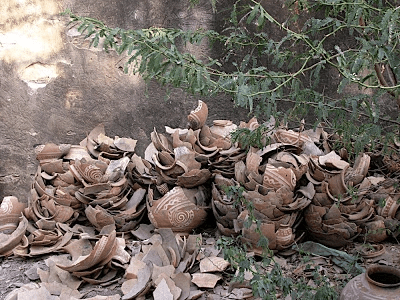
“Then break the jar while those who go with you are watching, and say to them, ‘This is what the Lord Almighty says: I will smash this nation and this city just as this potter’s jar is smashed and cannot be repaired. They will bury the dead in Topheth until there is no more room. This is what I will do to this place and to those who live here, declares the Lord. I will make this city like Topheth. The houses in Jerusalem and those of the kings of Judah will be defiled like this place, Topheth—all the houses where they burned incense on the roofs to all the starry hosts and poured out drink offerings to other gods.’”

Jeremiah then returned from Topheth, where the Lord had sent him to prophesy, and stood in the court of the Lord’s temple and said to all the people, “This is what the Lord Almighty, the God of Israel, says: ‘Listen! I am going to bring on this city and all the villages around it every disaster I pronounced against them, because they were stiff-necked and would not listen to my words.’” (New International Version)

When God wants to get someone’s full attention, the Lord engages the people’s full senses in order to communicate an important message. Through the prophet Jeremiah, we get symbolic action that does just that.

The symbolism, in this case, is a judgment speech, visually and viscerally depicted through the breaking of a pottery jug. The point of the action, and the words, was meant to convey a singular message: God will bring disaster and destruction against Jerusalem and its surrounding towns.

The act of breaking the pottery took place at the entrance to the Potsherd Gate – which was also known as the Dung Gate because that is where the garbage and refuse came out of the city to a dump located in the Valley of Ben Hinnom. It just so happened that this valley was also the location of altars to false gods other than Yahweh. Idolatrous practices – including child sacrifice – were carried on there.

In the ancient Near East, smashing pottery was a ritual act that depicted the destruction of enemies.

I will proclaim the Lord’s decree:

He said to me, “You are my son;
    today I have become your father.
Ask me,
    and I will make the nations your inheritance,
    the ends of the earth your possession.
You will break them with a rod of iron;
    you will dash them to pieces like pottery.” (Psalm 2:7-9, NIV)

The prophet Jeremiah was going to make his oracle against the people both unforgettable and irreversible. He wanted to be clear about what God truly thinks about harming children in religious rituals. But more than that, that it’s absolutely unacceptable for people who worship Yahweh to let it happen, just outside their own city gates, and to even participate in it.

The pottery jar represented Jerusalem. And when a piece of pottery is broken and smashed, there is no opportunity of remaking it from all that destruction. That’s what it would be like for the city who turned their backs on the Lord’s holiness.

Sometimes contemporary people may struggle with the reality that God gets angry – even angry to the point of pouring out wrath on a city. Yet, perhaps we fail to notice the gross and terrible injustice that has been done in the name of religion. The anger of God is always a reflection of God’s love. For love cannot contend with evil perpetrated on innocent people, especially children.

Love is purely subversive. It declares that harming others and hurting people by means of religious violence is not to be accepted nor tolerated. Love is an absolute refusal to settle for the injustice that exists in the world.

Today, and every day, is our opportunity, purpose, and privilege to put love where love is not – to upset the status quo of injustice and establish love as the supreme ethic of God’s commands.

Grant us, Lord God, a vision of your world as your love would have it:
a world where the weak are protected, and none go hungry or poor;
a world where the riches of creation are shared, and everyone can enjoy them;
a world where different races and cultures live in harmony and mutual respect;
a world where peace is built with justice, and justice is guided by love.
Give us the inspiration and courage to build it, through Jesus Christ our Lord. Amen.

Becoming Holy (Isaiah 4:2-6)

And that’s when God’s Branch will sprout green and lush. The produce of the country will give Israel’s survivors something to be proud of again. Oh, they’ll hold their heads high! Everyone left behind in Zion, all the discards and rejects in Jerusalem, will be reclassified as “holy”—alive and therefore precious. God will give Zion’s women a good bath. He’ll scrub the bloodstained city of its violence and brutality, purge the place with a firestorm of judgment.

Then God will bring back the ancient pillar of cloud by day and the pillar of fire by night and mark Mount Zion and everyone in it with his glorious presence, his immense, protective presence, shade from the burning sun and shelter from the driving rain. (The Message)

One of the characteristics of Holy Scripture I deeply appreciate are the wonderful prose sections letting us, the readers and listeners, know that our longings for better days will come. There is a day coming when all of our good imaginings of the future shall be realized; and our present circumstances of hatred, discord, jealousy, and envy of one another shall be a thing of the past.

Unfortunately, we will likely (and biblically!) have to see some devastating and violent loss, and experience some terrible and awful destruction of both body and soul. All of the Old Testament prophets spoke messages of both judgment and grace, suffering and glory. Although hammered with ruin, biblical readers are given glimpses of hope to see the possibility of life beyond all of the carnage.

In other words, there will indeed be restoration and renewal. All shall not be lost forever. Death does not have the last word; resurrection does. It will happen because God has a determined resolve to find resilient ways of restoring the divine/human relationship back to its original and intended peaceful good.

It takes faith to have hope, and hope to have faith, and love to win the day forever. If God can create ex nihilo, out of nothing, then the Lord can reform and renew that which already exists, even though it may be in an awfully deformed state.

The ones who remain, the survivors, are the remnant of true believers, the people who hold onto faith and patience in the face of adversity, hardship, and difficulty. These are the dreamers, the seers, the prophets who foresaw both the need for divine judgment, and equally understood the promise of divine restoration.

The earth will once again be blessed. A rainbow of promise shall rise to remind us all that the storms which ravaged us have passed, never to return again.

But let us also clearly understand that it is because of human stubbornness, of hard-hearted people failing to love mercy and show steadfast love, that got us in this pickle of judgment to begin with. There comes a point when the repeated refusal to change, and use the gifts God has given us, leads to our shelf life on this earth coming to a moldy ruin. To be thrown into the divine incinerator is something brought on by us, not God.

Evil is like a cancer which must be purged from our existence so that we can be clean and healthy. The commands of God are not meant to keep people under a heavy divine thumb, but rather to help people live well in this world in a good healthy way. Living a holy life means that we participate in productive spiritual practices that strengthen faith and support the spirit.

People become “unclean” when they take a different path which is inconsistent with how we were designed by our Creator to live. It would be a bit like believing we can ignore all traffic laws and drive how we want, and then are surprised when we are nearly killed in an accident. Sadly, the unclean perish in their self-preoccupations, with God’s generosity completely off of their spiritual radar.

Yet, no matter where we’ve come from or what we have done, there is always the possibility of rehabilitation, of renewing our relationship to God, experiencing the divine presence, and receiving divine grace.

Getting in sync with the healthy spiritual forces of this universe is like having the ancient provision and protection of God’s pillar of cloud by day and fire by night – reassuring us that we are not alone and belong securely in the merciful arms of a loving Lord.

In Christianity, a holy life and a clean heart results from the person and work of Jesus Christ. God got down to it, taking the judgment we deserved and giving us grace. All of the temporary ritual cleanings merely pointed forward to the once for all scrubbing of the cross.

The blood of goats and bulls and the ashes of a heifer sprinkled on those who are ceremonially unclean sanctify them so that they are outwardly clean. How much more, then, will the blood of Christ, who through the eternal Spirit offered himself unblemished to God, cleanse our consciences from acts that lead to death, so that we may serve the living God!…

 and since we have a great priest over the house of God, let us draw near to God with a sincere heart and with the full assurance that faith brings, having our hearts sprinkled to cleanse us from a guilty conscience and having our bodies washed with pure water. Let us hold unswervingly to the hope we profess, for he who promised is faithful. (Hebrews 9:12-14, 10:21-23, NIV)

May you experience the blessing of becoming clean, and know the blessing of being holy and pure in all your relationships and activities. Amen.